

Pass Google Business verification with a video-first checklist. Film one continuous 30 second take, fix flagged issues, and know when to hire help.
Voice search optimization guide for local businesses
Most local service businesses are losing customers they never even knew were looking for them. Someone across town says, “Hey Siri, find a plumber near me open right now,” and your competitor’s name comes up instead of yours. Not because they’re better at what they do, but because they’ve adapted to how people actually search. The shift toward voice-activated discovery is real, and as answer engine optimization becomes a recognized strategy, businesses that ignore conversational search are handing leads to whoever figured this out first.
Table of Contents
Table of Contents
- What is voice search optimization?
- Voice search, answer engines, and the future of search
- How voice search changes local customer journeys
- Core strategies for optimizing your business for voice search
- Common mistakes and pitfalls in voice search optimization
- Why thinking beyond keywords will put you ahead in voice search
- Ready to grow your local business with voice search optimization?
- Frequently asked questions
Key Takeaways
| Point | Details |
|---|---|
| Voice search is growing | Voice search is changing the way customers find local service businesses. |
| Optimize for answers | Focusing on conversational answers and questions boosts your chances of being found. |
| AEO is the next step | Answer engine optimization (AEO) means your business gets picked by AI-powered assistants, not just listed in web results. |
| Action beats awareness | Claiming business profiles, using real customer questions, and fast-loading mobile sites give you a voice search edge. |
What is voice search optimization?
Voice search optimization, often shortened to VSO, is the practice of structuring your online content, business listings, and website so that voice-enabled devices can find and recommend your business when someone speaks a search query out loud. This is different from typing “plumber Chicago” into Google. When people use voice, they talk the way they’d talk to a friend.
Think about it this way. A homeowner with a burst pipe isn’t going to carefully type keywords into a search bar. They’re going to grab their phone and say, “Who’s the best emergency plumber near me that’s open at 10 PM?” That question is longer, more specific, and phrased in natural language. Traditional SEO, which focuses on short keyword phrases and ranking in blue-link results, often misses these queries entirely.
“Voice and AI-powered discovery are part of broader answer engine optimization strategies that go beyond ranking for typed keywords.”
The devices driving voice search include smartphones with Siri or Google Assistant, smart speakers like Amazon Echo and Google Nest, and increasingly, AI-powered chat interfaces that answer questions directly. Each of these tools pulls answers from online sources, and if your business isn’t structured to be that answer, you won’t appear.
Key differences between traditional SEO and VSO include:
- Query length: Typed searches average 2 to 3 words. Voice searches average 6 to 10 words.
- Query format: Typed searches are fragments (“roof repair Austin”). Voice searches are full questions (“How much does roof repair cost in Austin?”).
- Intent: Voice searches almost always carry high local or immediate intent.
- Results format: Traditional SEO aims for ranked lists. VSO targets a single spoken answer.
For local service businesses, the opportunity here is significant. When you optimize blog posts and website content for voice search, you position your business to be the one answer a device reads aloud. That’s not just a click. That’s a warm lead who’s already heard your name.
Pro Tip: Use Google’s “People Also Ask” boxes and your own customer conversations to find the exact long-tail question phrases people use when looking for your type of service locally. These are gold for VSO content.
The foundation of VSO is understanding that people don’t speak in keywords. They speak in sentences, questions, and intentions. When you write content that mirrors that natural language, you become more findable in the voice era. This is also the starting point for growing local leads through smarter search strategy.
Voice search, answer engines, and the future of search
Understanding VSO alone only takes you partway. Here’s how it fits into the larger transformation of search powered by AI and voice interfaces.
Answer Engine Optimization, or AEO, is the next evolution of search strategy. Where traditional SEO asks “how do I rank higher in search results?”, AEO asks “how do I become the direct answer to a user’s question?” Voice search is one of the most visible expressions of this shift. When someone asks a voice assistant a question, the device doesn’t show a list of ten links. It picks one answer and reads it. That answer has to come from somewhere, and AEO is how you make sure it comes from you.
“Voice search is part of a larger shift toward direct answers from AI-powered interfaces, which changes how businesses need to think about discoverability.”
The overlap between VSO and AEO is significant. Both prioritize natural language content, structured data (a way of tagging your website’s information so search engines can understand it more easily), and direct answers over long-form keyword-heavy writing. Both also reward businesses that are seen as authoritative, accurate, and locally relevant.
Here’s a side-by-side comparison to make this concrete:
| Feature | Classic SEO | Voice Search Optimization | Answer Engine Optimization |
|---|---|---|---|
| Input type | Typed keywords | Spoken questions | Questions (typed or spoken) |
| Output format | List of ranked links | Single spoken answer | Direct answer or featured snippet |
| Optimization focus | Keyword density, backlinks | Natural language, FAQ content | Structured data, authority, context |
| User intent | Browsing or researching | Immediate, local, action-driven | Specific question resolution |
| Content style | Keyword-optimized pages | Conversational, question-based | Concise, direct, factually accurate |
For local service businesses, this table tells a clear story. The customer who types “HVAC repair” is browsing. The customer who says “What HVAC company near me can fix my AC today?” is ready to call. That’s the difference between a passive visitor and an active lead.
Understanding how search algorithms and local leads connect helps you see why AEO and VSO aren’t optional extras. They’re the direction search is heading, and the businesses that adapt early will dominate their local markets.
How voice search changes local customer journeys
As AI and voice-powered engines reshape the playing field, let’s see how these changes actually affect your potential customers’ path to your door.
Voice-enabled devices have become part of everyday routines. People ask their phones for restaurant recommendations while driving. They ask their smart speakers for service provider suggestions while cooking dinner. They ask Google Assistant for directions to a business while standing in a parking lot. These aren’t tech-savvy early adopters anymore. This is mainstream behavior across all age groups.

The voice-powered customer journey for a local service business typically moves through three stages:
Stage 1: Discovery. The customer realizes they have a need and asks a device for help. “Find a pest control company near me” or “Who does same-day HVAC repair in [city name]?” At this stage, your Google Business Profile and local SEO presence determine whether you show up at all.
Stage 2: Evaluation. The customer asks follow-up questions. “How much does pest control cost?” or “Are they open on weekends?” Your website’s FAQ content, your business listing’s hours and reviews, and your overall online reputation all factor into whether the device recommends you or a competitor.
Stage 3: Action. The customer says “Call them” or “Get directions.” This is the conversion moment. If your contact information isn’t accurate and easy for devices to read, you lose the lead even after making it this far.
Optimizing for local phrases and questions helps businesses get surfaced at all three stages of this journey, not just the first one. Most local businesses only think about discovery, which means they’re missing the evaluation and action stages entirely.
What local businesses get wrong most often:
- Ignoring FAQ-style content that answers the real questions customers ask
- Failing to keep Google Business Profile hours, phone numbers, and service areas current
- Writing website content in formal, corporate language instead of conversational answers
- Not thinking about map results and local pack optimization
- Assuming that ranking for a keyword is the same as being found by voice
Pro Tip: Ask your front desk staff or technicians what questions customers ask most often before booking. Those questions are exactly what potential customers are speaking into their devices. Turn each one into a short, direct answer on your website.
Winning local SEO quick wins and keeping your Google Business Profile accurate and complete are two of the most direct ways to improve your visibility in voice search results. These aren’t complicated technical tasks. They’re foundational steps that pay off quickly.
Core strategies for optimizing your business for voice search
You understand the landscape. Now here’s how to actually make your business more discoverable in the voice era.
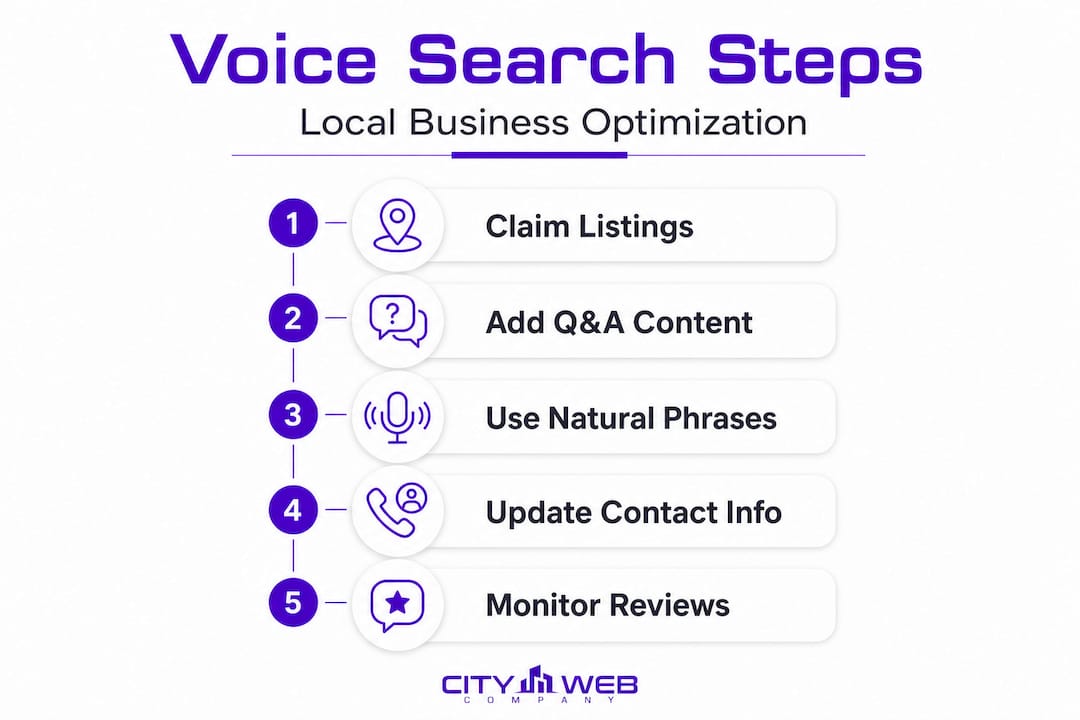
The good news is that VSO doesn’t require starting from scratch. It requires shifting your focus and filling specific gaps in your current online presence. Here’s a step-by-step approach:
- Claim and fully complete your Google Business Profile. Add your correct address, phone number, service areas, hours (including holiday hours), photos, and service descriptions. Voice assistants pull heavily from this data when answering local queries.
- Add an FAQ section to your website. Write questions the way customers actually ask them, then answer each one in two to four clear sentences. This is the single most impactful content change you can make for VSO.
- Optimize for featured snippets. These are the boxed answers that appear at the top of Google results. Voice assistants often read these aloud. Structure your content with a clear question as a heading, followed by a concise answer.
- Improve your website’s mobile speed. Voice searches happen almost entirely on mobile devices. A slow site gets skipped. Use Google’s PageSpeed Insights tool to identify what’s slowing you down.
- Use structured data markup. This is code added to your website that helps search engines understand your business type, location, hours, and services. A web developer can implement this, and it significantly improves your chances of appearing in voice and AI answers.
- Build local content around question-based topics. Write blog posts or service pages that answer questions like “How long does it take to replace a water heater?” or “What should I do if my AC stops working in summer?” These match voice query patterns precisely.
- Gather and respond to reviews. AI-powered answer engines factor in review quality and quantity when selecting which businesses to surface. A business with 50 detailed, positive reviews outperforms one with 10 generic ones.
Optimizing for question-based and natural queries improves your chances of being selected in voice and AI answers, which is where the real competitive advantage lives right now.
Here’s a practical comparison of classic SEO actions versus voice search optimization actions:
| Goal | Classic SEO approach | Voice search optimization approach |
|---|---|---|
| Keyword targeting | Short phrases (“roof repair”) | Full questions (“How much does roof repair cost?”) |
| Content format | Long-form keyword articles | Short FAQ answers and direct responses |
| Business listing | Basic NAP (name, address, phone) | Complete profile with hours, photos, services |
| Link building | Backlinks from authority sites | Local citations and consistent directory listings |
| Technical focus | Desktop page speed | Mobile speed and structured data |

Following a solid website optimization guide helps you address both the technical and content sides of VSO. And if you want to go deeper on local search, mastering your Google Business Profile is the single highest-leverage action you can take right now.
Pro Tip: Tools like AnswerThePublic, AlsoAsked, and Google’s own autocomplete feature show you the exact questions people type and speak when searching for your services. Use these to build your FAQ content library.
Investing in local SEO services that understand the voice search landscape can accelerate all of these steps significantly, especially if you’re managing a business and don’t have time to learn the technical side yourself.
Common mistakes and pitfalls in voice search optimization
Steering clear of these common pitfalls will keep your optimization efforts effective and future-proof.
Many business owners try to apply classic SEO tactics to voice search and wonder why nothing changes. The rules are different, and some old habits actively work against you. Here are the five most common mistakes:
- Keyword stuffing your content. Writing “best plumber Chicago plumber emergency plumber Chicago” doesn’t help voice search. It hurts you. AI-powered engines are sophisticated enough to recognize unnatural language and will favor content that reads clearly and naturally.
- Writing in overly formal language. If your service page sounds like a legal document, voice assistants won’t choose it as an answer. Conversational content wins. Write the way your best technician explains things to a customer.
- Ignoring your contact information accuracy. If your phone number or address is wrong on even one directory listing, voice assistants may pull incorrect data. Consistent, accurate contact information across all platforms is non-negotiable.
- Skipping map and local pack optimization. A large percentage of voice searches result in map-based answers. If you haven’t optimized for local pack results (the map listings that appear in Google searches), you’re invisible for the queries that matter most.
- Creating content without answering a specific question. Generic “About Us” pages and keyword-stuffed service descriptions don’t serve voice search. Every piece of content should answer something a real customer would actually ask.
“Voice search and AEO require a shift from traditional keyword stuffing to natural and contextual content that genuinely addresses user intent.”
To audit your own content for voice readiness, read each page out loud. Does it sound like a natural conversation? Does it answer a specific question clearly within the first two sentences? If you find yourself stumbling over the language or struggling to identify what question the page answers, it needs revision.
Another real-world mistake is businesses that have great services but bury their contact information at the bottom of the page or make it hard to find. Voice assistants need to surface a phone number or address instantly. If your site structure makes that difficult, you lose the lead at the final moment.
Revisiting your blog post voice tips and applying them consistently across all your content is one of the most practical ways to fix these issues systematically rather than page by page.
Why thinking beyond keywords will put you ahead in voice search
Here’s an uncomfortable truth that most SEO advice won’t tell you directly: the businesses winning at voice search aren’t necessarily the ones with the most optimized pages. They’re the ones that have genuinely become the most helpful answer to real customer questions in their area.
We’ve worked with local service businesses long enough to see a clear pattern. The companies that obsess over keyword rankings often plateau. The companies that focus on being genuinely useful, accurate, and easy to reach tend to rise steadily in both traditional and voice search results. That’s not a coincidence.
Industry thought leaders now see voice search as only one facet of a broader answer engine strategy, which means the businesses that win long-term are the ones building real authority in their local market, not just chasing algorithm tricks.
What does local authority actually look like? It means your business has consistent, accurate information everywhere online. It means your reviews reflect real customer experiences. It means your website answers the questions your customers are actually asking, not just the questions you wish they were asking. It means AI-powered tools can trust your data because it’s consistent and complete.
The next wave of voice and AI-powered search is going to be even more personalized. Devices will start factoring in past behavior, location history, and user preferences to decide which business to recommend. The businesses that have built strong local signals now will have a head start when that personalization layer kicks in fully.
The real competitive edge isn’t a technical trick. It’s deciding to be the most helpful, accurate, and trustworthy source of information in your service area. That mindset shift, from “how do I rank?” to “how do I become the best answer?”, is what separates businesses that grow through voice search from those that stay invisible. Pairing that mindset with a solid understanding of search algorithms explained gives you both the strategy and the technical foundation to compete effectively.
Ready to grow your local business with voice search optimization?
After all this insight, you might be wondering how to put this into practice quickly. Here’s what makes the difference:
Voice search optimization isn’t a one-time fix. It’s an ongoing process of refining your content, keeping your listings accurate, and building the kind of local authority that AI-powered devices trust. The businesses that commit to this process consistently are the ones that show up when customers are ready to call.
At City Web Company, we specialize in helping local service businesses get found by the customers who are actively looking for them, whether through typed searches, voice queries, or AI-powered discovery. Understanding the difference between local SEO vs. traditional SEO is the first step. From there, our team can help you optimize your Google Business Profile, build out FAQ content, improve your site speed, and implement the structured data that gets you surfaced in voice and AI results. If you’re ready to stop missing leads, our search engine ranking guide is a great place to see what’s possible for your business.
Frequently asked questions
How is voice search optimization different from regular SEO?
Voice search optimization focuses on conversational, question-based queries and direct answers, while traditional SEO targets typed keywords and ranked search listings. As contextual content strategies replace keyword stuffing, VSO requires a fundamentally different approach to how you write and structure your content.
What are three quick ways to get started with voice search optimization?
Start by claiming and fully updating your Google Business Profile, adding question-and-answer style content to your website, and improving your site’s mobile speed and usability. These three steps address the core factors that determine whether local phrases and questions surface your business in voice results.
Why is voice search important for local service businesses?
Voice search connects local customers with service providers at the exact moment of need, often resulting in immediate calls or visits rather than passive browsing. It’s part of a larger AI-powered shift in how people find and choose local businesses, making it one of the highest-intent channels available.
What mistakes should business owners avoid with VSO?
Avoid keyword stuffing, ignoring FAQ content, and using formal language that doesn’t match how customers actually speak. Focusing on natural and contextual content that directly answers real customer questions is the foundation of effective voice search optimization.
Recommended
- How to Optimize Your Blog Posts for Voice Search – City Web Company | Digital Marketing Agency
- Website Optimization Guide 2026 for Local Businesses
- Search Optimization: Growing Leads for Local Service Businesses
- Local SEO for Businesses: 5 Quick Wins to Get Found by More Customers – City Web Company | Digital Marketing Agency
These articles were popular with other readers too: