
Discover what voice search optimization is and how it can help local businesses attract more customers through better voice-activated discovery.
Google Ads in healthcare marketing: 2026 guide
Digital advertising accounts for 75% of healthcare marketing budgets in 2025, yet many healthcare marketers hesitate to embrace Google Ads due to regulatory concerns. Here’s the reality: Google Ads search campaigns convert 50% better than organic search for healthcare services. In today’s competitive U.S. healthcare landscape, mastering Google Ads isn’t optional. It’s the difference between thriving clinics and those struggling to fill appointments. This guide walks you through compliance requirements, campaign strategies, AI optimization, and practical steps to transform patient acquisition in 2026.
Table of Contents
Table of Contents
- Why Google Ads Matters In Healthcare Marketing
- Regulatory And Compliance Considerations For Healthcare Google Ads
- Google Ads Campaign Types And Targeting Strategies In Healthcare
- The Role Of AI And Automation In 2026 Healthcare Google Ads
- Common Misconceptions And Pitfalls In Healthcare Google Ads
- Practical Implementation: Steps And Optimization For Healthcare Google Ads
- Conclusion: Maximizing Google Ads For Healthcare Growth And Patient Engagement
- Discover Expert Digital Marketing Services Tailored For Healthcare
Key takeaways
| Point | Details |
|---|---|
| Precision targeting | Google Ads enables compliant, focused advertising reaching patients and healthcare professionals effectively. |
| Compliance first | Regulatory adherence and Google certification are mandatory for successful healthcare campaigns in 2026. |
| AI with oversight | Automation improves optimization but requires human review to maintain compliance standards. |
| Campaign selection | Search campaigns drive immediate patient acquisition while display supports remarketing strategies. |
| Data optimization | Continuous tracking and refinement maximize ROI and fuel sustainable clinic growth. |
Why Google Ads matters in healthcare marketing
The shift to digital advertising has fundamentally changed how healthcare providers connect with patients. Traditional marketing channels simply can’t match the precision and measurability Google Ads delivers.
Healthcare organizations now allocate the majority of their marketing budgets to digital channels because they work. The conversion advantage over organic search isn’t marginal. It’s substantial enough to justify the investment even in highly regulated environments.
Here’s why Google Ads stands out for healthcare providers:
- Immediate visibility when patients search for specific healthcare services
- Geographic targeting ensures local clinics reach nearby patients actively seeking care
- Budget control allows precise spending aligned with patient acquisition goals
- Measurable results track every dollar spent to patient appointments booked
- Competitive advantage in saturated healthcare markets where organic rankings take months
The patient journey begins with search. When someone types “urgent care near me” or “orthopedic surgeon Denver,” they’re ready to book. Google Ads puts your practice at the top of that critical moment. Balancing brand awareness campaigns with direct response strategies creates a comprehensive approach that builds reputation while filling appointment slots.
Local patient engagement particularly benefits from Google’s location-based targeting. You’re not wasting ad spend on people three states away. Every impression reaches potential patients in your service area.
Regulatory and compliance considerations for healthcare Google Ads
Healthcare advertising operates under stricter rules than most industries. HIPAA protects patient information, and Google enforces specific policies for health-related ads. Ignoring these isn’t just risky. It guarantees campaign disapproval and potential legal consequences.
The May 2025 Google Ads update expanded targeting to licensed healthcare professionals with certification requirements. This change opened new opportunities for B2B healthcare marketing while maintaining strict compliance standards. If you’re advertising prescription medications or restricted health topics, certification becomes mandatory.
Key compliance requirements include:
- HIPAA compliance when handling patient data in campaign targeting or remarketing lists
- Google Healthcare and Medicines certification for ads mentioning prescription drugs or restricted treatments
- Transparent disclosure of healthcare provider credentials and qualifications
- Accurate claims backed by medical evidence, avoiding misleading health promises
- Regular policy review since Google updates healthcare advertising rules frequently
Pro Tip: Set calendar reminders to review Google’s healthcare advertising policies quarterly. Policy changes can suspend campaigns overnight if you’re not staying current.
Compliance creates competitive advantage. Many healthcare providers avoid Google Ads entirely due to perceived regulatory complexity. Those who master compliant campaign optimization capture market share their competitors leave untapped.
Common pitfalls include using patient testimonials without proper consent, making unsubstantiated treatment claims, or targeting audiences without required certifications. Each mistake triggers ad disapproval at best and regulatory investigation at worst. The healthcare advertising regulations update clarifies current standards worth reviewing before launching campaigns.
Google Ads campaign types and targeting strategies in healthcare
Choosing the right campaign type determines whether your ads reach patients ready to book or waste budget on unqualified clicks. Each Google Ads format serves distinct purposes in healthcare marketing.
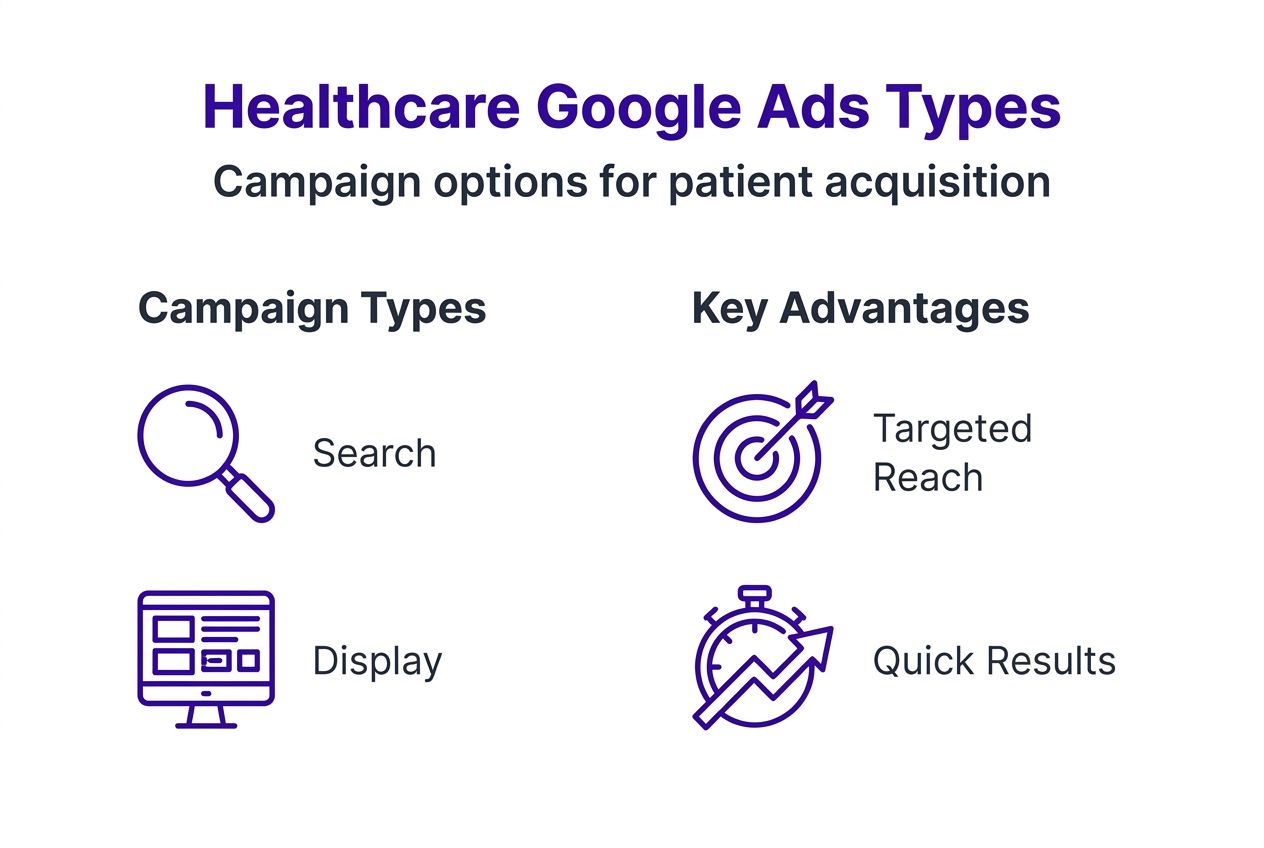
| Campaign Type | Best For | Key Advantage |
|---|---|---|
| Search | Immediate patient acquisition | Captures high-intent searches |
| Display | Brand awareness and remarketing | Visual engagement across web |
| Local Services | Local healthcare providers | Google-verified badge builds trust |
| Performance Max | Multi-channel automation | AI-powered cross-platform reach |
Search campaigns dominate healthcare Google Ads because they target people actively seeking care. When someone searches “family doctor accepting new patients,” they’re not browsing. They’re ready to schedule. Search campaign optimization focuses on keyword relevance and compelling ad copy that addresses patient concerns directly.
Display campaigns work differently. They build awareness and nurture consideration through visual ads across Google’s network. A patient who visited your cardiology page but didn’t book benefits from display remarketing that reminds them to schedule that consultation.
Targeting separates effective campaigns from money pits:
- Geographic targeting ensures ads reach patients within your service area
- Demographic filters align with your ideal patient profiles
- In-market audiences identify people actively researching healthcare services
- Custom intent audiences target users searching specific healthcare terms
- Healthcare professional targeting (post-May 2025 update) reaches B2B audiences
Patient versus professional targeting requires different approaches. Consumer campaigns emphasize accessibility, convenience, and outcomes. Professional campaigns highlight clinical evidence, continuing education, or pharmaceutical information.
Remarketing transforms one-time visitors into patients. Someone who researched knee replacement surgery on your site represents warm interest. Strategic remarketing campaigns nurture that interest with educational content and appointment incentives until they’re ready to commit.
Campaign objectives dictate format selection. New patient acquisition? Search campaigns. Building specialist reputation? Display campaigns. Local clinic visibility? Local Services Ads with Google verification. The mistake is running identical campaigns across all formats without strategic differentiation.
The role of AI and automation in 2026 healthcare Google Ads
AI has transformed Google Ads from manual bid management to intelligent optimization that adapts in real time. AI-driven campaign optimization through Responsive Search Ads and Performance Max significantly enhances delivery efficiency and compliance for healthcare advertisers.

Responsive Search Ads use machine learning to test headline and description combinations automatically. You provide multiple options. Google’s AI determines which combinations resonate with different audiences. A patient searching “pediatrician evening hours” sees different ad copy than someone searching “pediatrician downtown Denver.”
Performance Max campaigns take automation further by managing bids, budgets, and placements across Search, Display, YouTube, and Gmail simultaneously. The AI optimizes toward your conversion goals whether that’s appointment bookings, form submissions, or phone calls.
Key AI benefits for healthcare marketing:
- Dynamic creative testing identifies top-performing ad variations without manual A/B testing
- Automated bidding adjusts bids based on conversion likelihood in real time
- Audience expansion discovers new patient segments beyond your initial targeting
- Cross-channel optimization allocates budget to highest-performing placements automatically
- Predictive analytics forecast campaign performance helping budget planning
Pro Tip: AI excels at optimization but can’t interpret healthcare compliance requirements. Always maintain human oversight to catch potential policy violations before ads go live.
The balance between automation and control matters. Letting AI manage bidding improves efficiency. Letting AI write ad copy without compliance review invites trouble. Smart healthcare marketers use AI-powered optimization for technical tasks while maintaining strategic and compliance oversight.
A common misconception suggests AI eliminates the need for marketing expertise. Reality: AI amplifies expert strategy but can’t replace it. The algorithms optimize toward goals you define. Poorly defined goals produce optimized campaigns that still fail business objectives. Similarly, AI doesn’t understand that your orthopedic practice shouldn’t advertise surgical procedures requiring certifications you don’t possess.
The AI revolution in healthcare marketing continues accelerating. Early adopters who learn to harness AI while maintaining compliance vigilance gain significant competitive advantages in patient acquisition efficiency.
Common misconceptions and pitfalls in healthcare Google Ads
Misunderstandings about healthcare advertising capabilities cost clinics countless patient opportunities. Let’s clear up the confusion that keeps healthcare marketers from maximizing Google Ads potential.
Myth: Healthcare regulations make effective Google Ads impossible. Reality: Updated policies specifically facilitate compliant healthcare advertising. The May 2025 targeting expansion proves Google actively supports healthcare marketers who follow guidelines. Compliance enables opportunity rather than blocking it.
Myth: AI handles everything including compliance. Reality: Automation optimizes campaigns but can’t interpret complex healthcare regulations. Machine learning identifies high-performing audiences and adjusts bids brilliantly. It can’t determine whether your ad copy violates HIPAA or makes unsubstantiated medical claims requiring human judgment.
Myth: All campaign types deliver similar results. Reality: Strategic campaign selection dramatically impacts performance. Search campaigns excel at immediate patient acquisition. Display builds awareness. Local Services Ads generate verified leads. Running Performance Max without understanding its cross-channel approach wastes budget.
Frequent mistakes that tank healthcare campaigns:
- Launching campaigns without required Google certifications for restricted healthcare content
- Ignoring policy updates then wondering why ads get disapproved months into successful campaigns
- Using generic targeting instead of healthcare-specific audience segmentation
- Neglecting conversion tracking making ROI measurement and optimization impossible
- Setting unrealistic expectations about immediate results in competitive healthcare markets
Certification neglect causes the most campaign suspensions. You can’t advertise prescription medications or certain treatments without proper credentials submitted to Google. The application process takes time. Start early rather than discovering certification requirements after building entire campaigns.
Conversion tracking deserves special attention because it’s simultaneously critical and commonly ignored. Without tracking, you’re flying blind. You don’t know which keywords drive appointments, which ad copy resonates, or whether campaigns profitably acquire patients. Every healthcare Google Ads campaign needs conversion tracking configured before launch.
Practical implementation: steps and optimization for healthcare Google Ads
Theory means nothing without execution. Here’s your practical roadmap to launch and optimize healthcare Google Ads campaigns that drive measurable patient growth.
Step 1: Assess goals and compliance requirements
Define specific objectives. “Get more patients” lacks actionable clarity. “Generate 50 consultation bookings monthly for our sports medicine practice” provides a measurable target. Simultaneously document compliance requirements for your specific healthcare services. Do you need Google certification? What HIPAA considerations apply to your remarketing?
Step 2: Select campaign types aligned with objectives
Match campaign formats to goals:
- Search campaigns for immediate patient acquisition from high-intent searches
- Display remarketing to re-engage website visitors who didn’t book appointments
- Local Services Ads to capture local searches with Google-verified credibility
- Performance Max for comprehensive multi-channel presence with AI optimization
Step 3: Implement precise targeting
Layering targeting parameters focuses budget on qualified prospects:
- Geographic radius around your clinic locations
- Demographic filters matching your patient population
- In-market audiences for healthcare services
- Custom intent based on healthcare-related search behavior
- Negative keywords excluding irrelevant searches
| Targeting Layer | Purpose | Example |
|---|---|---|
| Location | Service area focus | 15-mile radius |
| Demographics | Patient profile match | Ages 35-65 |
| Intent | Active healthcare seekers | In-market for medical services |
| Keywords | Specific service alignment | “orthopedic surgeon knee replacement” |
Pro Tip: Start with tighter targeting and expand gradually based on performance data. Broad targeting wastes budget learning what doesn’t work.
Step 4: Apply for required certifications
If advertising prescription medications, addiction treatment, or other restricted healthcare content, complete Google’s certification process before launching campaigns. Submit required documentation of your healthcare credentials and wait for approval. Skipping this step guarantees ad disapproval.
Step 5: Track conversions and optimize continuously
Implement conversion tracking for all valuable actions: appointment bookings, form submissions, phone calls. Use this data to refine campaign performance:
- Increase bids on keywords driving appointments
- Pause ad variations with poor click-through rates
- Expand targeting to similar audiences showing strong conversion rates
- Adjust ad schedules based on when patients book most frequently
- Test landing page variations to improve conversion rates
Optimization never stops. Markets shift. Competitors adjust strategies. Patient behavior evolves. Monthly performance reviews identify opportunities for improvement and catch declining metrics before they crater campaign ROI.
Conclusion: maximizing Google Ads for healthcare growth and patient engagement
Google Ads represents the most efficient patient acquisition channel available to healthcare marketers willing to navigate compliance requirements and leverage AI-powered optimization. The 50% conversion advantage over organic search isn’t hype. It’s measurable reality driving clinic growth across the United States.
Regulatory compliance unlocks rather than restricts advertising potential. Updated policies create opportunities for reaching both patients and healthcare professionals with unprecedented precision. The marketers who master compliant campaign strategies while competitors hesitate capture disproportionate market share.
AI enhancements continue improving campaign efficiency, but human oversight remains essential for compliance assurance and strategic direction. The future belongs to healthcare marketers who harness automation intelligently rather than fearing or blindly trusting it. Strategic campaign design informed by data-driven optimization creates sustainable competitive advantages in patient acquisition and clinic growth.
Discover expert digital marketing services tailored for healthcare
Mastering Google Ads compliance and optimization requires expertise that most healthcare practices lack internally. That’s where specialized support transforms good campaigns into exceptional patient acquisition engines.
City Web Company delivers comprehensive digital marketing solutions designed for local healthcare leads and measurable clinic growth. Our team navigates healthcare advertising regulations while implementing AI-powered optimization strategies that maximize your patient acquisition ROI. From initial campaign setup through ongoing performance refinement, we handle the technical complexity so you focus on patient care.
Explore our comprehensive digital marketing services covering SEO, paid advertising, website development, and promotional strategies tailored to healthcare providers. Ready to maximize ROI with expertly managed Google Ads campaigns? Let’s transform your digital marketing into your most productive patient acquisition channel.
FAQ
What are the key compliance requirements for healthcare Google Ads?
Healthcare Google Ads must follow HIPAA standards protecting patient privacy and Google’s specific healthcare advertising policies. Certification is required for restricted content including prescription drug terms and certain treatment categories. Staying current with Google policy updates prevents campaign disapproval and ensures sustained advertising effectiveness.
How can AI improve healthcare Google Ads without risking compliance?
AI automates targeting optimization and creative testing, significantly improving campaign efficiency and performance. However, manual compliance reviews remain essential because AI can’t interpret complex healthcare regulations. Use AI as a powerful optimization tool while maintaining human oversight for regulatory adherence and strategic direction.
Which Google Ads campaign types work best for healthcare marketing?
Search campaigns excel at capturing immediate patient acquisition from high-intent searches. Display campaigns and remarketing nurture warm leads who visited your site but haven’t booked appointments yet. Performance Max suits practices wanting multi-channel automation though it requires careful monitoring to ensure healthcare compliance across all placements.
What are common mistakes to avoid in healthcare Google Ads?
Ignoring policy updates leads to unexpected campaign suspensions even after months of successful performance. Overrelying on AI without manual compliance checks risks regulatory violations. Using generic campaigns without healthcare-specific audience segmentation wastes budget on unqualified clicks. Neglecting conversion tracking makes optimization impossible and obscures whether campaigns profitably drive patient growth.
Recommended
These articles were popular with other readers too: