

Discover the vital role of branding for home services. Learn how consistent branding boosts recognition, trust, and conversion rates.
Why Search Rankings Matter for Local Service Businesses
Search rankings are the single most important factor determining whether a potential customer finds your business or your competitor when they search Google for a plumber, HVAC technician, or landscaper in their area. The importance of search rankings goes far beyond vanity metrics. Your position in Google’s results directly controls how many people see your business, call your phone number, and ultimately hire you. This article covers how rankings drive customer acquisition, which factors move the needle in 2026, how high positions reduce your marketing costs over time, and what the rise of AI-generated search results means for your visibility strategy. Tools like Google Business Profile, Google Search Console, and structured local SEO are central to everything discussed here.
Table of Contents
How do search rankings affect visibility and customer acquisition?
Search engine position is the primary filter between your business and every customer searching for your services right now. Moving from position four to position two on high-intent queries nearly doubles clicks, pushing click-through rate from 8.4% to 15.8%. That is not a marginal gain. For a roofing company or pest control service generating 50 leads per month, doubling the click-through rate from a single ranking improvement can mean 40 to 50 additional inquiries without spending a dollar more on advertising.
The first page of Google captures over 90% of all clicks, which means page two is effectively invisible. Local service businesses face an even steeper challenge because the local pack, the three-business map block that appears above organic results, commands a disproportionate share of attention for queries like “emergency electrician near me” or “roof repair [city name].” If your business does not appear in the local pack or on page one, you are not competing.

Brand authority compounds with ranking position in ways that most business owners underestimate. Ranking #1 builds trust even when users do not click through to your website. A homeowner searching for a disaster restoration company sees your name at the top, does not click, but remembers your brand when they call three days later. That offline influence is real and measurable in brand recall studies.
Zero-click searches add another layer to why search rankings matter. Nearly 50% of all searches end without a click because Google answers the question directly in the results. Top-ranked businesses still win in this environment because their name, rating, and phone number appear in the featured snippet or knowledge panel. Businesses ranked on page two get nothing from zero-click searches.
Pro Tip: Focus your ranking efforts on high-intent local keywords like “water damage restoration [city]” or “HVAC repair near me” rather than broad informational terms. High-intent searches convert at a far higher rate and represent customers who are ready to hire.
The practical takeaway is straightforward. Every position you gain on a competitive local keyword translates directly into more calls, more form submissions, and more booked jobs. The significance of SEO rankings is not theoretical. It shows up in your revenue within weeks of a ranking improvement.
What ranking factors matter most for local service businesses?
The factors that determine your search engine position in 2026 are not a mystery, but they do require consistent attention across multiple channels simultaneously. Reviews, listings, website relevance, and activity all work together to signal trust and authority to both Google and AI systems. Treating any one of these in isolation reduces the effectiveness of all the others.
Here is how the most critical factors break down for local service businesses:
- Google Business Profile activity: Posting updates, responding to questions, adding photos, and keeping hours accurate signals to Google that your business is active and trustworthy. An optimized Google Business Profile is the single highest-leverage action for local pack rankings.
- Review volume and recency: A plumbing company with 200 reviews averaging 4.7 stars outranks a competitor with 30 reviews averaging 4.9 stars in most markets. Recency matters too. Reviews from the past 90 days carry more weight than a cluster of old reviews.
- NAP consistency: Your business name, address, and phone number must match exactly across Google, Yelp, Angi, HomeAdvisor, and every other directory. A single discrepancy creates a trust signal conflict that suppresses rankings.
- Website relevance and Core Web Vitals: Google evaluates whether your website loads fast, works on mobile, and directly addresses what the searcher needs. A slow, cluttered website with no service-specific pages loses to a clean, fast competitor site every time.
- Content alignment with customer intent: A landscaping company that publishes a page specifically about “spring lawn care in [city]” ranks for that query. A generic homepage does not.
The comparison below shows how these factors stack up in practical terms:
| Ranking factor | What it looks like in practice |
|---|---|
| Google Business Profile | Updated weekly with photos, posts, and accurate service categories |
| Review signals | 50+ reviews with responses, earned consistently over time |
| NAP consistency | Identical business info across 20+ directories and citations |
| Website Core Web Vitals | Page loads under 2.5 seconds on mobile, passes Google’s speed test |
| Content relevance | Dedicated service pages for each offering in each city served |
| Structured data | Schema markup that tells Google your business type, location, and services |
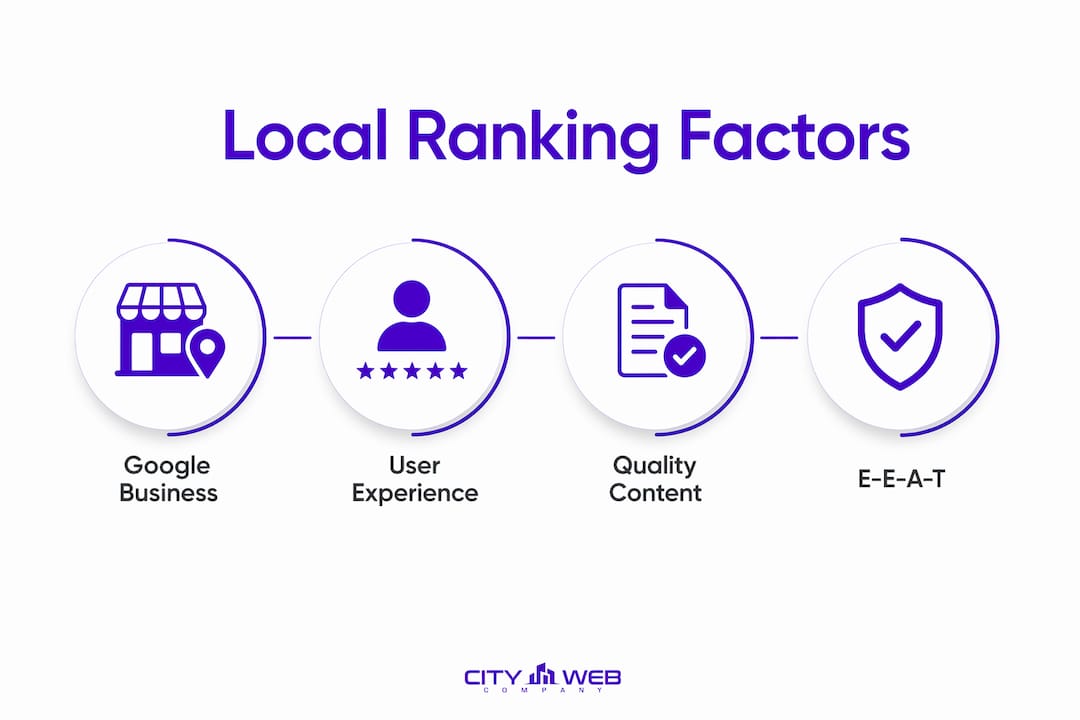

Ranking signals now include Google Business Profile, user experience, and quality content unified across local and organic SEO. Optimizing these channels separately, rather than as a coordinated system, consistently underperforms. A landscaper who runs a great Google Business Profile but has a slow website with no local content will plateau well below their potential ranking.
Pro Tip: Unify your local SEO and organic SEO efforts under one strategy. The local SEO best practices that improve your map pack ranking, like consistent citations and review management, also strengthen your organic page rankings.
Search rankings now incorporate E-E-A-T, which stands for Experience, Expertise, Authoritativeness, and Trustworthiness, as a core quality signal. For a local HVAC company, this means publishing content that demonstrates real technical knowledge, displaying licenses and certifications on your website, and earning mentions from local news outlets or industry associations.
Why high rankings reduce marketing costs over time
The financial case for strong search rankings is one of the most compelling and least discussed aspects of local SEO strategy. A high-ranking page can reduce blended Customer Acquisition Cost by 30 to 50% within 12 months compared to relying on paid advertising alone. That reduction compounds because the same page keeps generating leads without ongoing spend.
Consider a moving company spending $4,000 per month on Google Ads to generate 80 leads. The cost per lead is $50. If that same company invests in SEO and earns a first-page ranking for “local movers [city],” those organic leads cost a fraction of the paid leads once the ranking is established. The page does not stop working when the budget runs out.
Well-optimized content generates leads for 3 to 5 years with regular updates. Some legacy content accounts for 30% of organic revenue years after it was first published. This is the compounding effect that paid advertising cannot replicate. A Google Ad disappears the moment you stop paying. A well-ranked service page keeps attracting customers indefinitely.
The revenue math also shifts when you focus on the right keywords. Ranking for commercial-intent terms yields revenue increases that far exceed what the traffic volume alone would suggest, because searchers using those terms are ready to buy. A pest control company ranking for “termite treatment [city]” attracts customers with an immediate, high-value need. Ranking for “what are termites” attracts curious readers who may never convert.
Local searches with “near me” queries convert at 2.5 times the rate of non-local queries. This single statistic explains why local pack ranking is worth more per click than a generic national ranking. The person searching “HVAC repair near me” is not researching. They are ready to call.
Pro Tip: Measure your SEO performance by revenue per session, not just traffic or rankings. A page that ranks for a high-intent keyword and converts at 8% is worth more than a page with triple the traffic converting at 1%.
Maintaining strong rankings also prevents costly revenue loss because dislodging a well-established competitor requires significant time and investment. Businesses that treat SEO as a continuous process rather than a one-time project hold their positions and force competitors to spend heavily just to catch up. That is a structural competitive advantage, not just a marketing tactic.
How do AI-generated search results change your ranking strategy?
AI-powered search features, including Google’s AI Overviews and tools like ChatGPT and Perplexity, are changing how customers find local service businesses. The instinct many business owners have is to assume rankings matter less now that AI answers questions directly. That instinct is wrong. Traditional SEO and AI visibility are directly linked, and high organic ranking remains the foundation for appearing in AI-generated recommendations.
AI models like ChatGPT reference high-ranking pages when generating answers, which means your Google ranking directly influences whether your business gets cited by AI tools. A disaster restoration company that ranks on page one for “water damage restoration [city]” is far more likely to be recommended by an AI assistant than a competitor buried on page three. The two channels reinforce each other.
Here is what this means practically for local service businesses in 2026:
- AI Overviews pull from top-ranked sources. Google’s AI-generated summaries at the top of search results draw from pages that already rank well. Improving your organic position increases your chances of being included in these summaries.
- Zero-click searches still create brand impressions. Even when a user gets their answer from an AI Overview without clicking, the businesses named in that summary gain brand recognition. Top-ranked businesses are named. Others are not.
- Structured data accelerates AI citation. Schema markup that clearly identifies your business type, service area, and offerings makes it easier for AI systems to understand and recommend your business accurately.
- Content authority drives both channels. Pages that demonstrate genuine expertise, cite specific local details, and answer questions thoroughly perform well in both traditional rankings and AI citation systems.
The defensive value of maintaining rankings is just as important as the offensive opportunity. A competitor who outranks you does not just take your clicks. They take your AI citations, your brand impressions, and the trust signals that come from being the most visible option in your market.
Pro Tip: Structure your service pages to answer specific customer questions directly, like “How much does HVAC repair cost in [city]?” or “What is included in a pest control treatment?” This format performs well in both Google’s featured snippets and AI-generated answers.
Ignoring either the traditional SEO or AI visibility channel reduces your overall search presence and hands market share to competitors who treat both as part of one integrated strategy. The businesses winning in local search right now are not choosing between Google optimization and AI optimization. They are doing both simultaneously.
Key takeaways
Strong search rankings are revenue infrastructure for local service businesses, not a marketing add-on, because every position gained directly increases calls, reduces acquisition costs, and compounds into long-term growth.
| Point | Details |
|---|---|
| Rankings drive disproportionate clicks | Moving from position four to position two nearly doubles your click-through rate on high-intent queries. |
| Local pack ranking is non-negotiable | Over 90% of clicks stay on page one, making first-page and map pack presence the baseline for customer acquisition. |
| SEO reduces acquisition costs | High-ranking pages can cut Customer Acquisition Cost by 30 to 50% within 12 months compared to paid ads alone. |
| AI visibility depends on Google rankings | AI tools like ChatGPT cite high-ranking pages, so strong organic rankings directly influence AI-generated recommendations. |
| Unified strategy outperforms siloed tactics | Combining Google Business Profile optimization, review management, and on-site SEO produces better results than any single channel alone. |
Search rankings as revenue infrastructure: a perspective from the field
I have worked with local service businesses long enough to see the same pattern repeat. A business owner invests in a website, maybe runs some Google Ads, and then wonders why the phone is not ringing consistently. The answer is almost always the same. Their rankings are not where they need to be for the keywords that actually drive revenue.
The mistake I see most often is chasing traffic instead of revenue. A landscaping company ranking for “lawn care tips” gets visitors who will never hire them. The same company ranking for “lawn maintenance service [city]” gets calls. The distinction sounds obvious, but most businesses optimize for the wrong thing because traffic numbers feel like progress.
What actually works is treating your SEO for service businesses the same way you treat your equipment. You maintain it regularly, you invest in it when it needs upgrading, and you do not let it sit idle. Rankings decay when you stop paying attention. A competitor who publishes two new service pages and earns 20 new reviews in a quarter will move past you if you are standing still.
The AI shift is real, but it is not a reason to abandon traditional ranking strategy. It is a reason to double down on it. The businesses I see thriving right now are the ones who built strong Google rankings over the past two to three years and are now reaping the benefit of being cited by AI tools as well. That dual visibility is not luck. It is the result of consistent, disciplined SEO work.
Businesses winning in 2026 treat SEO as durable revenue infrastructure rather than a temporary traffic source. That framing changes everything about how you prioritize it, budget for it, and measure it. Stop asking “how much traffic did we get?” and start asking “how much revenue did our rankings generate this month?”
— Matt
How City Web Company helps local businesses dominate search rankings
If you run a local service business and your phone is not ringing as consistently as it should, your search rankings are the most likely cause. City Web Company specializes in local SEO services built specifically for service businesses like HVAC companies, plumbers, pest control operators, landscapers, and disaster restoration firms.
City Web Company’s approach covers Google Business Profile optimization, citation building, review management, and on-site content strategy, all coordinated as a single system rather than disconnected tactics. If you want to understand how local and traditional SEO compare for your specific situation, the local SEO vs. traditional SEO guide breaks down which approach grows your business faster. The team at City Web Company builds ranking strategies that generate measurable revenue, not just traffic reports.
FAQ
What is a search ranking and why does it matter for local businesses?
A search ranking is your business’s position in Google’s results when someone searches for a service you offer. Higher positions capture more clicks, more calls, and more customers, making ranking position the most direct lever for local business growth.
How do search rankings affect how many customers call my business?
Moving from position four to position two nearly doubles your click-through rate, and local searches with “near me” intent convert at 2.5 times the rate of non-local queries. Better rankings mean more qualified callers, not just more website visitors.
How long does it take for SEO to improve my search rankings?
Most local service businesses see measurable ranking improvements within three to six months of consistent SEO work, and well-optimized pages generate leads for three to five years with regular updates. The timeline depends on competition level and the current state of your website and Google Business Profile.
Do AI tools like ChatGPT affect how customers find my business?
Yes. AI models reference high-ranking pages when generating answers, so your Google ranking directly influences whether AI tools recommend your business. Maintaining strong organic rankings is the most reliable way to appear in both traditional and AI-generated search results.
What is the fastest way to improve my local search ranking?
Optimizing your Google Business Profile optimization and actively generating new customer reviews are the two highest-impact actions for local pack rankings. Pairing those with consistent NAP citations and service-specific website pages produces the fastest measurable results.
Recommended
These articles were popular with other readers too: