

See how plumbers can turn Facebook scrollers into booked jobs with clear offers, local targeting, a 30 day test budget, fast follow up, and a path to scale.
What Is Service-Based Marketing? A Guide for Small Businesses
Service-based marketing is defined as the practice of promoting intangible services by building trust, demonstrating value, and communicating the customer experience rather than showcasing physical product features. Unlike selling a pair of shoes or a piece of software, service marketing requires you to convince a prospect to buy something they cannot touch, test, or return. That challenge shapes every decision you make, from your website copy to your pricing page. Tools like testimonials, case studies, and the extended 7Ps marketing mix exist specifically to solve this problem. The US Chamber of Commerce, Shopify, and Webflow all point to the same core truth: service businesses win clients by reducing perceived risk, not by listing features.
Table of Contents
What is service-based marketing and why does it matter?
Service-based marketing is the strategic discipline of promoting offerings where the value is delivered through expertise, labor, or experience rather than a physical object. A law firm, a landscaping company, a med spa, and a disaster restoration crew all face the same core challenge: the customer cannot evaluate quality before they buy. That uncertainty creates hesitation, and hesitation kills conversions.
The importance of service marketing comes down to one word: trust. Perceived risk is higher in service purchases than in product purchases because there is no prototype to inspect. Your marketing must close that gap before a prospect ever picks up the phone. Every asset you create, from your Google Business Profile to your service page copy, functions as risk reversal.

Service businesses also operate in a relationship economy. A plumber who earns a five-star review gets the next three calls in the neighborhood. A pest control company that explains its treatment process on its website converts more visitors than one that simply lists prices. Understanding how a marketing agency for small businesses operates can help you see exactly where these trust signals fit into a broader system.
How do the unique characteristics of services shape their marketing?
Services have four key characteristics that separate them from physical goods: intangibility, inseparability, variability, and perishability. Each one creates a distinct marketing challenge you need to address directly.
Intangibility means a prospect cannot see, smell, or hold your service before buying it. A homeowner hiring an HVAC technician cannot test the repair in advance. This is why photos of completed work, before-and-after comparisons, and detailed service descriptions matter so much.
Inseparability means the service is produced and consumed at the same time. A massage therapist and the client are both present during the service. This makes the provider’s personality, communication style, and professionalism part of the product itself.
Variability means service quality can shift depending on who delivers it, when, and under what conditions. A moving company with ten crews may deliver ten slightly different experiences. Standardized processes and staff training are the marketing answer to variability because consistency becomes a selling point.
Perishability means unsold service capacity disappears forever. An empty appointment slot at a dental office cannot be stored and sold tomorrow. This is why service businesses use promotions, off-peak pricing, and reminder campaigns to fill gaps.
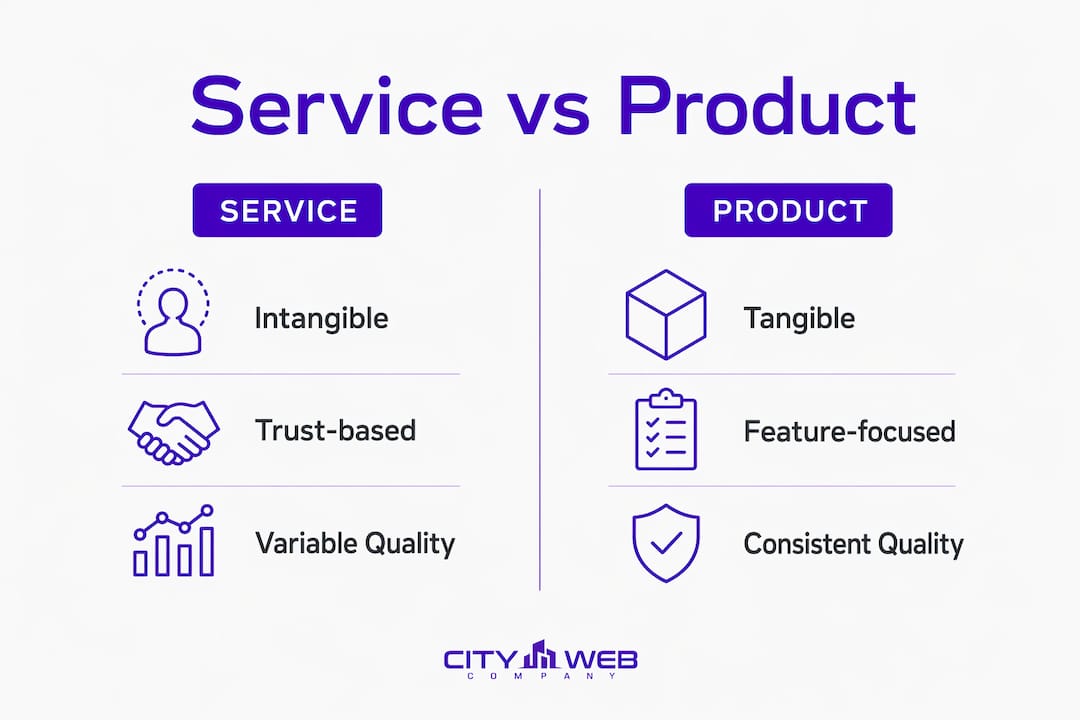

The table below shows how goods and services differ across these dimensions.
| Dimension | Physical Goods | Services |
|---|---|---|
| Tangibility | Can be seen, touched, tested | Cannot be evaluated before purchase |
| Production vs. Consumption | Produced before purchase | Produced and consumed simultaneously |
| Consistency | Standardized by manufacturing | Varies by provider and context |
| Inventory | Can be stored and sold later | Capacity expires if unused |
| Ownership | Transferred to buyer | Experience or outcome delivered, not owned |
Understanding this table tells you where your marketing dollars should go. If you run a home services company, your biggest return comes from solving the intangibility and variability problems, not from running generic brand awareness ads.
How does the extended 7ps marketing mix apply to service businesses?
The traditional 4Ps marketing mix, Product, Price, Place, and Promotion, was built for physical goods. It does not account for the human and process elements that define service delivery. The extended 7Ps model, developed by Booms and Bitner, adds People, Process, and Physical Evidence to address exactly that gap.
Adding People, Process, and Physical Evidence to your marketing mix improves conversion more reliably than adding new advertising channels. That finding should shift how you allocate your time and budget.
Here is what each of the seven elements means in practice for a service business:
- Product: The service itself, defined by its scope, quality, and outcomes. For a landscaping company, this is lawn care, design, and seasonal cleanup.
- Price: Your pricing model, whether flat rate, hourly, retainer, or tiered. Flexible pricing signals accessibility and reduces purchase friction.
- Place: Where and how the service is delivered, whether on-site, remotely, or through a hybrid model.
- Promotion: Your advertising, content marketing, social media presence, and referral programs.
- People: The staff who deliver the service. Their training, communication skills, and professionalism are part of the product.
- Process: The step-by-step delivery system. A clearly documented process reduces uncertainty and builds confidence before a client commits.
- Physical Evidence: Tangible cues that signal quality, including your website design, uniforms, vehicles, office environment, and printed materials.
The comparison below shows how the 4Ps and 7Ps differ in practical application.
| Marketing Mix | 4Ps Focus | 7Ps Addition |
|---|---|---|
| Core Elements | Product, Price, Place, Promotion | Adds People, Process, Physical Evidence |
| Best Suited For | Physical product companies | Service businesses of all sizes |
| Trust Mechanism | Product quality and packaging | Staff expertise, delivery process, visual cues |
| Customer Evaluation | Pre-purchase product inspection | Post-experience reviews and visible evidence |
Combining People and Process elements is more effective than relying on physical evidence cues alone. A polished website means little if your intake process is confusing or your technicians arrive without uniforms. All three elements must work together.
Pro Tip: On your service pages, add a “How It Works” section that lists three to five steps from first contact to job completion. This single addition addresses both the Process and Physical Evidence elements of the 7Ps and directly reduces the hesitation that kills conversions.
What are effective service marketing strategies for small businesses?
Practical service marketing strategies for small businesses center on one goal: making the invisible visible. A website that clearly explains the service process and sets expectations enhances client comfort and conversion rates. That principle extends to every channel you use.
Here are the most effective tactics, ranked by impact:
- Build a process-transparent website. Your service pages should answer three questions: What do you do? How do you do it? What does the client experience at each step? Webflow’s research confirms that explaining your service process online manages expectations and builds credibility before the first conversation.
- Collect and display testimonials strategically. Place reviews near your calls to action, not buried in a separate tab. Learning how to use testimonials effectively on your website can double the trust signal of a page that already has strong copy.
- Use case studies to show outcomes. A pest control company that shows a before-and-after photo of a termite-damaged home, along with the treatment timeline and result, gives prospects a concrete picture of what they are buying.
- Invest in relationship marketing. Retaining existing customers costs less than acquiring new ones, and this is especially true in service industries with high churn. Email follow-ups, loyalty discounts, and seasonal check-ins keep your name at the top of a client’s mind.
- Run referral programs. A moving company that offers a $50 credit for every referred booking turns satisfied customers into a sales force. Referrals carry built-in trust because the recommendation comes from a known source.
- Use targeted local ads. Service-based online ads for local businesses work best when they address a specific pain point and link to a landing page that mirrors the ad’s promise.
- Offer flexible pricing models. Tiered packages, free consultations, and satisfaction guarantees all reduce the perceived risk of buying an intangible service for the first time.
A common failure in service marketing is applying product-style messaging to a service offer. Listing features without explaining the customer journey creates confusion. Marketing must show the journey, including who performs the service, what happens at each stage, and what the client receives at the end.
How does service marketing differ from product marketing?
Service marketing vs. product marketing is not just a philosophical distinction. It changes your budget allocation, your messaging strategy, and your sales cycle. Service businesses require personalization and relationship-building to justify value in ways product companies rarely need.
The critical differences include:
- Evaluation timing: Product buyers evaluate before purchase. Service buyers evaluate during and after delivery. Your marketing must set accurate expectations upfront because the experience is the product.
- Trust dependency: A product can speak for itself on a shelf. A service cannot. Every piece of marketing you produce must carry trust signals, whether that is a credential, a guarantee, or a client photo.
- Sales cycle length: Service purchases, especially in healthcare, legal, or creative fields, involve longer consideration periods. Service marketing systems must close trust gaps across a longer buyer journey with consistent, credible communication.
- Pricing transparency: Product prices are usually visible and comparable. Service pricing is often custom or context-dependent. Explaining your pricing logic, even without publishing exact rates, reduces friction.
- Relationship continuity: Product transactions are often one-time events. Service relationships are ongoing. A landscaping client who stays for three years is worth far more than the first invoice suggests.
Building trust online requires a different playbook than building product awareness. Service marketers must treat every touchpoint as a trust-building opportunity, from the first Google search result to the post-service follow-up email.
What do successful service marketing campaigns look like?
Examples of service marketing done well share a common structure: they make the intangible feel concrete, they reduce risk, and they show the human behind the service. Here is what that looks like across different industries.
Healthcare: A med spa that publishes a detailed FAQ about its injectable treatments, includes practitioner credentials, and shows real patient photos with consent builds far more credibility than one that simply lists services and prices. The FAQ addresses variability concerns. The credentials address competency concerns. The photos address outcome uncertainty.
Home Services: A disaster restoration company that posts a video walkthrough of its water damage process, from initial assessment to final inspection, gives a distressed homeowner a clear picture of what to expect. That transparency converts calls into booked jobs faster than any discount offer.
Consulting: A business consultant who publishes case studies with specific numbers, such as a 30% reduction in overhead for a retail client over six months, gives prospects a measurable outcome to evaluate. Vague promises of “better results” do not close deals. Specific documented outcomes do.
Personal Care: A hair salon that shows its booking process, introduces its stylists by name and specialty, and displays a gallery of completed styles addresses intangibility, inseparability, and variability in a single page. Prospects know who they are booking, what to expect, and what the outcome could look like.
The practical lesson across all these examples is the same. Relationship marketing strategies that focus on ongoing client engagement, not just acquisition, produce the most durable results for service businesses. Acquisition gets the first booking. Relationship marketing gets the next ten.
Pro Tip: Review your top three competitors’ websites and note every trust signal they use: certifications, guarantees, staff bios, process diagrams, and review counts. Then audit your own site against that list. The gaps you find are your next marketing priorities.
Key takeaways
Service-based marketing works because it systematically reduces the perceived risk of buying something intangible by combining trust signals, transparent processes, and relationship-focused communication.
| Point | Details |
|---|---|
| Intangibility is the core challenge | Every marketing asset must help prospects evaluate quality they cannot see or test before buying. |
| The 7Ps model outperforms the 4Ps | Adding People, Process, and Physical Evidence to your mix converts more clients than adding new ad channels. |
| Process transparency drives conversions | A “How It Works” section on your service page reduces hesitation and increases booked appointments. |
| Retention beats acquisition in cost | Keeping existing service clients costs less than finding new ones, making relationship marketing a priority. |
| Trust signals must be specific | Vague promises fail. Named credentials, documented outcomes, and real client photos close the trust gap. |
Why most service businesses are marketing themselves wrong
Most service business owners I work with make the same mistake: they write their marketing copy the way a product company would. They list what they offer, maybe add a price range, and wait for the phone to ring. That approach fails because it skips the one thing a service buyer actually needs before committing: confidence that the experience will go well.
The businesses that consistently win in competitive service markets do something different. They show their work before the client ever pays for it. They publish their process. They introduce their team by name. They share real outcomes with real numbers. They follow up after every job. These are not complicated tactics. They are the basics of trust, applied consistently.
What I have seen work best for local service businesses is treating the website as a sales conversation, not a brochure. A brochure tells you what a company does. A sales conversation answers the questions a nervous buyer is actually asking: Who will show up at my house? What happens if something goes wrong? How long will this take? When your website answers those questions before the prospect has to ask them, your close rate goes up and your sales cycle gets shorter.
The other mistake I see constantly is abandoning relationship marketing after the first job. Service businesses have a structural advantage that product companies envy: repeat customers. A homeowner who trusts your HVAC company will call you for every service need they have. But only if you stay in contact. A quarterly email, a seasonal reminder, a birthday discount. These small touches compound into a client base that refers you without being asked.
Service marketing is not complicated. It is just different from product marketing, and most people are using the wrong playbook.
— Matt
How city web company helps service businesses get more clients
Service businesses need marketing that speaks to how clients actually make buying decisions, and that requires more than a generic website and a few social posts.
City Web Company specializes in local SEO services for small service businesses, from HVAC companies and plumbers to med spas and moving companies. The team builds websites that communicate process and trust, runs targeted ad campaigns that reach local buyers at the moment of need, and optimizes your Google Business Profile so you show up when it counts. If you want a marketing system built specifically for how service buyers think, City Web Company is ready to build it with you.
FAQ
What is service-based marketing in simple terms?
Service-based marketing is the practice of promoting intangible offerings like consulting, repairs, or healthcare by building trust and demonstrating value rather than showcasing a physical product. It focuses on the customer experience and the people delivering the service.
How is service marketing different from product marketing?
Service marketing emphasizes trust, process transparency, and relationship-building because buyers cannot evaluate the offering before purchase. Product marketing focuses on features, packaging, and pre-purchase inspection.
What are the 7ps of service marketing?
The 7Ps are Product, Price, Place, Promotion, People, Process, and Physical Evidence. The last three were added specifically to address the unique challenges of marketing intangible services.
Why do service businesses need testimonials and case studies?
Testimonials and case studies serve as physical evidence of service quality, reducing the perceived risk that comes with buying something intangible. Specific outcomes and named clients are more persuasive than general claims.
What is the biggest mistake in service marketing?
The most common mistake is using product-style feature messaging without explaining the service delivery process or customer journey. Prospects need to understand what happens, who does it, and what they will receive before they feel confident enough to buy.
Recommended
These articles were popular with other readers too: