

See how plumbers can turn Facebook scrollers into booked jobs with clear offers, local targeting, a 30 day test budget, fast follow up, and a path to scale.
What Is Promotional Swag: Definition, Examples, and How to Choose
Promotional swag is any item imprinted with a brand’s logo, name, or message and given away free (or sold at a steep discount) to raise awareness, reward an audience, or support a campaign. Think t-shirts at a trade show booth, branded pens in a welcome kit, or a tote bag tucked into a new customer’s first order. According to the Promotional Products Association International, wearable items alone account for the largest share of the promotional products market, making apparel the single largest category. City Web Company offers custom swag as part of its full-service local marketing programs, helping service businesses put their brand in customers’ hands.
Three quick examples of who gets swag and why:
- Employees and new hires: branded notebooks, water bottles, and apparel in onboarding kits
- Trade show and event attendees: pens, tote bags, lanyards, and tech accessories at booths
- Customers and prospects: stickers, mugs, or premium gifts shipped with orders or sent as loyalty rewards
Table of Contents
Table of Contents
- What Is Promotional Swag? The Core Categories
- When and Where Do Businesses Actually Use Swag?
- Swag vs. Merch vs. Promotional Products vs. Corporate Gifts
- How Promotional Swag Is Produced and Sourced
- What Does Promotional Swag Actually Cost, and What Is the ROI?
- Sustainability and Ethical Sourcing: Questions to Ask Your Vendor
- How to Choose the Right Swag for Your Campaign
- The U.S. Promotional Products Market: Key Stats and Trade Bodies
- Why Well-Designed Swag Actually Works: The Psychology Behind It
- Key Takeaways
- The Part Most Marketers Get Wrong About Swag
- City Web Company Can Handle Your Promotional Swag
- Useful Sources for Further Reading
- FAQ
What Is Promotional Swag? The Core Categories
Promotional merchandise covers a wide range of item types, but most fall into five practical buckets. Knowing which bucket fits your goal saves you from ordering 500 fidget spinners nobody keeps.
- Wearables (t-shirts, hats, outerwear): The largest single category. A well-designed shirt becomes a walking billboard for months or years. Durability and print quality matter here because a faded logo does more harm than good.
- Everyday carry and office items (pens, notebooks, drinkware, tote bags): These generate the most repeated impressions because people use them daily. A $2 pen that sits on someone’s desk for a year delivers far more brand exposure than a one-time digital ad.
- Tech and peripherals (power banks, wireless chargers, USB drives): Higher perceived value relative to cost. A $15 power bank feels like a premium gift, which lifts brand perception at trade shows and corporate events.
- Low-cost volume items (stickers, lanyards, buttons, keychains): Best for awareness at scale. Hand out 1,000 stickers at a festival for less than $300 and your logo ends up on laptops, water bottles, and car bumpers across the city.
- Premium merchandise and corporate gifts (branded speakers, high-end apparel, premium drinkware): Reserved for VIP clients, top recruits, or partner relationships where you want to signal real investment in the relationship.
When and Where Do Businesses Actually Use Swag?
Swag works best when it matches the moment. Handing a premium gift to a cold prospect feels off; giving a useful item to someone actively exploring your brand at a trade show feels natural. Here are the five highest-value deployment scenarios:
- Trade shows and conferences: Attendees are in discovery mode, which makes branded items at events unusually effective for lead capture and B2B relationship building. A useful item keeps your name in front of a prospect long after the show floor closes.
- Customer onboarding and retention: A welcome kit with a branded notebook, pen, and mug signals that you take the relationship seriously. Subscription boxes and loyalty gifts reinforce that message over time.
- Employee engagement and recruiting: New-hire swag packs reduce first-day anxiety and build team identity fast. Recruiting events benefit from the same logic: a well-designed item makes your company memorable in a crowded job market.
- Sales and partner enablement: Gift-with-purchase promotions, reseller kits, and sales incentive packages all use swag to deepen commercial relationships without a large cash outlay.
- Ecommerce inserts: A small branded sticker or handwritten note with a product in a shipped order costs almost nothing but consistently drives repeat purchases and social sharing.
For industry-specific ideas, City Web Company’s guide on promotional merchandise for law firms shows how the same principles apply across professional service verticals.
Swag vs. Merch vs. Promotional Products vs. Corporate Gifts
These terms get used interchangeably in vendor conversations, but they carry different budget and strategy implications. Getting the vocabulary right helps when briefing a supplier or writing a purchase order.
- Swag: Informal shorthand for high-volume, low-cost branded giveaways. The goal is awareness and reach, not deep engagement. Pens, stickers, and lanyards are classic swag.
- Promotional products: The industry’s formal term, used by trade bodies like ASI and PPAI. Covers everything from a $0.50 pen to a $75 branded jacket. Swag is a subset of promotional products.
- Branded merchandise (merch): Often higher quality and sometimes sold rather than given away. A band’s tour t-shirt or a company’s retail store line falls here. The emphasis shifts from awareness to identity and revenue.
- Corporate gifts: Premium, often personalized items sent to specific recipients (clients, executives, top performers). The goal is long-term relationship building, not mass distribution. Think engraved drinkware, curated gift boxes, or branded tech accessories at the $50–$150 price point.
When briefing a vendor, use “promotional products” for volume orders and “corporate gifts” for high-value, targeted sends. It signals to the supplier which quality tier and fulfillment model you need.
How Promotional Swag Is Produced and Sourced
Most companies never buy directly from a manufacturer. Distributors handle artwork prep, printing, proofing, and delivery across multiple manufacturing sources, which is why working with a distributor or full-service agency is the standard path for most buyers.
Common decoration methods and when to use them:
- Screen printing: Best for t-shirts, tote bags, and flat surfaces with 1–4 spot colors. Cost-effective at volume (100+ units).
- Embroidery: Ideal for hats, polos, and outerwear. Durable and premium-feeling, but not suited for fine detail or gradients.
- Pad printing: Used for pens, mugs, and small hard goods. Precise for small logos on curved surfaces.
- Laser engraving: Clean, permanent finish on metal and wood items. No ink to fade or peel.
- Full-color dye sublimation: Best for all-over prints on polyester apparel and soft goods. Vibrant but limited to light-colored substrates.
Standard production windows run 7–14 business days after artwork approval. Rush options (3–5 days) exist but add cost. Minimum order quantities vary by item: pens often start at 100 units, custom apparel at 12–24 pieces, and premium tech items sometimes at 25–50 units.
If you run into artwork or sourcing problems mid-order, City Web Company’s custom promotional products troubleshooting guide covers the most common fixes.
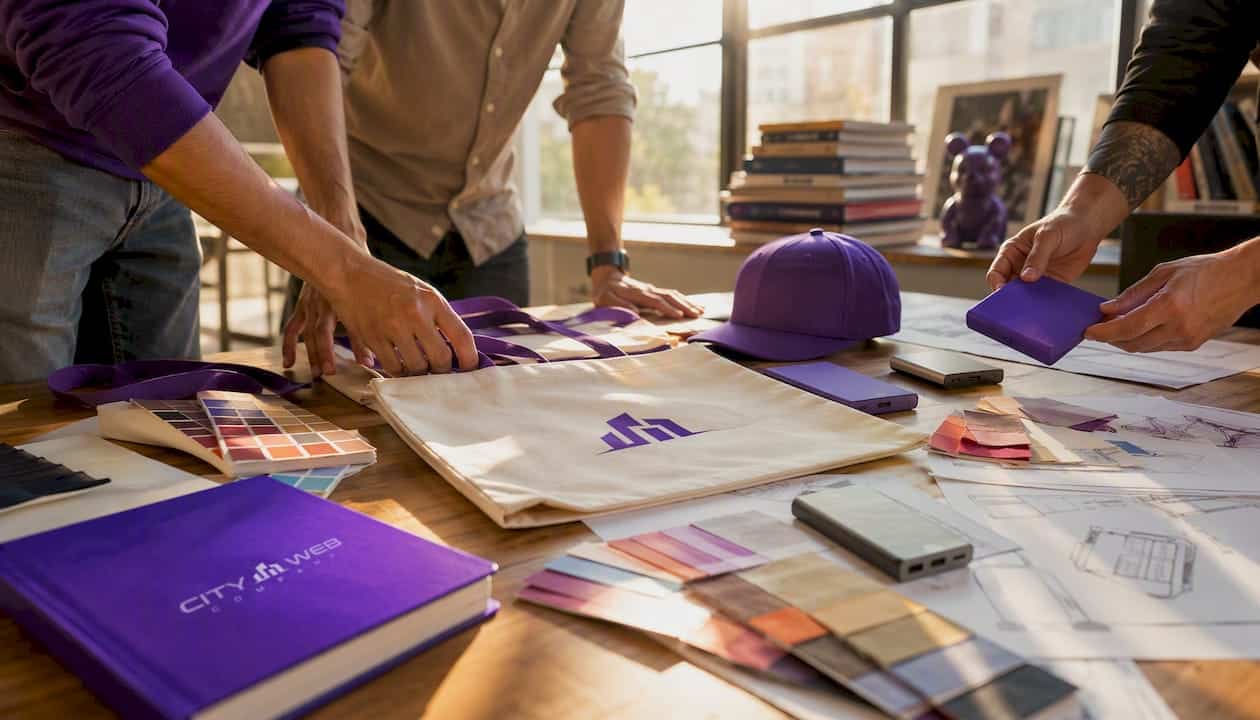
Pro Tip: Always request a physical sample and a digital proof before approving a full run. Ask the supplier for material specs (fabric weight, coating type, imprint durability) and end-use data. A $0.10-per-unit savings is not worth discovering the logo peels after three washes.
What Does Promotional Swag Actually Cost, and What Is the ROI?
Price bands vary widely by category, but the cost-per-impression (CPI) math is where swag consistently outperforms other ad formats.
Typical unit price ranges by tier:
- Low-cost giveaways (pens, stickers, buttons): $0.50–$3 per unit
- Mid-range items (drinkware, notebooks, tote bags): $4–$15 per unit
- Premium gifts (tech accessories, branded apparel, curated kits): $20–$75+ per unit
According to ASI’s 2026 Ad Impressions Study, a $6 tote bag can generate nearly 5,000 impressions over its lifetime, putting CPI at roughly 0.1 cent. A $13 baseball cap delivers CPI around 0.3 cents. For context, digital display ads typically run $2–$5 per thousand impressions (CPM), which is $0.002–$0.005 per impression. A tote bag at 0.1 cent per impression is competitive with the cheapest digital formats, and it keeps working without a media budget.
| Item | Approx. Unit Cost | Est. Lifetime Impressions | Approx. CPI |
|---|---|---|---|
| Tote bag | $6 | ~5,000 | ~0.1 cent |
| Baseball cap | $13 | — | ~0.3 cent |
| Branded pen | — | ~1,000 | — |
| Power bank | $20 | — | — |
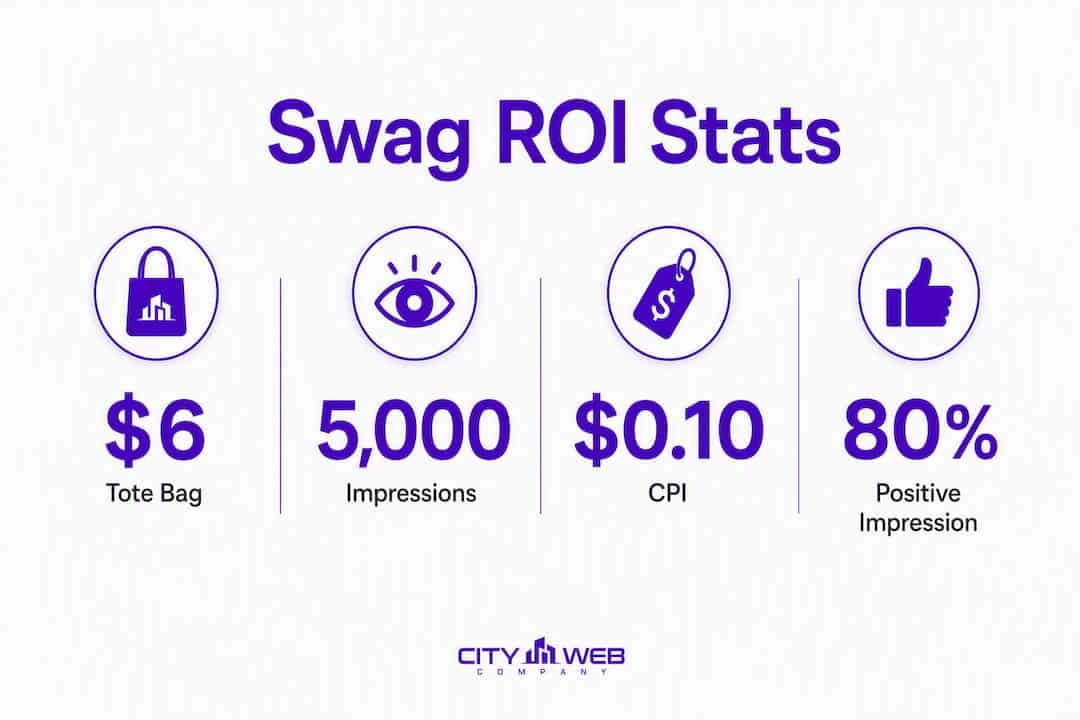
Tote bag and baseball cap figures sourced from ASI’s 2026 Ad Impressions Study. Pen and power bank rows are illustrative estimates.
The ASI study also found that nearly 80% of U.S. consumers report a more favorable impression of an advertiser after receiving a promotional item. That favorability lift is hard to buy with a banner ad.
KPIs worth tracking: impressions per item (ask recipients), retention rate (do people keep it?), lead quality from event giveaways, and follow-up conversion rate from campaigns that include a swag component.
Sustainability and Ethical Sourcing: Questions to Ask Your Vendor
Sustainability is no longer a niche concern. Durable, responsibly sourced products increase recipient favorability and reduce the carbon footprint per impression of your marketing program. The good news is that choosing sustainable swag and choosing effective swag are mostly the same decision: durable items get used longer, which means more impressions and less waste.
Questions to ask any supplier before placing an order:
- What materials are used, and are any recycled or certified (OEKO-TEX, GOTS, FSC)?
- Where is the item manufactured, and does the supplier audit labor practices?
- Is there a carbon offset program or a take-back/end-of-life disposal option?
- Are local or domestic manufacturing options available for shorter shipping distances?
Eco-friendly item categories worth exploring: recycled PET apparel, biodegradable bamboo drinkware, FSC-certified notebooks and paper goods, and organic cotton tote bags. For a deeper look at material choices and certifications, the sustainable promotional products guide from Chilli Promotions covers sourcing criteria in detail.
Pro Tip: Prioritize usefulness and longevity over novelty. A recipient who uses a branded item for two years generates far more impressions than someone who tosses a gimmick item on day one. Utility is the single best sustainability strategy.
How to Choose the Right Swag for Your Campaign
Follow this five-step process before placing any order. It takes 30 minutes and prevents the most common mistakes.
- Define the goal and recipient. Are you driving awareness at a trade show, welcoming a new employee, or rewarding a top client? The answer changes everything: volume items for events, quality items for relationships.
- Prioritize utility and longevity. The ASI study found nearly eight in 10 respondents keep a promo product because it is useful. Pick items people will actually use in their daily routine.
- Set a budget and compute a target CPI. Divide total spend by estimated lifetime impressions. If a $500 order of tote bags generates 250,000 impressions, your CPI is 0.2 cents. Compare that against your other ad channels.
- Confirm lead time, artwork specs, and fulfillment. Get a digital proof and, for orders over $1,000, a physical sample. Confirm shipping costs and delivery windows before approving production.
- Run compliance and sustainability checks. U.S. textile labeling rules (fiber content, country of origin) apply to apparel. For imported goods, confirm import origin disclosures. Ask about material certifications if sustainability is a brand priority.
Pro Tip: Pilot with a small run of 50–100 units before scaling. Measure retention (do recipients still have the item 30 days later?) and follow-up conversion from any campaign tied to the giveaway. Scale what works.

The U.S. Promotional Products Market: Key Stats and Trade Bodies
The U.S. promotional products industry is large, well-organized, and well-studied. Two trade associations publish the benchmarks most marketers rely on.
- ASI (Advertising Specialty Institute): Publishes the annual Ad Impressions Study, which is the most-cited source for CPI benchmarks and consumer favorability data in the industry. ASI also runs a supplier and distributor directory used by procurement teams across the country.
- PPAI (Promotional Products Association International): The other major trade body. PPAI offers supplier standards, a product safety program, and research reports on industry size and buyer behavior. Their member directory and annual Expo are the primary sourcing events for U.S. distributors.
Both organizations maintain publicly accessible research summaries. If you are building a business case for a swag budget, the ASI Ad Impressions Study and PPAI’s annual industry reports are the two sources your finance team will find credible.
The American Marketing Association notes that nearly three-quarters of people who receive a promotional item can recall the name of the company that gave it to them, a recall rate that outperforms many traditional ad formats.
Why Well-Designed Swag Actually Works: The Psychology Behind It
Physical items do something digital ads cannot: they create a tactile connection. The psychology of swag explains this through familiarity and friction reduction. When someone holds a branded item, uses it, and sees your logo repeatedly over weeks or months, they develop a low-level familiarity with your brand that lowers the psychological barrier to doing business with you. It is the same mechanism behind why people trust brands they recognize, even when they cannot explain why.
Promotional products generate ongoing impressions long after distribution because recipients keep and use them. A novelty item gets tossed; a useful item stays. That is why a $6 tote bag outperforms a $20 branded stress ball on every ROI metric.
Marketing leaders consistently report the best results when items are well-designed and genuinely useful, especially at trade shows where discovery intent is high. City Web Company integrates promotional merchandise into local marketing campaigns precisely because the physical touchpoint reinforces the digital brand presence built through SEO and paid media. The two channels compound each other.
Pro Tip: Match the item to the brand’s values, not just the logo. A sustainability-focused HVAC company that hands out recycled-material tote bags sends a consistent message. A law firm that gives away premium leather notebooks signals quality. The item is a brand statement, not just a giveaway.
Key Takeaways
Promotional swag delivers some of the lowest cost-per-impression of any marketing channel when items are useful, well-made, and matched to the right audience and occasion.
| Point | Details |
|---|---|
| Core definition | Promotional swag is branded items given away or sold at a discount to raise awareness, reward audiences, or support campaigns. |
| Best item categories | Everyday carry items (drinkware, tote bags, pens) generate the most repeated impressions and the lowest CPI. |
| CPI benchmark | A $6 tote bag generates nearly 5,000 impressions at roughly 0.1 cent CPI, per ASI’s 2026 Ad Impressions Study. |
| Selection checklist | Define goal, prioritize utility, set a CPI target, confirm lead times and proofs, and pilot before scaling. |
| City Web Company | City Web Company offers custom promotional merchandise integrated with local SEO and paid media for service businesses. |
The Part Most Marketers Get Wrong About Swag
The conventional wisdom is that swag is a nice-to-have, a booth filler, something you order because everyone else does. That framing is wrong, and it is why so many swag budgets produce nothing measurable.
The mistake is treating the item as the strategy. A branded pen is not a strategy. A branded pen handed to every attendee who scans their badge at your trade show booth, followed by a personalized email referencing the item two days later, is a strategy. The physical item creates the memory; the follow-up converts it.
The other common error is skipping the pilot. Ordering 2,000 units of something you have never tested is how you end up with a warehouse of items nobody wants. A 100-unit pilot run costs almost nothing relative to a full order, and it tells you whether the item actually gets kept and used.
Shipping and fulfillment costs also catch buyers off guard. A $4 item that costs $8 to ship individually is not a $4 item. Factor fulfillment into your CPI calculation from the start, especially for ecommerce inserts or direct-mail swag campaigns.
City Web Company builds promotional merchandise into broader local marketing campaigns because the physical and digital touchpoints reinforce each other. A local HVAC company that hands out branded drinkware at a home show and runs a Google Ads campaign the same week gets more out of both channels than either would deliver alone.
City Web Company Can Handle Your Promotional Swag
Custom swag is most effective when it connects to a broader marketing strategy, not when it sits in a box waiting for the next event. City Web Company offers promotional merchandise services for local service businesses, with ordering, artwork, and fulfillment handled alongside SEO, paid media, and web design. That means your branded items, your Google Ads, and your local search presence all push in the same direction at the same time.
For service businesses that want to combine physical brand presence with local SEO and digital advertising, City Web Company offers a straightforward starting point: a quick consultation to identify which swag items fit your audience and how they slot into your current marketing calendar. Get in touch at citywebcompany.com/promotional-products to start a pilot order or request a sample pack.
Useful Sources for Further Reading
These are the primary references behind this article. Each one covers a distinct angle.
- ASI’s 2026 Ad Impressions Study: The definitive U.S. benchmark for CPI figures, consumer favorability data, and item-level impression estimates. Start here if you need numbers for a budget proposal.
- PPAI (Promotional Products Association International): The industry’s other major trade body. Their research and supplier standards are the baseline for procurement teams.
- Wikipedia: Promotional Merchandise: A solid overview of item categories, distribution methods, and the distributor model. Good for orientation.
- American Marketing Association: Do Promotional Products Work?: Covers recall rates, lead magnet applications, and social media giveaway mechanics.
- VistaPrint: What Is Swag?: Practical vendor explainer with common item examples and use case guidance.
- Sustainable Promotional Products Guide: Partner resource covering sustainability trends, material certifications, and ethical sourcing criteria for 2026.
FAQ
What does promotional swag mean?
Promotional swag refers to branded items given away or sold at a discount to promote a company, event, or cause. The term is informal shorthand for promotional merchandise, which is the industry’s standard term.
What are some examples of swag?
Common examples include t-shirts, hats, pens, tote bags, mugs, power banks, stickers, and notebooks, all imprinted with a company’s logo or message. Wearables are the largest single category, accounting for more than 30% of the promotional products market.
What does SWAG stand for?
SWAG is widely used as a casual noun for branded giveaways, but it does not have a single agreed-upon acronym origin. The most common backronym is “Stuff We All Get,” though the word predates that phrase and is not an official industry term.
How is promotional swag different from corporate gifts?
Swag is typically high-volume and low-cost, focused on awareness and reach. Corporate gifts are lower-volume, higher-value, and targeted at specific recipients to build long-term relationships, often in the $50–$150 per-item range.
Where can I order promotional swag for my business?
Distributors and full-service agencies handle artwork, printing, and fulfillment for most buyers. City Web Company offers custom promotional products integrated with local marketing services for small and mid-sized service businesses across the U.S.
Recommended
These articles were popular with other readers too: