

See how plumbers can turn Facebook scrollers into booked jobs with clear offers, local targeting, a 30 day test budget, fast follow up, and a path to scale.
Top Website Builders for Service Businesses in 2026
Table of Contents
What are the best website builders for service businesses?
Wix is the strongest all-around pick for most service businesses, with Squarespace leading for booking-heavy, design-conscious providers. Those two cover the majority of use cases. The rest of the field fills specific gaps: Shopify for businesses that sell products alongside services, WordPress.org for owners who need full control, Duda for agencies managing multiple client sites, and HubSpot CMS for businesses running inbound marketing alongside their service operations.
The table below covers all 16 platforms on the dimensions that matter most to service providers: what they do best, booking capabilities, client management, and ease of use.
| Platform | Best For | Booking Features | Client Management | Ease of Use |
|---|---|---|---|---|
| Wix | All-in-one small to medium service businesses | Built-in Wix Bookings with calendar sync | CRM, email marketing, forms | Very easy, drag-and-drop |
| Squarespace | Creative and visually-driven service businesses | Acuity Scheduling integration, specialized booking tools | Client portal, intake forms | Easy, guided editor |
| Shopify | Service businesses with product sales | App-based booking (e.g., Sesami) | Order and client tracking | Moderate |
| WordPress.org | Full control and scalability | Plugin-based (Amelia, BookingPress) | Plugin-based CRM options | Steep learning curve |
| GoDaddy | Speedy online presence launch | Built-in appointment scheduling | Basic contact management | Very easy |
| Hostinger | AI-powered site creation for small businesses | Basic booking via plugins | Limited native tools | Very easy |
| Jimdo | Simple booking setup for small providers | Integrated booking modules | Basic client contact tools | Very easy |
| Weebly/Square Online | Booking plus light ecommerce | Square Appointments integration | Square ecosystem tools | Easy |
| SeedProd | Growth-focused service businesses | Custom landing pages with booking embeds | Third-party CRM integration | Moderate |
| Duda | Agencies and large service businesses | Widget-based booking embeds | White-label client dashboards | Moderate |
| HubSpot CMS | Inbound marketing-driven service businesses | HubSpot Meetings integration | Full built-in CRM | Moderate to advanced |
| Yola | Very small providers needing basic setup | Basic booking integration | Minimal | Very easy |
| Webnode | Rapid setup for service practitioners | Basic booking setup | Minimal | Very easy |
| Setmore | Appointment-first service providers | Core product is scheduling | Client history, reminders | Easy |
| WordPress.com | Hosted WordPress with plugin flexibility | Plugin-based booking options | Plugin-based CRM | Easy to moderate |
| WordPress | Custom-built service sites | Fully customizable via plugins | Full plugin ecosystem | Varies by setup |
Top picks at a glance:
- Wix: Best overall for service businesses that want booking, marketing, and a polished site without hiring a developer. Wix has held the top spot in independent testing for multiple years running.
- Squarespace: Best for salons, fitness studios, consultants, and any service provider where visual presentation drives conversions. Its built-in booking tools are more organized than those of Wix or GoDaddy.
- WordPress.org: Best when you need custom workflows, advanced SEO control, or integrations that no hosted builder can match.
- Duda: Best for digital agencies building and managing sites for multiple service business clients.
- HubSpot CMS: Best when your sales pipeline and website need to share the same data.
- GoDaddy: Best when speed of launch matters more than design depth.
- Setmore: Best when the website is secondary and the booking calendar is the real product.
Most service businesses can launch a functional site in one to three days on Wix, Squarespace, or GoDaddy. WordPress.org typically takes one to two weeks, depending on the plugins and theme chosen.

How do the top website builders for service businesses actually compare?
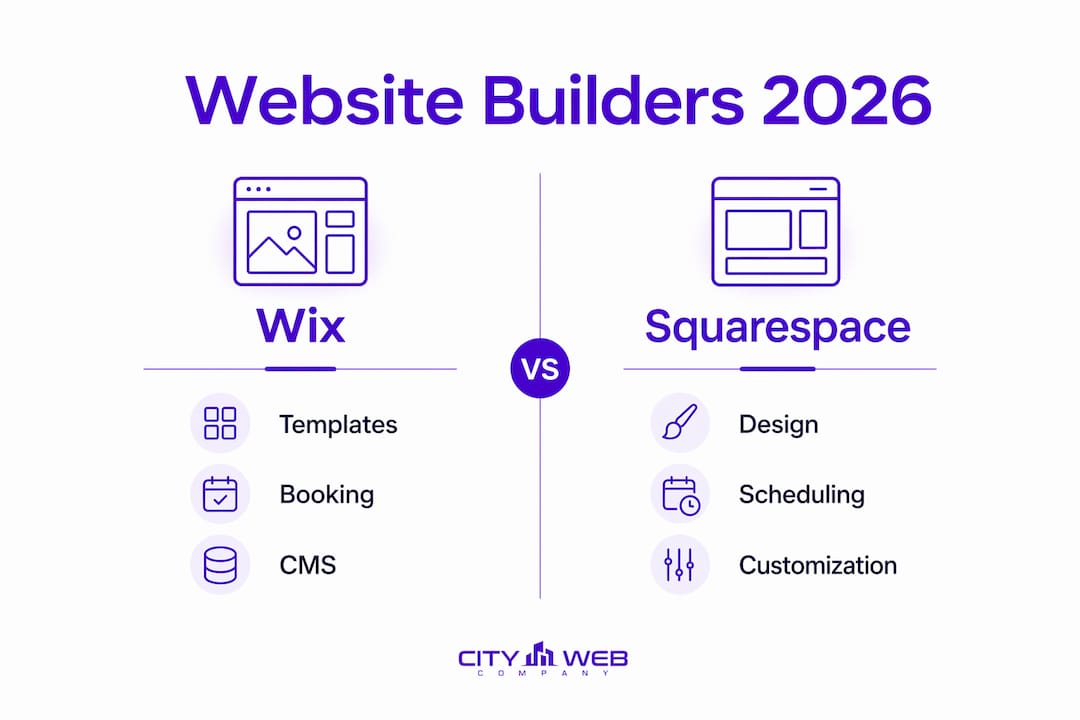

The table above gives you the quick read. What follows is where the real differences show up in practice.
Wix and Squarespace: the two platforms most service businesses should start with
Wix wins on breadth. Its drag-and-drop editor, 900-plus templates, built-in CMS, and Wix Bookings module cover the full range of service business needs without requiring a single plugin. You can add email marketing, a client portal, and an online store from the same dashboard. The tradeoff is that the editor gives you so many options that first-time builders sometimes spend hours on decisions that do not affect conversions.

Squarespace wins on depth of booking organization. Its scheduling and booking tools are more specialized than Wix’s, offering superior booking organization and client management specifically tailored for service businesses. Its intake forms, package management, and client-facing portals are regarded as the most robust among mainstream website builders for service providers. The design templates are also a tier above most competitors, which matters when your brand is part of your pitch.
WordPress.org vs. WordPress.com: not the same product
WordPress.org is the self-hosted, open-source platform. You own everything, install any plugin, and have no platform restrictions. Booking plugins like Amelia and BookingPress give you scheduling features that rival dedicated booking software. The cost of that freedom is setup time and ongoing maintenance. WordPress.com is the hosted version, which trades some flexibility for convenience. It supports booking plugins on higher-tier plans, but you cannot install arbitrary third-party plugins on entry-level plans.
Shopify, Weebly/Square Online, and SeedProd
Shopify is primarily an ecommerce platform, but service businesses that also sell physical products (a personal trainer selling supplements, a cleaning company selling gift cards) benefit from its payment infrastructure. Booking is handled through apps like Sesami rather than natively. Weebly/Square Online fits businesses already inside the Square ecosystem: if you take payments through a Square terminal, the website and booking flow connect without friction. SeedProd focuses on landing pages and conversion-oriented design, making it a better fit for service businesses running paid ads than for those building a full site from scratch.
GoDaddy and Hostinger: speed over depth
GoDaddy’s builder offers a 7-day free trial, 24/7 support, and appointment scheduling built in. It is the fastest path from zero to a live, bookable site. The design ceiling is lower than Wix or Squarespace, but for a plumber or HVAC company that needs a phone number, a service list, and a booking button, that ceiling is high enough. Hostinger’s AI builder accelerates the initial design phase by generating a site from a short prompt, which suits small service businesses that want to get online quickly without making dozens of design decisions.
Duda: built for scale, not solo operators
Duda is the outlier on this list. It is not designed for a single business owner building their own site. It is built for agencies and professionals managing many client sites at once. Its white-label dashboard, global theme controls, and AI-assisted page creation let agencies spend 50% less time building and 75% less time maintaining sites compared to previous platforms. If you are a service business owner, Duda is relevant only if your web agency uses it to build your site.
HubSpot CMS, Setmore, Jimdo, Yola, Webnode
HubSpot CMS is the right call when your service business depends on inbound marketing. The CRM is built into the platform, so every form submission, page visit, and email open ties directly to a contact record. Setmore is not a traditional website builder at all. It is appointment scheduling software that embeds into an existing site. If you already have a site and just need a booking layer, Setmore is worth considering. Jimdo, Yola, and Webnode are simple, fast, and limited. They suit very small providers who need a basic web presence and have no plans to scale the site’s functionality.
Pros and cons summary:
- Wix: Pros: widest feature set, best template variety, strong booking tools. Cons: can feel cluttered for beginners, premium plans required for full features.
- Squarespace: Pros: best booking organization, superior design. Cons: less flexible editor, higher starting price.
- WordPress.org: Pros: unlimited customization, full ownership. Cons: requires hosting, maintenance, and technical comfort.
- GoDaddy: Pros: fastest setup, 24/7 support. Cons: limited design depth, basic client management.
- Hostinger: Pros: AI-assisted setup, low cost. Cons: limited native booking and client tools.
- Duda: Pros: best for agencies, white-label ready. Cons: not designed for solo business owners.
- HubSpot CMS: Pros: full CRM integration, strong marketing tools. Cons: expensive at higher tiers, overkill for simple sites.
- Setmore: Pros: best-in-class scheduling. Cons: not a full website builder.
How to choose the right website builder for your service business
The right platform depends on three things: what your clients need to do on your site, how much time you can spend building and maintaining it, and where you expect your business to be in two years.
Questions to ask before you commit:
- Does the platform include native booking, or do you need a third-party plugin? Native booking (Wix, Squarespace, GoDaddy) is faster to set up and less likely to break during updates.
- Can clients pay deposits or full fees at the time of booking? Payment-at-booking reduces no-shows and improves cash flow.
- Does the builder generate local SEO metadata automatically? Dedicated website builders that integrate local SEO metadata outperform generic profile links for local search visibility.
- What happens to your site if you stop paying? Hosted builders (Wix, Squarespace, GoDaddy) take your site offline if you cancel. WordPress.org gives you full ownership.
- Can you add staff members, locations, or service categories as you grow? Squarespace and Wix both support multi-staff booking. GoDaddy’s tools are more limited.
- Is the mobile experience built in, or do you have to configure it separately? Every platform on this list produces mobile-responsive sites, but some require manual adjustments to the mobile layout.
- What does the platform charge for transaction fees on bookings? Some builders take a percentage of each booking on lower-tier plans.
Criteria ranked by importance for service businesses:
- Booking and scheduling quality
- Client management and communication tools
- Mobile performance
- Local SEO capabilities
- Ease of editing without developer help
- Pricing transparency (no surprise fees at renewal)
- Template quality for your industry
Pro Tip: Before signing up for any paid plan, test the booking flow as a client would. Book a fake appointment, receive the confirmation email, and try to reschedule. That five-minute test reveals more about a platform’s booking quality than any feature list.
Avoid platforms that lock your domain, charge transaction fees on bookings, or require a developer to make basic content changes. Those costs compound quickly for a growing service business.
What features does a service business website need in 2026?
The gap between a website that generates leads and one that just exists online comes down to a specific set of features. Generic brochure sites no longer convert. Clients expect to book, pay, and communicate without leaving your site.
Must-have features:
- Online booking with calendar sync. Clients should be able to see real-time availability and book without calling. Calendar sync with Google Calendar or Outlook prevents double-bookings.
- Payment processing at booking. Accepting deposits or full payment upfront reduces no-shows. Squarespace, Wix, and Square Online all support this natively.
- Mobile-responsive design. The majority of local service searches happen on phones. A site that loads slowly or displays poorly on mobile loses those visitors before they read a single line.
- Local SEO metadata. Auto-generated page titles, meta descriptions, and local business schema markup help your site appear in “near me” searches. Dedicated builders handle this better than link-in-bio tools or generic profile pages.
- Client intake forms. Collecting information before an appointment (medical history for a med spa, project scope for a contractor) saves time and sets professional expectations.
- Service-specific templates. A template designed for a law firm looks different from one designed for a cleaning company. Starting with the right template cuts design time significantly.
- Automated reminders and confirmations. Email and SMS reminders reduce no-shows without any manual effort. Squarespace’s Acuity integration and Wix Bookings both handle this.
- Built-in CRM or CRM integration. Tracking client history, preferences, and communication in one place improves retention. HubSpot CMS does this natively. Wix and Squarespace offer lighter versions.
- SSL certificate and ADA accessibility. Every major builder includes SSL. Accessibility compliance (WCAG standards) protects against legal risk and expands your potential client base.
- Review display. Showing Google or Yelp reviews directly on your site builds trust before a visitor ever clicks “Book Now.”
The platforms that combine booking, payment, client management, and SEO in a single interface require less technical maintenance than those that rely on multiple third-party plugins. That matters most for service business owners who are not developers and do not want to become one.
When should you scale beyond a website builder?
Website builders are the right starting point for most service businesses. They are fast, affordable, and require no technical background. But they have a ceiling, and some businesses hit it faster than they expect.
The clearest sign that a builder is holding you back is when your workflows require custom logic that no plugin can replicate. A single-location massage therapist can run everything through Wix. A multi-location med spa with different service menus, staff credentials, and intake requirements at each location will eventually outgrow what any hosted builder can do cleanly.
Other indicators worth paying attention to:
- Your booking system requires integrations with practice management software, EHR systems, or custom CRMs that the builder does not support.
- Page load speed is suffering because of the number of apps and plugins you have added.
- You need custom client portals, membership areas, or gated content that the builder’s native tools cannot produce.
- Your SEO needs have grown beyond what the builder’s metadata tools can handle.
Agencies that move to purpose-built platforms like Duda report spending 50% less time building client sites and 75% less time on ongoing maintenance. That efficiency gain is not just about the agency. It means faster turnaround, fewer errors, and more consistent results for the service businesses those agencies serve.
When you do plan a migration, protect three things: your domain (keep it registered in your own name, not the builder’s account), your content (export it before canceling), and your SEO (set up 301 redirects from old URLs to new ones). Losing search rankings during a migration is common and avoidable with basic planning. For guidance on designing service websites that hold their rankings through a platform change, the fundamentals are consistent across builders.
Key Takeaways
Wix and Squarespace cover the majority of service business website needs in 2026, with Squarespace leading on booking organization and Wix leading on overall feature breadth.
| Point | Details |
|---|---|
| Best all-around pick | Wix suits most small to medium service businesses with native booking, CRM, and marketing tools in one platform. |
| Best for booking-heavy businesses | Squarespace leads for booking-heavy businesses with more specialized booking tools and superior organization for salons, studios, and consultants compared to Wix or GoDaddy. |
| When to use WordPress.org | Choose WordPress.org when you need full ownership, custom integrations, or advanced SEO control that hosted builders cannot provide. |
| Signs you need to upgrade | Custom workflows, multi-location complexity, or slow load times from plugin overload signal it is time to move beyond a builder. |
| City Web Company’s role | City Web Company builds and markets service business websites with SEO, booking integration, and local lead generation built in from day one. |
Why a strong web presence is the foundation, not the finish line
Most service business owners treat their website as a one-time project. Build it, launch it, move on. That mindset is exactly why so many service business websites generate traffic but not clients.
A website for a service business is not a brochure. It is the first step in a client relationship, and every element, from the booking flow to the page load speed to the local schema markup, either builds or erodes trust before a visitor ever contacts you. The builders on this list give you the tools. What they cannot do is make the strategic decisions: which services to lead with, how to position your pricing, what local keywords to target, or how to turn a first-time visitor into a repeat client.
City Web Company works specifically with local service businesses, including HVAC companies, med spas, pest control operators, landscapers, and disaster restoration firms, to build websites that do more than look good. The focus is on lead generation, local search visibility, and client conversion, with booking and client management built into the architecture from the start, not added as an afterthought.
City Web Company builds service business websites that generate leads
If you have read this far, you know what a good service business website needs: fast booking, local SEO, mobile performance, and client management that does not require three separate tools. City Web Company delivers all of that as a managed service, so you are not spending evenings troubleshooting plugins or wondering why your booking page stopped syncing.
The difference between a DIY builder and a professionally built site is not just design. It is the local lead generation strategy built into every page, the Google Business Profile optimization that drives calls before a visitor even reaches your site, and the paid advertising that fills your calendar when organic traffic is not enough. City Web Company handles web design, local SEO, and digital marketing for service businesses across the country, with a track record in home services, med spas, HVAC, plumbing, landscaping, and more.
FAQ
Which website builder is best for service businesses in 2026?
Wix is the best all-around choice for most service businesses, with Squarespace leading specifically for booking-heavy and design-focused providers. Both include native booking, client management tools, and mobile-responsive templates without requiring plugins.
Does Squarespace have better booking tools than Wix?
Yes. Squarespace’s scheduling and booking system offers more specialized and superior booking features and organization for service providers compared to Wix, making it the top choice where scheduling is central to the business.
How long does it take to launch a service business website?
Most service businesses can go live on Wix, Squarespace, or GoDaddy within one to three days. WordPress.org typically takes one to two weeks depending on the theme and plugins selected.
When should a service business move beyond a website builder?
When your workflows require custom integrations, your site has slowed down from plugin overload, or you are managing multiple locations with different service menus, a custom-built or agency-managed site is the more practical solution.
Can City Web Company help with booking and SEO for a service business website?
Yes. City Web Company builds service business websites with local SEO, booking integration, and lead generation built in from the start, and manages ongoing digital marketing including Google Ads, social media advertising, and Google Business Profile optimization.
Recommended
These articles were popular with other readers too: