

Use website DNI, connect call reports to Google Ads and your Google Business Profile, then tie calls to booked jobs. City Web Company can handle setup.
The Role of Content Strategy in Local Service Marketing
Content strategy is defined as the planning and governance framework that determines what content your brand creates, why it exists, and how it delivers measurable business value. The role of content strategy goes far beyond writing blog posts or scheduling social media updates. Organizations with a documented strategy achieve 33% higher ROI than those without one, and 73% of B2B marketers report having a documented strategy in place. For marketing professionals and business owners in local service industries, that gap between documented and undocumented is the difference between content that generates leads and content that collects dust.
Table of Contents
What is content strategy and how does it differ from content marketing?
Content strategy and content marketing are not the same thing. Conflating them is one of the most expensive mistakes a local service business can make.
Content strategy governs the why, who, and what of your content program. It answers questions like: Who is your audience? What problems do they have? What does your brand stand for? What content must exist to move a prospect from awareness to a signed contract? Content marketing, by contrast, governs the how and where. It handles distribution, SEO execution, social posting, and email campaigns. Strategy sets the rules. Marketing runs the plays.

When businesses skip strategy and jump straight to marketing, they produce high volumes of content with no compounding value. A plumbing company might publish 40 blog posts in a year and see zero increase in calls. The posts exist, but they were written without a governing framework, so they target the wrong audience, use inconsistent messaging, and fail to build topical authority. Conflating strategy with marketing leads to exactly this outcome: content that doesn’t compound.
A complete content strategy contains six core elements:
- Audience research: Who you are creating content for, including their specific questions, fears, and buying triggers
- Goals: What the content must achieve, tied to real business outcomes like booked appointments or phone calls
- Content audit: An honest assessment of what you already have and whether it serves your goals
- Planning: A documented editorial calendar that maps content to audience needs and business cycles
- Creation and optimization: The process for producing content that meets both human and search engine standards
- Measurement: The metrics that tell you whether the content is working and what to change
Pro Tip: Write your content goals as business outcomes, not content outputs. “Publish 12 blog posts” is an output. “Generate 30 inbound calls per month from organic search” is a goal. Strategy starts with the second type.
How does content strategy enhance brand visibility in 2026’s dual search landscape?
Brand visibility now requires satisfying two distinct search surfaces, and most local service businesses are only optimizing for one.
Traditional search engines like Google reward backlinks and technical SEO signals. A pest control company that earns links from local news sites and home improvement directories will rank well in Google’s results. AI-driven search platforms, including tools like Perplexity and ChatGPT, evaluate content differently. They prioritize topical depth, author credibility, and how directly a piece of content resolves a specific query. A page that ranks well on Google may be invisible to AI search if it lacks the depth and authority signals those platforms require.
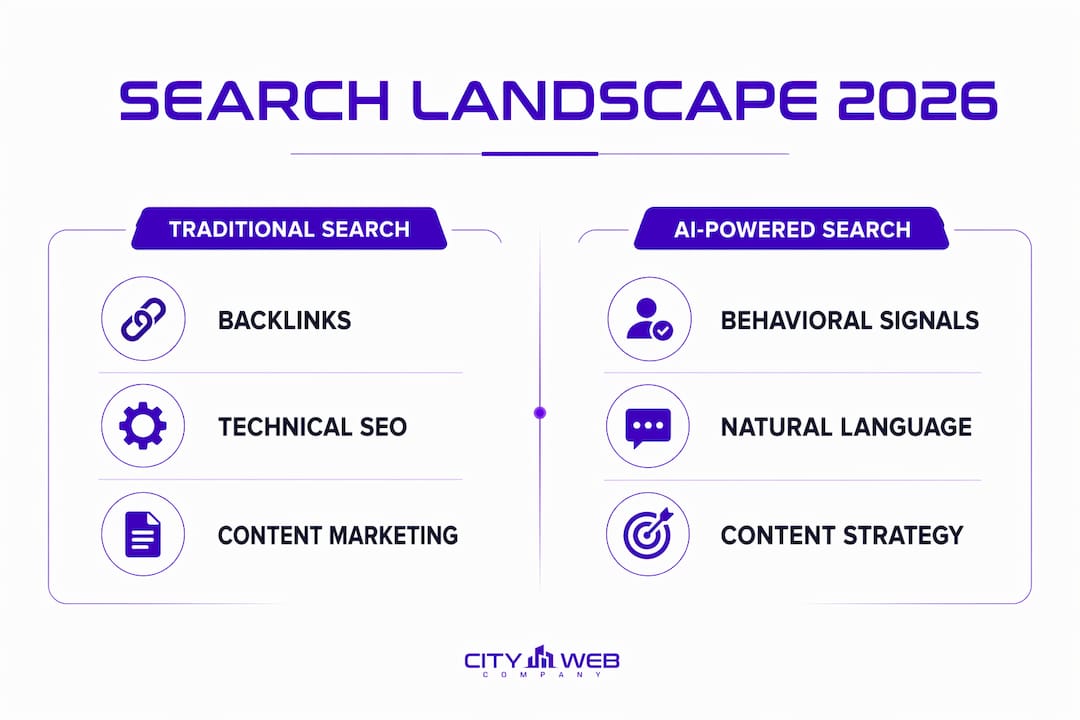

This split creates a real planning problem. Your content strategy must now account for both surfaces simultaneously. That means auditing your existing content to identify which pieces serve traditional search and which serve AI-driven queries. A service page optimized for “HVAC repair near me” satisfies commercial intent for Google. A detailed guide explaining how to diagnose a failing capacitor satisfies the topical depth that AI engines reward. Both types of content belong in your plan.
| Search surface | Primary ranking signals | Content type that wins |
|---|---|---|
| Traditional search (Google) | Backlinks, technical SEO, commercial intent | Service pages, location pages, review-rich content |
| AI-driven search | Topical depth, author credibility, query resolution | In-depth guides, FAQs, expert-authored articles |
The practical implication is that your editorial calendar needs two tracks. One track produces content that earns links and ranks for high-intent local queries. The other produces content that demonstrates genuine expertise and answers the specific questions your customers type into AI tools. Understanding how AI shapes content strategy is no longer optional for local marketers. It is a core planning requirement.
Pro Tip: Run a simple audit: take your top 10 existing pages and ask whether each one resolves a specific question completely. If a reader still needs to search elsewhere after reading it, the page fails the AI search standard.
Local service businesses that address both search surfaces in their content plans will build search rankings that matter across every platform where their customers are looking.
Why is content strategy essential for local service businesses?
The primary case for content strategy is waste prevention. Without a strategy, content defaults to intuition, and intuition-driven content rarely supports revenue or retention goals. A landscaping company that publishes “spring lawn care tips” every april because it feels seasonal is not operating from strategy. It is guessing.
Here is what a documented content strategy prevents and enables for local service businesses:
-
Prevents the content pile problem. Most local businesses accumulate content over time with no coherent structure. Old blog posts contradict newer ones. Service pages overlap. No single piece of content clearly owns a topic. A strategy defines what content must exist and what it must achieve, so every new piece has a purpose.
-
Aligns content with lead generation goals. A moving company’s content strategy should map directly to the questions people ask before booking a move: How much does it cost? How far in advance should I book? What should I do with items movers won’t take? Each piece of content targets a specific stage of the buying decision, not a general topic.
-
Builds topical authority unique to your market. A disaster restoration company in a specific region can own the topic of water damage recovery for that area. That ownership comes from publishing a connected body of content that covers the topic more completely than any competitor. Strategy creates that connection. Random publishing does not.
-
Improves efficiency across campaigns. When your content strategy is documented, every team member, freelancer, or agency partner knows what to produce and why. You stop briefing the same concepts repeatedly. You stop publishing content that duplicates existing pages. You stop paying for content that serves no defined goal.
The content marketing workflow for local service businesses runs far more efficiently when it is governed by a documented strategy. The time savings alone justify the upfront investment in planning.
How to develop an effective content strategy for local service businesses
Building a content strategy is not a one-afternoon exercise. It requires six documented artifacts that function as your governance framework.
A successful content strategy includes these specific artifacts:
- Positioning statement: A single, clear declaration of who you serve, what you offer, and why your brand is the right choice. This is not your tagline. It is the internal compass that every piece of content must align with.
- Content model: The types of content your brand will and will not produce. A med spa might commit to educational video, before-and-after case studies, and FAQ articles. It will not produce opinion pieces or industry news roundups.
- Taxonomy: The topic categories and tags that organize your content. For a plumbing company, this might include categories like water heater repair, drain cleaning, emergency services, and preventive maintenance.
- Editorial calendar: A forward-looking schedule that maps specific content pieces to audience needs, seasonal demand, and business goals. This is not a spreadsheet of deadlines. It is a strategic document that shows why each piece is being produced and when.
- Brief template: A repeatable format for briefing content creators. It includes the target audience, the specific question the content answers, the search intent, and the success metric.
- Governance RACI: A clear record of who is responsible, accountable, consulted, and informed for each content decision. This prevents the situation where content sits in review for three weeks because no one knows who has final approval.
The table below shows how each artifact connects to a business outcome:
| Artifact | Business outcome it supports |
|---|---|
| Positioning statement | Consistent brand messaging across all content |
| Content model | Focused production that matches audience preferences |
| Taxonomy | Topical authority and site structure for SEO |
| Editorial calendar | Predictable lead flow aligned to seasonal demand |
| Brief template | Faster production with fewer revisions |
| Governance RACI | Reduced bottlenecks and faster publishing cycles |
Measurement turns strategy from opinion into a feedback loop. Set specific metrics for each content type before you publish. A service page should be measured by organic traffic and form submissions. A how-to guide should be measured by time on page and return visits. When you measure from the start, you learn what works and what to change. Without measurement, you are still guessing.
AI tools can accelerate content production, but they cannot replace the judgment that a documented strategy provides. Use AI to draft, research, and repurpose. Use your strategy to decide what gets produced, for whom, and why. The 2026 SEO trends that matter most for local businesses all point in the same direction: depth, credibility, and consistency win. Those qualities come from strategy, not from publishing volume.
A complete content strategy guide for 2026 will also address how to integrate your content plan with paid advertising, local SEO, and website structure. Content strategy does not operate in isolation. It connects every marketing channel into a coherent system.
Key Takeaways
A documented content strategy is the single most effective way to align content production with business goals and prevent wasted marketing spend.
| Point | Details |
|---|---|
| Strategy vs. marketing | Content strategy governs the why and what; content marketing executes the how and where. |
| ROI impact | Documented strategies deliver 33% higher ROI than undocumented approaches. |
| Dual search landscape | Modern strategies must address both traditional Google signals and AI-driven search depth requirements. |
| Six governance artifacts | A positioning statement, content model, taxonomy, editorial calendar, brief template, and governance RACI form the foundation of any working strategy. |
| Measurement is non-negotiable | Setting metrics before publishing turns content into a learning system rather than a guessing game. |
What I’ve learned about content strategy that most guides won’t tell you
The most common mistake I see local service businesses make is not the absence of content. It is the absence of conviction. They produce content, but it does not stand for anything. It reads like every other HVAC or landscaping blog on the internet because it was built around keyword lists rather than a genuine point of view.
Content strategy without a core belief system risks drifting toward sameness. In a market flooded with AI-generated content, sameness is fatal. The businesses that build lasting brand authority are the ones whose content reflects a real perspective. A pest control company that genuinely believes in integrated pest management rather than chemical-first approaches has a story to tell. That story, documented in a positioning statement and expressed consistently across every piece of content, is what separates a brand from a commodity.
The dual search landscape has also changed how I think about content depth. I used to advise clients to write for their customers first and search engines second. That advice still holds, but the definition of “writing for customers” has expanded. AI search engines surface content that resolves a query completely. That means a 300-word service page is no longer enough. Your content must answer the question, address the follow-up questions, and provide enough context that a reader does not need to search again. That is not just good SEO. That is good content.
My practical advice for local marketers: start with the governance RACI before you write a single word. Knowing who approves content, who briefs it, and who measures it will save you more time than any content tool on the market. Strategy is a decision-making system. Build the system first.
— Matt
How City Web Company helps local businesses build content that drives real leads
City Web Company works with local service businesses across industries including home services, pest control, HVAC, and disaster restoration to build content programs that generate measurable results.
The team at City Web Company connects content strategy directly to local lead generation, ensuring that every piece of content serves a defined business goal. From positioning and editorial planning to SEO execution and performance measurement, City Web Company provides the full framework that local businesses need to compete in both traditional and AI-driven search. If your content is not generating calls and form submissions, the problem is almost always a strategy gap, not a content volume gap. City Web Company can help you close it.
FAQ
What is content strategy in simple terms?
Content strategy is the documented plan that defines what content your brand creates, who it serves, and what business goal each piece must achieve. It is the governance layer that sits above content production.
How does content strategy differ from content marketing?
Content strategy governs the why, who, and what of your content program. Content marketing executes the distribution, SEO, and social tactics that get that content in front of your audience.
Why do local service businesses need a content strategy?
Without a documented strategy, content production defaults to guesswork and fails to support revenue goals. A strategy aligns every piece of content with specific business outcomes like booked appointments and inbound calls.
What are the core elements of an effective content strategy?
An effective content strategy includes six artifacts: a positioning statement, content model, taxonomy, editorial calendar, brief template, and governance RACI. Together, these create a repeatable system for consistent content production.
How does content strategy support SEO for local businesses?
A documented content strategy builds topical authority by creating a connected body of content that covers a subject more completely than competitors. That depth satisfies both Google’s ranking signals and AI-driven search platforms that evaluate query resolution and author credibility.
Recommended
These articles were popular with other readers too: