

Use website DNI, connect call reports to Google Ads and your Google Business Profile, then tie calls to booked jobs. City Web Company can handle setup.
SEO Checklist for Home Services: Rank Higher in 2026
An effective SEO checklist for home services is a step-by-step framework that ensures your business website and online presence are fully optimized to attract local customers and rank higher on search engines. Local SEO, the recognized industry term for this practice, covers everything from your Google Business Profile to your website’s technical health. Home service businesses that follow a structured local SEO checklist consistently outperform competitors who treat search visibility as an afterthought. This guide walks you through every critical step, from Google Business Profile setup to review velocity management, so you can attract more calls, more bookings, and more revenue.
Table of Contents
How to optimize your Google Business Profile for maximum local SEO impact
Your Google Business Profile (GBP) is the single most powerful tool in your local SEO arsenal. Getting it right is not optional. The primary GBP category accounts for 14% of local ranking weight, making it the biggest single signal Google uses to decide where you show up. Choose the most specific category available. “Plumber” beats “Home Services.” “HVAC Contractor” beats “Contractor.”
Here is a numbered checklist to get your GBP fully optimized:
- Select your primary and secondary categories carefully. Pick the most specific primary category for your core service. Add secondary categories for every additional service you offer, such as drain cleaning or water heater installation.
- Complete every field in your profile. Fill in your business name exactly as it appears on your website, your service area (not a physical address if you go to customers), phone number, hours, and business attributes like “free estimates” or “veteran-owned.”
- Add 10 or more high-quality photos. Photos of your team, trucks, and completed work outperform stock images. They build authenticity and contribute directly to ranking signals and conversion rates.
- Configure your service area correctly. If you do not have a customer-facing storefront, do not display a physical address. Instead, specify the cities and zip codes you serve. Incorrect setup triggers penalties and reduces local relevance.
- Post to your GBP weekly. Share seasonal promotions, completed projects, or tips. Google treats active profiles as more relevant than dormant ones.
- Pre-populate your Q&A section. Write the questions customers ask most often and answer them yourself. This controls the narrative and fills your profile with keyword-rich content.
Pro Tip: Set a recurring calendar reminder every Monday to post one update to your GBP. Consistency over 90 days produces measurable ranking improvements.
What website structure and content strategies best support home service SEO?
Your website architecture determines how well Google understands what you do and where you do it. A flat, generic site with one “Services” page will never compete with a site built around individual service pages and location-specific content.

The core principle is simple: one page per service, one page per city. A plumbing company serving three cities with five services needs 15 dedicated pages, not one page that mentions all of them. Each page targets a specific keyword combination like “water heater repair in Denver” and delivers content written for that exact audience.
Building pages that rank without penalties
City and neighborhood service pages require at least 250–300 words of unique local content to avoid Google’s doorway page penalty. Generic pages that swap only the city name get filtered out of search results. The fix is to include local landmarks, climate references, and neighborhood-specific details. A roofing company in Phoenix should mention monsoon season. A landscaper in Minneapolis should reference frost dates.
Here are the content and technical elements every page needs:
- Title tag: Include the primary keyword and city name within 60 characters. Example: “Drain Cleaning in Austin, TX | [Your Business Name].”
- Meta description: Write 150–160 characters that describe the service, mention the city, and include a call to action.
- H1 heading: Match the page’s primary keyword naturally. One H1 per page only.
- Body content: 300 or more words of unique, locally relevant text. Mention specific neighborhoods, local landmarks, or regional conditions.
- LocalBusiness and Service schema markup: Adding structured data to every service and location page helps Google understand your offerings and can unlock rich search result features like star ratings and service lists.
- Mobile performance: 76% of local searches happen on mobile, and pages must load in under 3 seconds. Include a click-to-call button above the fold on every page.
| Page element | Minimum requirement | Why it matters |
|---|---|---|
| Unique body content | 300 words per page | Prevents doorway page penalties |
| Title tag length | Under 60 characters | Displays fully in search results |
| Page load speed | Under 3 seconds | Required for mobile ranking and conversions |
| Schema markup | LocalBusiness + Service | Improves Google’s understanding of your services |
| Click-to-call button | Above the fold | Converts mobile visitors into phone leads |
How to leverage reviews and citations to build local authority and trust
Reviews are not just a trust signal for customers. They are a direct ranking factor. Review velocity, meaning the number of new reviews you collect in the last 90 days, and your owner response rate both influence where you appear in local search results. A business with 50 reviews collected over five years ranks below a competitor with 20 reviews collected in the last three months.
The most effective review acquisition method is the immediate post-service ask. Send an SMS within 30 minutes of completing a job. The customer’s satisfaction is at its peak, and the request feels natural rather than intrusive. Keep the message short and include a direct link to your Google review page.
Here is how to build a review and citation strategy that compounds over time:
- Ask every customer, every time. Do not cherry-pick. Consistent volume matters more than selective outreach.
- Respond to every review, positive and negative. Responding personally to negative reviews and resolving issues privately reduces public damage and improves your overall rating trajectory.
- Filter negative feedback offline. Send a satisfaction check via SMS immediately after service. If the response signals dissatisfaction, call the customer before they post publicly. This keeps your public ratings high without suppressing legitimate feedback.
- Build consistent NAP citations. Your Name, Address, and Phone number must match exactly across every directory. Even minor inconsistencies like “St.” versus “Street” confuse search engines and dilute your local authority.
- List your business on major and niche directories. Start with Google, Yelp, BBB, and Angi. Then add industry-specific directories relevant to your trade. Local citations from trusted directories increase your local authority and ranking potential.
Pro Tip: Create a saved SMS template on your phone that includes your Google review link. After every completed job, send it before you leave the driveway. This single habit can double your monthly review count within 60 days.
What tools and ongoing practices help monitor and improve your home services SEO?
SEO is not a one-time project. It is a monthly practice. The businesses that dominate local search results are the ones that track their performance, find problems early, and fix them before competitors do.
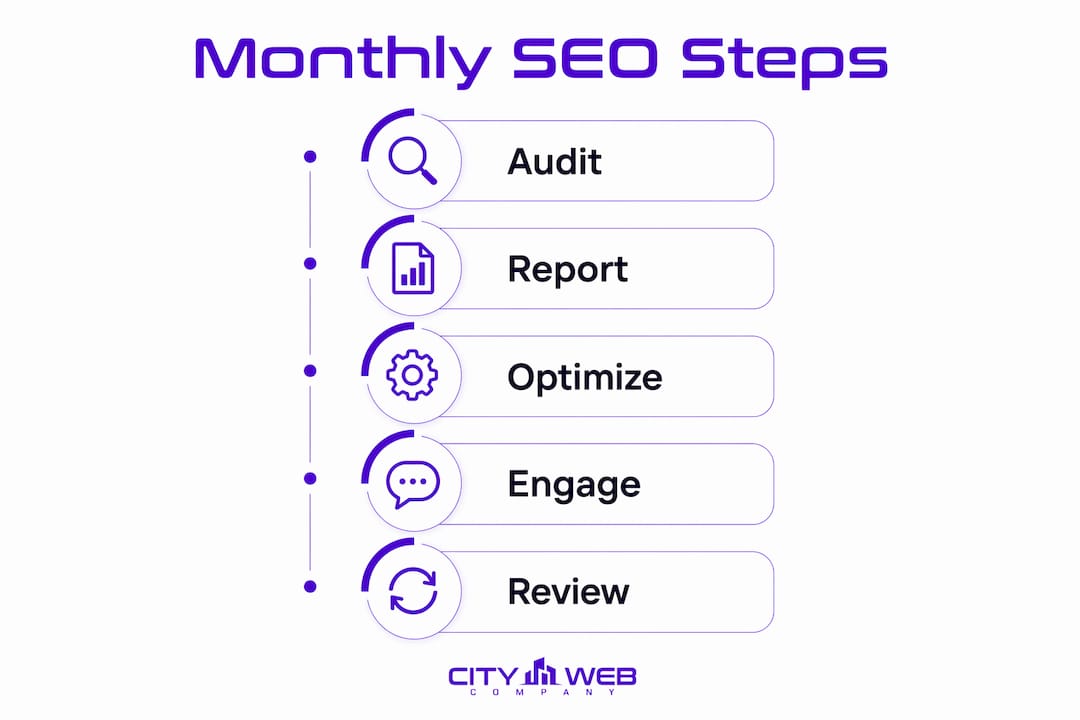

Regular SEO audits using professional tools identify issues in website speed, schema errors, content duplicates, and GBP inconsistencies. Finding and fixing one technical error, like a broken service page or a mismatched phone number, can produce a measurable ranking improvement within weeks.
Monthly SEO monitoring checklist
Follow this process every month without skipping steps:
- Run a website audit. Use a professional SEO audit tool to check for broken links, slow pages, missing schema, and duplicate content. Address any critical errors within 48 hours.
- Check your GBP insights. Review how many searches triggered your profile, how many people clicked for directions, and how many called directly. Declining numbers signal a problem worth investigating.
- Track your keyword rankings. Monitor your position for your top 10 to 20 target keywords. A drop of five or more positions on a key term warrants a content review.
- Review your citation consistency. Audit your NAP data across your top 20 directory listings quarterly. Correct any discrepancies immediately.
- Analyze your review metrics. Track your monthly review count, average star rating, and response rate. If your review velocity drops, reactivate your post-service SMS campaign.
- Build one new local link per month. Sponsor a local event, join your city’s chamber of commerce, or contribute a guest article to a local news site. Each relevant local backlink increases your domain authority in your service area.
The tools that support this process include Google Search Console for tracking organic traffic and indexing issues, Google Analytics 4 for understanding how visitors behave on your site, and your GBP dashboard for monitoring profile performance. Pair these free tools with a paid audit platform for deeper technical analysis.
Key Takeaways
A home service business that combines Google Business Profile optimization, locally specific content pages, consistent NAP citations, and active review management will outrank competitors who treat SEO as a one-time task.
| Point | Details |
|---|---|
| GBP category selection | The primary category carries 14% of local ranking weight; choose the most specific option available. |
| Local content depth | Each city or service page needs 300 or more words of unique, locally relevant content to avoid penalties. |
| Review velocity | New reviews collected in the last 90 days matter more than your total review count. |
| NAP consistency | Even minor address format differences across directories harm local search rankings. |
| Monthly audits | Regular SEO audits catch speed issues, schema errors, and GBP inconsistencies before they cost you rankings. |
What I’ve learned after years of watching home service SEO succeed and fail
Most home service businesses approach SEO the same way they approach a one-time repair: fix it once and forget it. That mindset is the single biggest reason good contractors with great reputations get buried on page three while less experienced competitors rank at the top.
The businesses I’ve seen win consistently share one trait. They treat their SEO checklist as a living document, not a completed task. They update their city pages when they expand into new neighborhoods. They respond to reviews within 24 hours. They check their GBP insights every month the same way they check their bank account.
The tactic that surprises most business owners is review velocity. They assume their 4.8-star rating from 200 reviews is an asset. It is, but a competitor with 30 reviews collected in the last 60 days will often outrank them in the local pack. Recency signals freshness and activity to Google. A business that stopped collecting reviews six months ago looks dormant, regardless of its total count.
Generic SEO checklists pulled from broad marketing blogs will not move the needle for a plumber in Tulsa or a landscaper in Charlotte. The checklist has to reflect your specific service area, your specific trade, and the specific search behavior of your local customers. That means city-specific pages with real local references, not templates with the city name swapped in. It means building citations on directories your competitors have not found yet. It means knowing that your GBP photo of a completed bathroom remodel in a recognizable local neighborhood will outperform a stock image every single time.
SEO for home services is not complicated. It is just specific, consistent, and ongoing. The contractors who commit to that reality are the ones who stop paying for leads and start receiving them.
— Matt
How City Web Company helps home service businesses rank and grow
Home service businesses that want to move faster than a monthly DIY checklist allows have a clear path forward. City Web Company builds and manages local SEO for home services from the ground up, covering Google Business Profile optimization, city-specific content pages, citation building, and review strategy.
The team at City Web Company specializes in the trades and service industries, which means your SEO strategy reflects how real customers in your area actually search. From HVAC companies to landscapers to restoration contractors, City Web Company delivers digital marketing for local leads that produces measurable results. If your phone is not ringing at the volume your business deserves, the checklist above is the starting point and City Web Company is the team that executes it.
FAQ
What is the most important part of a home service SEO checklist?
Google Business Profile optimization is the highest-impact starting point. The primary GBP category alone accounts for 14% of local ranking weight, making it the single most influential signal in local search.
How many words does a local service area page need?
Each city or neighborhood service page needs at least 250–300 words of unique local content. Pages with less content or only minor city-name changes risk being filtered out as doorway pages.
How do reviews affect home service SEO rankings?
Review velocity, meaning new reviews collected in the last 90 days, and owner response rate both directly influence local rankings. A steady stream of recent reviews signals an active, trustworthy business to Google.
What does NAP consistency mean for local SEO?
NAP stands for Name, Address, and Phone number. These details must match exactly across every online directory. Even small differences like “Ave” versus “Avenue” can confuse search engines and reduce your local ranking authority.
How often should a home service business audit its SEO?
A full SEO audit should happen monthly. Monthly checks on GBP insights, keyword rankings, citation accuracy, and review metrics catch problems early and keep your local visibility growing steadily.
Recommended
These articles were popular with other readers too: