

Discover 15 effective ways to improve online visibility in 2026. Boost your SEO, social media, and ads for rapid growth!
The Role of Brand Promotion in Business Growth
Brand promotion is the coordinated set of activities a business uses to build awareness, establish trust, and create customer preference that compounds into revenue over time. It is distinct from product advertising, which focuses on a single offer or transaction. The role of brand promotion operates at a higher level. It shapes how customers feel about your business before they ever need to buy. Research confirms that strong brand investment can deliver marketing efficiency gains of up to 30% and incremental revenue growth of up to 10% without increasing overall budgets. For marketing professionals and small business owners, that is not a soft benefit. It is a measurable return on a long-term asset.
Table of Contents
What is the role of brand promotion in business strategy?
Brand promotion is the engine that converts market presence into competitive advantage. Without it, even a well-run business competes on price alone. With it, you build something competitors cannot copy overnight: a reputation.

Building identity and emotional connection
Brand identity is the sum of what customers think, feel, and remember about your business. Promotion is the mechanism that shapes those perceptions consistently over time. A plumbing company that runs the same visual identity across its trucks, website, and social media creates recognition. That recognition lowers the mental effort a customer needs to choose you when a pipe bursts at 11 p.m.
Emotional connection goes deeper than recognition. Customers who feel aligned with a brand’s values are more likely to return and refer others. Brand promotion transforms marketing from a short-term acquisition cost into a long-term revenue engine by turning buyers into loyal advocates. That shift from buyer to advocate is where real growth compounds.
Competitive differentiation and pricing power
Strong brand equity reduces price sensitivity. When customers trust your brand, they are less likely to switch to a cheaper competitor. Brand equity enables pricing power by reducing price elasticity, allowing businesses to charge premiums and resist market turbulence. A landscaping company with a recognizable brand and consistent five-star reputation can charge more than an unknown competitor with identical services.
“Brand investment should be viewed as a capital investment creating a defensive asset that is difficult for competitors to replicate.”
This framing matters for small business owners who hesitate to invest in branding. It is not a cost. It is a barrier that protects your margins.
Mental availability and sales funnel efficiency
Mental availability is the likelihood that a customer thinks of your business when a purchase need arises. Brand promotion builds that mental availability through repeated, consistent exposure. A pest control company that runs seasonal social media content, sponsors local events, and maintains a clean Google Business Profile stays top of mind. When a homeowner spots a termite, that company gets the call.
The sales funnel becomes more efficient when brand promotion does its job. Leads arrive warmer. Conversion rates improve. Customer acquisition costs drop because you are not starting from zero with every prospect.
How does brand promotion improve marketing efficiency and revenue?
The financial case for brand promotion is stronger than most small business owners realize. The numbers are specific, and the mechanisms are well understood.
Quantified efficiency gains
Strong brand investment delivers marketing efficiency gains of up to 30% and incremental top-line revenue growth of up to 10%. That means a business spending $100,000 on marketing can effectively perform like one spending $130,000, without adding budget. The efficiency gain comes from lower customer acquisition costs, higher conversion rates, and better retention.
B2B companies with strong brand identity outperform weak-brand competitors by 20% in market performance. This is a critical finding for service businesses that sell to other businesses, such as commercial HVAC contractors or disaster restoration companies working with property managers.
The media discount effect
Recognized brands pay less for digital advertising. Strong brands enjoy higher click-through rates and lower digital advertising costs, a phenomenon known as the “media discount.” When your brand name appears in a Google Ads result, familiar prospects click more often. That higher click-through rate improves your Quality Score, which directly lowers your cost per click. Brand promotion and paid advertising are not separate budgets competing for resources. They are multipliers of each other.
Social engagement as a retention driver
38% of consumers say direct interaction with brands on social media is a primary factor driving repeat purchases. That is not a passive benefit. It means responding to comments, sharing customer stories, and posting content that reflects your brand’s personality directly influences whether customers come back. For a local med spa or moving company, social media is not just awareness. It is a retention channel.
| Benefit | Mechanism | Business Impact |
|---|---|---|
| Marketing efficiency | Lower acquisition costs, higher conversion | Up to 30% efficiency gain |
| Revenue growth | Stronger retention and referral rates | Up to 10% incremental revenue |
| B2B performance | Brand recognition in competitive bids | 20% market performance advantage |
| Media discount | Higher CTR, lower CPC in paid ads | Reduced advertising spend |
| Pricing power | Reduced price sensitivity among loyal customers | Higher margins, premium positioning |
What is the right balance between brand promotion and performance marketing?
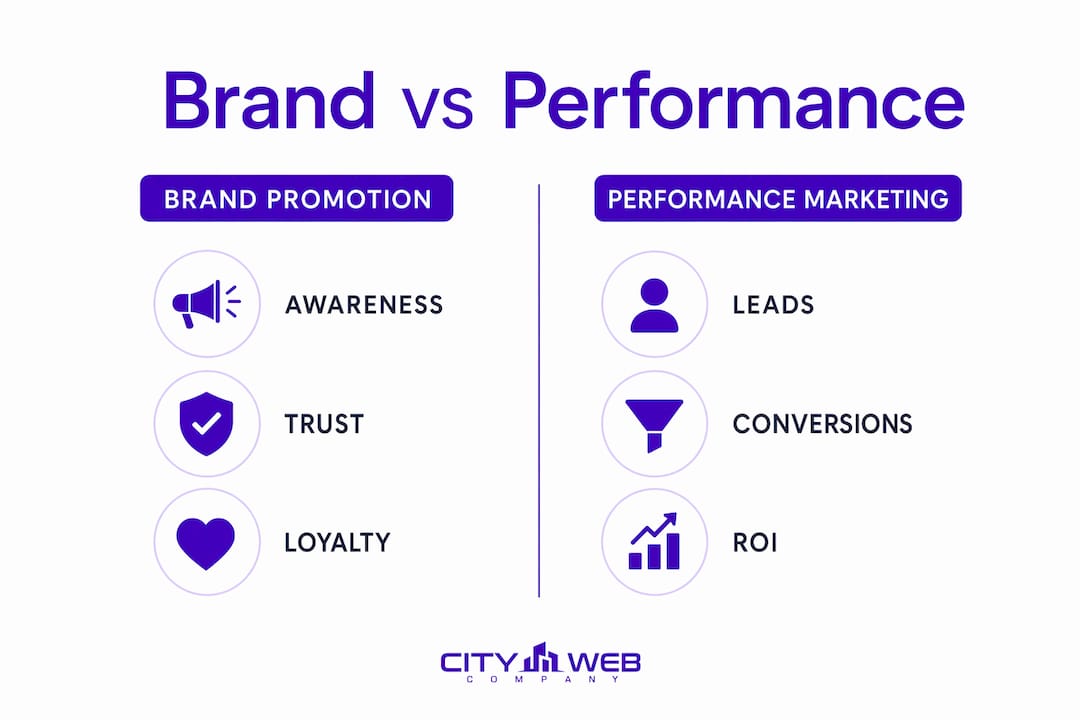
Brand promotion and performance marketing serve different functions. Performance marketing, which includes Google Ads, paid social, and retargeting, drives immediate conversions. Brand promotion builds the conditions that make those conversions cheaper and more frequent. The mistake most small businesses make is treating them as alternatives rather than partners.
How the budget split works
Experts recommend a 60/40 split in consumer industries, allocating 60% of marketing resources to brand-building and 40% to performance tactics. For B2B service businesses, the recommended split shifts closer to 45% brand and 55% performance, reflecting longer sales cycles and the importance of direct lead generation.
The 60/40 framework is not arbitrary. It reflects decades of research on how brand equity accumulates and decays. Brands that spend heavily on performance marketing while neglecting brand investment see diminishing returns over time. Their ads become less effective as brand recognition fades.
The risks of underinvesting in brand promotion
Businesses that rely entirely on performance marketing face a specific vulnerability. When ad spend drops, so does revenue. There is no residual brand equity to carry them through a slow period. A home services company that built its customer base entirely through Google Ads has no floor when ad costs rise or competition increases.
Brand marketing builds mental availability and familiarity that consumers draw on at purchase moments. Performance marketing captures demand. Brand promotion creates it. Both are necessary, but only one builds a durable asset.
Pro Tip: If you are unsure where to start with budget allocation, audit your current spend first. If more than 80% goes to direct response tactics, your brand is likely underinvested. Redirect a portion toward content, social presence, and visual consistency before scaling ad spend further.
Here is a practical framework for thinking about the split:
- Audit your current marketing spend and categorize each line item as brand-building or performance-driven.
- Calculate what percentage of your budget currently goes to each category.
- If brand-building is below 40%, identify one or two low-cost brand channels to activate, such as organic social or content marketing.
- Set a 90-day goal to shift the ratio by 10 percentage points toward brand investment.
- Measure the downstream effect on conversion rates and cost per lead from your performance channels.
How can small businesses implement brand promotion strategies effectively?
Small businesses face a specific challenge with brand promotion. Resources are limited, and the pressure to show immediate ROI is real. The solution is not to spend more. It is to spend consistently and across the right channels.
Consistency across every touchpoint
Brand promotion must be consistent across all channels. Failure to synchronize online and offline experiences wastes promotional budgets. A landscaping company with a polished website but unmarked trucks and no social presence sends mixed signals. Customers notice the gap, even if they cannot articulate it.
Consistency means the same logo, colors, tone of voice, and core message appear everywhere: your website, your vehicles, your invoices, your social profiles, and your customer service interactions. This is not about perfection. It is about coherence. A multi-channel marketing approach ensures your brand message reaches customers at multiple points without contradicting itself.
Pro Tip: Conduct a brand audit once per quarter. Pull up your website, your most recent social posts, and a photo of your physical presence side by side. If they do not look like they belong to the same business, that is the gap costing you conversions.
Leveraging social media for retention
Social media is the most cost-effective brand promotion channel available to small businesses. It does not require a large budget. It requires consistency and genuine engagement. Post content that reflects your expertise, your team, and your values. Respond to every comment and review. Share customer success stories with permission.
The 38% of consumers who cite social interaction as a driver of repeat purchases are not responding to ads. They are responding to presence. A pest control company that posts seasonal tips, answers questions publicly, and celebrates customer milestones builds a community. That community is a retention asset.
Integrating brand with customer experience
The most overlooked aspect of brand promotion is the customer experience itself. Every interaction a customer has with your business is a brand moment. A clean, professional service visit reinforces the brand. A slow response to a complaint damages it. Aligning offline experiences such as in-store visits and customer service with online messaging is the difference between a brand that grows and one that stagnates.
Small businesses that use custom promotional products as part of their brand promotion mix extend their visibility into customers’ daily lives. A branded pen, hat, or tote bag keeps your name in front of customers between service visits. It is a low-cost, high-frequency touchpoint that reinforces recognition.
- Align your visual identity across your website, vehicles, uniforms, and printed materials.
- Post consistently on at least one social platform where your customers are active.
- Respond to every Google review, positive or negative, within 24 hours.
- Use branded merchandise at community events, trade shows, or as customer thank-you gifts.
- Train your team to deliver a consistent customer experience that matches your brand’s promise.
Key Takeaways
Brand promotion is the single most durable investment a small business can make because it builds equity that compounds over time, lowers acquisition costs, and protects margins against price competition.
| Point | Details |
|---|---|
| Brand promotion drives efficiency | Strong brand investment delivers up to 30% marketing efficiency gains without increasing budgets. |
| Balance brand and performance spend | A 60/40 brand-to-performance split is recommended for consumer industries to sustain long-term growth. |
| Social engagement retains customers | 38% of consumers cite direct brand interaction on social media as a key driver of repeat purchases. |
| Consistency prevents wasted spend | Synchronizing online and offline brand experiences is required to avoid budget waste. |
| Brand equity is a financial asset | Strong brands reduce price elasticity, earn a media discount on ads, and outperform competitors in market performance. |
Why brand promotion deserves more credit than it gets
Most small business owners I work with treat brand promotion as a luxury. They see it as something large companies do with large budgets. That framing is wrong, and it costs them money every year.
The businesses I have seen grow most consistently are not the ones with the biggest ad budgets. They are the ones that show up the same way every time. Same logo, same tone, same quality of service. Their customers recognize them, trust them, and refer them. That consistency is brand promotion. It does not require a national campaign. It requires discipline.
The hardest conversation I have with clients is about ROI timelines. Performance marketing shows results in days. Brand promotion shows results in quarters. That gap makes brand investment feel risky to a business owner watching monthly revenue. But the businesses that cut brand investment to fund more ads almost always regret it within 18 months. Their ad costs rise, their conversion rates drop, and they have no equity to fall back on.
The other misconception I see constantly is that brand promotion and branding strategy are the same thing. Branding strategy is the plan. Brand promotion is the execution. You need both, but execution without strategy produces inconsistency, and strategy without execution produces nothing.
My honest advice: start with consistency before you start with scale. Get your visual identity right. Get your message clear. Then promote it everywhere, repeatedly, and patiently. The compounding effect is real, and it is worth the wait.
— Matt
How City Web Company supports your brand promotion goals
Building a recognizable brand takes more than a good logo. It takes coordinated digital marketing across every channel where your customers spend time.
City Web Company works with local service businesses to build the kind of brand presence that generates leads and keeps customers coming back. From local lead generation through SEO and paid advertising to custom promotional merchandise that keeps your name in front of customers, City Web Company builds the full picture. If your brand promotion efforts feel scattered or are not producing measurable results, the digital marketing services at City Web Company are built to fix that. Reach out to see how a coordinated approach can turn your brand into your strongest growth asset.
FAQ
What is the role of brand promotion in marketing?
Brand promotion builds awareness, trust, and customer preference over time. It creates the conditions that make performance marketing more effective and customer acquisition less expensive.
How does brand promotion differ from advertising?
Advertising promotes a specific product, offer, or call to action. Brand promotion builds the overall identity and reputation of a business, which supports all advertising efforts over the long term.
What budget split should small businesses use for brand vs. performance marketing?
Experts recommend allocating 60% of marketing resources to brand-building and 40% to performance tactics in consumer industries. B2B businesses typically use a 45/55 split favoring performance.
How does social media support brand promotion for small businesses?
Direct brand interaction on social media drives repeat purchases for 38% of consumers. Consistent posting, engagement, and community building on social platforms are cost-effective brand promotion tactics for small businesses.
How long does it take for brand promotion to show results?
Brand promotion builds equity over months and quarters, not days. Businesses that invest consistently in brand-building typically see compounding returns in lower acquisition costs, higher conversion rates, and stronger customer retention within 12–18 months.
Recommended
These articles were popular with other readers too: