

Pass Google Business verification with a video-first checklist. Film one continuous 30 second take, fix flagged issues, and know when to hire help.
Small Business Website Cost in 2026: A Budgeting Guide
Most small businesses should plan to spend somewhere between $500 and $10,000 to get a professional website live, with $3,000 to $5,000 covering the sweet spot for a service business that wants custom branding without agency-level fees. If you’re weighing options, a DIY builder can get you online for under $450 in year one, while a full agency build runs $10,000 to $35,000 or more. Add a moderate contingency on top of your quote, because line items like stock photography, extra plugins, or a rush timeline often appear after the quote is signed.
Here’s the breakdown by approach:
- DIY/SaaS builder: $200 to $600 per year, live in days
- WordPress (self-managed): $300 to $1,200 first year, live in one to three weeks
- Freelancer: $3,000 to $5,000, live in three to six weeks
- Agency: $5,000 to $25,000+, live in six to twelve weeks
Quick take: for most local service businesses generating steady revenue, a freelancer or small agency build in the $3,000 to $10,000 range delivers the best balance of custom branding and long-term cost control, according to pricing data compiled across small business projects.
Table of Contents
Key Takeaways
A properly budgeted small business website costs $3,000 to $10,000 upfront for most service businesses, plus 10% to 20% contingency and an ongoing maintenance or SEO plan to protect that investment long-term.
| Point | Details |
|---|---|
| Budget by tier | DIY runs $200 to $600/year, freelancer $3,000 to $8,000, agency $5,000 to $25,000+. |
| Add contingency | Set aside 10% to 20% above any quote for plugins, photography, or timeline changes. |
| Total cost of ownership matters more than build price | A $3,000 build plus $100/month running costs totals roughly $9,000 over five years. |
| Vet every quote | Ask about asset ownership, post-launch support, and billing terms before signing. |
| Pair design with marketing | City Web Company bundles website builds with local SEO and paid media so the site actually generates leads. |
Table of Contents
- What Does a Small Business Website Cost by Build Path?
- How Much Do Individual Website Line Items Cost?
- What’s the Real Long-Term Cost of Owning a Website?
- How Do I Choose a Budget and Avoid Bad Quotes?
- What Do City Web Company Clients Actually Get?
- Does Your Location Change What You’ll Pay?
- A Practical Take on Budgeting for a Website in 2026
- Ready to Get a Website That Actually Generates Leads?
- Sources
- FAQ
What Does a Small Business Website Cost by Build Path?
The path you choose determines both your upfront number and how much control you have later. Each option trades price against flexibility, and picking the wrong one for your stage of business is the single most common budgeting mistake small owners make.
SaaS DIY builders (Wix, Squarespace, Shopify) bundle hosting, templates, and basic security into one monthly fee. Entry plans run around $16 to $17 a month, with Shopify’s basic ecommerce tier starting near $29. You’ll hit a ceiling fast if you need custom functionality, and switching platforms later means starting over on design.
WordPress, self-hosted, costs almost nothing to license, but you pay in hosting, theme, and plugin fees, plus your own time. Managed WordPress hosting adds convenience and typically runs $30 to $75 a month. It’s the most flexible low-cost path, but only if you’re comfortable troubleshooting the occasional broken update.
Freelancers typically charge $3,000 to $8,000 for a 5 to 10 page professional site, according to industry-wide project pricing data. Hourly rates vary widely by experience and region, and scope creep is the biggest risk since most freelancers work solo without a project manager catching gaps.
Agencies charge $5,000 to $25,000+ because you’re paying for a team: designer, developer, project manager, and often a copywriter, working from a documented process rather than one person’s calendar.
- Define your must-have features before requesting quotes.
- Match your timeline to your build path (rushed builds cost more).
- Confirm who owns the final files and code.
Pro Tip: If you’re not sure which tier fits, ask any provider what happens when you outgrow the current setup. A vague answer is a warning sign; a clear upgrade path is not.
How Much Do Individual Website Line Items Cost?
Breaking a quote into line items is the fastest way to spot where your money is actually going, and where a provider might be padding the number.
- Domain name: $10 to $20 per year; premium or short domains can run into the hundreds.
- Hosting: shared hosting $5 to $15/month, managed WordPress $30 to $75/month, VPS $20 to $100+/month.
- Design: template customization $500 to $2,000; full custom design $3,000 to $10,000+.
- Development: custom features, booking systems, or CRM integrations typically add $1,000 to $5,000+ depending on complexity.
- Plugins/apps: premium plugins commonly cost $50 to $200 per year each.
- Content and photography: professional copywriting runs $50 to $150 per page; a half-day photo shoot averages $300 to $800.
- SEO setup: basic on-page SEO during build, $300 to $1,500; ongoing SEO is a separate monthly cost.
- Security/SSL/backups: often bundled free with hosting, or $10 to $30/month as a standalone service.
The math that surprises people: a “simple” small-business site can stay under a few hundred dollars a year when you stick to essential features, but every custom feature you bolt on compounds the design and development line items simultaneously, not just one.
What’s the Real Long-Term Cost of Owning a Website?
The build price is only part of what you’ll spend. Hosting renews, plugins expire, and if you want the site to actually generate leads, someone has to maintain it and market it. A basic maintenance plan runs $50 to $200 a month for updates, backups, and uptime monitoring. Layer in SEO or marketing services and invested small businesses typically pay $500 to $2,500+ a month depending on competitiveness and market size.
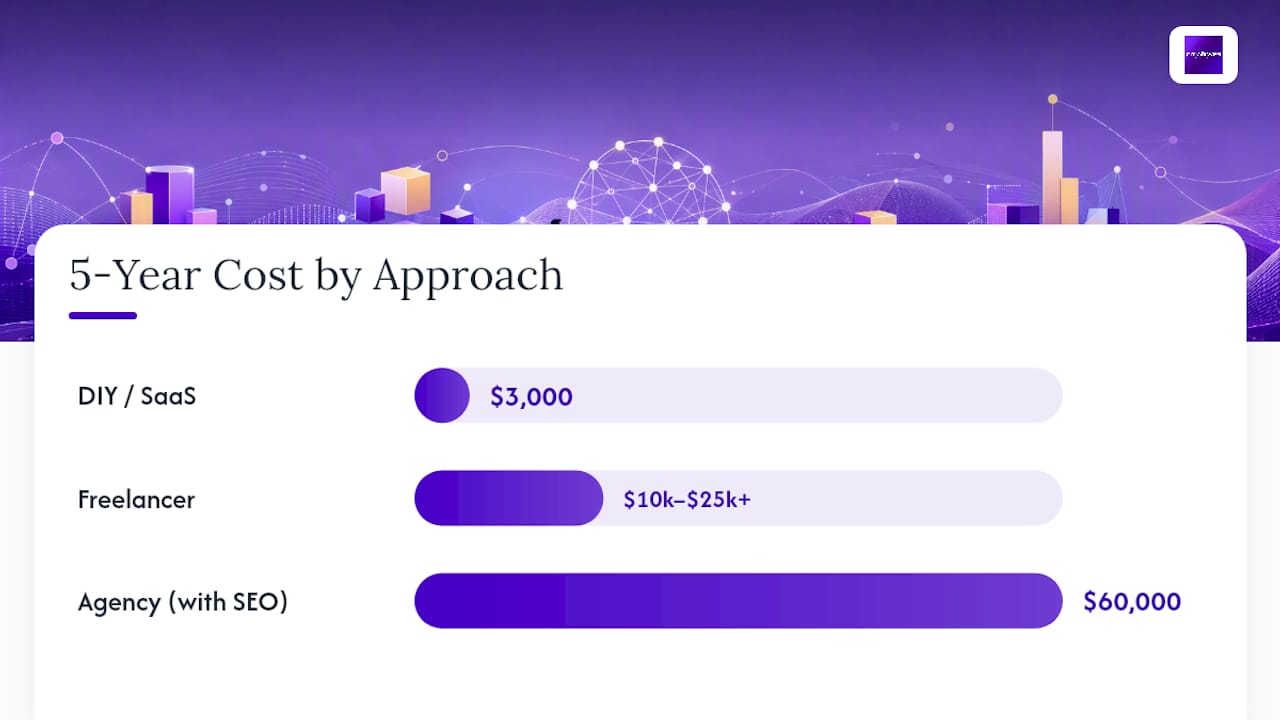
Here’s how that plays out over five years for three common paths, based on typical build and running costs:
| Approach | Year 1 build | Monthly running cost | 5-year total (approx.) |
|---|---|---|---|
| DIY/SaaS | $450 | $30 | $3,000 |
| Freelancer | $3,000 to $5,000 | $150 | $10,000 to $25,000+ |
| Agency (with SEO retainer) | $10,000 to $25,000+ | $1,000 | $60,000 |
A $3,000 build with $100 a month in running costs becomes roughly $9,000 over five years, meaning the initial build is only about a third of what you’ll actually spend. Annualizing your one-time build cost against expected revenue is the cleanest way to judge whether a quote is reasonable for your business size.
- Hosting and plugin renewals compound annually, budget for them explicitly.
- A marketing retainer is optional at launch but becomes the biggest recurring line item for growth-focused sites.
How Do I Choose a Budget and Avoid Bad Quotes?
Start with your business goals, not a price point. A site meant to generate phone calls needs different functionality (and a different budget) than a digital brochure. Ask yourself how many pages you actually need, whether you need booking or payment integrations, and how fast you need to launch.
- Ask for a written scope document listing every deliverable, not just “a website.”
- Ask who owns the final assets (domain, code, design files) after the project ends.
- Ask about testing and post-launch support, including how bugs are handled in the first 30 to 90 days.
- Ask about billing terms upfront versus milestone-based versus monthly retainer.
- Compare at least two quotes before committing to either a freelancer or an agency.
Red flags include a quote with no timeline attached, a price dramatically below every other bid you received, or a provider who can’t explain what’s included in “maintenance.” A rough budgeting rule many small service businesses use: allocate 2% to 5% of annual revenue toward web presence, with a practical floor around $3,000 for any site expected to actively generate leads.
Pro Tip: Get every deliverable in writing before you pay a deposit. Verbal promises about “unlimited revisions” or “free updates” rarely survive past the invoice.
What Do City Web Company Clients Actually Get?
City Web Company works with local service businesses (HVAC, plumbing, med spas, pest control, landscaping) where the website has to do one job: generate calls and booked jobs, not just look good. Project tiers scale from a focused lead-generation site through full custom builds, paired with ongoing local SEO and paid media management.
Service businesses that pair a properly built site with local SEO and Google Business Profile optimization consistently see stronger lead volume than businesses that treat the website as a one-time expense.
- Website design and development scoped to lead generation, not just aesthetics
- Local SEO and Google Business Profile management bundled at higher tiers
- Ongoing maintenance and paid media add-ons for businesses ready to scale
City Web Company generally steers service businesses toward the mid-to-upper budget tier described above, because a cheap site with no marketing plan behind it rarely produces enough leads to justify even its low cost.
Does Your Location Change What You’ll Pay?
Where you’re located shapes your website budget more than most owners expect, mainly through the cost of local labor. A freelancer or agency in a major metro area (New York, San Francisco, Chicago) commonly charges more per hour than one in a smaller city, simply because their own overhead is higher.


That said, remote work has flattened a lot of this gap. Plenty of small businesses in high-cost cities hire freelancers or small agencies based elsewhere and pay rates closer to a mid-size market average. Platform costs (hosting, domains, plugins, SaaS builder fees) stay essentially flat regardless of where your business is located, since those are set by the vendor, not your local labor market.
Where location matters more is on the marketing side, not the build side. A service business in a competitive metro area will typically need a bigger local SEO or paid advertising budget to rank and generate leads than the same business in a smaller town with less competition. If you’re comparing quotes from providers in different regions, ask what’s driving the price difference. It’s usually labor cost, not necessarily quality, but it’s worth confirming rather than assuming.
A Practical Take on Budgeting for a Website in 2026
The conventional advice to “just get a cheap site up” undersells what a website actually needs to do for a service business. A $300 DIY site with no ongoing plan behind it is fine for a hobby, but for a business that depends on phone calls and booked jobs, that same $300 site often costs more in lost leads than it saved in build fees.
Where most owners get it wrong is treating the build price as the whole budget. It’s the entry fee. The real decision is whether you’re willing to pair that build with even modest ongoing SEO or maintenance, because an unmaintained site degrades in search rankings within months.
My honest read on the data: skip the cheapest option unless your business genuinely doesn’t depend on the site for revenue, and skip the most expensive agency tier unless your lead volume already justifies it. The $3,000 to $10,000 middle ground, paired with a maintenance and SEO plan, is where nearly every service business should start.
Ready to Get a Website That Actually Generates Leads?
Freelancers and DIY builders can get you online, but neither one typically pairs the build with the local SEO and lead tracking a service business needs to turn traffic into booked jobs. City Web Company builds that combination in from day one, so you’re not paying twice, once for the site, then again for someone to fix its SEO a year later.

Engagement models scale to fit budget: a focused design and development package for businesses just getting a professional presence online, or a fuller build paired with ongoing local SEO and Google Business Profile management for businesses ready to generate consistent lead volume. Every tier includes a clear scope document and defined post-launch support, so you know exactly what you’re paying for before you sign anything.
If you’re ready to see what a properly scoped website design and development project would cost for your business, get started here and City Web Company will walk you through a tier that fits your budget and lead goals.
Sources
- How much does a small business website cost?
- Small Business Website Cost 2026 — Real Pricing Data
- How much does a website cost?
FAQ
Do I need an LLC to run a website?
No. You can legally run a business website as a sole proprietor, though forming an LLC can offer liability protection as your business grows. This is a legal structure question separate from your web hosting or domain registration.
Is $1,500 a good price for a website?
It depends on scope: $1,500 typically covers a template customization or a very basic freelancer build, which fits many small businesses fine but leaves less room for custom features or extensive content. For a lead-generating service business site with SEO built in, most budgets land higher, closer to $3,000 and up.
Is it worth making a website for a small business?
Yes, for nearly any service business, since a website is typically the first place a potential customer checks before calling. The return depends heavily on pairing the site with basic local SEO rather than treating it as a static brochure.
Why is owning a website so expensive?
The build price is only one part of the cost; hosting, plugin renewals, content updates, and marketing all add up over time. A $3,000 build easily triples in total cost over five years once you factor in ongoing hosting and maintenance.
What’s the fastest way to compare platform options before hiring anyone?
Reviewing a side-by-side platform breakdown, such as this Webflow versus WordPress comparison, helps clarify which platform fits your design flexibility and SEO needs before you request quotes from a freelancer or agency.
Recommended
These articles were popular with other readers too: