
Use website DNI, connect call reports to Google Ads and your Google Business Profile, then tie calls to booked jobs. City Web Company can handle setup.
AdWords and SEO: A Guide for Local Business Growth
Most local business owners do not have an ad problem or an SEO problem. They have a coordination problem.
One month, the phones need to ring, so budget shifts into Google Ads. The next month, ad costs feel too high, so attention swings back to SEO. What often gets missed is the system between those two decisions. That gap is where wasted spend shows up, profitable keywords get overlooked, and lead generation becomes harder than it should be.
That is why adwords and seo should not be managed like competing tactics. For a local service business, they work best as two parts of the same search strategy. One captures demand now. The other builds the asset that reduces dependence on paid traffic later.
Early on, Google proved how powerful paid search could become. Google AdWords launched on October 23, 2000 and generated $70 million in revenue in its first year, helping establish the paid search model that still shapes digital marketing today, according to Integrity Marketing’s history of SEO and AdWords. The lesson for local businesses is still relevant. Search visibility has always had two sides. Immediate access through paid placement, and lasting equity through earned presence.
Table of Contents
The Search Marketing Dilemma Most Businesses Face
A common local business pattern looks like this.
An HVAC company needs leads before the busy season. It turns on ads and gets traffic quickly. A plumbing company gets frustrated by rising cost per lead, pauses ads, and tells the team to focus on SEO. A roofer invests in blog content for months but does not know which service keywords produce jobs.
None of those decisions are irrational. They are incomplete.
Why the false choice creates waste
When ads run without feeding insight into SEO, you pay for clicks but fail to build a durable advantage.
When SEO runs without paid search data, your team can spend months trying to rank for terms that attract traffic but not revenue.
That creates two expensive outcomes:
- Paid search becomes rent. You keep paying for visibility, but nothing compounds.
- SEO becomes guesswork. Content gets published, pages get optimized, and rankings may improve, but the business lacks proof that the terms being targeted produce qualified leads.
- Reporting stays siloed. One report says clicks are up. Another says rankings improved. Neither explains whether blended acquisition cost is getting healthier.
What local owners usually feel first
You see it in day-to-day decisions.
A service manager asks why calls dropped when ad spend was cut. An owner asks why SEO is taking so long. Front desk staff report that some leads are price shoppers while others are ready to book. Marketing feels active, yet the business lacks predictability.
The core issue is not choosing Google Ads or SEO. The problem is running them without a shared strategy for lead quality, keyword learning, and long-term cost control.
That matters more in local service markets, where urgency and trust often sit side by side. Someone searching for emergency plumbing repair behaves differently from someone researching whole-home repiping. One search needs immediate capture. The other needs authority, education, and visibility over time.
What a connected approach changes
A connected search strategy treats both channels as inputs into the same business goal.
Ads help identify what people search when they are ready to act.
SEO helps build the pages, local relevance, and trust signals that keep producing traffic without ongoing click charges.
When those two pieces work together, the business stops swinging between short-term panic and long-term hope. It starts building a search engine for growth.
Understanding the Two Pillars of Search Visibility
A homeowner searches "emergency plumber near me" at 10:30 p.m. Another searches "best tankless water heater for older home" on a Saturday morning. Both are valuable searches. They are not the same opportunity, and they should not be handled by the same search tactic.
That is the practical difference between Google Ads and SEO.
Google Ads captures demand now
Google Ads, formerly AdWords, is built for speed and control. It puts your business in front of people who are actively searching, and it lets you decide where you appear, which services you promote, what message they see, and what happens after the click.
For local service businesses, that matters most when timing drives the sale. Emergency HVAC repair, same-day plumbing, garage door repair, locksmith services, and storm cleanup all have short decision windows. In those cases, waiting for organic visibility to build can mean missed calls this week.
Ads also produce faster learning. You can test service-specific headlines, offers, landing pages, and geo targeting without waiting months for rankings to settle. That makes paid search useful beyond lead generation. It is also a market testing tool. If you want a clearer picture of campaign structure, targeting, and local intent strategy, this Google Ads guide for local businesses covers the mechanics in more detail.
The trade-off is simple. Ads create visibility you rent. Once spend stops, traffic usually stops with it.
SEO builds visibility you own
SEO works on a different timeline and a different economic model. Instead of paying for each visit, you invest in the assets that help your business earn visibility over time. That includes service pages, location pages, internal linking, technical health, local signals, and the topical depth that supports trust.
For a local owner, the value is cumulative. A well-optimized page for "AC replacement in Plano" or "water heater installation in Mesa" can keep generating qualified traffic long after the original work is published. The upfront effort is higher, and the feedback loop is slower, but the long-term cost per lead often improves as those pages mature.
SEO also reaches parts of the buying process that ads do not always cover efficiently. Some searches are urgent. Others are investigative. People compare providers, research service options, check service areas, and look for proof that a company is credible before they call. Strong organic visibility supports those earlier and mid-stage searches, which often improves conversion rates later.
Search visibility is broader than rankings
Search behavior has changed. People still search on Google, but they also scan map packs, read FAQs directly in results, compare review profiles, and get quick answers without visiting many websites.
For local service businesses, that changes the job. Search marketing is no longer just about bidding on urgent keywords or chasing organic rankings in isolation. It is about occupying as much useful visibility as possible across paid listings, organic results, local map presence, and the pages that answer real service questions clearly.
That is why these two channels work best as paired systems. Google Ads tells you where immediate intent exists and which messages pull calls. SEO turns that learning into durable pages and local authority that can lower dependency on paid clicks over time.
The practical distinction
| Channel | Primary role | Best use case | Main limitation |
|---|---|---|---|
| Google Ads | Immediate demand capture | Urgent, high-intent searches | Visibility stops when spend stops |
| SEO | Long-term visibility asset | Sustainable local authority and ongoing discovery | Takes time and consistent execution |
Businesses usually get better results when they stop asking which channel is better and start assigning each one a job.
Ads help you capture demand now. SEO helps you build an asset that keeps producing later. Used together, they do more than share search real estate. They improve lead flow today while building lower-cost visibility for the months ahead.
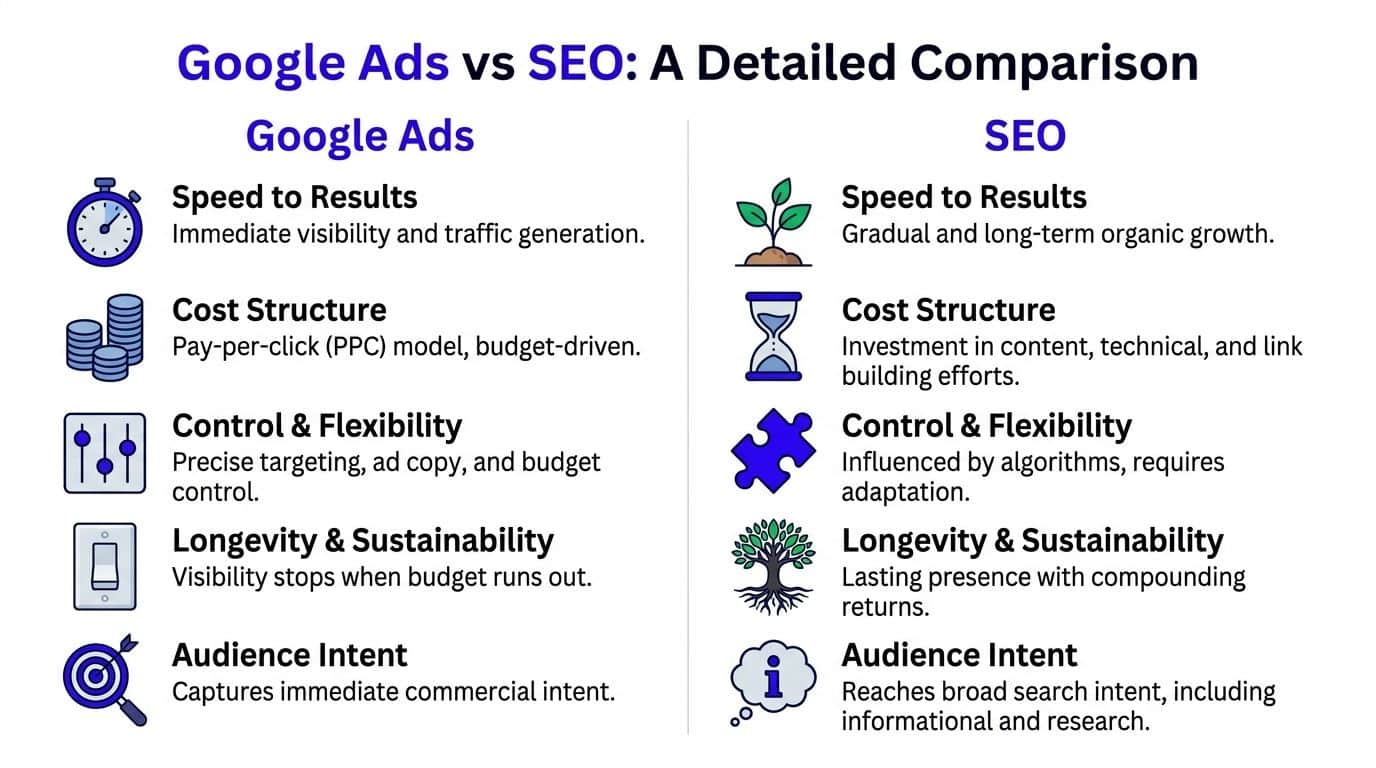
Google Ads vs SEO A Detailed Comparison
The better comparison is not which channel is better. It is which channel solves which business problem.
| Criteria | Google Ads | SEO |
|---|---|---|
| Speed | Fast visibility for active searches | Slower build, longer payoff |
| Cost model | Pay per click | Invest in site, content, technical work |
| Control | High control over targeting and messaging | Lower direct control because rankings depend on search algorithms |
| Durability | Stops when spend stops | Can continue producing leads after the work is done |
| Best fit | Immediate lead flow, testing, urgent service demand | Long-term growth, trust, lower dependence on paid media |
Speed to results
Google Ads wins on speed. If your campaign structure is sound, your landing pages are clear, and your service area targeting is tight, traffic can start as soon as campaigns go live.
SEO does not work that way. It requires page development, technical cleanup, local relevance, internal linking, and authority signals. Results build gradually.
For a company that needs booked jobs this month, ads can fill a gap that SEO cannot fill immediately. For a company trying to stop overpaying for every lead, SEO becomes the more important long-term lever.
Cost structure and economics
For Home Services, Google Ads benchmarks show an average CTR of 4.40%, CPC of $6.15, and CPA of $160.54, according to WordStream’s Google Ads industry benchmarks. Those numbers explain why many local owners feel pressure from paid search even when campaigns are working.
SEO carries a different profile. Organic results in the #1 position capture 28% of clicks, and there is no per-click fee on that traffic, based on the same WordStream benchmark source.
That does not mean SEO is free. It takes investment. But the cost logic is different. Paid search charges every time someone clicks. SEO charges upfront through work, then has the potential to keep producing after the initial effort.
If your business depends only on paid search, you are renting demand. If your business builds organic visibility around proven terms, you are turning search into an asset.
Control and targeting
Ads offer more direct control.
You can choose keywords, locations, devices, audiences, schedules, and bidding strategies. You can launch two offers and see which one pulls better lead quality. That makes Google Ads a practical testing environment. For a more tactical breakdown of campaign setup, City Web Company’s guide to Google Ads for local businesses outlines the moving parts local owners should understand before scaling spend.
SEO gives you influence, not control. You can improve content structure, page depth, Core Web Vitals, schema, internal links, and local landing pages. But you cannot force rankings. Search engines decide how much trust and relevance your site has earned.
Longevity and business stability
Here, the split becomes clear.
If you pause ads, visibility fades quickly. If you build rankings for the right service pages, those pages can keep generating calls and form submissions without paying for each visit. That is why a hybrid model matters. The same benchmark set notes that using SEO to support a paid program can lower blended customer acquisition cost over time.
The practical takeaway
Use Google Ads when the business needs speed, demand capture, offer testing, or visibility for urgent searches.
Use SEO when the business wants durable search presence, lower dependence on paid clicks, and stronger long-term economics.
Use both when you want a system instead of a cycle.
The Strategic Synergy Combining AdWords and SEO
Businesses get better results from search when paid and organic are managed as one system. For a local service company, that means using Google Ads to accelerate learning and using SEO to turn those lessons into assets that keep producing leads.

Ads reveal what SEO should prioritize
The usual problem is not a shortage of keywords. It is uncertainty about which searches produce qualified jobs.
Google Ads closes that gap faster than SEO. If a paid campaign shows that specific terms generate calls, estimate requests, or booked appointments, those terms deserve deeper SEO investment. That gives the business a clearer roadmap. Instead of publishing pages based on assumptions, you build around demand that has already shown buying intent.
The same applies to message fit. Ad testing often surfaces the angles that matter in your market. Emergency response, same-day availability, financing, warranty coverage, and reputation all influence conversion rates. Those insights should shape service page headlines, title tags, on-page copy, and call-to-action language.
Paid activity can support local organic performance
This matters most in branded search behavior, Google Business Profile engagement, and map pack visibility.
BrightEdge notes in its discussion of SEO or Google Ads that running paid local campaigns can increase overall SERP visibility and reinforce brand familiarity during repeated searches. The same source says businesses may see a 20-30% higher impression share for their Google Business Profile when paid local ads are active, according to BrightEdge’s discussion of SEO or Google Ads. It also says those engagement signals can contribute to map pack gains within 3-6 months, according to BrightEdge’s discussion of SEO or Google Ads.
For a local owner, the strategic takeaway is straightforward. Paid search can do more than fill the pipeline this month. It can also increase branded familiarity and interaction patterns that support the organic presence you want to strengthen over time.
Dual presence improves credibility at the point of choice
A homeowner searching for “water heater replacement near me” may see your ad, your organic service page, and your map listing in the same results page.
That stacked visibility changes the decision environment.
One appearance can be missed. Several coordinated appearances make the business look established, active, and relevant to the search. In local service categories, that matters because buyers often shortlist providers before they ever visit a website. More visibility across paid and organic placements can reduce hesitation and improve the odds of a call or form submission.
What breaks the compounding effect
The failure point is usually operational, not technical.
- Separate keyword strategies: The paid campaign targets high-intent service terms, while the SEO plan focuses on different queries with weaker commercial value.
- Mismatched promises: Ads highlight fast response or financing, but the landing pages and service pages do not carry the same message through to conversion.
- Split reporting: Google Ads data, Search Console data, and CRM outcomes stay in separate places, so nobody builds a shared view of cost, lead quality, and revenue.
Compounding returns come from shared intelligence. The businesses that execute this well treat adwords and seo as one search program with two jobs. One captures demand quickly. The other builds durable visibility that lowers acquisition pressure over time.
Practical Scenarios for Local Service Businesses
A local service business rarely has one kind of search buyer. On the same day, one prospect wants help in the next hour, another is comparing options for a project three months out, and a third does not yet understand why your newer service matters. The right adwords and seo plan accounts for all three.
HVAC contractor with urgent and planned demand
An HVAC company usually operates in two buying conditions.
Emergency no-cool and no-heat searches justify paid search because speed matters more than brand storytelling in that moment. The campaign should stay tight. Service-specific keywords, strict service-area targeting, call-first landing pages, and ad scheduling around response capacity all affect cost per lead.
Replacement systems, air quality upgrades, and maintenance plans behave differently. Homeowners research efficiency, pricing, warranties, and financing before they call. That is where SEO earns its keep through service pages, local proof, FAQ content, and a stronger Google Business Profile. A solid local SEO process for service-area businesses helps those pages bring in demand long after the ad spend stops.
The integration point is simple. Use Google Ads to capture breakdown-driven demand now, and use SEO to build lower-cost acquisition for the services people evaluate over time.
Multi-location dental or med spa group
A group practice needs local precision and brand consistency at the same time.
Paid search helps fill chairs fast in specific markets. It is useful for promoting higher-margin services, limited-time offers, or locations with open appointment inventory. It also gives management a fast read on which services and messages produce qualified calls instead of low-intent inquiries.
SEO carries the longer-term workload. Each location needs its own page, local reviews, provider detail, and service relevance. A single generic services page usually weakens visibility because Google has less reason to rank that business for market-specific searches. In practice, the best results come when paid search highlights short-term priorities while SEO builds location authority that reduces dependence on constant ad spend.
Home remodeling company with long sales cycles
A remodeling firm usually loses money when it treats every click like a ready-to-book lead.
Search ads still have value, especially for kitchen remodels, bath remodels, additions, and other high-intent project searches. But the landing experience has to reflect how people choose a remodeler. Before submitting a form, homeowners often want project photos, process details, financing information, timelines, and evidence that the company can handle work at their budget level.
SEO becomes more valuable as the consideration cycle gets longer. Detailed project pages, before-and-after galleries, service area pages, and educational content help the company stay visible while the buyer narrows the shortlist. In this category, adwords creates entry points. SEO supports trust-building across multiple visits.
When search is not enough
Some services have weak search demand because the market is unfamiliar with the offer, not because the campaign setup is poor.
That comes up with newer categories, such as eco-friendly HVAC upgrades or less common treatment options in aesthetic and wellness practices. In those cases, search still matters, but it only captures the portion of demand that already exists. A broader approach can help introduce the offer before people start searching for it. In this discussion of hybrid search and demand creation, the presenter states that streaming TV advertising on Hulu and Disney+ can capture 18% more awareness-stage traffic for contractors.
The business takeaway is practical. If prospects do not yet understand the service, paid search and SEO alone may leave reachable demand untouched. Search captures intent efficiently. Top-of-funnel channels help create that intent, which then improves the performance of both adwords and seo over time.
The best channel mix follows buying behavior, sales cycle, and market awareness. That is how local businesses turn search from a channel debate into a coordinated growth system.
Building Your Integrated Search Strategy
A local service business usually hits the same wall at some point. Ads are bringing leads, but the cost is uneven. SEO is improving, but it is not filling the pipeline fast enough on its own. The answer is not choosing one channel over the other. It is building one search system where each channel makes the other more efficient.
Start with one keyword system
Use a single keyword framework for paid and organic search.
Organize it around business value and buying intent, not around which team owns the work. Emergency searches, premium services, diagnostic terms, branded searches, competitor terms, and local modifiers should sit in the same view. That makes budget decisions clearer. It also prevents a common problem where Google Ads spends heavily on terms the SEO plan ignores, or the SEO team builds pages around phrases that never produce qualified leads.
Google Ads helps identify commercial intent quickly through search term data, audience signals, geography, and bidding controls. SEO shows whether you are building durable visibility through rankings, service-page coverage, and technical performance, as noted in G Squared’s comparison of SEO vs Google Ads.
Use paid search as a testing engine
Paid search is the fastest way to validate demand before you invest months into organic content and page expansion.
If a service keyword group drives strong lead quality, good conversion rates, and acceptable cost per lead, treat that as a signal to build permanent SEO support around it. That usually means stronger service pages, better internal linking, more useful FAQs, and location-specific supporting content. The goal is simple. Use ads to learn what the market is willing to pay for, then use SEO to reduce reliance on paid clicks over time.
Local businesses waste money when they build SEO around assumptions instead of real search behavior. Testing first produces a sharper roadmap.
Align landing pages with both channels
The page experience has to work whether the visit came from an ad click or an organic search result.
For high-value keyword groups, build pages that match intent clearly, show local relevance fast, and make conversion easy. That includes a service-specific headline, proof that you operate in the area, visible calls and forms, and trust signals such as reviews, certifications, process details, and FAQs. If the page wins the click but does not build confidence, both channels suffer.
For businesses that need stronger local relevance signals alongside service-page performance, a structured process like this step-by-step local search engine optimization guide can help tighten the foundation.
Balance budget by stage, not by habit
Budget should follow what the business needs now.
A newer company, a new service line, or an expansion into another suburb usually needs paid search to carry more of the early load because it generates data and leads quickly. A business with proven search demand and a credible website often gets better long-term returns by putting more into SEO assets such as service pages, local pages, technical fixes, and supporting content.
G Squared reports that using Ads to test high-intent terms and then shifting budget into SEO for those proven terms can lower blended customer acquisition cost by over 40%, according to its analysis of SEO and Google Ads.
Tighten local intent signals
Local intent is built through consistency.
Your Google Business Profile, service area references, city pages, titles, headings, mobile usability, and page speed should all point in the same direction. Google needs a clear picture of what you do and where you do it. So do potential customers.
The businesses that get compounding returns from adwords and seo are usually not doing anything flashy. They are sending the same message across paid clicks, organic pages, and local signals, then improving each piece based on lead quality and acquisition cost.
Measuring What Matters A Unified Framework
Most reporting creates confidence without clarity.
You can have rising clicks in Google Ads and improving keyword positions in SEO while the business still struggles with poor lead quality or unstable acquisition cost. That happens when each channel is measured separately, and nobody looks at the combined outcome.
Track blended acquisition cost
The first number that matters is not paid CPA alone or organic traffic growth alone. It is your blended customer acquisition cost across search.
If ads generate immediate leads but SEO steadily reduces dependence on paid clicks, the business should see healthier economics over time. If both channels are active but blended acquisition cost keeps rising, the system needs work.
Owners should push past platform dashboards at this stage. Google Ads reports on paid actions. Search Console reports on organic visibility. The business needs a view that combines both with booked jobs, qualified leads, and close rates.
Measure visibility, not just traffic
Search performance is larger than website visits now.
Track your overall presence across paid listings, map pack exposure, organic rankings, and service-page coverage. Share of voice is useful here because it reflects whether your business is becoming more visible for the searches that matter in your market.
If your paid campaigns are running and your SEO program is active, but competitors still own the map pack and dominate organic service results, your market visibility is weaker than the spend suggests.
The point of measurement is not to prove activity. It is to show whether search is becoming more efficient, more defensible, and more connected to revenue.
Use a single review rhythm
A practical review cadence works better than constant dashboard checking.
At a minimum, local service businesses should look at:
- Lead source quality: Which channel produces the calls and forms that turn into real opportunities
- Keyword contribution: Which search themes influence both paid and organic wins
- Landing page performance: Which pages convert regardless of traffic source
- Local visibility: Whether map presence and service-area relevance are improving
- Sales outcome: Which channel mix produces booked work, not just inquiries
The goal is simple. Stop managing adwords and seo as separate scoreboards. Start managing them as one growth system.
Your Path to Sustainable Growth
The decision is not whether Google Ads is better than SEO or whether SEO is better than Google Ads.
The decision is whether you want to keep buying visibility in isolated bursts, or build a search strategy that gets smarter and more efficient over time.
For local service businesses, the strongest model is clear. Use ads to capture active demand, test high-intent terms, and fill short-term gaps. Use SEO to turn those insights into durable visibility, stronger local authority, and lower reliance on paid clicks.
That approach gives you speed without sacrificing long-term value.
It also brings discipline to marketing decisions that often feel reactive. Instead of asking which channel to choose next, you start asking how each channel should support the other. That is the shift that produces compounding returns.
If your current search marketing feels expensive, slow, or disconnected, the missing piece is not more activity. It is a better system.
If you want help building that system, City Web Company works with local and regional businesses on integrated search strategies that connect Google Ads, local SEO, website performance, and lead tracking into one practical growth plan.
These articles were popular with other readers too: