

Discover 15 effective ways to improve online visibility in 2026. Boost your SEO, social media, and ads for rapid growth!
Boost Google Ads ROI: Proven Steps for Local Services
TL;DR:
- Effective Google Ads strategies start with clear goals and precise local audience targeting.
- Proper campaign structure, compelling ad copy, and ongoing testing are key to maximizing ROI.
- Regular tracking, optimization, and considering expert help can significantly improve campaign performance.
You’re spending real money on Google Ads, but the phone isn’t ringing the way it should. For local service businesses in healthcare, legal, and home services, this is a frustratingly common story. The problem usually isn’t your budget. It’s strategy. Most campaigns underperform because of misaligned targeting, weak ad copy, or zero optimization after launch. This guide walks you through every layer of a high-ROI Google Ads campaign, from setting goals to testing ads to tracking what actually matters, so you can stop guessing and start seeing returns that justify every dollar you spend.
Table of Contents
Table of Contents
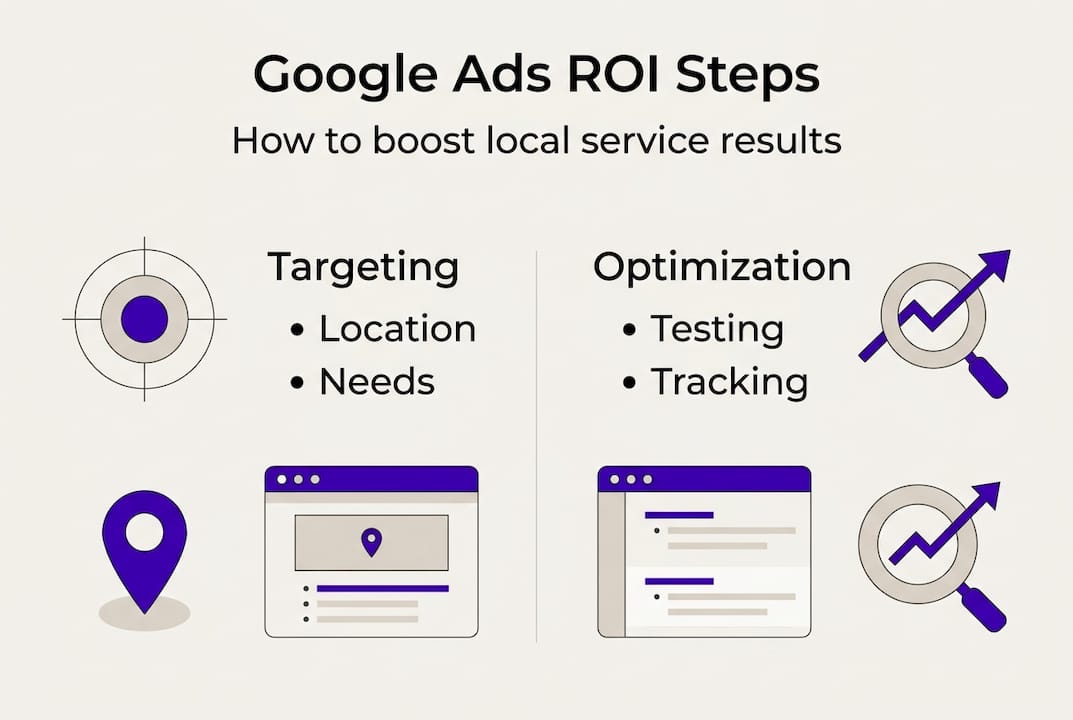
- Know your objectives and local audience
- Build your campaign the smart way
- Write ads that really convert
- Track, test, and optimize for real ROI
- Why relentless testing and humility are the secret to Google Ads ROI
- Get expert help to maximize your Google Ads ROI
- Frequently asked questions
Key Takeaways
| Point | Details |
|---|---|
| Target the right audience | Researching and refining your local audience ensures every ad dollar goes further. |
| Structure campaigns wisely | Well-organized ad groups and keyword types help you avoid costly mistakes and wasted spend. |
| Write compelling local ads | Local relevance and clear calls-to-action increase both click-through and conversion rates. |
| Track and optimize relentlessly | Continuous testing and adjustments drive real improvement in Google Ads ROI for service businesses. |
Know your objectives and local audience
Every strong Google Ads campaign starts before you touch a single setting. It starts with clarity. What do you actually want? More appointment bookings? More calls from people in your service zip codes? More form fills from homeowners with burst pipes? Without a specific, measurable goal, your campaign has no direction and your budget has no guardrails.
For local service businesses, goals typically fall into three categories:
- Calls from new patients or clients (healthcare, legal)
- Appointment bookings or quote requests (dental offices, law firms, HVAC companies)
- Emergency service inquiries (plumbers, electricians, urgent care)
Once your goal is clear, you need to understand who you’re trying to reach. This means more than demographics. It means understanding the search behavior of your ideal local customer. A parent searching “pediatric dentist near me” has different urgency than someone searching “estate planning attorney Grand Junction.” One wants speed. The other wants trust and credentials.
Geographic targeting is where many local businesses leave serious money on the table. Google Ads for local businesses should be tightly focused on the actual areas you serve, not broad metro regions that bleed your budget on clicks from people you can’t help. Set radius targeting around your physical location or define specific zip codes and neighborhoods.
Here’s a quick breakdown of how audience priorities differ by sector:
| Industry | Primary customer need | Key search behavior |
|---|---|---|
| Healthcare | Convenience and trust | Location-based, symptom-specific |
| Legal | Credibility and results | Problem-specific, high research intent |
| Home services | Speed and reliability | Urgency-driven, local area focus |
Misaligned audience targeting is a leading cause of wasted ad spend, and it’s one of the easiest things to fix when you start with a clear picture of your customer. Take 30 minutes before your next campaign to map out who you’re targeting, what they’re searching for, and where they live. That half hour can save you hundreds in wasted clicks.
Build your campaign the smart way
Once you know who you want to reach and what you want them to do, it’s time to architect your campaign for success. Campaign structure is one of the most overlooked factors in local Google Ads performance. Get it wrong and even a great budget will underdeliver.
Here’s how to build a campaign that works from the ground up:
- Choose the right campaign type. For most local service businesses, Search campaigns are your best starting point. They capture people actively looking for what you offer. Local Services Ads (LSAs) are worth layering in for home services and legal, since they appear above standard search results and include a Google Guaranteed badge.
- Organize ad groups by theme. Each ad group should focus on one specific service or topic. A plumbing company might have separate groups for “water heater repair,” “drain cleaning,” and “emergency plumber.” This keeps your ads relevant and your quality scores high.
- Build a strong negative keyword list. This is non-negotiable. Add terms like “free,” “DIY,” “jobs,” and “how to” to block searches that will never convert. Ad structure is directly linked to performance and cost efficiency, and negative keywords are a core part of that structure.
- Add every relevant ad extension. Location extensions show your address. Call extensions let mobile users call with one tap. Structured snippets highlight specific services. These aren’t optional extras. They expand your ad’s footprint and give searchers more reasons to click.
- Review your Google Ads setup steps before going live to catch structural errors early.
Pro Tip: When launching Google Ads for local leads, start with exact match and phrase match keywords only. Broad match can work later once you have conversion data to guide it, but early on it burns budget fast on irrelevant searches.
Here’s a quick comparison of campaign types for local service businesses:
| Campaign type | Best for | Key advantage |
|---|---|---|
| Search | All local services | Captures active intent |
| Local Services Ads | Home services, legal, healthcare | Google Guaranteed badge, pay per lead |
| Display | Brand awareness | Wide reach, lower cost per click |
Write ads that really convert
A well-structured campaign only works if your ads inspire action. Here’s how to write them for maximum results. Most local service ads fail not because the offer is bad, but because the message is generic. “Quality service at great prices” tells a potential customer absolutely nothing.
Ad relevance and clarity increase click-through and conversion rates, which means your ad copy directly affects both your results and your cost per click. Here’s what strong local service ads include:
- Your city or service area in the headline. “Grand Junction HVAC Repair” beats “HVAC Repair” every time for local intent.
- A specific benefit, not a vague claim. “Same-day appointments available” or “Free case evaluation” gives people a concrete reason to act.
- A clear call-to-action. “Call now,” “Book online today,” and “Get a free quote” outperform passive phrases like “Learn more.”
- Urgency where it fits naturally. For home services, “24/7 emergency service” works. For legal, “Don’t wait, protect your rights” fits the emotional state of the searcher.
- Trust signals for legal and healthcare. Years in practice, board certifications, or client reviews mentioned in ad copy build credibility before the click.
Pro Tip: Write at least 3 different headlines and 2 different descriptions for each responsive search ad. Google will test combinations automatically, but you need enough variation to find what resonates. Check your maximizing local PPC ad spend strategy to make sure your copy aligns with your landing page message.
For legal services specifically, tone matters enormously. People searching for a DUI attorney or a family law firm are often stressed and vulnerable. Your ad copy should feel reassuring and direct, not salesy. Review Google Ads for legal services to understand how tone and compliance considerations shape effective legal ad copy.
Dynamic keyword insertion can be useful, but use it carefully. If your ad group themes aren’t tight, it can produce awkward or misleading headlines. Test it in controlled groups before rolling it out broadly.
Track, test, and optimize for real ROI
ROI isn’t about “set it and forget it.” Ongoing measurement and refinement seal the deal. The businesses that get the best returns from Google Ads aren’t necessarily the ones with the biggest budgets. They’re the ones paying attention.
Here’s how to build a real optimization process:
- Set up conversion tracking before you spend a single dollar. Track phone calls from ads, form submissions, and appointment bookings separately. Without this, you’re flying blind.
- Focus on cost per lead, not cost per click. A $10 click that converts is worth more than a $2 click that bounces. Your cost per lead tells you what you’re actually paying to acquire a potential customer.
- Run A/B tests on your ads and landing pages. Change one element at a time: headline, call-to-action, or offer. Let each test run long enough to collect statistically meaningful data before drawing conclusions.
- Review performance at least monthly. Pause underperforming keywords, increase bids on high-converting terms, and refresh ad copy that’s gone stale.
- Use Google’s automated recommendations with caution. Some are helpful. Others, like broad match expansion suggestions, can quietly erode your targeting precision.
Tracking and optimization is ongoing. Top campaigns monitor results weekly or daily, not just when something feels wrong.
Pro Tip: Set a recurring calendar reminder for your ad review. It sounds simple, but most campaign neglect happens because reviews get pushed back week after week. Consistent attention to tracking ROI from ads is what separates growing campaigns from stagnant ones.
Return on ad spend (ROAS) is worth tracking too, especially for home service businesses with clear job values. If you know a new HVAC installation is worth $4,000 and your ads generate those leads at $150 each, your math is clear. For healthcare and legal, where lifetime client value is high, even a higher cost per lead can still deliver strong ROI. Understanding boosting brand awareness with PPC can also help you see the full-funnel value of your ad spend beyond direct conversions.

Why relentless testing and humility are the secret to Google Ads ROI
Here’s something we’ve seen consistently working with local service businesses: the ad they were most confident about rarely outperforms the one they almost didn’t test. That’s not a knock on instinct. It’s a reminder that customer behavior is unpredictable, and the only way to know what works is to let data decide.
The businesses that grow their Google Ads ROI best practices year over year share one trait. They treat every campaign as an ongoing experiment, not a finished product. They test headlines that feel risky. They pause keywords that feel safe but convert poorly. They’re willing to be wrong about what their customers want.
In competitive local markets like healthcare, legal, and home services, small changes compound fast. A headline tweak that improves click-through by 15% and a landing page change that lifts conversion by 10% can together double your effective ROI without touching your budget. That’s the real opportunity most businesses miss by not testing consistently.
Get expert help to maximize your Google Ads ROI
If refining your own campaigns feels daunting or you want a faster track, you don’t have to do it alone.
City Web Company specializes in helping local service businesses in healthcare, legal, and home services maximize ROI with Google Ads through campaigns built on the exact strategies covered in this guide. From audience research and campaign structure to ad copy testing and conversion tracking, our team handles the details so you can focus on serving your clients. Whether you need a full campaign build or an audit of what’s already running, we offer tailored digital marketing for local leads designed to generate real results. Reach out today to schedule a free strategy session and find out where your campaigns have room to grow.
Frequently asked questions
What is the most important metric for Google Ads ROI?
Cost per lead or conversion is the most important metric because it directly measures how efficiently your budget turns clicks into real business opportunities, not just traffic.
How often should I review my Google Ads campaigns?
Review performance at least once a month. Regular ad review is essential for ongoing ROI, and high-spend or highly competitive campaigns often benefit from weekly check-ins.
Do ad extensions really boost ROI for local service businesses?
Yes. Ad extensions like location and call buttons increase your ad’s visibility and give local searchers direct ways to contact you, which typically lifts both click-through and conversion rates.
What are negative keywords and why are they important for ROI?
Negative keywords block your ads from showing on irrelevant searches. Negative keywords can drastically cut wasted spend and keep your budget focused on searches that are actually likely to convert.
Recommended
These articles were popular with other readers too: