

See how plumbers can turn Facebook scrollers into booked jobs with clear offers, local targeting, a 30 day test budget, fast follow up, and a path to scale.
$53,088 Fine Risk for U.S. Businesses Over Review Gating
Review gating is not allowed under United States law or the policies of every major review platform. If your business sorts customers by likely sentiment before asking for feedback, whether through software or a front-desk script, stop that flow today, audit every review request you send, and document the fix. Both the FTC and platforms like Google treat it as deceptive.
TL;DR:
- Filtering customers based on their sentiment before requesting reviews can lead to significant legal penalties, with fines up to $53,088 per violation.
- Platforms like Google and Yelp prohibit any form of review gating, and violations often result in review removal or account suspension.
- Auditing every review request touchpoint and ensuring all customers receive the same public review link helps maintain legal compliance and preserve review volume.
- Offering every customer both a public review option and a private feedback channel, without gating, improves reputation accuracy and customer trust.
- Businesses should document their review solicitation processes and seek professional guidance to prevent unintentional gating practices.
Table of Contents
Table of Contents
- What Is Review Gating, and Where Does It Show Up?
- Why Gating Is Risky: the FTC Rule and Real Penalties
- How Google, Yelp, and Other Platforms Handle Gating
- Auditing Your Review Funnel: a Practical Checklist
- Compliant Alternatives That Actually Convert Better
- City Web Company’s Approach to Remediation
- What Practitioners Get Wrong About Review Gating
- Get a Compliance Check on Your Review Program
- Sources
- FAQ
What Is Review Gating, and Where Does It Show Up?
Review gating happens whenever a business filters customers before asking for a public review, based on how happy that customer seems likely to be. The classic version asks “How was your experience?” first, then routes anyone who answers positively to Google or Yelp, while quietly sending unhappy customers to a private form or nowhere at all. That is the core definition, and it is what makes review gating different from ordinary customer feedback management.
It shows up in subtler ways too. A front-desk employee might hand the tablet to a smiling customer and skip the one who complained about wait times. A CRM tool might auto-trigger review requests only for jobs marked “completed without issue.” A text campaign might exclude anyone who called in for a refund.
- Pre-rating filters that ask sentiment before offering a public review link
- Staff instructed to “only ask the happy ones”
- Automated review software with a sentiment-routing feature turned on by default
- Selectively deleting or hiding negative reviews once posted
Each version inflates the public rating artificially, and research on review authenticity shows customers notice the difference between a genuine mixed profile and a suspiciously perfect one.
Why Gating Is Risky: the FTC Rule and Real Penalties
The FTC’s guidance on featuring online customer reviews makes clear that suppressing negative feedback while soliciting only positive reviews counts as a deceptive practice under existing consumer protection law. The rule, codified at 16 CFR Part 465, targets any business practice that misrepresents a product or service through manipulated review displays, including selectively gating who gets asked to leave feedback.
Statistic Callout: Enforcement isn’t theoretical. Legal explainers tracking FTC actions cite civil penalties reaching as high as $53,088 per violation in cases involving review manipulation, and each gated customer interaction can potentially count as a separate instance.
Beyond fines, the practical fallout tends to hurt more over time. An injunction can force a business to overhaul its entire review solicitation process under scrutiny. Reputational damage compounds once a pattern of gating becomes public, and local competitors are often quick to point it out in their own marketing.
Regulators view selective solicitation as deceptive because it manufactures a false impression of overall customer sentiment. A 4.8 star average built by excluding unhappy customers isn’t a rating problem. It’s a disclosure problem, and that’s exactly the framing the FTC applies when evaluating complaints.

How Google, Yelp, and Other Platforms Handle Gating
Platform policies back the FTC’s position, sometimes with sharper teeth. Google’s own support threads describe review gating as a violation of its policies against fake engagement, specifically the practice of discouraging or blocking negative reviews before they’re posted. Yelp’s guidelines similarly prohibit any solicitation approach that filters customers by expected sentiment.
Consequences vary by platform, but they follow a familiar pattern:
- Removal of reviews collected through a gated flow, sometimes in bulk
- Google Business Profile suspension or feature restrictions during an investigation
- Loss of access to review-related API features for repeat offenders
- Manual account reviews triggered by unusual review velocity or sentiment ratios
Platforms increasingly rely on automated signals to flag suspected gating: a sudden spike in five-star reviews, an unnatural ratio of perfect scores, or review timestamps that cluster around specific staff shifts. Once flagged, a human reviewer typically checks the account’s solicitation method, and if a sentiment filter shows up in the workflow, sanctions follow quickly.
Auditing Your Review Funnel: a Practical Checklist
Most businesses that gate reviews don’t set out to break the rules. It usually starts with a vendor default, a well-meaning staff habit, or a tool feature nobody read the fine print on. An honest audit catches all three.
- Map every touchpoint where a review request goes out, whether by text, email, in-app prompt, or a staff member handing over a tablet.
- Run test flows using two dummy accounts, one posing as a satisfied customer and one as dissatisfied, and confirm both reach the same public review link.
- Check your vendor’s feature flags. Log into your review software’s settings and look for anything labeled “smart routing,” “sentiment filter,” or “feedback gate.”
- Read your vendor contract. Some reputation-management tools have historically marketed sentiment-based routing as a feature, and the vendor’s marketing language doesn’t shift legal liability away from you.
- Document everything. Save screenshots of every flow variant, dated, along with your staff training materials.
Pro Tip: Keep a dated folder of screenshots showing your review request flow exactly as customers experienced it, even after you fix it. If a platform ever flags your account, that documentation is the fastest way to demonstrate the issue is resolved.
Compliant Alternatives That Actually Convert Better
The fix isn’t complicated: ask every customer for a public review, and separately offer a private feedback channel to everyone, not just people you suspect will complain. The distinction that matters legally is whether the private option ever replaces the public one for some customers. If it does, that’s gating. If it’s simply offered alongside the public request to everyone equally, that’s routing, and it’s fully compliant.
- Send the same review request text or email to every customer, no exceptions
- Time requests for 24 to 48 hours after service, when memory is fresh but frustration has cooled
- Offer a small, disclosed incentive (a discount on a future service, entered into a raffle) available to everyone who leaves feedback, positive or negative
- Respond publicly to negative reviews instead of trying to prevent them
Pro Tip: A business with a 4.5 star profile that includes a few honest negative reviews often converts better than one showing a flawless 5.0, because the mixed feedback signals the reviews are real. Consumer research backs this up: shoppers trust profiles with visible imperfections more than suspiciously perfect ones.
Responding to a bad review publicly does more than damage control. It shows every future customer reading that profile how you handle problems, which is often the deciding factor for someone on the fence. For a deeper framework on turning that response habit into a system, see this 4-step approach to improving online reputation.
City Web Company’s Approach to Remediation
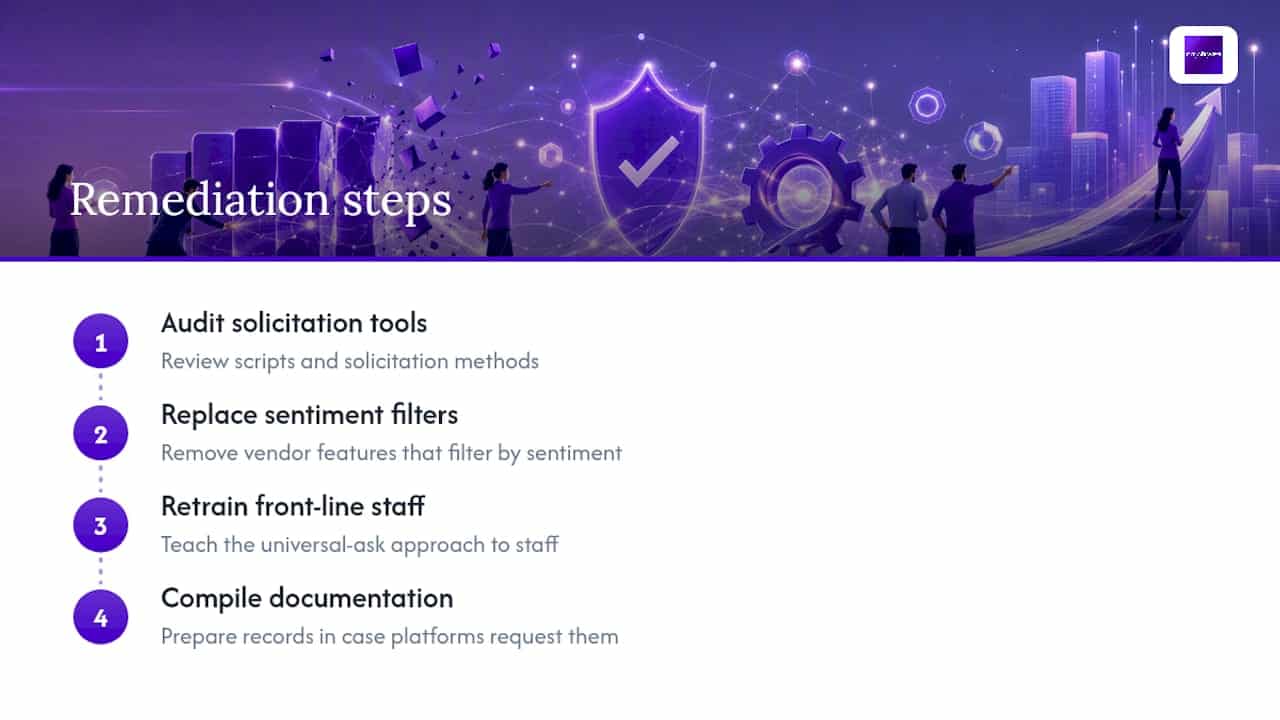
City Web Company works with local service businesses across the United States on Google Business Profile optimization and reputation recovery, which means untangling gated review flows is familiar territory. A typical remediation follows four steps: audit the existing solicitation tools and scripts, replace any vendor feature that filters by sentiment, retrain front-line staff on the universal-ask approach, and compile documentation in case a platform requests it. Businesses that skip the documentation step tend to face longer platform reviews if their account ever gets flagged.

What Practitioners Get Wrong About Review Gating
The mistake I see most often isn’t malicious. A business owner adopts a review tool, doesn’t dig into its settings, and only learns the tool defaults to sentiment routing after a Google Business Profile gets suspended. Fixing the routing is the easy part. Rebuilding staff habits takes longer, because “only ask the happy ones” often started as informal advice from a well-meaning manager years before anyone called it gating.
One pattern worth remembering: businesses that switch from gating to universal routing, offering every customer both a public and private option, tend to see a short-term dip in average star rating followed by a longer climb in total review volume and conversion. Small-scale routing experiments back this up, showing fewer one-star public complaints over time as private feedback channels absorb the friction instead. The takeaway is simple: document every review flow you run, and default to routing over gating every time.
— Matt
Get a Compliance Check on Your Review Program
City Web Company is the practical alternative to guessing whether your review software is exposing you to an FTC complaint or a Google suspension. Instead of hunting through vendor settings alone, you get a team that already knows which reputation tools quietly default to sentiment routing and how to fix it without losing review volume.

City Web Company serves local service businesses across the United States, including HVAC companies, plumbers, med spas, pest control operators, and moving companies, with local SEO and reputation management services built around compliant review collection. A compliance audit typically covers your current solicitation flow, your vendor’s feature settings, and a documented remediation plan you can hand to staff immediately. If you’re not sure whether your current setup gates reviews, get started with a review compliance check and find out before a platform tells you.
Sources
For further reading, the FTC’s guidance on featuring customer reviews is the primary legal source, and Google’s own support thread on review gating examples shows platform-level enforcement language directly.
- Featuring online customer reviews: Guide for businesses — FTC
- Is review gating illegal under consumer protection laws? – LegalClarity
- What is review gating? – Bazaarvoice
- Review gating example – Google Business Profile support thread
FAQ
Is Review Gating Illegal?
Yes. Review gating violates the FTC’s rule against suppressing negative reviews (16 CFR Part 465), and penalties can reach $53,088 per violation in cases the FTC pursues.
What Does Review Gating Mean?
Review gating means filtering customers by expected sentiment before asking for a public review, typically by routing happy customers to Google or Yelp while diverting unhappy ones to a private form or nowhere.
Can I Get Paid to Write Reviews?
No. Paying for reviews, or offering incentives tied to a positive rating specifically, violates both FTC guidelines and platform policies; a compliant incentive must be offered equally regardless of the review’s sentiment.
What Percentage of People Actually Leave Reviews?
Exact response rates vary widely by industry and request timing, but businesses that ask every customer, rather than gating by sentiment, consistently see higher total review volume over time as the private feedback channel absorbs complaints that would otherwise become public one-star reviews.
Recommended
These articles were popular with other readers too: