

Pass Google Business verification with a video-first checklist. Film one continuous 30 second take, fix flagged issues, and know when to hire help.
Consultation First Med Spa Websites, HIPAA Capable, by City Web Company
A med spa website has one job: turn a skeptical visitor into a booked consult. That means conversion-first architecture, visible proof (before-and-afters, credentials, reviews), and a consultation-first booking flow with HIPAA-capable intake. Skip any of those three, and you’re paying to send traffic to a page that leaks leads. Run the checklist below first, then decide if you need a rebuild or an agency consult.
TL;DR:
- A med spa website must have a clear booking button visible within three seconds on mobile with a consultation-first flow and HIPAA-capable intake forms.
- Treatment pages should prioritize results, target audience, treatment process, FAQs, and repeated CTAs, with trust signals like reviews and provider credentials on every page.
- The site’s aesthetic should align with either luxurious dark tones or clinical minimalism, and all imagery must feature real patient photos to reinforce credibility.
- Platforms should support HIPAA compliance, native booking integrations, schema markup, and fast mobile load times to maximize lead conversion.
- Building a cost-effective website depends on scope, typically ranging from a few thousand dollars for a template update to more for custom, multi-location, or headless setups.
Table of Contents
Table of Contents
- Med Spa Website Design Checklist: Fast Audit
- What Page Elements Actually Move Visitors To Book?
- Dark Luxury Or Clinical Clean: Which Aesthetic Fits Your Spa?
- Do Med Spa Websites Need HIPAA-Compliant Booking?
- Which Platform And Integrations Actually Matter?
- How Much Does A Med Spa Website Cost?
- What Should Be In Your Med Spa Website RFP?
- How City Web Company Approaches Med Spa Sites
- Ready For A Med Spa Website That Actually Converts?
- Sources
- FAQ
Med Spa Website Design Checklist: Fast Audit
Open your homepage on a phone and count how many seconds pass before you see a booking button. If it’s more than three, you’ve found problem one.
- Hero section: clear value proposition plus a booking CTA above the fold, no scrolling required
- Service pages: treatments grouped by category (injectables, laser, body contouring) with individual CTAs
- Trust signals: before-and-after gallery, patient reviews, provider bios with credentials visible
- Speed and mobile: loads fast on a phone, no pinch-to-zoom, no broken tap targets
- Booking flow: consultation-first scheduling with HIPAA-capable intake forms
- Integrations: analytics and CRM connected so leads don’t disappear into a void
A homepage, easy navigation, mobile responsiveness, and content that actually engages visitors are the baseline elements the American MedSpa Association flags as non-negotiable for conversion. If your site is missing two or more items above, it’s costing you consults right now, not just looking dated.
What Page Elements Actually Move Visitors To Book?
Conversion architecture beats visual polish. A gorgeous site with buried CTAs loses to a plain one where booking is always one tap away. Managed MedSpa’s research on conversion-focused med spa design makes the same point: placement, form friction, and tracking drive booking lift more reliably than aesthetics alone.
Every treatment page should follow roughly the same anatomy:
- Results first: a strong before-and-after or outcome statement at the top
- Who it’s for: skin type, age range, or concern the treatment addresses
- The process: what happens during the visit, downtime, and number of sessions
- FAQ block: pricing ranges, pain level, recovery, answered honestly
- CTA: a consultation booking button repeated at the top and bottom
Trust elements belong on every service page, not just a standalone gallery: photo carousels, a short provider bio with credentials, and a review snippet pulled from Google.
Pro Tip: Add a sticky “Book a Consult” button that follows the scroll on mobile. It’s a small build cost that consistently outperforms a static header CTA because it removes the need to scroll back up.
Microcopy matters more than most owners assume. “Book Your Free Consult” converts differently than “Schedule Appointment,” because it signals no financial commitment yet.
Dark Luxury Or Clinical Clean: Which Aesthetic Fits Your Spa?
Design should reinforce positioning, not just look nice. Colorlib’s review of top-performing sites found that med spas typically choose between two visual directions: dark, moody luxury or bright clinical minimalism, and the strongest sites commit fully to one instead of blending both.
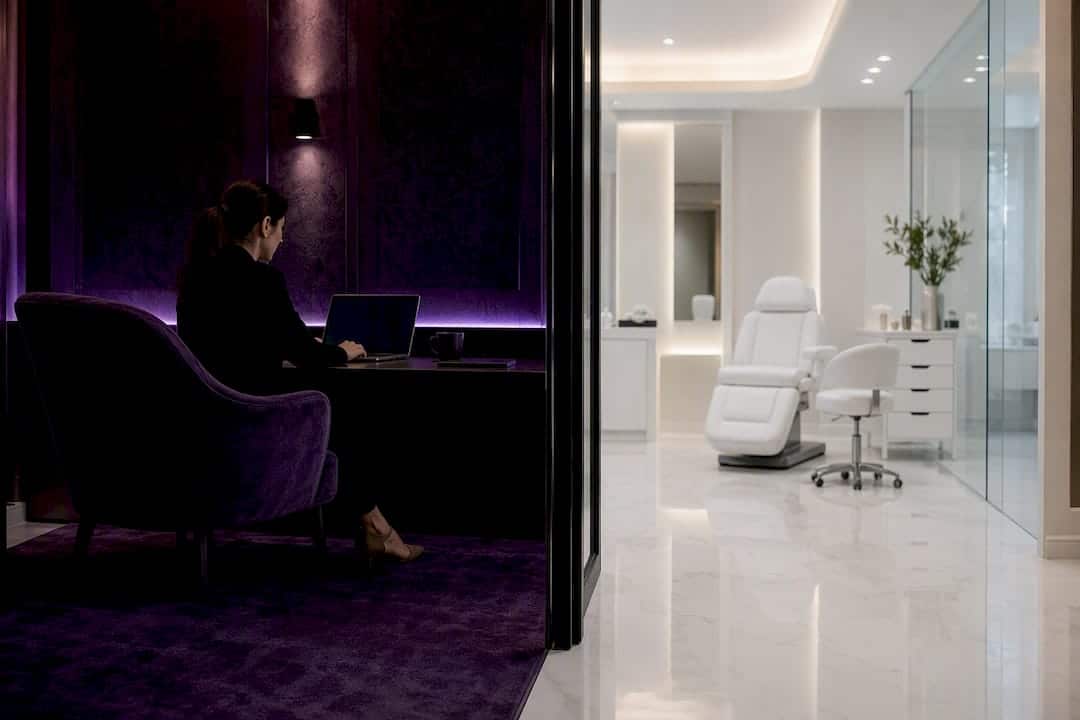
Dark luxury signals exclusivity and higher price points. It works for medspas leaning into body contouring, high-end injectables, or membership models. Expect black or deep jewel tones, serif or editorial typography, cinematic hero video, and a slow-scroll before-and-after carousel.
Clinical clean signals safety and medical credibility. It fits practices built around dermatology-adjacent treatments, acne programs, or a physician-led brand. Expect white space, sans-serif type, soft blues or greens, and provider credentials placed prominently near the top.
- Dark luxury pairs well with cinematic full-bleed hero imagery and slow-motion before/after transitions
- Clinical clean pairs well with grid-based service cards and visible certification badges
- Both styles fail if photography is stock or low resolution; real patient photos (with consent) always outperform
Pick one direction and make every design decision reinforce it. A site that mixes moody hero shots with clinical white service cards reads as unfinished, not versatile.
Do Med Spa Websites Need HIPAA-Compliant Booking?
Yes, if intake forms collect health history before treatment, which most consultation-first flows do. HIPAA compliance isn’t a single checkbox added at launch; it has to be built into the forms, storage, and integrations across the entire patient journey, from the first contact form to the confirmation email.
Consultation-first booking works because it lets staff qualify a lead and flag contraindications before anyone shows up for treatment, which reduces risk and improves the quality of booked consults. A visitor who books a filler appointment directly, with zero screening, is a liability waiting to happen.
Booking features worth requiring from any vendor:
- Provider-specific calendars so double-booking doesn’t happen across injectors
- HIPAA-capable intake forms embedded in the flow, not a separate emailed PDF
- Deposit or card-on-file capture to cut no-shows
- Automated confirmation and follow-up sequences
Modern platforms are increasingly built around HIPAA-compliant scheduling as a default rather than an add-on, which is the direction any new build should follow.
Which Platform And Integrations Actually Matter?
Squarespace and Webflow templates suit a single-location boutique spa that needs to launch fast and update content in-house. Practices selling retail skincare often lean toward Shopify-integrated builds. Multi-location or franchise operations usually need something more flexible than a template, since larger practices commonly outgrow drag-and-drop builders once they need dozens of near-identical location pages.
For scale, a headless setup (something like Next.js paired with a content system) supports hundreds of service pages and lets marketing spin up landing pages for ad campaigns without waiting on a developer. Webflow’s own template library is a solid reference point for what a fast, template-based build looks like before you decide you need custom code.
Non-negotiables regardless of platform:
- Booking software that’s either HIPAA-capable natively or integrates cleanly via API
- Schema markup on service pages so search engines understand what you treat
- Fast load times, especially on mobile, where most consult research happens
- Conversion tracking tied to actual booking events, not just page views
How Much Does A Med Spa Website Cost?
Budget follows scope, and scope follows how many locations and how custom the build needs to be.
- Discovery and strategy (1 to 2 weeks): sitemap, competitor review, positioning decisions
- Design (2 to 4 weeks): homepage and treatment page mockups, revisions
- Build and integrations (3 to 6 weeks): CMS setup, booking software connection, forms
- QA and launch (1 to 2 weeks): mobile testing, speed checks, redirects if migrating
Price bands vary widely: a template refresh on an existing platform can run a few thousand dollars, a custom single-location build with booking integration typically lands in the five-figure range, and multi-location or enterprise builds with headless architecture cost more and take longer. Ongoing costs, hosting, maintenance, integration fees, and marketing spend on top of the build, are recurring and should be budgeted separately from the launch price. An agency build usually pays for itself once you factor in the cost of a landing page that fails to convert paid traffic, which template DIY builds frequently overlook.
What Should Be In Your Med Spa Website RFP?
Give any agency a written brief before the first call. It saves weeks of back-and-forth and forces vague vendors to show their hand early.
Include in the RFP: business goals, target patient demographics, required integrations (HIPAA intake, booking software, CRM), sample treatment pages you like, budget range, and launch timeline.
Ask every finalist these questions directly:
- How do you handle HIPAA-sensitive form data end to end?
- What’s your process for reducing form friction and increasing consult bookings?
- What deliverables do we get: wireframes, a staging environment, analytics setup, training?
- What’s included in post-launch support, and what’s billed separately?
Pro Tip: Ask who owns the code and content after launch. Some agencies build on proprietary systems that lock you in; get ownership and export rights in writing before signing anything.
Contract protections to require: content and design ownership, a defined support SLA, accessibility compliance, and clear data-handling terms for patient information.
How City Web Company Approaches Med Spa Sites
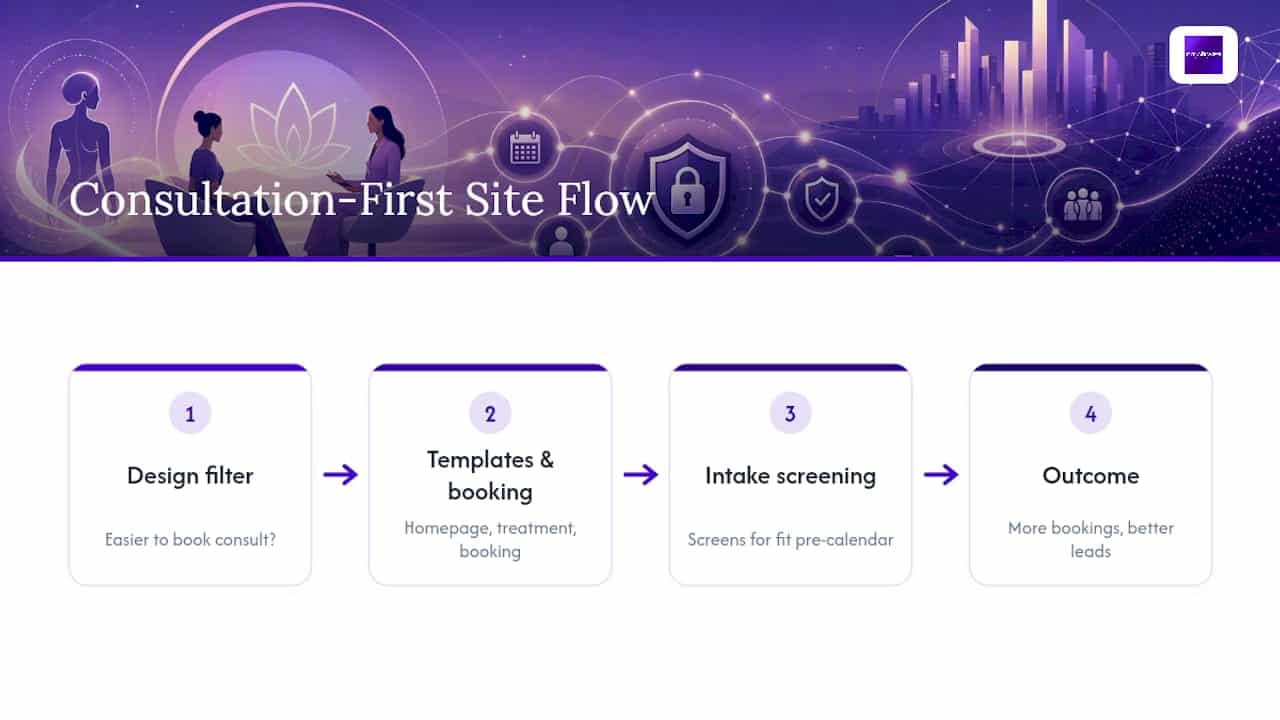
City Web Company builds med spa sites around one question: does this page make it easier to book a consult than the page before it? That’s the filter behind every homepage layout, treatment-page template, and booking integration we recommend to med spa clients.
The pattern we see after a conversion-focused redesign is consistent: consult bookings go up, and the leads that do come in are better qualified, because the intake flow screens for fit before anyone gets on the calendar. That’s the whole point of consultation-first architecture. It’s not just a nicer-looking site, it’s a different funnel.
— Matt
Ready For A Med Spa Website That Actually Converts?
City Web Company builds med spa websites the way this article just described: consultation-first booking, real trust signals, and pages built to move a visitor toward a consult rather than a bounce. If you’ve been quoted a template price for a custom build, or a custom price for what’s really a template, we’ll tell you which one you actually need before you spend anything.

An initial consult with our team covers a quick audit of your current site against the checklist above, a look at your booking flow specifically for HIPAA gaps, and a straight answer on scope and rough investment before you commit to anything. We also handle the local SEO work that gets a rebuilt site found in the first place, since a great design with no traffic still books zero consults. Start with our web design and development page to see examples and book that first conversation.
Sources
- Medical Spa Appointment Booking: HIPAA-Compliant Scheduling for Medspas | Zenoti
- 29 Best Med Spa Website Examples 2026 – Colorlib
- What Every MedSpa Needs to Know About Website Design | American MedSpa Association
FAQ
How Do I Make A Med Spa Website?
Start with a conversion-first structure: a hero with a booking CTA, treatment pages grouped by category, a before-and-after gallery, and a HIPAA-capable consultation booking flow, then choose a platform that supports your scale.
Is A Med Spa A Profitable Business?
Med spas can be highly profitable because treatments carry strong margins and repeat-visit models, but profitability depends heavily on consistent lead flow, which is exactly what a conversion-focused website is built to deliver.
What Is The Best Software For A Med Spa?
The right choice depends on scale: boutique single-location spas often do well with template platforms plus a HIPAA-capable booking add-on, while multi-location practices need software with native compliance features and CRM integration built in.
What Are The 7 C’s Of Web Design?
Definitions vary across sources, but the concept generally points to fundamentals like clarity, consistency, credibility, and usability, which line up with what actually drives med spa bookings: a clear CTA, consistent trust signals, and a frictionless path to consultation.
Does A Med Spa Website Need Before-And-After Photos?
Yes. Before-and-after galleries are one of the strongest trust signals on a med spa site and consistently appear across the best-performing examples in the category.
Recommended
These articles were popular with other readers too: