

Discover 15 effective ways to improve online visibility in 2026. Boost your SEO, social media, and ads for rapid growth!
Local Business Branding Guide: Build Trust and Win Locally
Local business branding is the process of crafting a unique identity and consistent experience that connects deeply with your community, builds trust, and sets you apart from competitors who can never match your local roots. This local business branding guide covers every practical step: defining your brand strategy, building visual and verbal identity, engaging your community authentically, and maintaining consistency across every customer touchpoint. You will find specific tools, named frameworks, and real tactics that work for service businesses in 2026, whether you run an HVAC company, a landscaping crew, a med spa, or a pest control operation. The payoff is measurable. Effective local branding grows revenue by 10 to 20% through consistent use of local landmarks, seasonal relevance, and community-focused messaging.
Table of Contents
What is a local business branding guide and why does it matter?
A local business branding guide is a structured framework that helps small business owners define, build, and maintain a recognizable identity within their specific geographic market. It is not a logo project or a color palette exercise. It is a system that aligns your purpose, your visuals, your words, and your community presence into one coherent signal that customers recognize and trust.
The competitive advantage here is real. National chains have bigger budgets, but they cannot replicate the trust a local business earns by knowing its customers by name, sponsoring the youth soccer league, or referencing the neighborhood by name in every ad. Local connectivity is the pivotal advantage local brands hold over large competitors because of community trust and values alignment. That advantage only compounds when your brand identity is sharp and consistent.

The core elements of any strong local brand are four: a clear strategy, a recognizable visual identity, a consistent brand voice, and an active digital presence anchored by tools like Google Business Profile and a well-structured website. Miss any one of these and the others underperform. A beautiful logo with no strategy behind it is decoration. A strong story with no digital presence reaches no one new.
How to define your brand identity and core strategy
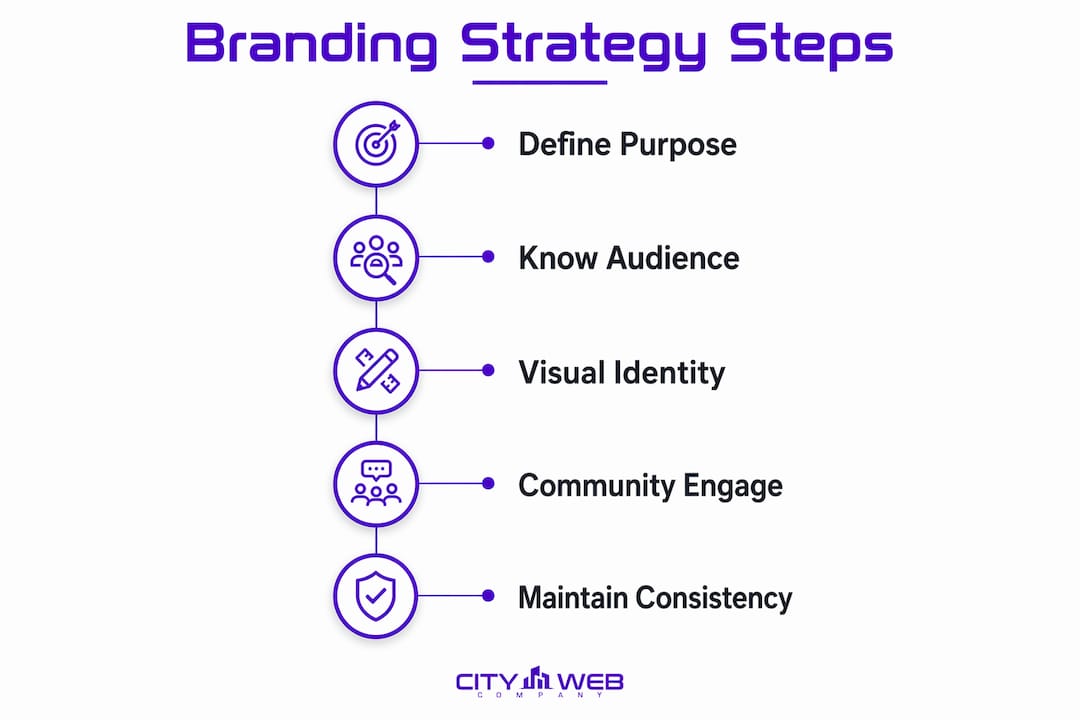
The most effective brand strategies for local businesses fit on a single page. A one-page brand strategy addresses four key questions: your purpose beyond profit, your specific target audience, your point of differentiation, and your brand personality. Answering these four questions with discipline gives you a filter for every future decision, from what colors to choose to what to post on Facebook.
Here is how to work through each question:
-
Why does your business exist beyond making money? A plumber who exists to give homeowners peace of mind during emergencies has a different brand than one who competes purely on price. Your “why” shapes your messaging, your customer service standards, and the emotional tone of everything you produce.
-
Who specifically are you serving? “Homeowners in the Denver metro area” is a start, but “first-time homeowners in suburban Denver who are overwhelmed by maintenance decisions” is a brand-ready audience definition. The more specific you are, the more your messaging will resonate with the right people.
-
How are you different from the next option? Local brands must compete not on pricing but on differentiation through high-quality local craftsmanship, cultural authenticity, and personalized service. Your differentiator should be something a national chain structurally cannot replicate.
-
What is your brand personality? Choose three to five adjectives that describe how your brand should feel: approachable, expert, no-nonsense, warm, bold. These adjectives become the guardrails for your visual choices and your tone of voice.
Once you have answered these four questions, you have a minimum viable brand strategy. Do not skip ahead to a full brand system before you have validated this foundation with real customers. Building a comprehensive brand system too early is a common misstep that wastes resources before you have consistent revenue or market validation.
On naming: your business name should be easy to spell, easy to say, and available as a .com domain. Run a quick trademark search through the USPTO database before committing. A name conflict discovered after you have printed 500 yard signs is an expensive problem.

Pro Tip: Before finalizing your brand concept, share it with five to ten real customers or community members and ask them one question: “What kind of business does this feel like?” Their answers will tell you immediately whether your brand is communicating what you intend.
How to build visual and verbal brand elements that resonate locally
Your visual identity is the shorthand version of your brand strategy. When someone sees your truck, your website, or your social media post, they should get an immediate, accurate impression of who you are before reading a single word.
The core visual components every local business needs are:
- Logo: Choose a wordmark, lettermark, or combination mark based on how recognizable your business name is. A new business with an unfamiliar name benefits from a combination mark that pairs an icon with the name. Keep it simple enough to read at one inch on a business card and large enough to work on a vehicle wrap.
- Color palette: Limit your primary palette to two or three colors. Colors carry psychological weight. Blue signals trust and reliability, which is why so many HVAC and plumbing companies use it. Green signals growth and nature, which works well for landscapers. Choose colors that reflect your personality and stand out in your local market.
- Typography: Use no more than two typefaces: one for headlines and one for body text. Pair a strong display font with a clean, readable sans-serif. Google Fonts offers free, professional options including Montserrat, Lato, and Playfair Display.
- Brand voice: Your brand voice should match your community culture, balancing formality, friendliness, and authenticity to resonate with local customers. A disaster restoration company serving rural communities needs a different tone than a med spa in an upscale urban neighborhood.
The table below shows how brand personality maps to visual and verbal choices:
| Brand personality | Color direction | Voice tone | Font style |
|---|---|---|---|
| Trustworthy and reliable | Navy, gray, white | Direct, calm, reassuring | Clean sans-serif |
| Warm and community-focused | Earth tones, warm orange | Friendly, conversational | Rounded, approachable |
| Premium and expert | Deep green, gold, black | Confident, precise | Serif with clean pairing |
| Bold and energetic | Bright red, yellow, black | Punchy, direct | Strong display font |
Once you have these elements defined, document them in a brand style guide. This does not need to be a 40-page PDF. A two-page document in Canva that shows your logo versions, color hex codes, font names, and three sample voice phrases is enough to keep your website designer, your social media manager, and your sign printer all working from the same playbook. Consistent application of logo, color palette, typography, and brand voice across all touchpoints is fundamental to building customer trust and recognition.
Pro Tip: Canva’s Brand Kit feature lets you store your colors, fonts, and logos in one place so every team member creates on-brand graphics without asking you for the hex code every time.
How to engage your community through authentic local branding
Community engagement is where local businesses win the branding battle that national chains cannot fight. Authenticity is not a marketing tactic. It is the result of genuinely knowing your community and showing up for it consistently. Brand storytelling centered on local roots, founder journey, and community impact creates emotional loyalty that large competitors structurally cannot replicate.
Here are four proven strategies for building that community connection:
-
Sponsor and participate in local events. Youth sports leagues, neighborhood festivals, charity 5K races, and school fundraisers put your brand in front of local families in a context that signals you are invested in the same community they are. Sponsorship does not require a large budget. A $500 banner at a little league field seen by 200 families every weekend for a season is a high-value brand impression.
-
Build partnerships with complementary local businesses. A landscaping company and a pest control company serve the same homeowners. Cross-promote each other’s services, co-host a neighborhood workshop, or bundle a referral discount. These partnerships expand your reach without paid advertising costs.
-
Use local micro-influencers. A neighborhood parent with 3,000 Instagram followers who genuinely loves your service carries more persuasive weight in your local market than a national influencer with 500,000 followers who has never visited your city. Authenticity scales down, not up.
-
Optimize your Google Business Profile. This is the single highest-leverage digital action a local business can take. Local SEO tactics including Google Business Profile optimization, location keywords, and local content enable small businesses to outrank larger competitors in regional searches. Post weekly updates, respond to every review within 24 hours, and add photos of your actual team and work.
Beyond these four strategies, your local SEO approach should include location-specific pages on your website, schema markup for your business address, and consistent NAP (name, address, phone) data across every directory listing. Google prioritizes proximity and relevance in “near me” searches, and your content strategy should reflect that.
Effective local branding also requires active engagement with local residents to understand community-specific values beyond superficial symbols. Do not assume you know what your community cares about. Ask. Run a short survey, read local Facebook group conversations, or simply talk to your customers at the point of service.
How to maintain brand consistency across every touchpoint
Brand recognition is built through repetition. Every time a customer sees your logo, reads your website copy, or interacts with one of your employees, they are either reinforcing or eroding the brand impression you have worked to build. Inconsistency is the most common and most damaging branding mistake local businesses make.
Here is a practical checklist for maintaining consistency across your key touchpoints:
- Website: Your homepage headline, color scheme, photography style, and tone of voice should all match your brand style guide exactly. If your brand is warm and approachable, stock photos of stiff corporate handshakes undermine that message immediately.
- Social media profiles: Use the same profile photo (your logo), the same cover image style, and the same bio language across Facebook, Instagram, Google Business Profile, and Nextdoor. Inconsistent profile images across platforms signal a disorganized operation.
- Vehicle wraps and signage: Your trucks and vans are mobile billboards. They should display your logo, primary color, phone number, and website in a layout that matches your other branded materials. A truck wrap that uses different colors than your website creates cognitive dissonance for customers who see both.
- Uniforms and staff presentation: Your team is your brand in person. Branded shirts, hats, or jackets with your logo reinforce professionalism and make your crew instantly recognizable on a job site.
- Customer communications: Email signatures, invoices, estimate templates, and follow-up texts should all carry your logo and use your brand voice. A formal invoice from a business that markets itself as friendly and approachable sends a mixed signal.
Review your brand touchpoints every six months. Markets shift, your business grows, and your visual identity may need a refresh to stay current without losing the recognition you have built. A refresh is not a rebrand. Updating a font or modernizing a logo mark while keeping your core colors and name intact preserves equity while staying relevant. Use your branding strategy definition as the anchor point for any update so you are evolving deliberately, not reacting randomly.
Track brand performance with local data: Google Business Profile insights, website traffic from local searches, and customer survey responses asking how people heard about you. These data points tell you which touchpoints are working and which need attention.
Key takeaways
Strong local business branding requires a clear one-page strategy, consistent visual and verbal identity, authentic community engagement, and disciplined execution across every customer touchpoint.
| Point | Details |
|---|---|
| Start with a one-page strategy | Answer four questions: purpose, audience, differentiation, and personality before designing anything. |
| Build a minimum viable brand first | Launch with a logo, color palette, and style guide before investing in a full brand system. |
| Community engagement beats ad spend | Sponsorships, partnerships, and Google Business Profile optimization outperform generic advertising for local trust. |
| Consistency drives recognition | Apply the same logo, colors, voice, and tone across your website, trucks, uniforms, and social profiles. |
| Track and refresh deliberately | Review brand touchpoints every six months and update based on local data, not trend chasing. |
Why most local brands plateau before they ever get traction
I have worked with enough local service businesses to recognize a pattern that almost never gets discussed openly. Most owners spend their first branding dollars on a logo and a website, then wonder why nothing changes. The logo looks fine. The website is functional. But the brand has no spine.
The problem is almost always the same: the strategy step got skipped. The owner went straight to design because design is tangible and strategy feels abstract. But a logo without a strategy is just a graphic. It cannot tell a customer why they should choose you over the competitor two miles away with a nearly identical truck.
The businesses I have seen break through the plateau share one trait. They know exactly who they are talking to and they say something specific to that person. Not “quality service at a fair price.” Something like: “We show up the same day, every time, because we know a broken furnace in January is not a scheduling problem.” That is a brand position. That is something a national chain cannot say credibly.
The other thing I would push back on is the instinct to look polished before you look real. Customers in local markets are sophisticated enough to recognize when a business is performing professionalism versus actually delivering it. A photo of your actual crew on a real job site converts better than a stock photo of a smiling technician every single time. Authenticity in branding builds trust in ways that no amount of design polish can manufacture.
Start small, stay consistent, and let your community do the talking. The brands that win locally are the ones that show up, follow through, and make it easy for happy customers to tell their neighbors.
— Matt
How City Web Company helps local businesses build brand visibility
Your brand strategy means nothing if the right people never see it. City Web Company works with local service businesses across industries including HVAC, landscaping, pest control, and home services to translate strong brand identity into measurable digital visibility.
From local SEO and Google Business Profile optimization to website design that reflects your brand accurately, City Web Company builds the digital infrastructure that puts your brand in front of local customers at the exact moment they are searching. If you are ready to turn your brand into a lead-generating asset, explore the local lead generation services that City Web Company has built specifically for businesses like yours.
FAQ
What is local business branding?
Local business branding is the process of defining and consistently communicating a unique identity that connects with customers in a specific geographic market. It includes your visual identity, brand voice, community presence, and digital footprint.
How much should a small business spend on branding?
A reasonable initial branding budget for small local businesses ranges from $500 to $5,000, prioritizing logo design, brand guidelines, and digital presence setup. Spending more before validating your market position is a common and costly mistake.
What is the most important branding element for a local business?
Consistency is the most important element. Mixed messages or inconsistent branding erode customer trust faster than any single design flaw, so applying your logo, colors, and voice uniformly across all platforms matters more than perfecting any one asset.
How does local SEO connect to branding?
Local SEO amplifies your brand by making it visible when nearby customers search for your services. Optimizing your Google Business Profile with accurate information, photos, and regular posts reinforces your brand identity while improving your ranking in location-based searches.
How often should a local business update its branding?
Review your brand touchpoints every six months and consider a visual refresh every three to five years. A refresh updates your look without abandoning the recognition you have built, keeping your brand current without starting over.
Recommended
These articles were popular with other readers too: