

See how plumbers can turn Facebook scrollers into booked jobs with clear offers, local targeting, a 30 day test budget, fast follow up, and a path to scale.
Healthcare Website Optimization Guide for Clinics in 2026
Healthcare website optimization is the process of improving site structure, content, and user experience to attract and convert patients while meeting strict industry compliance and SEO standards. In 2026, this process has expanded beyond traditional SEO to include Answer Engine Optimization (AEO), a discipline focused on earning citations from AI-powered tools like Google’s AI Overviews, ChatGPT, and Perplexity. This healthcare website optimization guide covers every layer of that process: foundational data hygiene, on-page and technical SEO, AI readiness, patient-focused UX design, and measurable performance tracking. Tools like Google Search Console, schema markup validators, and provider directory platforms are all part of the equation.
Table of Contents
What are the prerequisites for healthcare website optimization?
Before you write a single meta description or add a schema tag, your data foundation must be solid. Listing inconsistencies act as silent killers for local search rankings, particularly for multi-location healthcare brands. A clinic with three locations showing different phone numbers across Google Business Profile, Healthgrades, and Yelp sends conflicting signals to search engines and loses ranking ground to competitors with clean data.
Fix NAP data before anything else
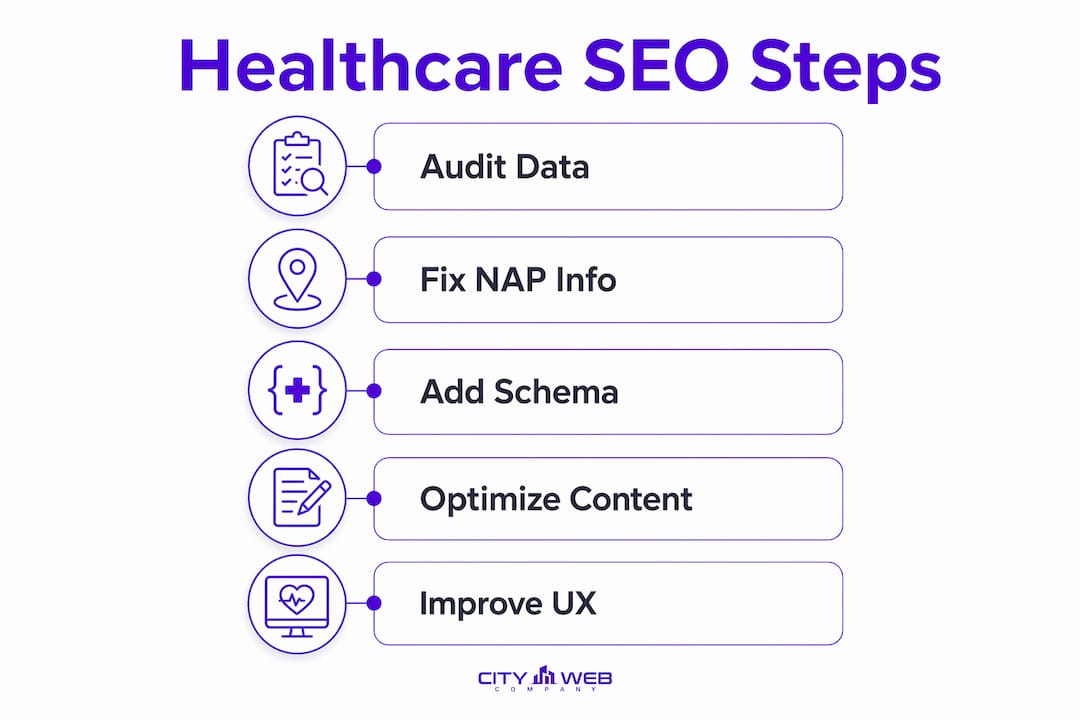
NAP stands for Name, Address, and Phone number. Every instance of your practice’s contact information across the web must match exactly. Run an audit using tools like BrightLocal or Moz Local to identify duplicate listings and inconsistencies. Managing multi-location listing integrity is a foundational step that must happen before keyword targeting or content scaling.

Compliance is a technical requirement, not a legal afterthought
HIPAA governs patient data handling, and WCAG 2.1 governs accessibility. Both affect your website directly. WCAG compliance requires sufficient color contrast, keyboard navigation support, and alt text on all images. Failing WCAG standards exposes your practice to legal risk and reduces usability for patients with disabilities. GDPR applies if your site collects data from European visitors, which is common for academic medical centers and specialty practices with international reach.
Here are the foundational prerequisites every healthcare site must address before optimization begins:
- NAP consistency: Audit all directory listings and correct mismatches across Google Business Profile, Healthgrades, WebMD, and Yelp.
- HTTPS security: Every page must load over a secure connection. Google treats HTTP sites as untrustworthy.
- Core Web Vitals: Google’s Largest Contentful Paint (LCP), Interaction to Next Paint (INP), and Cumulative Layout Shift (CLS) scores directly affect rankings.
- Mobile-first design: Google indexes the mobile version of your site first. A desktop-only design is an invisible site.
- Schema markup foundation: Implement MedicalOrganization and Physician schema before building out content. Structured data markup is critical for both search engines and AI answer engines to understand your content structure.
Pro Tip: Use Google’s Rich Results Test and Schema Markup Validator to confirm your structured data is error-free before publishing any new provider or location pages.
How to execute on-page and technical SEO for healthcare sites
Healthcare SEO operates under stricter rules than most industries. Google classifies medical content as YMYL (Your Money or Your Life), meaning higher thresholds for expertise and trustworthiness apply. A page about diabetes management written by an anonymous author will not outrank a page authored by a named endocrinologist with credentials, institutional affiliations, and cited sources.

Build service line hubs, not isolated pages
The most effective site architecture for healthcare is a hub-and-spoke model. Create a primary service line page (the hub) for each specialty, such as cardiology, orthopedics, or urgent care. Then build supporting pages (the spokes) for specific conditions, procedures, and provider profiles. Each spoke links back to the hub and to relevant appointment booking pathways. This structure signals topical authority to Google and makes navigation intuitive for patients.
Keyword research focused on patient intent
Patients search differently than clinicians write. A patient searches “knee pain after running” while a physician writes “patellofemoral syndrome.” Your keyword strategy must bridge that gap. Use tools like Semrush, Ahrefs, or Google Keyword Planner to identify high-intent queries. Prioritize condition-based and symptom-based keywords alongside service and location terms.
Follow these steps to execute on-page SEO for a healthcare service page:
- Target one primary keyword per page. Avoid cannibalizing your own rankings by covering the same topic across multiple URLs.
- Write a title tag under 60 characters that includes the primary keyword and location where relevant (e.g., “Knee Pain Treatment in Denver | Orthopedic Care”).
- Craft a meta description under 155 characters that states the service, location, and a clear next step like “Book an appointment today.”
- Place the primary keyword in the H1, first paragraph, and at least one H2. Do not force it into every sentence.
- Add author credentials to every clinical page. Include the author’s name, title, board certifications, and a link to their provider profile.
- Use internal links to connect service pages, provider profiles, and blog content. A page about back pain should link to your spine surgery service page and your neurosurgery team page.
| SEO Element | Best Practice | Tool to Use |
|---|---|---|
| Title Tag | Under 60 characters, includes keyword + location | Semrush, Yoast SEO |
| Meta Description | Under 155 characters, includes a call to action | Screaming Frog |
| Schema Markup | MedicalOrganization, Physician, Service types | Schema.org, Google Rich Results Test |
| Core Web Vitals | LCP under 2.5s, CLS under 0.1 | Google PageSpeed Insights |
| XML Sitemap | Updated automatically, submitted to Google Search Console | Yoast SEO, Rank Math |
E-E-A-T principles must extend beyond content to technical SEO and structured data for full effectiveness. A well-written article with no schema, no author credentials, and slow load times will underperform against a technically sound competitor page.
How to optimize for ai-powered search and answer engines
AI-generated search visitors are not the same as traditional organic visitors. AI search visitors convert at 4.4 times the rate of standard organic visitors. That gap is significant for healthcare practices where a single new patient relationship can generate thousands of dollars in lifetime value. Ignoring AEO in 2026 is not a neutral decision. It is a decision to cede high-value traffic to competitors who have adapted.
What AEO means for healthcare content
Answer Engine Optimization (AEO) is the practice of structuring content so AI systems can extract, summarize, and cite it accurately. For healthcare websites, this means writing in a question-and-answer format, placing direct answers in the first sentence of each section, and using schema types that AI systems recognize. The overlap with traditional SEO is substantial. Nearly 40% of Google’s AI overview answers come from pages already ranking in the top 10. Ranking well in traditional search is still the fastest path to AI citation.
Schema types that drive AI visibility
The following schema types are most valuable for healthcare AEO:
- MedicalOrganization: Identifies your practice type, specialties, and location data for AI systems.
- Physician: Links individual providers to their specialties, credentials, and affiliated locations.
- MedicalCondition and MedicalProcedure: Helps AI engines understand the clinical content on condition and treatment pages.
- FAQPage: Directly feeds question-and-answer content into AI overview responses.
- LocalBusiness with healthcareService: Captures local intent queries for clinics and urgent care centers.
Pro Tip: Add FAQPage schema to every service and condition page. AI systems pull FAQ content directly into answer panels, and this schema type requires minimal technical effort to implement.
AI and traditional search engines share authority and relevance signals. Successful healthcare websites implement one unified data architecture to fuel both. Splitting your strategy into separate SEO and AEO workstreams wastes resources and creates inconsistent signals. The role of AI in search rankings is now inseparable from traditional ranking factors, and healthcare sites that treat them as one system outperform those that do not.
“Local ‘near me’ searches in healthcare rarely trigger AI answer overviews, so traditional SEO remains vital for capturing ready-to-book patients locally.” — DexCare
This means your local SEO investment is not made obsolete by AI. Patients searching “urgent care near me” or “pediatrician in Austin” are routed through traditional local results, not AI overviews. Both channels require attention. Review the local SEO checklist for doctors to confirm your local signals are fully optimized alongside your AEO work.
How can healthcare websites improve UX to boost patient conversion?
Website design directly drives patient acquisition. Healthcare websites with patient-centered user journeys see up to 67% growth in patient inquiries. That number reflects what happens when a website stops functioning as a digital brochure and starts functioning as a conversion tool. The difference is intentional design built around how patients actually make decisions.
Designing around patient decision-making lowers bounce rates and improves booking completion rates. Patients arrive at healthcare websites with specific needs: finding a provider, understanding a condition, or booking an appointment. Every page should serve at least one of those needs directly.
Here are the UX elements that most directly affect patient conversion:
- Above-the-fold trust signals: Display the practice phone number, a “Book Now” button, and provider photos within the first screen view. Patients decide within seconds whether to stay or leave.
- Find-a-provider widget: Multi-specialty practices need a filterable provider directory. Patients search by specialty, insurance accepted, and location. A directory that requires clicking through 15 profiles to find the right doctor loses patients to competitors with better tools.
- Mobile-first appointment booking: Mobile-first design directly impacts urgent care searches and appointment conversions. A booking form that requires pinching and zooming on a phone will be abandoned.
- Health literacy-appropriate content: Write at a 6th to 8th grade reading level for patient-facing pages. Use plain language, short paragraphs, and visual aids. Reserve clinical terminology for provider-facing content.
- Patient reviews prominently placed: Display Google and Healthgrades reviews on service pages, not just a dedicated testimonials page. Reviews on service pages reduce hesitation at the moment of decision.
- WCAG accessibility compliance: Accessible design serves patients with disabilities and protects your practice from legal exposure. Screen reader compatibility, keyboard navigation, and sufficient color contrast are non-negotiable.
The healthcare website design decisions you make today determine how many patients complete the journey from search result to booked appointment. Treat every page as a conversion page, not just the homepage.
What mistakes should healthcare administrators avoid when optimizing?
The most expensive mistake in healthcare website optimization is treating SEO and AEO as competing priorities. Practices that separate SEO and AEO under-invest in the unified signals that fuel both, limiting overall search visibility and patient acquisition. One content strategy, one schema architecture, and one analytics framework should serve both channels simultaneously.
Follow this checklist to avoid the most common optimization failures:
- Do not ignore listing accuracy. A single incorrect phone number on Healthgrades can cost you dozens of patient calls per month. Audit all third-party listings quarterly.
- Do not skip compliance reviews. HIPAA violations on web forms and WCAG failures in site design create legal liability that no SEO gain can offset.
- Do not publish unattributed clinical content. Anonymous health articles fail Google’s YMYL standards and will not rank competitively against credentialed author pages.
- Do not measure success by rankings alone. A page ranking number one for a low-intent keyword generates less value than a page ranking fifth for a high-intent query like “orthopedic surgeon accepting new patients.”
- Do not treat the website as a one-time project. Search algorithms, AI systems, and patient behavior all change. Quarterly content audits and monthly technical checks are the minimum maintenance standard.
Kpis that actually measure optimization success
Track these metrics monthly using Google Analytics 4, Google Search Console, and your practice management system:
- Online booking rate: The percentage of website visitors who complete an appointment request. This is the primary conversion metric.
- Organic search traffic by page: Identifies which service and condition pages are driving patient visits.
- AI-generated traffic share: Segment referral traffic to identify visits originating from AI overview citations.
- Bounce rate by page type: High bounce rates on service pages indicate a mismatch between search intent and page content.
- Local pack appearance rate: Track how often your Google Business Profile appears in the local three-pack for target keywords.
Pro Tip: Set up a custom Google Analytics 4 report that segments organic traffic by landing page type (service, provider, blog, location). This reveals which content categories drive the most patient inquiries and where to invest next.
For a deeper look at how SEO drives patient growth across different practice types, the data consistently points to the same conclusion: consistent technical maintenance and content quality compound over time in ways that one-time optimization projects never do.
Key takeaways
A healthcare website that integrates technical SEO, AEO schema, and patient-centered UX design within one unified strategy consistently outperforms sites that treat each discipline as a separate project.
| Point | Details |
|---|---|
| Fix data before optimizing | Audit NAP consistency and remove duplicate listings before any SEO or content work begins. |
| YMYL compliance is non-negotiable | All clinical content must carry named author credentials and meet Google’s E-E-A-T standards to rank. |
| AEO and SEO share the same signals | One unified schema architecture and content strategy serves both AI answer engines and traditional search. |
| UX design drives booking conversions | Patient-centered journeys with mobile-first booking and above-the-fold trust signals increase inquiries by up to 67%. |
| Measure what moves patients, not just rankings | Track online booking rate, AI traffic share, and local pack visibility as primary performance indicators. |
Why the “optimize once” mindset costs healthcare practices real patients
I have worked with enough healthcare clients to recognize a pattern that costs practices real money: they treat website optimization as a project with a finish line. They invest in a redesign, publish a batch of service pages, and then move on. Six months later, rankings have slipped, the booking form on mobile is broken, and a competitor with fresher content has taken the top local pack position.
The practices that grow consistently do one thing differently. They treat their website as a living system, not a finished product. They run monthly technical audits. They update provider profiles when credentials change. They add FAQPage schema every time they publish a new condition page. They check their Google Business Profile listings after every algorithm update. None of these tasks are glamorous, but they compound.
The integration of traditional SEO and AEO is where I see the biggest missed opportunity right now. Most healthcare administrators have heard of AI Overviews but assume they are a future concern. They are not. AI-generated search visitors already convert at a rate that makes them the highest-value traffic segment for most practices. The schema work required to capture that traffic is not complicated. It is just consistent.
The other thing I would push back on is the assumption that compliance and optimization are in tension. HIPAA-compliant web forms, WCAG-accessible design, and credentialed content authorship are not obstacles to SEO. They are ranking signals. Google rewards trustworthy, accessible, and accurate healthcare content because that is exactly what patients need. Build for the patient first, and the algorithm follows.
— Matt
How city web company helps healthcare practices compete online
City Web Company builds and manages digital marketing programs specifically designed for service-based businesses, including healthcare providers who need more than a generic agency approach.
From local SEO and Google Business Profile management to schema-optimized website design and AI-ready content architecture, City Web Company handles the technical and strategic work that keeps healthcare websites visible and converting. The team understands the compliance requirements, the YMYL content standards, and the local search dynamics that make healthcare marketing different from every other industry. If your practice needs a partner who treats your website as a revenue-generating asset, explore the full digital marketing services City Web Company provides for local and regional healthcare businesses.
FAQ
What is healthcare website optimization?
Healthcare website optimization is the process of improving a medical site’s structure, content, and technical performance to attract patients and rank in search results. It includes SEO, AEO schema markup, HIPAA compliance, and patient-focused UX design.
How does AEO differ from SEO for medical websites?
SEO targets traditional search rankings, while AEO structures content for AI answer engines like Google’s AI Overviews and Perplexity. Both share authority signals, and nearly 40% of AI citations come from pages already ranking in the top 10, so the strategies reinforce each other.
What schema types should healthcare sites use?
The most valuable schema types for healthcare are MedicalOrganization, Physician, MedicalCondition, MedicalProcedure, FAQPage, and LocalBusiness with healthcareService. Structured data markup using these types helps both search engines and AI systems understand and cite your content.
How do i measure healthcare SEO success?
Track online booking rate, organic traffic by page type, local pack appearance rate, and AI-generated traffic share using Google Analytics 4 and Google Search Console. Rankings alone are an incomplete measure of optimization performance.
Does mobile optimization affect patient appointment bookings?
Yes. Mobile-first design directly impacts urgent care searches and appointment conversion rates. Google also indexes the mobile version of your site first, meaning a poor mobile experience harms both rankings and patient acquisition simultaneously.
Recommended
These articles were popular with other readers too: