

See how plumbers can turn Facebook scrollers into booked jobs with clear offers, local targeting, a 30 day test budget, fast follow up, and a path to scale.
$1,500–$3,500 CTV Ads Starter Test for Local Service Businesses
Yes, small businesses should test CTV ads, and the simplest way in is a self-serve platform buy with a starter budget around $1,500 to $3,500 a month, geo-targeted to your service area and paired with search and retargeting. Run it for four to six weeks before judging results. Treat it as an awareness channel, not a direct-response one, and you will get a fair read on whether it earns a bigger budget.
TL;DR:
- Running a $1,500 to $3,500 monthly CTV campaign for four to six weeks provides sufficient coverage to assess its impact on local brand awareness and demand generation.
- Targeting should prioritize geographic focus first, with only one additional audience layer, using genre or contextual relevance to maintain reach and relevance without over-targeting.
- Most small businesses can manage self-serve platforms if they have a few hours weekly, but larger budgets or complex measurement needs benefit from agency management for better insights and creative quality.
- CTV advertising costs generally range from $7 to $27 CPM, with premium inventory and tighter targeting pushing CPMs higher; a $2,000 monthly budget typically buys around 80,000 impressions.
- Effective measurement relies on downstream signals like branded search, website traffic, and call volume increases, rather than immediate click-based attribution.
Table of Contents
Table of Contents
- What Is CTV Advertising and Why Does It Matter for Small Businesses?
- Which Buying Routes and Platforms Are Realistic for SMBs?
- Targeting and Audience Setup That Actually Works for SMBs
- How Much Do CTV Ads Cost? Budget Tiers and CPM Benchmarks
- Creative Best Practices for Small-Budget CTV Ads
- Measurement and Attribution: What You Can Realistically Track
- Step-by-Step Launch Plan: An 8-Step One-Month CTV Test
- City Web Company Proof Points and a Local-Service CTV Checklist
- When Should You Hire an Agency vs. Run CTV Yourself?
- Get a Managed CTV Test Built Around Your Local Market
- Sources
- FAQ
What Is CTV Advertising and Why Does It Matter for Small Businesses?
CTV, or connected TV, means ads served on internet-connected screens through apps like Roku, Paramount+, Hulu, and similar streaming services, as opposed to linear (broadcast/cable) TV or OTT, which is the broader “over the top” video category CTV lives inside. For a small business, the distinction that matters is simpler: your ad runs on a big screen, in a living room, during a show someone chose to watch. That is a very different attention environment than a scrollable feed.
Common formats you will run into include:
- Non-skippable pre-roll and mid-roll video spots, usually 15 or 30 seconds
- Shoppable or interactive overlays on some platforms
- Sponsored content placements within streaming apps
- Companion display banners that run alongside the video ad
The big screen produces stronger recall than mobile or desktop video in most agency reporting, which is part of why CTV works well as a demand-generation and trust-building channel rather than a last-click conversion tool. For local businesses, the real advantage of ctv ads for small business marketing is geographic precision. You can target households in a five-mile radius around your shop the same way you would with a direct mail drop, except the creative moves, has sound, and costs a fraction of print.
Which Buying Routes and Platforms Are Realistic for SMBs?
You have three practical paths into CTV, and the right one depends on how much time you have to manage it yourself.
Self-serve platforms let you set up a campaign directly through an ad manager, often with no minimum spend and launch times measured in days. Paramount’s self-service ads manager, for example, advertises CPMs starting around $7 in some promotional examples, though your actual rate will depend on targeting and inventory. This route suits owners comfortable uploading creative, setting a budget, and reading a dashboard.
Subscription-tier SMB offerings bundle creative production with distribution, usually through a third-party platform built specifically for small advertisers. These reduce setup friction because you are not sourcing your own video, but you trade some control over targeting granularity for that convenience.
Managed or agency buys hand the whole process, strategy, creative, media buying, and reporting, to a team that does this daily. You pay more, but you typically get better measurement, cleaner creative, and access to premium inventory you would not find through a self-serve interface alone.
The tradeoffs come down to three things:
- Inventory access: agency buys and larger platforms often reach premium, brand-safe placements self-serve tiers cannot
- Reporting depth: managed services usually include lift studies and cross-channel attribution; self-serve dashboards show impressions and completion rates
- Setup time: self-serve can launch in days; managed campaigns often take two to three weeks to build creative and set up tracking
Targeting and Audience Setup That Actually Works for SMBs
Start with geography, then add exactly one audience layer. That is the single most important rule in this whole guide. A plumber targeting a 15-mile radius around three zip codes, filtered by homeowner status, will outperform a campaign stacked with five overlapping demographic and behavioral filters, because narrow layering shrinks your reach faster than it improves your relevance.
Roku’s own documentation recommends leaning on platform optimization unless you have first-party data large enough to scale, since over-targeting early tends to inflate CPMs without a matching lift in results. If you do have a customer list, Roku’s custom audience tools let you upload hashed contact data or connect the Roku pixel and Conversions API to build audiences from site visits and past customers. The catch: if that list is too small, Roku will tell you to broaden the campaign, because a custom audience under a certain size simply cannot deliver at scale.
Genre and contextual targeting (running ads against home improvement shows for a roofing company, for instance) works well when you want relevance without shrinking reach. Automatic platform optimization tends to outperform manual targeting once a campaign has a few weeks of delivery data to learn from.
Frequency caps matter more on CTV than on social. Households only watch so much TV, so capping at two to four impressions per week per household prevents burnout and stretches your budget across more unique viewers.
- Geography first, one audience layer second
- Use hashed customer lists or the Roku pixel for custom audiences once you have enough volume
- Lean on contextual/genre targeting for relevance without narrowing reach
- Cap frequency at two to four impressions per household weekly
Pro Tip: If your custom audience list is under a few thousand matched records, skip it for now and run geography plus contextual targeting instead. A too-small audience usually just burns budget without adding scale.
How Much Do CTV Ads Cost? Budget Tiers and CPM Benchmarks
Most agencies that specialize in small business CTV recommend a starter tier of $1,500 to $3,500 a month for an initial test, a growth tier of $4,000 to $10,000 a month once you have a validated signal, and a scale tier above $10,000 for businesses ready to run CTV as a standing channel alongside search and social, according to Space Agency’s SMB advertising guidance.
CPM snapshot: Q1 2026 market reporting put average small-business CPMs around $22 to $27, while some self-serve platform examples advertise entry rates as low as $7. Your real number lands somewhere between those two poles depending on targeting tightness and inventory tier.
A few things push CPMs in one direction or the other:
- Narrower geographic or audience targeting tends to raise CPMs because you are competing for a smaller pool of impressions
- Premium, brand-safe inventory (top-tier apps and content) costs more than long-tail or programmatic-only placements
- Q4 holiday season and major sports windows drive CPMs up across the board; Q1 and late summer tend to run cheaper
- SMB adoption accelerated in early 2026, which has made this a genuinely cost-effective window for first tests, though that could shift as more advertisers enter the channel
A $2,000 monthly test at a $25 CPM buys roughly 80,000 impressions, enough to reach a meaningful slice of households in a mid-sized service area multiple times over a month.
Creative Best Practices for Small-Budget CTV Ads
Your brand needs to appear in the first three seconds, not the last. Viewers who are half paying attention or scrolling their phone during the ad will still register a logo, color scheme, or voice they saw in the opening beat, and that early exposure is what drives the recall and search-lift effects agencies rely on when measuring CTV’s downstream impact.
Beyond that, keep it simple:
- One message, one offer, one call to action, repeated at the start and end
- Large, legible text since viewers sit farther from a TV than a phone
- A clean visual hook in the first frame, not a slow fade-in
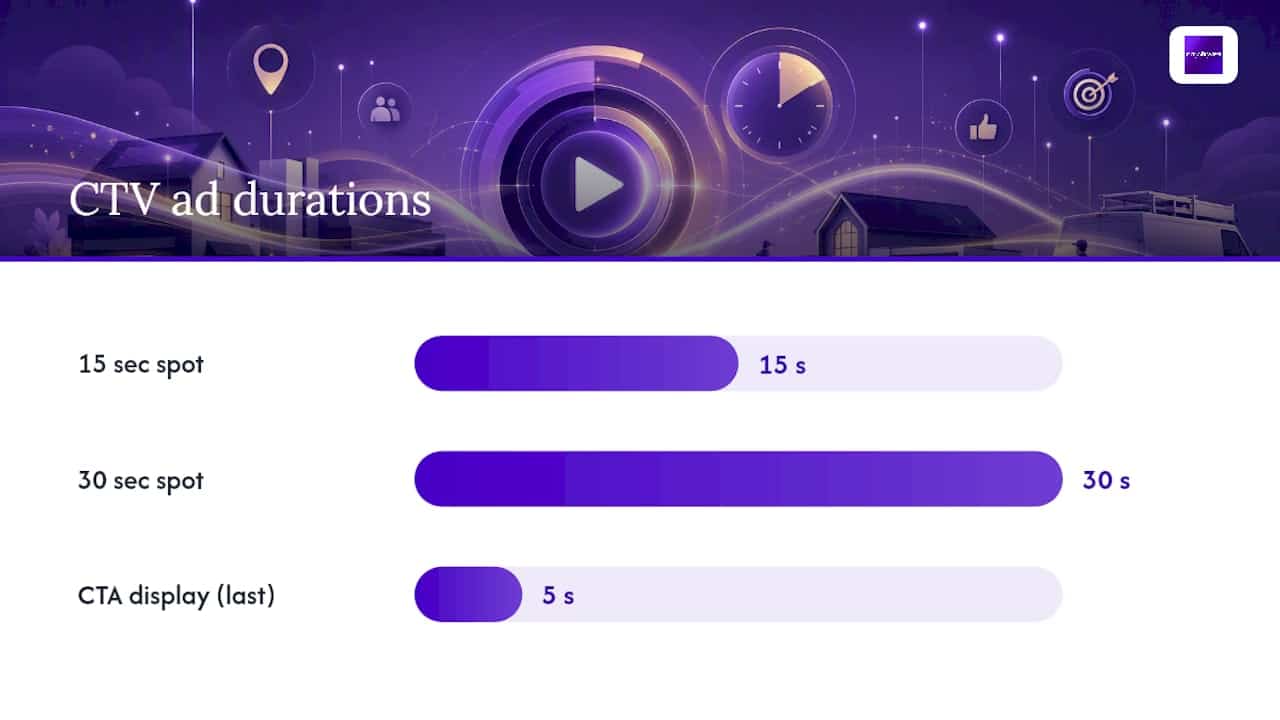
- 15 or 30 second lengths are standard; shorter rarely gives the story room to land
Production no longer requires a studio budget. AI-assisted creative tools and template-based workflows have meaningfully cut the cost of producing broadcast-quality video, which is part of why small businesses can now afford to test CTV at all. A basic setup, phone footage, a template, and a voiceover, is enough for a first test spot; you can review technical specs and format requirements in more detail in this breakdown of streaming TV ad formats.
Pro Tip: Keep your CTA on screen for the entire last five seconds of the spot, not just a flash at the end. Viewers glancing back at the screen need time to read it.
Measurement and Attribution: What You Can Realistically Track
CTV will not hand you last-click attribution the way a search ad does, and expecting it to is the fastest way to declare a working campaign a failure. Platform dashboards report impressions, completion rates, and reach, useful for confirming delivery, but not proof of business impact on their own.
The metrics that actually tell you something are downstream: branded search volume, direct site traffic, and assisted conversions in the weeks after launch. Most SMB guides recommend judging CTV against lift in these signals rather than single-view attribution, since TV exposure typically drives someone to search your name or visit your site later, not click through immediately.
A practical benchmark: compare a two-week pre-campaign baseline against your in-flight numbers for branded search and direct traffic. A meaningful jump in either, sustained for more than a week, is a real signal your CTV spend is working.
A workable tracking setup for a first test:
- A dedicated landing page URL used only in the CTV campaign, tagged with UTMs
- A separate tracking phone number if calls are your main conversion path
- A pre-campaign baseline pulled from Google Analytics and Search Console two weeks before launch
- Weekly checks on delivery and completion rate, with a full monthly review against your baseline
Judge success across the whole month, not the first week. TV-driven behavior change shows up gradually, and one slow week does not mean the campaign failed.
Step-by-Step Launch Plan: An 8-Step One-Month CTV Test
- Define your goal and KPI. Pick one: branded search lift, site traffic increase, or call volume, not all three at once.
- Choose your buying route. Self-serve for speed and control, managed for better measurement and creative support.
- Set your budget and duration. Start at $1,500 to $3,500 for a four to six week window.
- Build your creative. Brand it in the first three seconds, one CTA, 15 or 30 seconds long.
- Set up a trackable destination. A dedicated landing page with UTMs or a unique tracking phone number.
- Configure targeting. Geography first, then one audience layer, contextual targeting if you have no first-party list yet.
- Launch with frequency caps. Two to four impressions per household weekly to avoid burnout.
- Run weekly checks, then a full monthly review. Compare branded search, site traffic, and calls against your pre-campaign baseline; scale, adjust, or pause based on that lift.
Pro Tip: Set a calendar reminder for day 30, not day 7. Pulling the plug after one slow week is the single most common mistake small businesses make with a new channel.
Pairing this test with your existing search presence matters more than the CTV spend itself. Reviewing the fundamentals in a local lead generation playbook before you launch will help your search and retargeting be ready to catch the demand your TV spot creates.
City Web Company Proof Points and a Local-Service CTV Checklist
Author Matt has walked home service and med spa clients through CTV tests using the exact framework above, and the pattern holds across categories: the businesses that see results are the ones that set up measurement before they set up the ad. (Case study screenshots and campaign result data available on request.)
Before any CTV campaign goes live for a client, City Web Company runs through a fixed checklist:
- Roku pixel or Conversions API installed and firing correctly
- A dedicated, UTM-tagged landing page built for the campaign, not a generic homepage link
- A two-week pre-campaign baseline pulled from analytics and call tracking
- An initial custom audience seeded from the client’s own customer list, sized to actually deliver
For a med spa, that often means genre targeting against lifestyle and beauty content with geo-fencing around a 10-mile service radius. For a home services client, it usually means contextual placement against home improvement programming layered with homeowner audience data. In both cases, City Web Company ties the CTV buy directly to local SEO and Google Business Profile work already in motion, so the branded search lift a CTV spot generates actually lands on a page built to convert it.
When Should You Hire an Agency vs. Run CTV Yourself?
Run it yourself if your budget sits at the starter tier, you have a few hours a week to manage a dashboard, and your goal is a simple awareness test. That is a fair DIY project.
Once you are spending in the growth tier or above, or once you need cross-channel attribution tying CTV to search and social lift, a managed service starts earning its premium. City Web Company typically builds creative, sets up tracking, and manages targeting adjustments week to week for clients at that spend level, work that is hard to replicate part-time.
The honest line: agency management is worth it when measurement complexity, not just budget, outgrows what one person can watch between other responsibilities.
— Matt
Get a Managed CTV Test Built Around Your Local Market
City Web Company runs CTV campaigns the way this guide describes: geo-targeted, measured against a real baseline, and tied directly to the search and local SEO work already driving your leads, without locking you into a long-term contract to find out if it works. That combination, creative production, targeting setup, pixel and CAPI configuration, and monthly lift reporting, is exactly what most small businesses cannot assemble on their own in a spare hour a week.


If you are weighing a first CTV test against the starter budgets and timelines covered above, City Web Company can scope a campaign around your service area and existing digital marketing plan in a short consultation. Reach out to get a budget and timeline built around your specific market before your next slow season hits.
Sources
- Audience targeting — Roku Ads help
- Q1 2026 CTV Market Report: Trends for Small Businesses
- Connected TV & OTT Ads for Small Businesses | Space Agency
- CTV advertising examples — Paramount Ads Manager
FAQ
Is CTV Advertising Worth It for a Small Business?
For awareness and local demand generation, yes, especially when paired with search and retargeting to capture the interest it creates. It is not built for immediate, trackable conversions the way a search ad is.
What Are Examples of CTV Advertising?
Common formats include 15 and 30 second pre-roll or mid-roll video spots on apps like Roku and Paramount+, shoppable overlays, sponsored content placements, and companion display banners running alongside the video.
How Do I Get a TV Commercial for My Small Business?
You can build one through a self-serve platform’s ad manager, a subscription service that bundles creative with distribution, or a managed agency buy like City Web Company’s streaming TV advertising service, which handles creative, targeting, and measurement for you.
Do I Need a Large Budget to Start CTV Ads?
No. A starter tier in the $1,500 to $3,500 monthly range is enough to run a meaningful four to six week test with geo-targeting and basic measurement in place.
Recommended
These articles were popular with other readers too: