

Pass Google Business verification with a video-first checklist. Film one continuous 30 second take, fix flagged issues, and know when to hire help.
Streamline your content marketing workflow for more local leads
TL;DR:
- A structured content marketing workflow significantly increases organic traffic for local service businesses.
- Consistent publishing and optimizing content based on clear data and goals lead to sustained lead generation.
- Using AI tools can dramatically reduce content creation time and improve overall workflow efficiency.
If you’re running a local service business, you already know the frustration: you post something on social media, write a blog article every few months, maybe send an occasional email, and still watch your phone stay quiet. The leads aren’t coming in the way you expected, and your competitors seem to show up everywhere online while you’re barely visible. The problem usually isn’t effort. It’s the lack of a repeatable system. A structured content marketing workflow gives you a clear path from idea to published piece to measurable result. Organic traffic can grow 60 to 120% in six months when local service businesses follow a consistent 7 to 10 step workflow. This article walks you through every stage so you can stop guessing and start generating real leads.
Table of Contents
Table of Contents
- Understand the core steps in a content marketing workflow
- Preparation: Setting the foundation for your workflow
- Execution: Creating and optimizing your content
- Verification and iteration: Measuring success and refining your workflow
- Our take: Why most content marketing workflows fail and how to fix yours
- Ready to supercharge your local content marketing?
- Frequently asked questions
Key Takeaways
| Point | Details |
|---|---|
| Structured workflow boosts impact | A step-by-step workflow consistently increases local business leads and online visibility. |
| Preparation drives results | Defining your audience, goals, and keywords before creating content leads to better engagement. |
| AI and tools save hours | Leveraging AI and simple templates streamlines production and improves consistency. |
| Analyze and iterate regularly | Regular measurement and refinement of your workflow are essential for ongoing growth. |
Understand the core steps in a content marketing workflow
Now that you understand the value of a unified approach, let’s break down what a successful content marketing workflow looks like step by step. Most business owners think content marketing is just writing blog posts. It’s actually a system with distinct phases, each one feeding into the next. Skip a phase and the whole thing loses momentum.
The most effective workflows follow a 7 to 10 step process that covers audience definition, keyword research, and content calendar planning all the way through distribution and performance review. These aren’t just boxes to check. Each step serves a specific function that makes the next one easier and more effective.
Here’s how those steps break down in order:
- Define your audience — Know exactly who you’re trying to reach and what problems they need solved.
- Keyword research — Find the specific search terms your local customers use when they need your service.
- Content planning — Map out topics, formats, and publishing dates in a content calendar.
- Content creation — Write, record, or design the actual pieces.
- SEO optimization — Add keywords, meta descriptions, headers, and internal links to help search engines find your content.
- Internal linking — Connect new content to existing pages on your site to build authority.
- Distribution — Publish across your website, social channels, and email list.
- Promotion — Boost visibility through paid ads, partnerships, or community sharing.
- Measurement — Track traffic, leads, and conversions to see what’s working.
- Iteration — Use your data to refine topics, formats, and timing for the next cycle.
For local service businesses, not all content types carry equal weight. Here’s a breakdown of where to focus your energy:
| Content type | Recommended focus | Primary goal |
|---|---|---|
| How-to guides | 35% | Educate and attract search traffic |
| Local stories and case studies | 25% | Build trust and community connection |
| Service feature pages | 25% | Convert visitors into leads |
| Industry news and tips | 15% | Maintain authority and engagement |
The magic of a workflow is sequencing. When you follow the marketing workflow steps in order, each piece of content you create builds on the last. You’re not starting from scratch every time. You’re compounding your effort into a growing library of content that works for you around the clock.
Exploring content ideas for local businesses can also help you fill your calendar faster and avoid the blank-page paralysis that kills most content programs before they gain traction.
Preparation: Setting the foundation for your workflow
With the big-picture structure in mind, the next step is getting your foundation rock-solid before execution. Skipping prep is the number one reason local business content programs fizzle out after a few weeks. You need clarity before you create a single piece of content.
Start with your audience. For a local HVAC company, pest control service, or med spa, your audience is geographically specific and has very concrete pain points. A homeowner searching for emergency AC repair in August has a completely different mindset than someone casually browsing landscaping ideas. Write down your top three customer types, what they’re worried about, and what question they’re typing into Google at that moment.
Set measurable goals. Vague goals like “get more visibility” won’t help you. Instead, set targets like “generate 15 new service quote requests per month from organic search” or “rank in the top 3 for [city name] + plumber by the end of Q3.” Tie every content goal to a business outcome, whether that’s appointments booked, calls received, or forms submitted.
Do local keyword research. This is where most small businesses leave money on the table. Generic keywords like “pest control” are dominated by national brands. But “pest control in [your city]” or “termite inspection near [neighborhood]” are searches you can actually win. Use tools like Google Search Console, Google’s autocomplete, or a basic SEO platform to find the phrases your neighbors are actually typing.
Build a 90-day content calendar. A 90-day calendar gives you enough runway to see real results without feeling overwhelmed. Map out one to two pieces of content per week, assign topics to specific dates, and note the keyword target and content type for each entry. This single document becomes the backbone of your entire workflow.
Pro Tip: Don’t try to build a perfect calendar. Build a good enough calendar and adjust it monthly based on what’s performing. Flexibility beats perfection every time.
Here’s a quick preparation checklist before you launch:
- Audience profiles written and documented
- Business goals defined with specific numbers and timelines
- Local keyword list of at least 20 to 30 target phrases
- 90-day content calendar built and shared with your team
- Content tools selected (Google Docs, Trello, or a simple spreadsheet)
- Brand voice guidelines noted (tone, style, what to avoid)
- Distribution channels confirmed (blog, Facebook, email, Google Business Profile)
Understanding local marketing basics can sharpen your audience targeting before you commit to a content direction. And if social media is part of your distribution plan, reviewing social media tips for service businesses will help you get more reach from every post you publish.
Execution: Creating and optimizing your content
Once your prep work is complete, you’re ready to dive into the heart of content marketing: creation and continuous optimization. This is where most people either hit their stride or burn out. The difference is almost always process.

For local service businesses, the best content mixes three types: how-to guides that answer common customer questions, local stories that connect your brand to the community, and service feature pages that explain exactly what you do and why you’re the right choice. Rotating through these three keeps your content fresh and serves different stages of the buyer’s journey.
Here’s where AI tools are genuinely changing the game. AI-assisted workflows can cut content creation time from 8 hours down to 90 minutes by handling ideation, drafting, optimization, visual creation, and distribution in a structured five-stage process. That’s not a small efficiency gain. For a business owner who’s also managing crews, scheduling jobs, and handling customer calls, that time savings is the difference between a content program that happens and one that doesn’t.
Here’s how a five-stage AI-assisted workflow compares to a traditional manual approach:
| Stage | Traditional time | AI-assisted time | Savings |
|---|---|---|---|
| Topic ideation | 60 min | 10 min | 83% |
| Drafting | 180 min | 30 min | 83% |
| SEO optimization | 90 min | 15 min | 83% |
| Visual creation | 90 min | 20 min | 78% |
| Scheduling and distribution | 60 min | 15 min | 75% |
Even if you’re a one-person operation, you can assign yourself specific roles for each stage and batch your work. For example, spend Monday on ideation and drafting, Wednesday on optimization and visuals, and Friday on scheduling. This batching approach keeps you from context-switching all week.
Pro Tip: Use AI tools to generate your first draft, then rewrite the opening paragraph and any local references in your own voice. Readers can tell when content feels generic, and that personal touch is what builds trust in a local market.
For SEO optimization during execution, follow this order:
- Place your primary keyword in the title, first paragraph, and one subheading.
- Add two to three related keywords naturally throughout the body.
- Write a meta description under 160 characters that includes the keyword and a clear benefit.
- Add internal links to at least two relevant pages on your site.
- Compress images and add descriptive alt text before publishing.
Exploring AI tools for local marketing can show you which platforms are worth your time. And if you want to reduce bottlenecks in your publishing process, workflow streamlining tips built specifically for local lead generation are worth reviewing before you finalize your system.
Verification and iteration: Measuring success and refining your workflow
Great content alone won’t grow your business unless you track what actually works. Here’s how to complete the feedback loop.
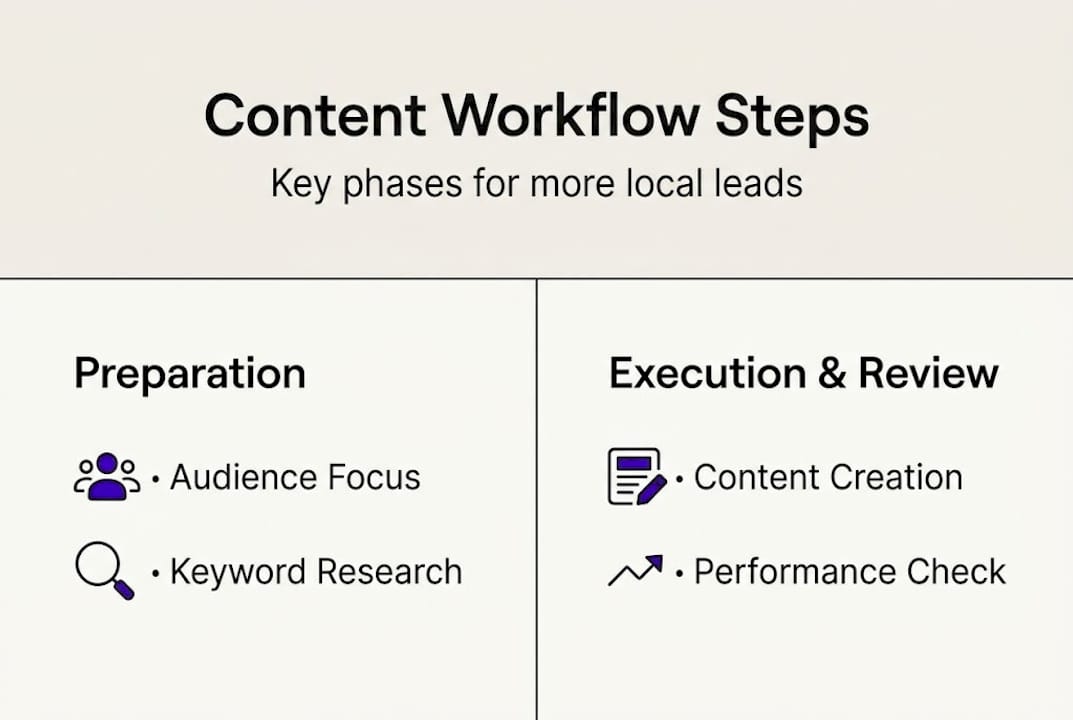

Most local business owners publish content and then never look at the numbers. That’s like planting seeds and never checking if anything grew. Measurement is what turns a content program into a lead generation machine. And it doesn’t have to be complicated.
Here’s what to track every month:
- Organic traffic — How many people found your site through search engines?
- Top landing pages — Which pieces of content are bringing in the most visitors?
- Lead conversions — How many visitors filled out a form, called, or booked an appointment?
- Keyword rankings — Are you moving up in search results for your target phrases?
- Bounce rate — Are visitors reading your content or leaving immediately?
- Time on page — Are people actually engaging with what you wrote?
Stat to know: Publishing 1 to 2 blog posts per week consistently for six months can increase your organic traffic by up to 120%. Consistency is the variable most businesses underestimate.
For tools, Google Analytics 4 and Google Search Console are free and give you most of what you need. Google Search Console shows you exactly which search queries are bringing people to your site, which is invaluable for refining your keyword strategy. If you want more depth, platforms like Semrush or Ahrefs offer local keyword tracking that can show you how you stack up against competitors in your area.
Every 30 days, review your content calendar against your actual results. Ask three questions: What performed better than expected? What underperformed? What topic or format should I test next? These three questions drive your iteration cycle.
Applying local SEO best practices during your review will help you identify technical gaps that might be holding your content back. And if you want to understand how your content fits into the bigger picture of customer acquisition, reviewing marketing funnels will show you where content is moving people closer to a purchase and where it’s losing them.
Our take: Why most content marketing workflows fail and how to fix yours
Here’s the uncomfortable truth: most local business content programs don’t fail because of bad writing or wrong keywords. They fail because the business owner treats content as a one-off project instead of an ongoing system.
You publish five blog posts in January when you’re motivated, then nothing happens for three months, then you try again in the summer. Search engines reward consistency, not bursts. Your audience forgets you exist between gaps. The workflow itself becomes the bottleneck.
Another common mistake is copying what big national brands do. A national HVAC brand can publish 20 pieces of content per week with a full marketing team. You can’t. And you don’t need to. A right-sized workflow for a local service business might mean two blog posts per month, one Google Business Profile update per week, and one email newsletter per month. That’s it. Done consistently, that beats a national brand’s generic content in your local market every time.
The fix isn’t a fancier tool or a bigger budget. It’s a simple, repeatable routine that you can actually sustain. Review your analytics on the first Monday of every month. Make one small change based on what you see. Publish on the same schedule every week, even when you’re busy. These micro-habits compound over time into real, measurable growth.
For a deeper look at building a routine that actually sticks, detailed workflow insights tailored to local businesses can give you a practical starting point.
Ready to supercharge your local content marketing?
A well-built content marketing workflow is one of the highest-return investments a local service business can make. It turns your expertise into searchable, shareable content that keeps generating leads long after you hit publish.
But building and maintaining that workflow takes time, strategy, and consistency. That’s where expert support makes a real difference. At City Web Company, we work specifically with local service businesses to build content systems that drive traffic, improve rankings, and fill your pipeline with qualified leads. Whether you’re starting from zero or trying to fix a stalled program, we can help.
Learn more about driving local leads through content, explore our full range of digital marketing services, or compare local SEO vs traditional SEO to understand which strategy fits your growth goals best.
Frequently asked questions
What are the essential steps in a content marketing workflow for local service businesses?
The workflow typically includes audience definition, keyword research, planning, creation, SEO optimization, internal linking, distribution, promotion, measurement, and iteration. Following these workflow best practices in sequence is what separates programs that generate leads from ones that stall out.
How often should I publish new content to see results?
Publishing 1 to 2 posts weekly for six months can grow your organic traffic by up to 120%. Consistency over six months matters far more than publishing frequency in any single week.
How can AI tools help my content marketing workflow?
AI-assisted workflows can handle topic ideation, drafting, optimization, and scheduling, cutting production time from hours to minutes. The key is using AI for speed while keeping your local voice and expertise front and center.
What should I track to measure content marketing success?
Monitor organic traffic, keyword rankings, lead conversions, and time on page to get a clear picture of workflow effectiveness. These four metrics together tell you whether your content is attracting the right people and turning them into customers.
Recommended
These articles were popular with other readers too: