

Discover 15 effective ways to improve online visibility in 2026. Boost your SEO, social media, and ads for rapid growth!
Boost law firm success: the vital role of content marketing
Most law firms spend thousands on paid ads and get little to show for it six months later. Meanwhile, the firms quietly publishing helpful legal guides and detailed practice area pages are pulling in qualified leads every week without spending a dollar on clicks. Content marketing is the strategic approach of creating and distributing genuinely useful information to attract, educate, and convert potential clients. For legal professionals, it is not just a marketing trend. It is one of the most powerful ways to build lasting trust, differentiate your firm, and grow a client base that comes to you already convinced you are the right choice.
Table of Contents
Table of Contents
- Why content marketing is essential for legal practices
- How content marketing transforms client acquisition and trust
- Key types of content that deliver results for law firms
- Best practices for building a content marketing strategy in legal
- Our perspective: Content marketing in legal is about trust, not buzzwords
- Ready to grow? Unlock your legal marketing potential
- Frequently asked questions
Key Takeaways
| Point | Details |
|---|---|
| Build trust with content | High-quality, well-crafted content establishes your law firm’s authority and credibility. |
| Avoid low-quality shortcuts | Cheap or poorly researched content exposes legal practices to compliance and reputational risks. |
| Strategic variety matters | Different content types such as guides and FAQs address various client needs and journey stages. |
| Invest for consistent growth | A purposeful content marketing strategy delivers long-term client leads and firm growth. |
Why content marketing is essential for legal practices
Legal content marketing is the practice of creating written, visual, or multimedia content specifically designed to educate potential clients about legal topics, showcase your firm’s expertise, and guide people toward contacting you. It is fundamentally different from standard online marketing for law firms because it earns attention rather than buying it.
The legal industry has a trust problem that advertising alone cannot fix. People searching for an attorney are often scared, confused, or facing the most stressful situations of their lives. They do not want a flashy banner ad. They want answers. When your firm’s content provides those answers clearly and accurately, you become the authority they turn to when they are ready to hire.
Content marketing also delivers compounding returns that paid ads simply cannot match. A well-written practice area page or legal guide can rank on Google for years, generating leads long after you published it. Paid ads stop the moment you stop paying. That long-term cost efficiency is one of the most underappreciated advantages in legal marketing.
Here is what content marketing actually includes for law firms:
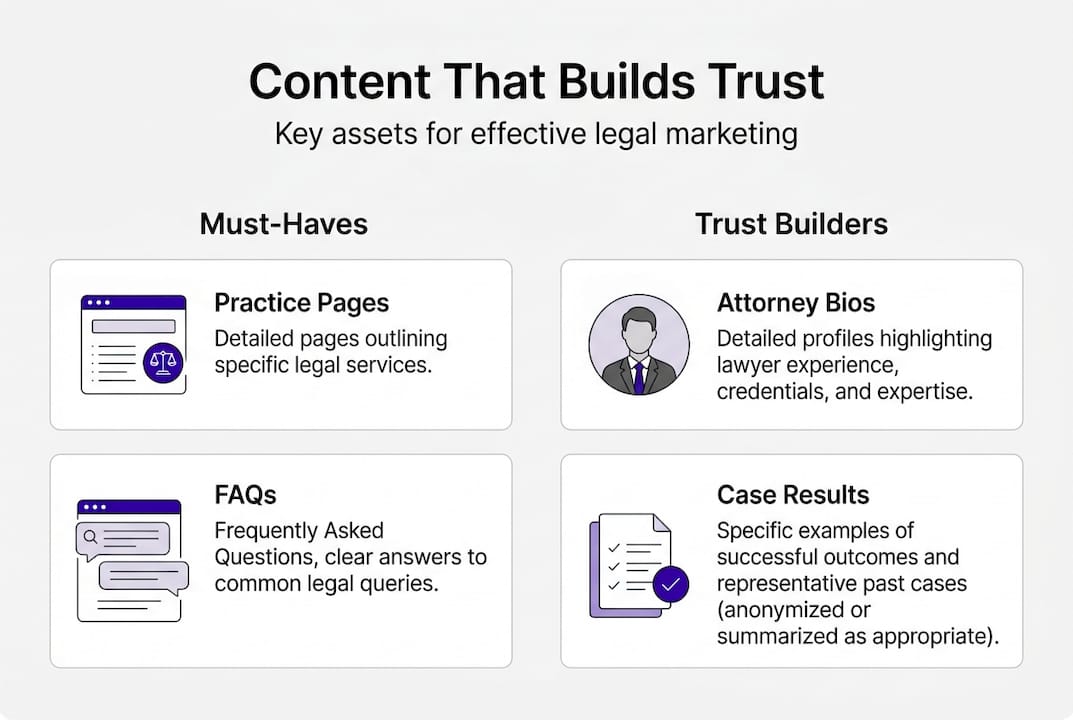
- Practice area pages that explain legal processes in plain language
- Attorney bio pages that build personal connection and credibility
- FAQ sections that address the questions clients actually search for
- Legal guides and explainers covering complex topics step by step
- Blog articles that address timely legal issues in your practice areas
- Client success stories that demonstrate real-world results
One of the most dangerous misconceptions is that volume matters more than quality. It does not. Publishing ten mediocre articles is worse than publishing one exceptional one. Cheap AI-generated content introduces inaccuracies, compliance risks, poor conversions, and Google penalties that can set your firm back significantly.
“The firms that treat content as a commodity will always lose to the ones that treat it as a credential.”
Before you publish anything, use the legal marketing checklist to make sure your content strategy is built on solid ground.
Pro Tip: Every piece of content your firm publishes should be reviewed by a licensed attorney for accuracy and compliance with your state bar’s advertising rules. One mistake can cost far more than the content ever earned.
How content marketing transforms client acquisition and trust
A potential client’s journey to hiring a law firm rarely happens in one step. They search a question, read several pages, compare firms, and then decide. Strategic content fits into each stage of that journey.
Here is how the client journey typically unfolds and where content plays a role:
- Awareness: The person searches a legal question. Your blog post or FAQ page appears in results and gives them a useful answer.
- Consideration: They visit your site, read your practice area pages, and review your attorney profiles to assess fit.
- Decision: They read a client success story or a detailed legal guide that confirms your expertise, then contact your firm.
- Retention: Post-engagement email content or resource articles keep past clients connected and encourage referrals.
This process works because content answers real questions at the right moment. It is not interrupting someone’s day. It is showing up when they need you.
| Factor | Traditional legal advertising | Content marketing |
|---|---|---|
| Cost over time | Ongoing, stops when budget stops | Compounds; content works long-term |
| Trust built | Low, often perceived as self-promotional | High, positions firm as educator |
| Lead quality | Mixed, broad audience | Higher, self-qualified prospects |
| Compliance risk | Ad-specific rules | Requires content accuracy review |
| Measurement | Impressions, clicks | Rankings, traffic, conversions |
The compliance dimension is critical and often overlooked. Low-quality legal content that contains inaccurate legal statements can expose your firm to bar complaints and erode client trust overnight. Every piece of content is a reflection of your professional judgment.

Practical formats that convert well include detailed FAQ pages that mirror real client questions, practice area explainers written in plain English, and attorney profiles that feel human rather than corporate. Review the law firm marketing types that complement content to build a fuller strategy.
For website structure guidance, the website essentials for law firms resource covers exactly what pages and content elements convert visitors into consultations.
Pro Tip: Keep a running list of every question a client asks during intake. Each question is a content idea. Build your editorial calendar directly from those real-world conversations, and you will never run out of relevant topics.
Key types of content that deliver results for law firms
Not all content formats perform equally in the legal space. Some build visibility. Others build trust. The best strategy uses a mix of both, matched to your firm’s goals.
Here is a breakdown of the top-performing legal content types:
- Practice area pages: The backbone of legal SEO essentials. These pages target high-intent search terms and explain what you do, who you help, and how the process works.
- Legal guides and explainers: Long-form content that walks readers through a process, such as how to file for divorce or what to expect after a DUI charge. These build deep authority.
- FAQ pages: Directly answer the questions people type into Google. Short, accurate, and incredibly useful for featured snippet rankings.
- Attorney profiles: People hire people, not firms. A well-written bio with a professional photo and clear background information builds immediate personal trust.
- Client success stories: Without violating confidentiality rules, outcome-focused stories show prospective clients what results look like. Strong branding tips for legal firms always include this format.
- Blog articles: Timely, topic-specific posts that address current legal questions, recent case law changes, or seasonal legal concerns in your practice area.
| Content type | Primary benefit | Compliance note |
|---|---|---|
| Practice area pages | Search visibility, conversions | Avoid guaranteeing outcomes |
| Legal guides | Authority, organic traffic | Must be jurisdiction-accurate |
| FAQ pages | Featured snippets, trust | Verify all legal statements |
| Attorney profiles | Personal trust, differentiation | Accurate credentials only |
| Client success stories | Social proof, conversion | Obtain proper consent |
| Blog articles | Topical authority, engagement | Review for bar ad rules |
The pattern here is clear. AI-generated legal content without expert review can fail on nearly every compliance note in that table. Jurisdiction-specific accuracy is non-negotiable in law. A guide about tenant rights in Texas cannot be repurposed for New York without a full rewrite.

For attorneys looking to maximize search performance, the SEO for attorneys guide covers how to align content with the technical side of search optimization.
Best practices for building a content marketing strategy in legal
A strategy without structure is just guessing. Here is a straightforward workflow for building a legal content marketing strategy that is compliant, consistent, and results-driven.
- Set clear goals. Are you trying to rank for specific practice areas, increase consultation requests, or build brand awareness in a new market? Your goals determine every other decision.
- Research your audience. Understand who your ideal clients are, what they search for, and what questions they have before hiring an attorney. Use intake data, Google Search Console, and competitor analysis.
- Conduct a compliance review. Before creating any content, understand your state bar’s advertising rules for written content, testimonials, and outcome claims. Build these rules into your editorial guidelines.
- Build an editorial calendar. Plan content at least 90 days in advance. Assign topics, formats, target keywords, and responsible reviewers for each piece.
- Distribute strategically. Publish on your website, share through email newsletters, and promote on LinkedIn or other platforms where your clients spend time. Law firm website optimization ensures your site is ready to convert that traffic.
- Measure and refine. Track organic traffic, time on page, consultation form completions, and keyword rankings. Cut what does not work. Double down on what does.
The most common mistakes firms make are publishing generic content that could belong to any firm, using unvetted AI tools that introduce factual errors, and skipping the compliance review entirely. All three mistakes can result in the exact opposite of what you want: lower trust, lower rankings, and potential bar complaints.
Local SEO for attorneys is another layer of the strategy that amplifies your content’s reach within your geographic market. Local relevance matters enormously for most practice areas.
Pro Tip: If you do not have an in-house attorney available to review marketing content, establish a written review protocol with a designated reviewer and a checklist tied to your state bar’s advertising rules. Consistency in that process protects your firm every time.
Our perspective: Content marketing in legal is about trust, not buzzwords
We have worked with enough law firms to see the same pattern repeat itself. A firm gets excited about content marketing, outsources it to the cheapest provider they can find, publishes a batch of generic articles, sees no results, and concludes that content marketing does not work for legal. The real conclusion should be that shortcuts do not work.
The firms that win with content are the ones that treat it as an extension of their professional reputation. Every article, every FAQ answer, every attorney bio is a signal to a potential client about how you think, how you communicate, and whether you can be trusted.
Digital marketing for law firms works best when the content strategy is built on genuine expertise rather than keyword stuffing or AI shortcuts. Algorithm updates come and go. Firms that have built real authority through quality content survive every shake-up. The ones chasing cheap volume do not.
Smart content investment is a strategic asset. It builds a library of credibility that works for your firm around the clock.
Ready to grow? Unlock your legal marketing potential
Understanding content marketing is one thing. Executing it consistently, compliantly, and at a level that actually moves the needle is another challenge entirely. That is where having the right partner makes all the difference.

At City Web Company, we specialize in digital marketing for law firms that goes beyond generic tactics. Our team builds custom content strategies designed around your practice areas, your clients, and your growth goals. From editorial planning to SEO-optimized content and full digital marketing services, we handle the strategy so you can focus on practicing law. Explore how our tailored approach to online marketing for law firms can help your firm attract better clients and build lasting authority.
Frequently asked questions
Why is content marketing better than paid ads for law firms?
Content marketing builds lasting authority and organic trust that continues generating leads long after publication, while paid ads stop delivering the moment your budget runs out. For most practice areas, low-quality content risks aside, a well-executed content strategy delivers a far better long-term return on investment.
What are the most effective content types for legal practices?
Practice area pages, FAQ sections, attorney profiles, and client success stories consistently deliver the strongest results because they match what potential clients are actively searching for and address the trust factors that drive hiring decisions.
Can AI tools safely write legal content?
Without thorough expert review, AI-generated legal content can introduce serious compliance risks and factual inaccuracies that expose your firm to bar complaints and damage your credibility with potential clients.
How often should law firms publish new content?
Quality and compliance always outweigh frequency. Aim for at least one substantive, well-reviewed piece per month rather than rushing out frequent content that lacks accuracy or strategic focus.
Recommended
These articles were popular with other readers too: