

Use website DNI, connect call reports to Google Ads and your Google Business Profile, then tie calls to booked jobs. City Web Company can handle setup.
Why Legal Firms Need SEO for Lasting Growth
Most American law firms underestimate how quickly an outdated website can cost them new business. With over 80 percent of potential clients starting their search for legal help online, relying on old advertising tactics puts your firm at a clear disadvantage. Understanding what legal SEO really means and clearing up common misconceptions empowers small and medium firms to grow their reach, attract quality cases, and build lasting credibility in the digital age.
Table of Contents
Table of Contents
- Legal SEO Defined And Common Misconceptions
- Types Of SEO For Law Firms Explained
- How SEO Attracts And Converts Clients
- Ethics, Bar Rules, And Legal Compliance
- Risks, Costs, And Common Mistakes To Avoid
Key Takeaways
| Point | Details |
|---|---|
| Importance of Ongoing SEO | Legal SEO is not a one-time effort; it requires continuous optimization to adapt to evolving search algorithms and maintain competitiveness. |
| Types of SEO for Law Firms | Understanding Local, Organic, Technical, and Content SEO can help law firms effectively attract and convert clients by addressing specific online visibility needs. |
| Compliance with Ethical Standards | Law firms must navigate complex legal advertising regulations to ensure all SEO efforts adhere to professional ethical standards and maintain client confidentiality. |
| Common SEO Pitfalls | Firms should avoid broad keyword targeting and neglecting technical SEO, as these can lead to wasted resources and opportunities for client acquisition. |
Legal SEO Defined and Common Misconceptions
Search engine optimization (SEO) represents a strategic digital marketing approach specifically designed to enhance online visibility for legal practices. Search engine optimization fundamentally improves website traffic through targeted organic search strategies that help law firms attract potential clients searching for legal services online.
Unlike traditional advertising, SEO focuses on positioning legal websites to appear prominently when potential clients search for specific legal assistance. This means optimizing website content, metadata, and technical structures to align with search algorithms and user search patterns. Effective legal SEO involves understanding complex ranking factors such as keyword relevance, content quality, site performance, and geographic targeting.
Common misconceptions about legal SEO often prevent law firms from maximizing their digital potential. Many attorneys mistakenly believe SEO is a one-time effort or exclusively about ranking first on Google. In reality, SEO requires ongoing optimization and strategic content development to maintain competitive search positions. Successful legal SEO demands continuous refinement of website content, monitoring search trends, and adapting to evolving search engine algorithms.
Pro Tip: Regularly audit your law firm’s website performance using professional SEO tools to identify and address technical optimization opportunities that could improve your search rankings.
Types of SEO for Law Firms Explained
Law firms must understand the nuanced landscape of search engine optimization to effectively attract and convert potential clients online. Different SEO strategies serve unique purposes in digital marketing for legal practices, each addressing specific aspects of online visibility and client engagement. Analyzing competitor website strategies can provide valuable insights into effective SEO approaches.
The primary types of SEO for legal practices include Local SEO, Organic SEO, Technical SEO, and Content SEO. Local SEO focuses on geographic-specific searches, helping law firms appear in location-based queries like “personal injury lawyer in Chicago” or “divorce attorney near me”. This approach optimizes Google Business Profile listings, local directory citations, and region-specific website content to attract clients in a specific service area.
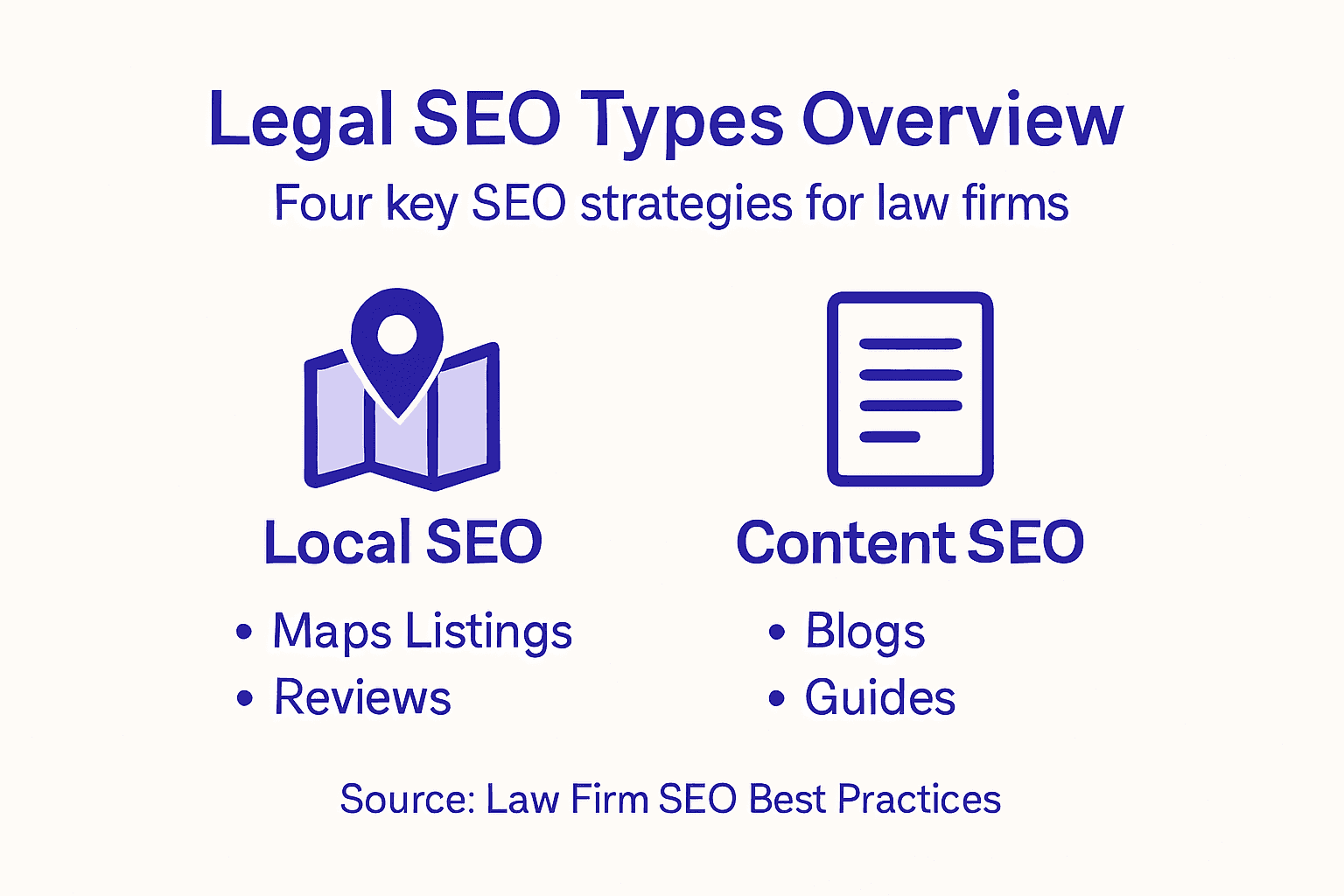
Organic SEO involves improving a law firm’s overall website ranking through strategic keyword optimization, high-quality content creation, and building authoritative backlinks. Technical SEO ensures websites meet search engine performance standards by improving site speed, mobile responsiveness, secure connections, and structured data markup. Content SEO concentrates on developing informative, relevant content that addresses potential clients’ legal questions and demonstrates the firm’s expertise across practice areas.
Pro Tip: Implement a comprehensive SEO strategy that integrates all four SEO types, regularly analyzing performance metrics to refine and improve your law firm’s online visibility and client acquisition efforts.
Here’s a quick comparison of the four main types of SEO for law firms and their distinct roles:
| SEO Type | Main Purpose | Key Activities | Impact on Client Acquisition |
|---|---|---|---|
| Local SEO | Target location-based search | Google Business optimization | Drives local clients to your practice |
| Organic SEO | Boost overall visibility | Keyword strategy, backlinks | Attracts broader client pool |
| Technical SEO | Improve site performance | Speed, mobile, security fixes | Enhances user experience and trust |
| Content SEO | Showcase legal expertise | Informative content creation | Builds authority, educates clients |
How SEO Attracts and Converts Clients
Search engine optimization transforms how law firms connect with potential clients in the digital marketplace. SEO improves website visibility and trust signals by strategically positioning legal practices where potential clients are actively searching for legal assistance. This approach goes beyond simple online advertising, creating meaningful connections through targeted, relevant content that addresses specific legal needs.


The conversion process begins with understanding user intent. When potential clients search for legal services, they typically seek solutions to complex legal challenges. Effective SEO strategies help law firms appear as authoritative, trustworthy resources by developing content that directly answers common legal questions, explains complex legal concepts, and demonstrates professional expertise. This approach involves creating detailed practice area pages, informative blog posts, comprehensive legal guides, and frequently asked questions sections that provide genuine value to potential clients.
Successful SEO conversion requires a multifaceted approach that combines technical optimization with high-quality, user-focused content. Law firms must optimize their websites for mobile devices, improve page loading speeds, ensure clear navigation, and implement strategic calls-to-action that guide potential clients toward consultation requests. Developing SEO-friendly content that engages visitors involves understanding client pain points, using clear and compassionate language, and creating content that positions the firm as both knowledgeable and approachable.
Pro Tip: Develop client personas to create hyper-targeted content that speaks directly to specific legal challenges, increasing the likelihood of converting website visitors into actual clients.
Ethics, Bar Rules, and Legal Compliance
Search engine optimization for law firms requires a delicate balance between effective marketing and strict adherence to professional ethical standards. Turning website visitors into paying clients demands careful navigation of complex legal advertising regulations that vary significantly across different jurisdictions and state bar associations.
Each state’s bar association maintains specific guidelines governing online marketing and attorney advertising. These regulations typically address critical areas such as false or misleading content, client confidentiality, direct solicitation prohibitions, and maintaining professional integrity in digital communications. Law firms must meticulously review their SEO content to ensure compliance with rules that prevent exaggerated claims, guarantee client privacy, and protect the fundamental principles of legal professional ethics. This means avoiding guaranteed outcome statements, protecting potential client information, and presenting factual, transparent representations of legal services.
The ethical challenges of digital marketing extend beyond content creation to include technical considerations of website design and client interaction. Law firms must implement robust privacy protections, secure contact forms, clear disclaimer language, and transparent communication about attorney-client relationships. Attorneys need to be particularly cautious about potential conflicts of interest, ensuring that online marketing strategies do not inadvertently create professional boundary issues or compromise the confidential nature of legal consultations.
Pro Tip: Conduct a quarterly compliance audit of your law firm’s digital marketing materials, involving both your marketing team and legal ethics counsel to ensure ongoing adherence to professional standards.
Risks, Costs, and Common Mistakes to Avoid
Legal firms investing in SEO must carefully navigate potential pitfalls that can derail their digital marketing efforts and waste valuable resources. Common SEO mistakes can significantly impact client acquisition and undermine a firm’s online visibility, making strategic awareness crucial for sustainable growth.
Some of the most critical risks involve keyword strategy and technical implementation. Many law firms mistakenly target overly broad or irrelevant keywords that fail to attract genuine potential clients. These errors can lead to inefficient marketing spend, low-quality website traffic, and diminished return on investment. Costly SEO mistakes often stem from neglecting technical optimization, which includes issues like slow website loading speeds, poor mobile responsiveness, inconsistent name and address information, and inadequate local search optimization.
Financial risks are significant for law firms that approach SEO without a comprehensive strategy. Unsuccessful SEO efforts can result in wasted marketing budgets, missed client opportunities, and competitive disadvantages. Firms must invest in consistent, high-quality content, maintain accurate online business profiles, leverage client reviews strategically, and implement robust conversion tracking mechanisms. The most successful law firm SEO strategies require ongoing commitment, regular performance analysis, and adaptive techniques that respond to changing search engine algorithms and user behaviors.
Below is a summary of common legal SEO risks, their effects, and tips to mitigate them:
| Risk Area | Potential Consequence | Mitigation Strategy |
|---|---|---|
| Poor Keyword Selection | Attracts wrong visitors | Research keywords relevant to clients |
| Neglected Technical SEO | Lower search rankings | Regular site audits and improvements |
| Inconsistent Listings | Reduces local search success | Keep business data updated everywhere |
| Compliance Oversights | Ethical or legal issues | Regularly review bar marketing rules |
Pro Tip: Allocate a dedicated monthly budget for SEO performance review and continuous optimization, treating digital marketing as a long-term investment rather than a one-time expense.
Unlock Lasting Growth for Your Legal Firm with Expert SEO Strategies
The article highlights the essential challenge legal firms face in maintaining ongoing online visibility through strategic SEO efforts. If you want to overcome common hurdles like staying compliant with bar rules, targeting the right local clients, and refining your technical and content SEO, you are in the right place. City Web Company specializes in tailored digital solutions that turn these SEO complexities into measurable growth opportunities by enhancing search rankings, driving qualified leads, and building trusted online reputations.

Discover how our comprehensive approach to SEO combines targeted local optimization with content excellence and technical precision. Visit our Digital Marketing Strategy Guides | City Web Company to learn actionable tactics designed specifically for law firms. Start transforming your online presence today and stay ahead of competitors by partnering with a proven agency. Take the next step now by exploring how we can amplify your legal firm’s growth at https://citywebcompany.com and manage your Online Reputation to build lasting client trust.
Frequently Asked Questions
What is legal SEO and why is it important for law firms?
Legal SEO is a strategic digital marketing approach aimed at improving the online visibility of law firms. It helps attract potential clients who are actively searching for legal services, ensuring that the firm’s website appears prominently in search results.
How does legal SEO differ from traditional advertising?
Unlike traditional advertising, which often focuses on paid placements, legal SEO aims to organically position law firm websites in search engine results. This involves optimizing content, metadata, and technical aspects of the site to align with user search behaviors and search algorithms.
What are the main types of SEO that law firms should consider?
Law firms should focus on four main types of SEO: Local SEO, Organic SEO, Technical SEO, and Content SEO. Each type addresses different aspects of online visibility, from location-specific searches to ensuring website performance and content quality.
What are some common mistakes law firms make with their SEO strategies?
Common mistakes include targeting irrelevant keywords, neglecting technical SEO aspects like site speed, maintaining inconsistent business listings, and failing to comply with legal advertising regulations. These errors can hinder visibility and reduce potential client engagement.
Recommended
- Law Firms Marketing Company | SEO & Lead Generation
- The True ROI of SEO – What the Numbers Don’t Always Show – City Web Company | Digital Marketing Agency
- How to Grow Your Small Business Online Successfully – City Web Company | Digital Marketing Agency
- Boost Your Rank with Our SEO Services – City Web Company
These articles were popular with other readers too: