

See how plumbers can turn Facebook scrollers into booked jobs with clear offers, local targeting, a 30 day test budget, fast follow up, and a path to scale.
Small Business SEO Cost: What You’ll Really Pay in 2026
Most small businesses should budget $1,000 to $3,000 a month for SEO, and skip straight to a paid audit before signing any retainer. That single decision, audit first, retainer second, prevents most of the budgeting mistakes small business owners make. Bare-bones local packages start around $500 a month, standard small business retainers commonly land between $1,000 and $3,500, and growth-stage programs in competitive markets run $3,500 or more.
Here’s the quick breakdown before we go deeper:
- Starter/local: $500 to $1,500/month, usually one location, basic Google Business Profile and on-page work
- Standard SMB: $1,500 to $3,500/month, broader keyword targeting, regular content, and link building
- Growth/competitive: $3,500+/month, multi-location or high-competition industries, heavier content and authority building
Pro Tip: Never sign a 12-month retainer before you’ve paid for a standalone audit. It costs a fraction of the retainer and tells you exactly what you’re buying.
Expect 3 to 6 months before you see meaningful movement in rankings, and 6 to 12 months before that movement turns into a reliable stream of leads. Anyone promising faster is either exaggerating or targeting keywords nobody searches for.
Table of Contents
Key Takeaways
Small business SEO cost depends far more on scope and market competition than on any single “average” price, and an audit is the only reliable way to set that scope correctly.
| Point | Details |
|---|---|
| Typical monthly range | Most small businesses should budget $1,000 to $3,000/month, with starter tiers as low as $500. |
| Audit comes first | A standalone audit ($500 to $30,000) scopes real technical debt before any retainer is signed. |
| Line items vary widely | Content runs $0.20 to $2.00 per word and links run $100 to $1,500 each, so quotes should itemize both. |
| Timeline expectations | Expect 3 to 9 months for starter results and 6 to 12 months for standard program growth. |
| City Web Company approach | Scopes starter and standard packages around each local business’s industry and location footprint, starting with a paid audit. |
Table of Contents
- How Much Does Small Business SEO Cost? Pricing at a Glance
- What Pricing Model Should You Choose: Retainer, Project, or Hourly?
- What Does Each Line Item Actually Cost?
- Why Does SEO Cost More for Some Businesses Than Others?
- What Budget Fits Your Business, and How Long Until It Pays Off?
- How Do You Set an SEO Budget and Evaluate a Quote?
- How a Local-Focused Agency Actually Scopes and Prices Packages
- What the Pricing Conversation Usually Gets Wrong
- Start With an Audit, Not a Contract
- Sources
- FAQ
How Much Does Small Business SEO Cost? Pricing at a Glance
Every SEO quote you get should map to one of a handful of recognizable price bands. If a proposal doesn’t fit anywhere close to these ranges, that’s your first red flag, not necessarily because it’s expensive, but because it’s unscoped.
Starter/local tier ($500 to $1,500/month). This typically covers Google Business Profile management, basic citation cleanup, and light on-page optimization for a single location. It rarely includes meaningful content production or link building. Local SEO for a single-location business commonly runs between $500 and $2,500 a month depending on how competitive your market is.
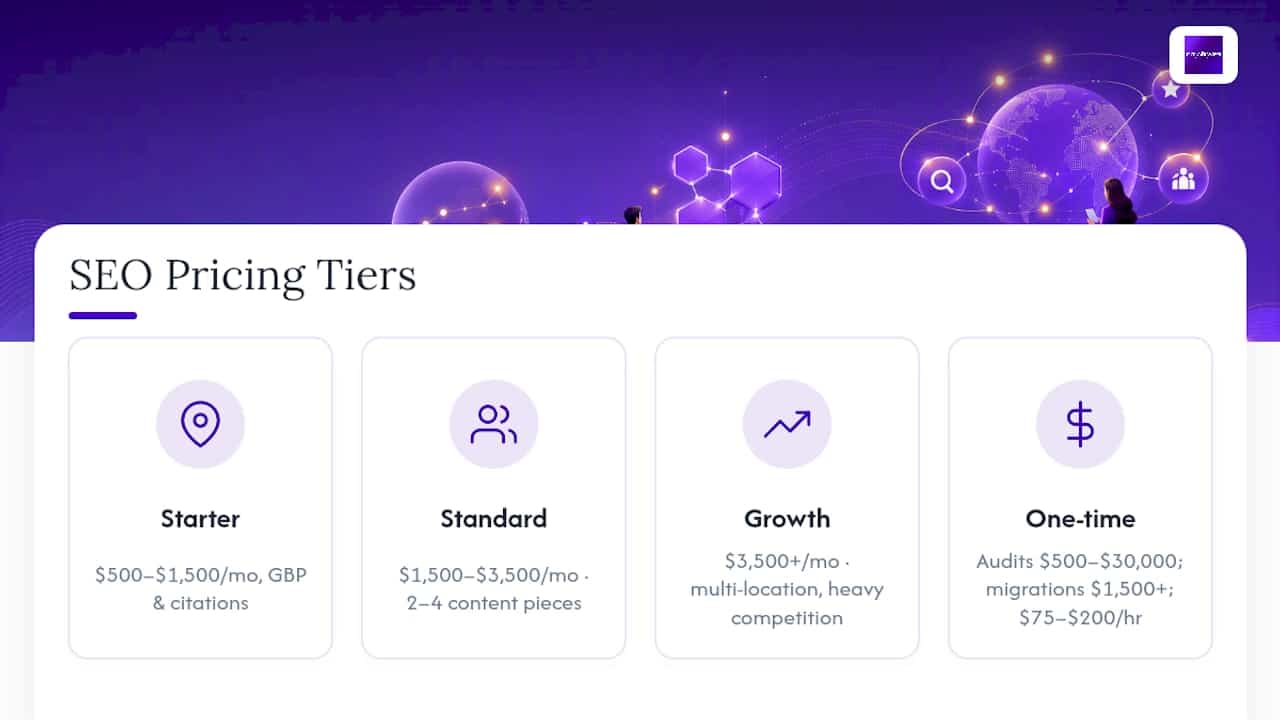
Standard SMB retainer ($1,500 to $3,500/month). This is where most established small businesses land. Expect ongoing content production (two to four pieces a month), technical monitoring, some link acquisition, and monthly reporting tied to actual ranking and traffic movement.
Growth/competitive retainer ($3,500 and up per month). Multi-location businesses, or anyone competing in a crowded category like personal injury law or med spas, needs this tier. It buys deeper content calendars, structured link campaigns, and often dedicated strategist time.
One-time and hourly work. A standalone audit ranges from $500 for a basic site review to $30,000 for an enterprise-level technical audit, according to Forbes Advisor. Site migrations are typically quoted as flat projects starting around $1,500. Hourly consulting for strategy or troubleshooting runs $75 to $200 an hour depending on the consultant’s experience.
What Pricing Model Should You Choose: Retainer, Project, or Hourly?
The model matters as much as the number. Here’s how the four common structures actually work in practice.
- Monthly retainer. This is the default for ongoing SEO because rankings build cumulatively. You’re paying for sustained content, link building, and technical maintenance month over month, not a one-time fix. Most agencies want a minimum three to six month commitment because Google needs time to reward consistent signals.
- Project-based pricing. Best for discrete, finite work: a technical audit, a site migration, or a content gap analysis. Expect flat fees from $500 for a basic audit up to $5,000 or more for a full technical and content strategy package.
- Hourly consulting. Useful when you need a second opinion on an in-house strategy or a one-time fix, not an ongoing relationship. Rates typically run $75 to $200 an hour, and it’s the least common way small businesses actually structure their SEO spend.
- Performance-based pricing. Rare, and for good reason. Agencies that tie fees strictly to ranking positions or traffic often push toward manipulative tactics or narrow, easy-to-rank keywords that don’t convert. Read the contract closely if anyone offers this model.
Pro Tip: If a vendor pitches performance-based pricing, ask exactly which keywords count toward “performance.” Vague answers here are the biggest red flag in the entire proposal.
What Does Each Line Item Actually Cost?
A retainer is a bundle of individual deliverables, and every one of them has its own market rate. Knowing these numbers lets you catch a quote that’s padded or, just as often, one that’s dangerously thin.
- SEO audit: $500 to $30,000 depending on site size and depth, per Forbes Advisor. A thorough audit covers technical crawlability, page speed, on-page structure, backlink profile, and competitor gap analysis, not just a generic checklist.
- Content production: $0.20 to $2.00 per word is the going range. Anything under $0.10 a word usually signals thin, AI-generated filler with no research or editing behind it.
- Link building: $100 to $1,500 per link depending on the outreach effort and the authority of the placement. A vendor promising “50 links a month for $300” is buying you spam, not authority.
- Technical work and tooling: Site speed fixes and migrations are typically quoted separately from the retainer. Monitoring tools (Ahrefs, Semrush, or similar platforms) usually run $100 to $400 a month and should be itemized, not buried in your management fee.
- Local tasks: Google Business Profile optimization and citation management scale with your location count. Each additional location adds real management time, so per-location pricing should step up, not stay flat.
Cheap monthly packages in the $300 to $500 range typically buy only a few hours of actual work each month, which rarely moves the needle in any competitive category.
Why Does SEO Cost More for Some Businesses Than Others?
Two businesses in the same city can get wildly different SEO quotes, and often both are fair. The price follows the difficulty, not the vendor’s mood.
- Keyword competition and market density. A plumber in a mid-size city competes with a dozen rivals. A personal injury attorney in a major metro competes with hundreds of firms spending six figures a month. That gap alone can triple the required budget.
- Technical debt and site size. A five-page WordPress site needs far less audit and fix work than a 500-page e-commerce catalog with years of accumulated redirects and duplicate content.
- Backlink and authority gaps. If your site has almost no backlink profile and your competitors have been building links for a decade, closing that gap costs more time and money than maintaining an already-strong position.
- Multiple locations. Each additional location multiplies Google Business Profile work, local citation cleanup, and often requires location-specific landing pages, all of which scale the retainer.
- Content and conversion complexity. A business selling a single service needs simpler content than one with a dozen service lines, each requiring its own optimized page and conversion path.
Market data on how consumers actually search for local businesses online backs up why Google Business Profile and local signals carry outsized weight in single-location budgets. Get that piece wrong and everything downstream costs more to fix.
What Budget Fits Your Business, and How Long Until It Pays Off?
Match your profile to a tier, not the other way around. Trying to compete in a growth-tier category on a starter-tier budget is the single most common way small businesses waste SEO spend.
- Starter/local profile ($500 to $1,500/month). Fits a single-location service business in a low-to-moderate competition market. Expect Google Business Profile optimization, basic on-page fixes, and light citation work. Timeline to noticeable movement: 3 to 9 months.
- Standard SMB profile ($1,500 to $3,500/month). Fits an established business ready to compete for broader keyword sets with regular content and link building. Timeline to measurable lead growth: 6 to 12 months.
- Growth/competitive profile ($3,500 and up per month). Fits multi-location businesses or crowded categories that need sustained authority building through heavier content output and structured outreach. Results compound over 12 months and beyond, and rarely arrive faster regardless of budget.
Before committing to any tier, run a one-time audit first. It exposes your actual technical debt and content gaps, which is the most defensible way to scope a realistic retainer rather than guessing.
| Point | Details |
|---|---|
| Starter budget | $500 to $1,500/month covers one location, GBP optimization, and basic on-page fixes. |
| Standard budget | $1,500 to $3,500/month adds regular content and link building for broader keyword targeting. |
| Growth budget | $3,500+/month fits multi-location or high-competition industries needing sustained authority building. |
| Timeline reality | Expect 3 to 9 months for starter results, 6 to 12 months for standard programs. |
How Do You Set an SEO Budget and Evaluate a Quote?
Budgeting for SEO isn’t guesswork if you work the math backward from your revenue goals instead of picking a number that feels comfortable.


Start with a three-step method. First, calculate what a new customer is worth to your business over their lifetime, not just the first sale. Second, set a realistic KPI target, say, 20 more qualified leads a month, based on that number. Third, match the scope (content volume, link velocity, technical depth) to that goal rather than to an arbitrary budget ceiling.
When you’re comparing vendor quotes, ask these questions directly:
- What specific deliverables come with this retainer each month, in writing?
- How do you report progress, and can I see rankings, traffic, and lead data, not just vanity metrics?
- Which tools do you use for tracking and reporting, and are those costs included or billed separately?
- What happens to my content, links, and Google Business Profile access if I leave?
Watch for red flags: vague language like “proprietary strategies,” no named deliverables, contracts with steep early-exit penalties, or a refusal to share which tactics they’re actually using. A clear digital marketing budget framework makes it easier to line up three competing quotes side by side and score each one on deliverables, transparency, and price per outcome, not just the headline number.
Pro Tip: Ask every vendor the exact same five questions in the same order. The differences in how confidently they answer tell you more than the price difference ever will.
How a Local-Focused Agency Actually Scopes and Prices Packages
City Web Company builds packages around what a specific local service business actually needs, not a one-size template. A starter package for a single-location HVAC company typically centers on Google Business Profile optimization, citation cleanup, and on-page fixes tied to service-area keywords. A standard package for a growing med spa or pest control company usually adds monthly content, structured local link building, and conversion-focused landing pages for each service line.
The businesses that get the most out of an SEO budget are the ones that treat the first month as a diagnostic, not a sprint. An audit that maps technical debt, content gaps, and competitor positioning before any retainer work begins protects the entire budget that follows.
Case studies and client results specific to City Web Company’s local service clients are available on request and detailed in how SEO drives revenue for small businesses.
- Transparent monthly reporting tied to rankings, traffic, and leads, not just activity logs
- An audit-first approach before any retainer commitment
- Scoping built around your specific service lines and locations, not a generic package
What the Pricing Conversation Usually Gets Wrong
The industry loves to frame SEO cost as a single number, and that framing sets small business owners up to fail before they even sign a contract. The real variable isn’t the price, it’s the scope hiding behind it. A $1,500-a-month retainer that includes real content production and technical monitoring beats a $3,000-a-month retainer that’s mostly account management and a monthly PDF.

Here’s what conventional advice tends to skip: the audit isn’t a sales gimmick, it’s the only way to know whether your business needs the starter tier or the growth tier in the first place. Skipping it and jumping straight to a 12-month retainer is how businesses end up paying growth-tier prices for starter-tier execution, or worse, starter-tier prices for a problem that actually needed growth-tier resources.
If there’s one thing worth prioritizing above everything else in this guide, it’s this: demand named deliverables before you sign anything. “SEO services” is not a deliverable. “Four blog posts, twelve local citations, and a technical fix list” is.
— Matt
Start With an Audit, Not a Contract
There are other ways to approach small business SEO, doing it yourself with free tools, hiring a freelancer by the hour, or bringing someone in-house. Each has its place, but each also asks you to either learn the discipline yourself or gamble on one person’s bandwidth. City Web Company works differently: it scopes your specific business, industry, and location footprint before quoting a single dollar of ongoing retainer.

That audit-first approach means you’re never paying for a growth-tier program when a starter package would do the job, and you’re never underpaying for a competitive market that actually needs more firepower. City Web Company builds starter and standard packages specifically for local service businesses, home services, med spas, pest control, HVAC, and similar categories, where the scoping has to match the local competition, not a national template. If white-label delivery or automated audit tooling fits your workflow better, BabyLoveGrowth’s white-label SEO services are worth a look too. For most readers here, the practical next step is the same one this article has recommended throughout: get a scoped audit before you commit to a retainer. Start by reviewing City Web Company’s small business marketing services and requesting a quote built around your actual site and market, not a generic price sheet.
Sources
- How Much Does SEO Really Cost? – Forbes Advisor
- How Much Does SEO Cost in 2026? US Pricing Guide (Real Numbers)
- Local SEO Budget Benchmarks by Industry: What Small Businesses Actually Pay in 2026
- How Much Does SEO Cost for a Small Business? (2026 Complete Pricing Guide) | ConversionCrush Blogs
FAQ
How Much Does It Cost To Do SEO?
Most small businesses pay $1,000 to $3,500 a month for ongoing SEO, though single-location local programs can start around $500 and competitive multi-location programs can exceed $3,500.
Is a Cheap SEO Package Ever Worth It?
Packages priced at $300 to $500 a month typically buy only a few hours of work monthly, which rarely produces results in any competitive category.
How Much Should a Small Business Spend on Local SEO?
Local SEO for a single location commonly runs $500 to $2,500 a month depending on how competitive the local market is.
Should I Do an Audit Before Signing a Retainer?
Yes. A standalone audit exposes technical debt and content gaps first, which prevents under-budgeting and helps you scope the right retainer tier instead of guessing.
How Long Does It Take To See SEO Results?
Expect 3 to 9 months for a starter-tier program and 6 to 12 months for a standard small business program before growth becomes reliable and measurable.
Recommended
These articles were popular with other readers too: