

Discover what a local citation is and how it can boost your small business's visibility. Check your NAP and enhance your local rankings today!
Best Marketing Tools for Healthcare: a Compliance-First Guide
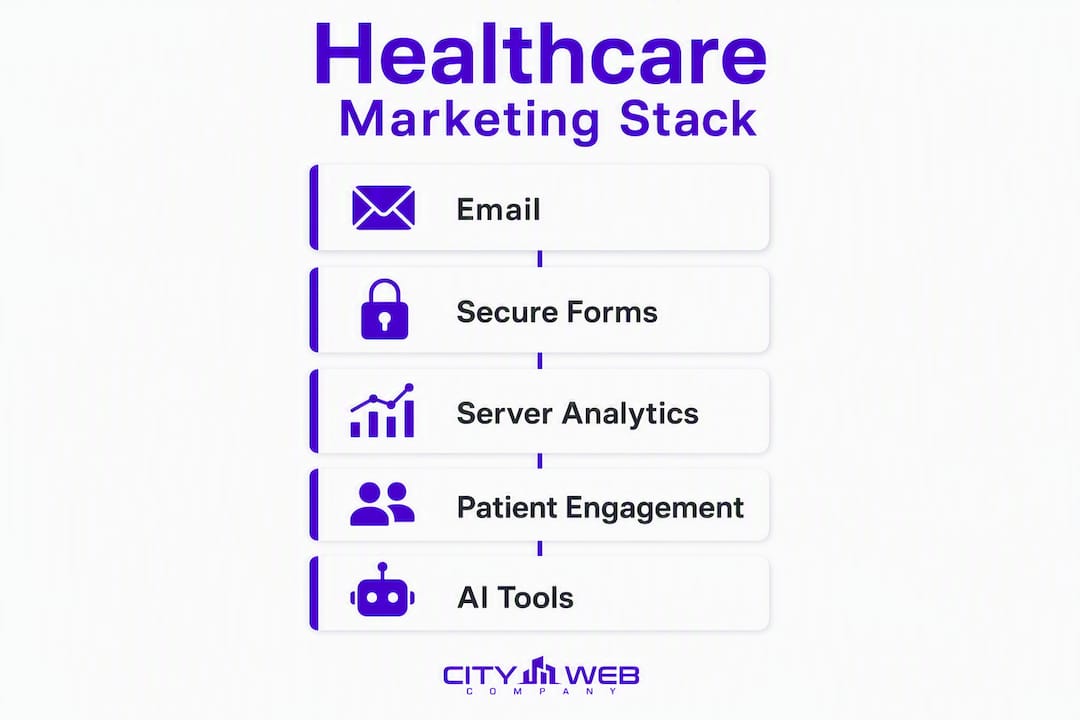
The best marketing tools for healthcare combine five categories into one defensible stack: a HIPAA-capable email platform with a signed Business Associate Agreement (BAA), a secure form builder configured for encrypted submission, server-side analytics using de-identified identifiers, a clinical-intent AI platform for HCP targeting, and a patient engagement layer that ties clinical outcomes to campaign performance. That combination covers the majority of everyday healthcare marketing needs for clinics, health systems, and pharma marketers alike.

Your immediate next step: confirm BAA availability with every vendor you are evaluating, run a 30-day pilot using server-side tagging before any campaign goes live, and bring in City Web Company or another vetted agency if your internal IT team cannot own the configuration.
What the compliant toolkit looks like in practice:
- HIPAA-capable email vendor with BAA, suppression lists, and audit logs (Mailchimp on qualifying plans, Marketo for enterprise)
- Secure form builder configured with field-level encryption and no plain-text email notifications (Formstack, JotForm)
- Server-side analytics with de-identified or tokenized identifiers (Piwik PRO, Matomo)
- Clinical-intent AI platform for HCP activation and closed-loop attribution (Doceree, Improvado)
- Patient engagement platform that connects clinical data to marketing performance (Cured)
- Reputation and local listings management for multi-location practices (SOCi)
- Conversation intelligence for inbound calls (Outreach)
NPI-level match rates vary by platform, but purpose-built HCP platforms like equals5 claim deterministic NPI identification of site visitors, which is a materially different capability than anything a general-purpose ad network offers.
Table of Contents
Table of Contents
- Which categories of marketing tools matter for healthcare and why
- What marketing teams must verify before deploying any tool
- How to use email for patient outreach without exposing PHI
- Which form builders can you configure for HIPAA-safe data collection?
- Analytics and tracking that respect patient privacy
- What AI tools can and cannot do for healthcare marketing
- How to evaluate tools and run a safe pilot
- How to measure real ROI by connecting clinical data to marketing
- Key Takeaways
- Why the compliance-first approach is the only approach worth taking
- City Web Company helps healthcare practices market compliantly and grow faster
- Useful sources for vendor validation and compliance research
- FAQ
Which categories of marketing tools matter for healthcare and why
Healthcare marketing does not map cleanly onto the standard B2C martech stack. PHI exposure risk, prescriber-level targeting requirements, and audit obligations create a different set of priorities. Here is how the core categories break down and when each one matters.
Patient engagement platforms connect clinical outcomes to marketing workflows. Cured, for example, breaks down data silos between clinical performance, digital marketing, and revenue so that a campaign’s success is measured in appointments and fills, not just clicks. This category matters most for health systems and multi-specialty practices that already have EHR data they want to activate.
HIPAA-capable email is the workhorse for appointment reminders, care gap outreach, and patient retention. Every single-location practice needs it. The distinction between a standard email platform and a HIPAA-capable one is the BAA and the data storage environment, not the sending interface.


CRM and marketing automation handle lifecycle sequencing: welcome series, post-visit follow-ups, and re-engagement. Marketo is the enterprise choice. Smaller practices often start with a lighter automation layer built into their patient engagement platform.
Secure form builders collect intake data, appointment requests, and consent. Formstack and JotForm both offer HIPAA-capable configurations on the right plan tier, but the configuration is not automatic.
Server-side analytics replace client-side pixel tracking for any page that might touch PHI. Piwik PRO and Matomo support self-hosted or enterprise-controlled deployments with data residency controls.
AI and clinical-intent platforms do two distinct jobs: content personalization for patient outreach, and NPI-level HCP targeting for pharma and device marketers. Doceree reads clinical intent in real time by connecting prescriber and patient signals, closing the loop from awareness to prescription fill without exposing PHI.
Social and ad platforms (Meta, Google, TikTok) are awareness channels only. Social ad networks do not provide NPI-level targeting or reporting, so they belong at the top of the funnel for brand building, not for precision clinical targeting.
Reputation and local listings matter most for multi-location providers. SOCi offers automated reputation management and centralized listing control with brand and regulatory guardrails, which is genuinely difficult to replicate manually across dozens of locations.
When does each category apply?
- Single-location practice: HIPAA email, secure forms, server-side analytics, local listings
- Multi-location clinic or health system: add patient engagement platform, CRM automation, reputation management
- Pharma or device marketer: add clinical-intent AI, HCP ad OS, closed-loop attribution to fills
What marketing teams must verify before deploying any tool
Compliance is not a checkbox you complete at contract signing. It is an ongoing configuration and governance obligation. The FTC has taken enforcement action against health-adjacent companies for sharing sensitive health data with advertising platforms, including a 2024 action against an alcohol addiction treatment firm and a 2023 order against BetterHelp for sharing user health data with Facebook and Snapchat for advertising. These are not edge cases.
Vendor-level checks before you sign:
- BAA availability and willingness to sign (non-negotiable for any tool that touches PHI)
- Encryption in transit (TLS 1.2 or higher) and at rest (AES-256 or equivalent)
- Role-based access controls and the ability to restrict PHI access by user or team
- Audit logs that capture data access, exports, and configuration changes
- Formal security documentation: SOC 2 Type II report, HITRUST certification, or equivalent
Cured and other healthcare platform vendors highlight HITRUST and HIPAA compliance as differentiators, and practices should request formal security documentation and evidence of healthcare use cases before contracting.
Operational obligations your team owns:
- De-identify data before it enters any third-party system that lacks a BAA
- Build consent and opt-out flows into every patient-facing touchpoint
- Scrub PHI from URL parameters, UTM strings, and query strings before firing any tracking tag
- Set data retention limits and document deletion policies
- Restrict staff access to PHI on a need-to-know basis
Technical configuration requirements:
- Use server-side tagging so that raw browser signals never reach ad platforms directly
- Replace raw patient identifiers with hashed or tokenized values in all integrations
- Maintain audit trails that support MLR-ready review workflows
- Test EHR/EMR integrations in a sandbox environment before connecting to production data
The single most common compliance failure in healthcare marketing is not a vendor problem. It is a configuration problem. A HIPAA-capable platform configured incorrectly exposes PHI just as readily as a non-compliant one. Require a security checklist and a sample BAA in every vendor RFP, and run a technical pilot that validates logging and access controls before any patient data flows through the system.
Pro Tip: Build a vendor RFP template that includes three required attachments: a signed BAA draft, a SOC 2 Type II summary or HITRUST certificate, and a documented data flow diagram showing where PHI is stored, processed, and transmitted. Vendors who cannot produce all three within a week are telling you something.
How to use email for patient outreach without exposing PHI
Email remains the highest-ROI channel for patient retention and appointment-driven campaigns, but the compliance requirements are specific. Standard email platforms are not HIPAA-capable by default. The BAA and the data storage environment are what separate a compliant deployment from a liability.
What to require from any email vendor:
- A signed BAA that covers the specific use case (patient outreach, appointment reminders, care gap campaigns)
- Patient data segmented and stored in a HIPAA-safe environment, separate from general marketing lists
- Double opt-in enrollment and a functioning suppression list that updates in real time
- Audit logs showing who accessed, exported, or modified patient lists
- Deliverability reporting that does not require exporting PHI to a third-party analytics tool
Vendor roles in a compliant stack:
Mailchimp offers HIPAA-compatible options on qualifying paid plans, but the configuration is not automatic and requires deliberate setup of data handling and access controls. It works well for smaller practices running straightforward appointment reminder and re-engagement campaigns.
Marketo is the enterprise choice for complex, multi-step automation workflows. It supports advanced segmentation, MLR-ready content approval workflows, and deep CRM integrations. The BAA and HIPAA-capable configuration require an enterprise contract and IT involvement. For marketing automation at scale, Marketo is the platform most health systems eventually land on.
Implementation steps for a compliant patient email program:
- Confirm the BAA is signed and covers your specific use case before importing any patient data.
- Keep PHI out of subject lines, preview text, and URL parameters in every template.
- Build a secure preference center so patients can update communication preferences without submitting PHI through an unencrypted form.
- Encrypt message content where required by your organization’s security policy.
- Map lifecycle automations (welcome, nurture, appointment reminders) to consent records so every send has a documented legal basis.
- Schedule a compliance review with legal and IT before the first campaign goes live, and repeat it quarterly.
Quick pre-launch checklist:
- BAA signed and filed
- Suppression logic tested with a dummy record
- All templates QA’d for PHI in subject lines, URLs, and dynamic fields
- Opt-out mechanism tested end to end
- Audit log access confirmed for compliance team
Which form builders can you configure for HIPAA-safe data collection?
Secure forms are where PHI exposure most often sneaks in unnoticed. A patient fills out an appointment request, the form fires a confirmation email with their name and reason for visit to a standard Gmail address, and the practice has just created a HIPAA violation without anyone realizing it.
What to look for in a form builder:
- BAA availability on the plan you are purchasing
- Encryption in transit (TLS) and at rest for all stored responses
- Field-level access controls so only authorized staff can view sensitive fields
- Secure hosting with documented data residency
- Webhook encryption for any downstream integrations
Formstack and JotForm both offer HIPAA-capable configurations, but only on specific plan tiers and only when the BAA is signed and the correct security settings are enabled. Neither is HIPAA-compliant out of the box on a free or entry-level plan. A mid-size practice with straightforward intake forms can use either. A large health system with complex conditional logic and EHR integrations will likely need Formstack’s enterprise tier or a custom-built solution.
Common pitfalls that cause accidental PHI exposure:
- PHI appearing in query strings after form submission (e.g.,
?name=John&condition=diabetesin the redirect URL) - Auto-notification emails that forward full form responses to staff inboxes on non-secure email servers
- Form response backups stored in public cloud buckets without encryption
- Third-party analytics scripts firing on the form confirmation page and capturing URL parameters
Configuration checklist before any form goes live:
- Verify the BAA covers form data storage and processing.
- Switch to server-side form submission so responses never appear in the browser URL.
- Disable plain-text email notifications entirely; use a secure portal for staff to review responses.
- Enable field-level encryption for all fields that could contain PHI.
- Document retention and deletion policies for form responses and test the deletion workflow.
- Test the confirmation page URL for PHI leakage before the form is published.
Pro Tip: Run a test submission with a clearly fake name and a recognizable condition label, then check your analytics platform, your email server, and your form backup storage for that string. If it shows up anywhere outside the secure form portal, you have a configuration problem to fix before going live.
Analytics and tracking that respect patient privacy
Client-side pixel tracking is the default for most marketing analytics, and it is also the fastest path to a HIPAA problem in healthcare. When a pixel fires on a page that contains PHI in the URL or DOM, that data can travel to a third-party ad platform without any BAA in place. Server-side tagging solves this by intercepting the data stream before it reaches the browser and stripping or hashing identifiers before forwarding events to downstream platforms.
| Analytics Approach | PHI Risk Level | Data Residency Control | NPI-Level Reporting | Best For |
|---|---|---|---|---|
| Client-side pixel (Google Tag Manager default) | High | None | No | General awareness campaigns only |
| Server-side tagging (GTM server-side) | Low when configured correctly | Partial | No | Most healthcare marketing teams |
| Piwik PRO (cloud or on-premise) | Low | Full (on-premise) | No | Practices needing EU/US data residency |
| Matomo (self-hosted) | Very low | Full | No | Organizations requiring full data ownership |
| Clinical-intent HCP platform (e.g., equals5) | Low (tokenized) | Platform-controlled | Yes | Pharma/device HCP campaigns |
Matomo’s privacy documentation outlines how self-hosted deployments keep all data under the organization’s direct control, which is the cleanest solution for practices that cannot accept any third-party data processing risk.
Piwik PRO offers a similar architecture with an enterprise cloud option that includes data processing agreements suitable for HIPAA-adjacent use cases. Both platforms support event-level de-identification, which reduces granularity but preserves compliance. You capture campaign performance through aggregated or tokenized attribution rather than individual-level tracking.
The practical trade-off: de-identified analytics will show you that a campaign drove 47 appointment requests from a specific ZIP code, but not which individual patients responded. For most marketing decisions, that is enough. For closed-loop attribution to fills or refills, you need a clinical-intent platform with a deterministic identity spine.
Pro Tip: Validate your analytics pipeline before any campaign launches. Trace a test token from click to conversion while reviewing server-side logs for accidental PHI. If you see a patient name, email address, or condition label in any log outside your secure environment, stop and fix the configuration before spending a dollar on media.
What AI tools can and cannot do for healthcare marketing
AI adds real capability to healthcare marketing in three areas: content personalization for patient outreach, clinical-intent detection for HCP campaigns, and conversation intelligence for inbound calls. The compliance risks are equally real and require specific governance practices.
Where AI delivers genuine value:
- Propensity scoring to identify patients most likely to schedule a specific service
- Clinical-intent detection that captures prescriber activity near the prescribing decision, not inferred interest from generic web behavior
- Automated content drafting for care gap campaigns, appointment reminders, and educational sequences
- Conversation intelligence (Outreach and similar platforms) for analyzing inbound call quality and identifying missed scheduling opportunities
Doceree reads clinical intent in real time by connecting prescriber and patient signals, closing the loop from awareness to prescription fill. PulsePoint positions its technology as a health-first programmatic platform with NPI-level website engagement insights and adaptive optimization for clinically relevant campaign targeting. Improvado handles data pipeline aggregation, pulling campaign performance data from multiple sources into a single reporting layer without requiring manual exports.
The governance rule that most teams skip: Never feed raw PHI into a third-party large language model, even for content drafting. If your AI content tool does not have a BAA and documented data handling policies, it cannot touch patient data. Use de-identified inputs or synthetic patient personas for any AI-assisted content workflow.
Compliance cautions specific to AI:
- Require encryption and HIPAA-capable model hosting for any AI tool that processes patient-adjacent data
- Maintain model audit trails and version history so you can demonstrate what data trained or prompted each output
- Build a human-in-the-loop review step for any patient-facing or clinical-facing AI output before it goes live
Implementation sequence for AI tools:
- Define a data governance policy before selecting any AI vendor
- Run a private pilot using de-identified inputs for the first 30 days
- Validate that the AI output does not inadvertently surface PHI through inference or hallucination
- Scale only after the pilot audit is clean
Pro Tip: Treat AI tools the same way you treat EHR integrations: assume they touch PHI until proven otherwise, and require the same vendor documentation (BAA, SOC 2, data flow diagram) before any patient data enters the system.
How to evaluate tools and run a safe pilot
The evaluation rubric below maps the dimensions that matter most for healthcare marketing tool selection. Use it to score vendors side by side before committing to a pilot.
| Dimension | What to Assess |
|---|---|
| Best for (use case / practice size) | Single location, multi-location, pharma/device, health system |
| HIPAA compliance / BAA availability | BAA offered, HITRUST or SOC 2 documentation, data residency options |
| AI and automation features | Propensity scoring, clinical-intent detection, lifecycle automation |
| Integrations | EHR/EMR connectors, CRM sync, ad platform APIs, webhook support |
| Reporting and analytics | Attribution depth, audit-ready logs, NPI-level vs. aggregated reporting |
| Pricing and scalability | Per-seat vs. usage-based, enterprise tiers, contract flexibility |
| Support and implementation | Onboarding resources, dedicated CSM, healthcare-specific implementation guides |
Pilot checklist (30-day minimum):
- Set measurable KPIs before the pilot starts: appointment conversion rate, cost per qualified patient, form completion rate, email open and unsubscribe rates.
- Select a representative patient segment or HCP audience that is small enough to monitor closely.
- Validate the BAA is signed and all security controls are active before any data enters the platform.
- Run integration smoke tests: confirm data flows correctly between the tool, your CRM, and your EHR without exposing PHI.
- Measure data flows end to end, including audit log completeness and suppression list accuracy.
- Review results with legal and IT before scaling.
Timeline and cost expectations:
A 30-day pilot for a single-location practice typically requires 10–20 hours of internal IT and marketing time, plus vendor onboarding support. A 90-day full integration for a multi-location system adds EHR token mapping, CRM sync validation, and compliance documentation, which can run 80–150 hours of internal resource time. Budget for small practices typically ranges from a few hundred dollars per month for email and forms to several thousand for a full patient engagement platform. Enterprise health systems should expect platform fees plus implementation services.
For practices without dedicated IT, healthcare advertising tools configured by an experienced agency reduce both the timeline and the compliance risk.
How to measure real ROI by connecting clinical data to marketing
The gap between marketing metrics and clinical outcomes is where most healthcare marketing programs lose credibility with leadership. Clicks and impressions do not justify budget. Appointment conversions, fill rates, and patient lifetime value do.
The architecture that closes this gap has three layers:
- Identity spine: tokenizes NPI and patient event data so that individual identifiers are never exposed in the measurement layer
- Secure match layer: maps tokenized campaign exposures to clinical events (fills, appointments, EHR encounters) while preserving de-identification
- Measurement layer: reports fills, appointments, and revenue attributed to specific campaigns without surfacing PHI
| Metric | What It Measures | Data Source |
|---|---|---|
| Attribution to fill | Campaign-driven prescription fills or refills | Claims or pharmacy data via tokenized match |
| Appointment conversion rate | Patients who book after a campaign exposure | CRM or EHR appointment data |
| Cost per qualified patient | Media spend divided by patients who complete a visit | Campaign spend + EHR encounter data |
| Patient lifetime value | Revenue per patient over a defined period | EHR billing data |
| Audit-ready engagement logs | Documented campaign interactions for compliance review | Platform audit logs |
Clinical-intent signals provide a higher-fidelity way to find prescribers and patients because they capture activity near the prescribing decision rather than inferred interest from generic web behavior. A tokenized identity spine that maps NPI signals to campaign exposures and then to fills is the architecture that makes this measurement defensible.
Equals5’s personal data graph claims high deterministic NPI match rates and the ability to identify NPIs that visit websites for NPI-level reporting. Doceree’s closed-loop attribution connects prescriber signals to prescription fill data without exposing PHI. Both represent the current state of the art for pharma and device marketers who need to prove ROI beyond the click.
For health systems and large practices, Cured connects clinical outcomes, digital marketing performance, and revenue impact using centralized growth tools, which is the practical implementation of the architecture described above.
Key Takeaways
The most defensible healthcare marketing stack combines HIPAA-capable email, secure forms, server-side analytics, and clinical-intent AI, all governed by signed BAAs and a documented data governance policy.
| Point | Details |
|---|---|
| BAA is non-negotiable | Every tool that touches PHI requires a signed BAA before any patient data enters the platform. |
| Server-side tagging prevents PHI leakage | Replace client-side pixels with server-side tagging and hashed identifiers on any page that could expose patient data. |
| Clinical-intent AI beats generic targeting | Platforms like Doceree and equals5 use NPI-level signals to attribute campaigns to fills, not just clicks. |
| Pilot before you scale | Run a 30-day pilot with measurable KPIs and a compliance audit before committing to a full rollout. |
| City Web Company handles setup | City Web Company configures compliant analytics, campaign activation, and local SEO for practices without internal IT resources. |
30-day actions: Confirm BAAs with your email and form vendors. Enable server-side tagging for your analytics. Schedule a pilot with one patient segment.
90-day goals: Complete CRM/EHR token mapping. Validate attribution for one campaign. Lock down your data governance policy.
180-day outcomes: Scale automation across patient lifecycle stages. Measure fill and appointment outcomes. Document compliance workflows for audit readiness.
Why the compliance-first approach is the only approach worth taking
Healthcare marketing sits at the intersection of two things that rarely coexist comfortably: aggressive growth goals and strict regulatory obligations. Most of the advice circulating about the best marketing tools for healthcare treats compliance as a feature to check off rather than the architectural constraint that shapes every other decision.
The FTC enforcement actions against BetterHelp and the alcohol addiction treatment firm are not cautionary tales about bad actors. They are examples of marketing teams using standard industry tools, the same pixels and ad platform integrations that work fine in retail, without accounting for the fact that health data carries a different legal weight. The tools were not the problem. The configuration and the governance were.
What this means practically: the vendor selection process for a healthcare practice should start with the BAA conversation, not the feature demo. A platform that cannot produce a signed BAA and a SOC 2 Type II report within a week is not ready for healthcare use, regardless of how good the dashboard looks. And a platform that offers a BAA but requires you to configure 14 settings correctly to actually protect PHI is a liability unless you have the IT resources to own that configuration.
The clinical-intent platforms, the server-side analytics tools, the HIPAA-capable email vendors: they all exist because the standard martech stack was not built for this environment. Using them correctly requires more upfront work than dropping a pixel on a landing page. The payoff is a marketing program that can survive an audit, attribute revenue to campaigns with clinical precision, and scale without accumulating compliance debt.
City Web Company helps healthcare practices market compliantly and grow faster
Healthcare practices that want compliant, measurable digital marketing without building an internal IT and compliance team have a concrete alternative. City Web Company sets up the full stack: server-side analytics and tagging, HIPAA-aware campaign configuration, local SEO tied to patient acquisition goals, and paid media management across Google Ads and social channels.

The agency’s approach starts with a 30-day discovery and pilot engagement. During that period, City Web Company audits your current analytics configuration for PHI exposure, sets up server-side tagging, confirms BAA status with your existing vendors, and launches one compliant campaign with measurable lead objectives. Practices get local SEO and Google Business Profile optimization alongside paid media management, so patient acquisition works across both organic and paid channels from day one.
For practices that need immediate lead volume, City Web Company’s Google Ads management is configured with healthcare-specific compliance settings from the start, not retrofitted after the fact.
Get started with a discovery call to scope your pilot and confirm which tools in your current stack need reconfiguration before your next campaign launches.
Useful sources for vendor validation and compliance research
Use these sources to request BAA templates, security documentation, and case studies from vendors you are evaluating.
- Cured: AI-powered healthcare marketing platform for patient lifecycle marketing and clinical outcome attribution
- Doceree: healthcare marketing platform for pharma for clinical-intent HCP targeting and closed-loop attribution
- Equals5: all-in-one HCP engagement intelligence system for NPI-level targeting and deterministic match rates
- PulsePoint: healthcare marketing technology for programmatic HCP advertising and NPI-level engagement insights
- SOCi: healthcare digital marketing for multi-location reputation management and listing control
- Matomo privacy documentation for self-hosted analytics configuration and data residency guidance
- FTC enforcement action: alcohol addiction treatment firm (2024) for understanding the regulatory risk of sharing health data with ad platforms
- FTC enforcement action: BetterHelp (2023) for precedent on health data and advertising platform integrations
This article provides general information about marketing tools and compliance considerations. It is not legal or compliance advice. Confirm current HIPAA requirements and your specific obligations with a qualified healthcare attorney or compliance officer before deploying any marketing technology.
FAQ
What are the best marketing tools for healthcare?
The strongest stack combines a HIPAA-capable email platform (Mailchimp or Marketo), a secure form builder (Formstack or JotForm), server-side analytics (Piwik PRO or Matomo), a clinical-intent AI platform (Doceree or equals5), and a patient engagement platform (Cured). Every tool requires a signed BAA before any patient data enters the system.
What HIPAA compliance features should a marketing tool have?
At minimum: a signed BAA, encryption in transit and at rest, role-based access controls, audit logs, and formal security documentation such as a SOC 2 Type II report or HITRUST certification. Configuration matters as much as vendor certification.
What are the 4 P’s of healthcare marketing?
The 4 P’s are product (the service or treatment offered), price (cost and payment options), place (where care is delivered, including telehealth), and promotion (how the practice communicates its value to patients and referring providers).
When should a practice hire an agency instead of managing tools in-house?
Hire an agency when your internal team lacks dedicated IT resources for server-side tagging and BAA management, when you need local SEO and paid media running simultaneously, or when a tight patient growth timeline does not allow for a long internal learning curve. City Web Company handles compliance-first configuration, campaign activation, and reporting for practices in exactly this position.
Can social media platforms be used for HIPAA-compliant healthcare marketing?
Social platforms like Meta and Google are appropriate for broad awareness campaigns, but they do not provide NPI-level targeting or reporting and should never receive PHI through pixel integrations. Use them for top-of-funnel brand building, and rely on healthcare-purpose platforms for precision HCP targeting and closed-loop attribution.
Recommended
These articles were popular with other readers too: