

Pass Google Business verification with a video-first checklist. Film one continuous 30 second take, fix flagged issues, and know when to hire help.
Social Media Advertising Workflow for Better Lead Generation
Every American home service business faces the challenge of getting the attention it deserves in crowded social media feeds. Marketing managers need practical strategies that cut through clutter and connect with the right customers. By focusing on clear campaign goals and smart audience targeting, you set the stage for advertising workflows that deliver measurable results. Discover how efficient planning can help you reach qualified leads and build real engagement across your favorite platforms.
Table of Contents
Table of Contents
- Step 1: Define Campaign Goals And Target Audience
- Step 2: Set Up Ad Accounts And Tracking Tools
- Step 3: Design Compelling Ad Creatives And Copy
- Step 4: Launch Campaigns And Manage Budgets
- Step 5: Monitor Results And Optimize Performance
Quick Summary
| Essential Insight | Detailed Explanation |
|---|---|
| 1. Define Clear Campaign Goals | Establish specific goals based on broader business objectives to shape your social media strategy effectively. |
| 2. Identify Your Target Audience | Gather data on demographics, behaviors, and psychographics to create audience personas that enhance messaging. |
| 3. Set Up Proper Tracking Tools | Implement analytics and conversion tracking to measure campaign performance and optimize advertising efforts continuously. |
| 4. Create Engaging Ad Creatives | Design visually appealing content and compelling copy that clearly communicates your value to potential customers. |
| 5. Continuously Monitor and Optimize | Regularly review performance metrics to make data-driven adjustments, enhancing lead generation effectiveness. |
Step 1: Define campaign goals and target audience
Defining clear campaign goals and identifying your target audience are foundational steps for successful social media advertising. This process ensures your marketing efforts are strategic, precise, and measurable.
To establish effective campaign goals, start by understanding your broader business objectives. Are you seeking to increase brand awareness, generate leads, boost sales, or drive website traffic? These goals will shape your entire social media advertising strategy. Detailed marketing campaign insights suggest breaking down broad goals into specific, actionable objectives.
When defining your target audience, collect comprehensive data across three key dimensions:
- Demographic details: Age, gender, income level, education, occupation
- Behavioral characteristics: Online browsing habits, purchasing patterns, social media usage
- Psychographic factors: Interests, values, lifestyle preferences, motivational triggers
Creating detailed audience personas helps you craft personalized messaging that resonates. Customer persona development involves deep analysis of customer motivations and preferences.
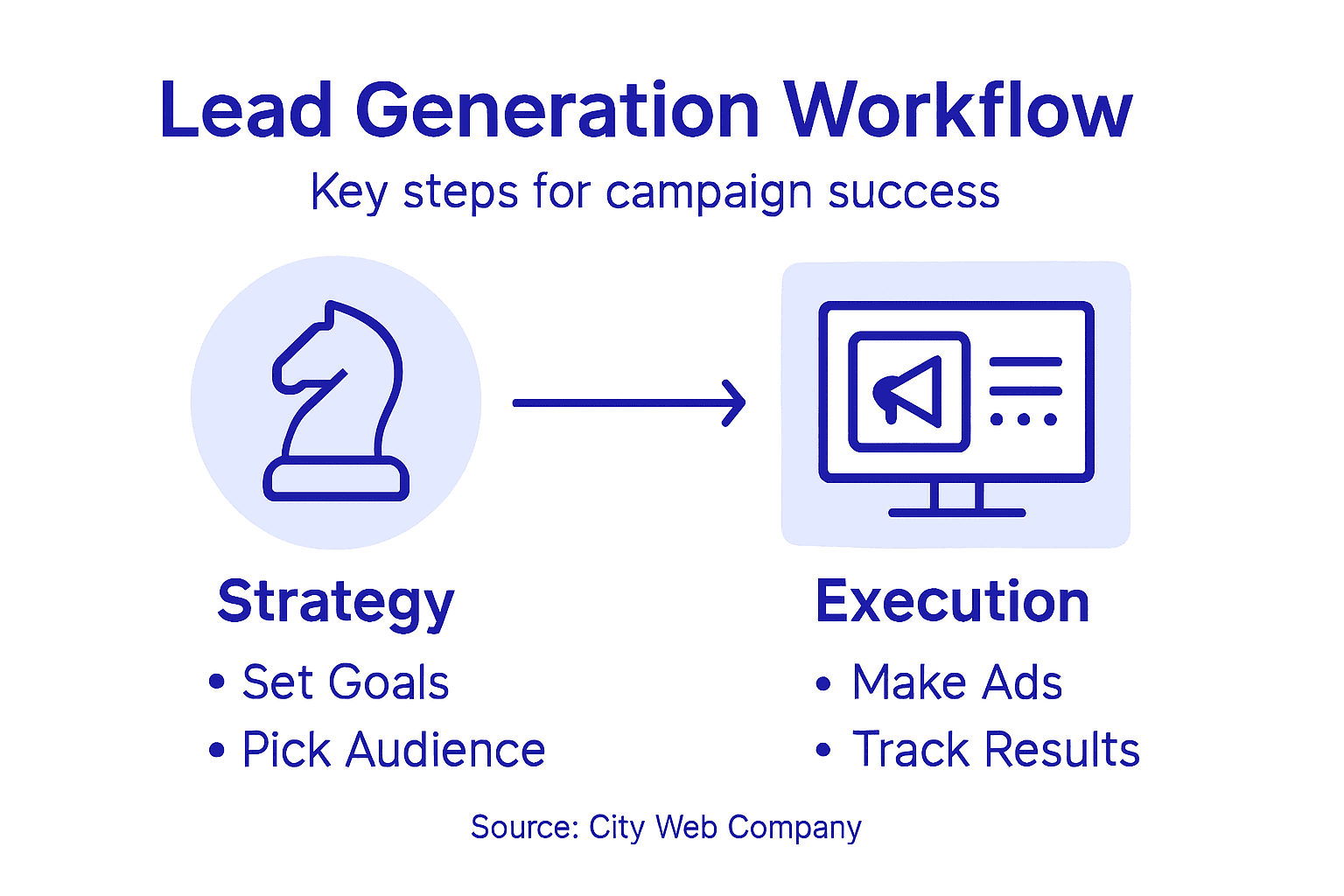
Once you’ve mapped out your goals and audience, you’ll be prepared to design a targeted social media advertising approach that speaks directly to potential customers.
Here is a summary of key goals for social media advertising campaigns and their typical metrics:
| Campaign Goal | Typical Metric | Example Objective |
|---|---|---|
| Brand Awareness | Impressions, Reach | Reach 10,000 unique users |
| Lead Generation | Leads Captured, Form Submits | Collect 500 email signups |
| Sales | Purchases, Revenue | Achieve $2,000 in sales |
| Website Traffic | Clicks, Sessions | Drive 1,500 website visits |
Pro tip: Use analytics tools to continuously refine your audience targeting and track performance metrics in real-time.
Step 2: Set up ad accounts and tracking tools
Setting up ad accounts and implementing robust tracking tools are critical steps in creating an effective social media advertising workflow. These foundational elements enable you to measure performance, optimize campaigns, and generate high-quality leads for your business.
Begin by creating accounts on key social media advertising platforms such as Facebook Ads Manager, Google Ads, and LinkedIn Advertising. Social media monitoring tools provide comprehensive insights into your campaign performance and audience engagement. Each platform requires specific authentication steps:
- Create business accounts: Use professional email addresses linked to your company domain
- Configure payment methods: Set up billing information for ad spending
- Enable two-factor authentication: Protect your advertising accounts from unauthorized access
- Link analytics platforms: Integrate your ad accounts with Google Analytics or other tracking systems
When setting up tracking, focus on implementing conversion tracking pixels and establishing clear measurement parameters. Ad account configuration requires careful OAuth authentication to ensure seamless data collection across platforms.
Proper tracking setup transforms raw data into actionable marketing intelligence, allowing you to make informed decisions about your advertising strategy.
Ensure you have UTM parameters and conversion tracking in place to accurately measure the performance of each advertising campaign and understand your return on investment.
Compare the main ad account setup requirements across popular platforms:
| Platform | Account Type Needed | Unique Setup Requirement |
|---|---|---|
| Business Manager | Two-factor authentication | |
| Google Ads | Google Account | Billing profile configuration |
| Company Page | Verified business email |
Pro tip: Create a dedicated spreadsheet to track login credentials, pixel codes, and key configuration details for each advertising platform to maintain organized access.
Step 3: Design compelling ad creatives and copy
Creating engaging ad creatives and persuasive copy is the heart of successful social media advertising. Your visual and textual content must capture attention, communicate your value proposition, and motivate potential customers to take action.
Digital marketing creatives require careful strategy across multiple dimensions. Develop your ad content by focusing on these critical elements:
- Visual design: Use high-quality, professional images or videos that represent your brand
- Color psychology: Select colors that evoke emotional responses aligned with your message
- Clear messaging: Craft concise, benefit-driven headlines and descriptions
- Brand consistency: Ensure visual and textual elements reflect your company’s personality
When constructing your ad copy, prioritize clarity and compelling value propositions. Your text should answer three fundamental questions for potential customers:
- What problem do you solve?
- Why are you different from competitors?
- What specific action should they take?
Effective ad creatives transform casual scrollers into interested prospects by speaking directly to their needs and desires.
Test multiple creative variations to understand which resonates most with your target audience. Monitor performance metrics and be prepared to iterate quickly based on engagement data.
Pro tip: Create a swipe file of successful ads in your industry to inspire and benchmark your creative approaches without directly copying them.
Step 4: Launch campaigns and manage budgets
Launching social media advertising campaigns and effectively managing your marketing budget requires strategic planning and continuous optimization. Your goal is to maximize lead generation while maintaining cost-efficiency and tracking performance closely.
Budget optimization strategies enable marketers to dynamically allocate resources across different advertising channels. Start by establishing clear budget parameters and performance expectations for each campaign:
- Initial budget allocation: Divide your total budget across selected platforms
- Performance tracking: Monitor key metrics like cost per lead and conversion rates
- Spending limits: Set daily and total campaign spend caps
- Flexibility: Prepare to reallocate funds based on real-time performance data
When launching campaigns, implement a systematic approach to budget management:
- Start with conservative daily budgets
- Monitor performance during initial days
- Scale successful ad sets
- Pause or reduce spending on underperforming campaigns
Smart budget management transforms advertising expenses from costs into strategic investments that generate measurable business growth.
Utilize platform-specific budget management tools to automate spending controls and receive real-time performance insights. This approach ensures you maintain financial discipline while maximizing potential lead generation opportunities.

Pro tip: Create a dedicated spreadsheet to track campaign spending, allocating columns for budget, actual spend, leads generated, and cost per lead for easy performance comparison.
Step 5: Monitor results and optimize performance
Monitoring and optimizing your social media advertising campaigns is a critical ongoing process that transforms raw data into actionable insights. Your objective is to continuously improve lead generation performance by understanding what works and quickly adapting your strategy.
Social media performance measurement requires a systematic approach to tracking key metrics and interpreting campaign data. Focus on these essential performance indicators:
- Engagement rates: Likes, comments, shares, and overall interaction
- Conversion metrics: Number of leads generated, conversion rate
- Cost per lead: Total spend divided by number of qualified leads
- Reach and impressions: How many unique users see your content
Implement a structured optimization process:
- Review performance dashboards weekly
- Identify top-performing and underperforming ad variations
- Analyze audience segments showing highest engagement
- Make data-driven adjustments to targeting and creative elements
Consistent monitoring transforms social media advertising from a guessing game into a precise, measurable marketing science.
Utilize platform-specific analytics tools and consider third-party tracking solutions to gain comprehensive insights. Continuous testing and incremental improvements are key to long-term advertising success.
Pro tip: Create automated reporting templates that compare current performance against historical benchmarks, allowing you to quickly identify trends and potential optimization opportunities.
Maximize Your Lead Generation with Expert Social Media Advertising Support
Struggling to turn your social media advertising workflow into a powerful lead generation machine? This article highlights common challenges like precise audience targeting, setting up tracking tools, and managing budgets effectively. These issues often leave businesses without clear insights or optimal ROI from their campaigns. Imagine cutting through this complexity with tailored strategies that focus on your unique goals and deliver measurable results.
At City Web Company, we specialize in transforming these hurdles into opportunities. Our team offers proven expertise in Social Media Marketing Tips & Tools designed to create compelling ad creatives and optimize campaign performance continuously. We also provide in-depth guidance on PPC & Paid Ad Strategies to manage your budgets efficiently and boost conversion rates with precise tracking.

Take control of your advertising success today. Connect with professionals who understand the importance of analytics, creative design, and budget management in driving real leads. Visit City Web Company Contact to start crafting your effective social media advertising strategy now and watch your lead generation soar.
Frequently Asked Questions
How can I define clear campaign goals for social media advertising?
Defining clear campaign goals involves understanding your broader business objectives, such as increasing brand awareness, generating leads, or driving website traffic. Break down these goals into specific, measurable objectives, like reaching 10,000 unique users within a month.
What data should I collect to identify my target audience for social media ads?
To identify your target audience, collect data on demographic details, behavioral characteristics, and psychographic factors. Create detailed audience personas based on this data to tailor your messaging effectively.
What steps should I follow to set up ad accounts and tracking tools?
Begin by creating accounts on social media advertising platforms like Facebook Ads Manager and Google Ads. Ensure you set up payment methods, enable two-factor authentication, and link your analytics platforms for seamless tracking of campaign performance.
How do I design compelling ad creatives and copy for lead generation?
Create engaging ad creatives by using high-quality visuals, clear messaging, and a consistent brand voice. Focus on addressing potential customers’ problems and motivating them to take action, such as signing up for a newsletter or making a purchase.
What are the best practices for launching and managing budgets for social media campaigns?
To effectively manage budgets, start with conservative daily budgets and regularly monitor key metrics like cost per lead. Be prepared to adjust spending based on real-time performance data, reallocating funds to successful ad sets to maximize lead generation.
How can I monitor results and optimize my social media advertising performance?
Monitor your campaigns by regularly reviewing performance metrics such as engagement rates and conversion metrics. Use this data to identify top-performing ads and make targeted adjustments to improve overall results, aiming for a reduction in cost per lead by around 20% within a few weeks.
Recommended
- Master Local Business Marketing Workflow for Lead Growth
- What Role Does Content Marketing Play In Driving Lead Generation For Small Businesses? – City Web Company | Digital Marketing Agency
- Online Advertising Guide 2026: Boost Local Leads Easily
- Local Business Advertising: The Ultimate Guide to Getting Customers – City Web Company | Digital Marketing Agency
- Social Media Automation Steps for Effective Ad Campaigns
These articles were popular with other readers too: