

Discover 15 effective ways to improve online visibility in 2026. Boost your SEO, social media, and ads for rapid growth!
Law Firm Website Optimization Guide for Maximum Leads
Every law firm faces the challenge of turning online visits into meaningful client connections. Website performance goes far beyond aesthetics and directly influences your ability to attract, engage, and convert prospects. By focusing on a thorough evaluation of metrics like load time, content quality, and user experience, you uncover actionable ways to strengthen your firm’s digital presence and generate qualified leads. Assessing current website performance is a critical first move in identifying what truly drives results for your legal practice.
Table of Contents
Table of Contents
- Step 1: Assess Current Website Performance
- Step 2: Refine Legal Content and Service Pages
- Step 3: Enhance User Experience and Accessibility
- Step 4: Implement SEO and Local Search Tactics
- Step 5: Test Conversion Tools and Lead Capture
Quick Summary
| Important Insight | Detailed Explanation |
|---|---|
| 1. Conduct Regular Website Performance Assessments | Analyze loading times, user engagement, and conversion rates at least quarterly to identify improvement areas. |
| 2. Refine Legal Content for Client Relevance | Develop clear, authoritative practice area pages that address potential client concerns with informative and engaging content. |
| 3. Enhance Website Accessibility | Implement accessibility features to accommodate all users, ensuring compliance with ADA guidelines to improve user experience. |
| 4. Optimize SEO and Local Search Strategies | Create location-based content and fully optimize your Google Business Profile to enhance visibility and attract local clients. |
| 5. Test and Improve Lead Capture Tools | Regularly perform A/B testing on your lead forms to identify the most effective designs that maximize conversion rates. |
Step 1: Assess Current Website Performance
Evaluating your law firm’s website performance begins with a comprehensive diagnostic approach. Understanding your current digital landscape helps identify improvement opportunities and potential lead generation barriers. You will systematically analyze key metrics that signal your website’s effectiveness in attracting and converting potential legal clients.
Start by examining your website’s performance metrics and responsiveness. These technical assessments reveal critical insights about loading times, user interactions, and overall site experience. Leverage tools like Google Analytics and PageSpeed Insights to measure load times, mobile responsiveness, and user engagement. Pay special attention to metrics such as bounce rate, average session duration, and conversion rates specific to lead generation forms or contact page interactions.
Your assessment should also incorporate content quality evaluation. Analyze the accuracy, authority, and currency of your website content to ensure it meets professional standards. Review each page for clear attorney credentials, updated practice area descriptions, and compelling client-focused messaging. Check that your content demonstrates expertise, addresses potential client questions, and presents a trustworthy online representation of your legal practice.
Pro tip: Conduct this performance assessment quarterly to stay ahead of potential website optimization opportunities and maintain a competitive online presence.
Here’s a summary of essential website performance metrics and their business impact:
| Metric | What It Measures | Business Impact |
|---|---|---|
| Bounce Rate | Visitors leaving quickly | Indicates low engagement |
| Load Time | Page speed | Affects client retention |
| Session Duration | Average time per visit | Reflects content relevance |
| Conversion Rate | Leads generated | Predicts growth potential |
| Mobile Responsiveness | Usability on phones | Expands reach to more clients |
Step 2: Refine Legal Content and Service Pages
Refinement of your law firm’s legal content and service pages is crucial for attracting and converting potential clients. You will strategically develop compelling, authoritative content that showcases your legal expertise while addressing potential client needs and concerns.
Begin by developing a comprehensive content strategy that aligns with your firm’s unique value proposition. Examine each practice area page to ensure it provides clear, concise descriptions of your legal services, highlighting specific expertise and potential client outcomes. Utilize extensive legal research resources to validate and enhance the accuracy of your legal content. Focus on creating informative sections that demonstrate your attorneys’ qualifications, successful case histories, and approach to client representation.

Each service page should tell a story that resonates with potential clients. Include specific details about your legal processes, potential case scenarios, and the unique solutions your firm provides. Incorporate client testimonials, relevant case studies, and clear calls to action that guide visitors toward consultation or contact. Ensure your content addresses common client questions, concerns, and the potential legal challenges they might face in their specific practice area.
Pro tip: Update your legal content quarterly and conduct regular peer reviews to maintain highest standards of accuracy and relevance.
Step 3: Enhance User Experience and Accessibility
Improving your law firm website’s user experience and accessibility is critical for attracting and retaining potential clients across all abilities. You will transform your digital presence into an inclusive, user friendly platform that removes barriers and creates a welcoming online environment for every visitor.
Web accessibility design principles provide a comprehensive framework for creating an inclusive website experience. Implement keyboard navigation options, provide alternative text for images, ensure color contrast meets legal standards, and design clear navigation paths that accommodate users with diverse abilities. Focus on creating a website that is perceivable, operable, understandable, and robust for all potential clients, regardless of their technological capabilities or physical limitations.
Carefully review your website against recent ADA web accessibility requirements to ensure compliance and demonstrate your firm’s commitment to inclusivity. This includes verifying that screen readers can effectively interpret your content, providing captions for video consultations, and designing forms that are easily navigable by keyboard and assistive technologies. Regularly test your website using automated accessibility checkers and consider engaging users with disabilities to provide direct feedback on their experience.
Pro tip: Conduct quarterly accessibility audits and involve users with disabilities in your testing process to continuously improve your website’s user experience.
Step 4: Implement SEO and Local Search Tactics
Optimizing your law firm’s online visibility requires a strategic approach to search engine optimization and local search positioning. Your goal is to create a robust digital presence that attracts potential clients precisely when they are searching for legal services in your area.
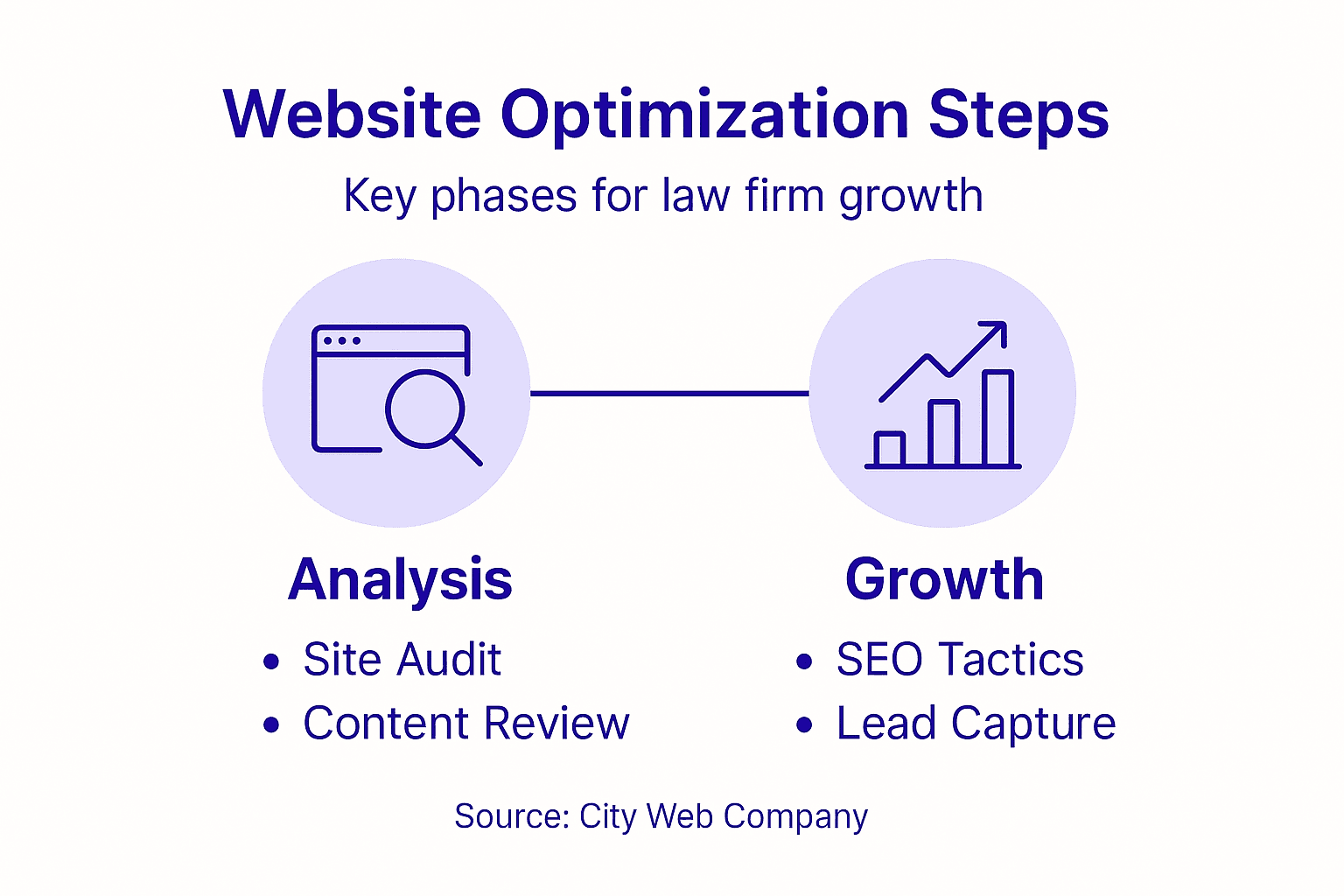

SEO practices enhance website visibility by strategically targeting relevant keywords and improving your site’s structural elements. Focus on creating location specific content that speaks directly to potential clients in your geographic region. This means developing practice area pages with locally targeted keywords, ensuring your Google Business Profile is completely filled out, and generating consistent local citations across online directories. Include specific geographic references that potential clients might use when searching for legal services.
Combine organic and local SEO strategies to maximize client reach. This involves developing high quality content that addresses specific legal questions, obtaining positive client reviews, and building authoritative backlinks from local business associations and legal directories. Regularly update your website with location specific case studies, local legal insights, and community engagement information to signal relevance to both search engines and potential clients.
Pro tip: Create a content calendar that balances local legal insights with broader practice area expertise to maintain consistent SEO momentum.
Below is a comparison of organic SEO and local SEO strategies for law firms:
| Aspect | Organic SEO | Local SEO |
|---|---|---|
| Target Audience | National and broad | Specific geographic areas |
| Content Focus | Expertise and resources | Local case studies, reviews |
| Key Benefit | Boosts authority and reach | Attracts nearby clients fast |
| Typical Tactics | Backlinks, keywords | Google profile, citations |
Step 5: Test Conversion Tools and Lead Capture
Evaluating and optimizing your law firm’s lead capture mechanisms is crucial for transforming website visitors into potential clients. Your objective is to create a seamless, user friendly process that encourages potential clients to reach out and schedule consultations.
Standardized testing methodologies provide a strategic framework for assessing your conversion tools. Implement A/B testing on contact forms, consultation request buttons, and call to action elements to identify which variations generate the highest engagement rates. Pay close attention to form length, field requirements, and design elements that might discourage potential clients from completing their information.
Utilize secure data capture tools to streamline and analyze your lead generation process. Configure your forms to collect essential client information while maintaining a user friendly interface. Track conversion metrics such as form completion rates, time spent on contact pages, and the number of successful submissions. Regularly review these analytics to refine your approach, remove potential barriers, and create a more intuitive path for potential clients to connect with your legal team.
Pro tip: Conduct monthly conversion rate audits and test one variable at a time to accurately measure the impact of your optimization efforts.
Unlock Your Law Firm Website’s True Potential with Proven Digital Strategies
Struggling to convert visits into clients despite driving traffic to your law firm website This article highlights common challenges like low conversion rates inefficient lead capture and poor local visibility that can keep your firm from thriving online. You need a partner who understands the power of refined web design & development insights and precise analytics & conversion tracking tips to maximize engagement and boost qualified leads.

At City Web Company, we specialize in transforming law firm websites by delivering tailored SEO, user-friendly web design, and measurable conversion optimization. Our comprehensive digital marketing expertise empowers your firm to rise above competitors and capture high-intent potential clients actively searching for legal services in your area. Don’t wait until visitors leave your site without contacting you Take your law firm’s growth seriously by visiting https://citywebcompany.com to start generating more leads today.
Frequently Asked Questions
How can I assess my law firm’s website performance?
You can assess your law firm’s website performance by analyzing key metrics such as load times, bounce rate, and conversion rates. Utilize tools to gather data on user engagement and session duration, focusing on areas that need improvement within a specified timeframe, such as quarterly reviews.
What should I include on my service pages to attract potential clients?
To attract potential clients, each service page should clearly describe your legal services, including specific outcomes and client needs. Incorporate client testimonials and clear calls to action to guide visitors toward scheduling a consultation.
How can I improve website accessibility for all users?
Improving website accessibility involves implementing web design principles that cater to users of all abilities. Ensure your website complies with accessibility standards, offer keyboard navigation options, and use alternative text for images, aiming to create an inclusive experience for every visitor.
What are key SEO strategies for law firms to increase online visibility?
Key SEO strategies include optimizing content with location-specific keywords, ensuring your Google Business Profile is complete, and generating local citations. Focus on consistent updates and high-quality content that answers potential client questions to enhance visibility in search results.
How can I test my lead capture forms for better conversion rates?
You can test your lead capture forms by implementing A/B testing to determine which variations yield higher engagement. Track metrics like form completion rates and conversion times, and refine based on findings to enhance the experience for potential clients, ideally optimizing these elements monthly.
Recommended
These articles were popular with other readers too: