

Discover 15 effective ways to improve online visibility in 2026. Boost your SEO, social media, and ads for rapid growth!
Why Invest in Web Development: A Guide for SMBs
Web development is the process of building and maintaining a website as a revenue-generating business asset, not a one-time expense. For small and medium business owners, the question of why invest in web development has a direct answer: a well-built website drives leads, expands market reach, and compounds returns through better user experience, accessibility, and performance. Research shows that every $1 invested in UX can return up to $100. That ratio makes web development one of the highest-return investments a business can make.
Table of Contents
Why invest in web development: ROI from UX and accessibility
The business case for web development starts with user experience (UX), the discipline of designing websites so visitors can find what they need and take action quickly. Forrester-cited research shows that UX investment can yield up to 9,900% ROI by increasing conversions, reducing customer support costs, and cutting churn. That figure is not a marketing claim. It reflects the compounding effect of removing friction from every page a visitor touches.
Accessibility is the second major ROI driver. Under ADA Title III requirements, public-facing websites must be accessible to people with disabilities. Non-compliance exposes businesses to legal risk and blocks a significant portion of potential customers. Companies that lead on disability inclusion generate 1.6x more revenue and 2.6x more net income than peers, according to Accenture research.

The financial returns from accessibility investment are concrete and fast. Case studies from Legal & General and Tesco show accessibility ROI between 37% and 100% within the first year of implementation. Those gains come from expanded audience reach, reduced remediation costs, and lower legal exposure.
Three business benefits of accessibility investment stand out:
- Expanded market reach. Roughly 1 in 4 American adults lives with a disability. An inaccessible website excludes them entirely.
- Reduced legal risk. ADA Title III litigation against websites has increased steadily. Proactive compliance is far cheaper than reactive settlement.
- Stronger SEO. Accessible design uses semantic HTML, proper heading structure, and descriptive form labels. These improve site crawlability and support higher search rankings.
Accessibility built into the initial design phase costs up to 20 times less than retrofitting it later. The earlier you address it, the less it costs.
Pro Tip: Run your site through WebAIM’s WAVE tool before your next redesign. It identifies accessibility gaps in minutes and gives you a prioritized fix list before you spend a dollar on development.
Quantifying UX ROI requires moving past subjective design opinions. Measure conversion rate changes, support ticket volume, and customer retention before and after any UX update. Those three metrics translate design decisions into financial outcomes that justify further investment.
How does website performance affect revenue and rankings?
Website performance is a direct revenue lever, not a technical detail. Google’s Core Web Vitals are the clearest proof. Sites with a Largest Contentful Paint (LCP) under 1.5 seconds carry a median conversion rate of 3.8%. Sites with LCP between 2.5 and 4.0 seconds drop to a 2.4% median conversion rate. That gap compounds across thousands of monthly visitors.
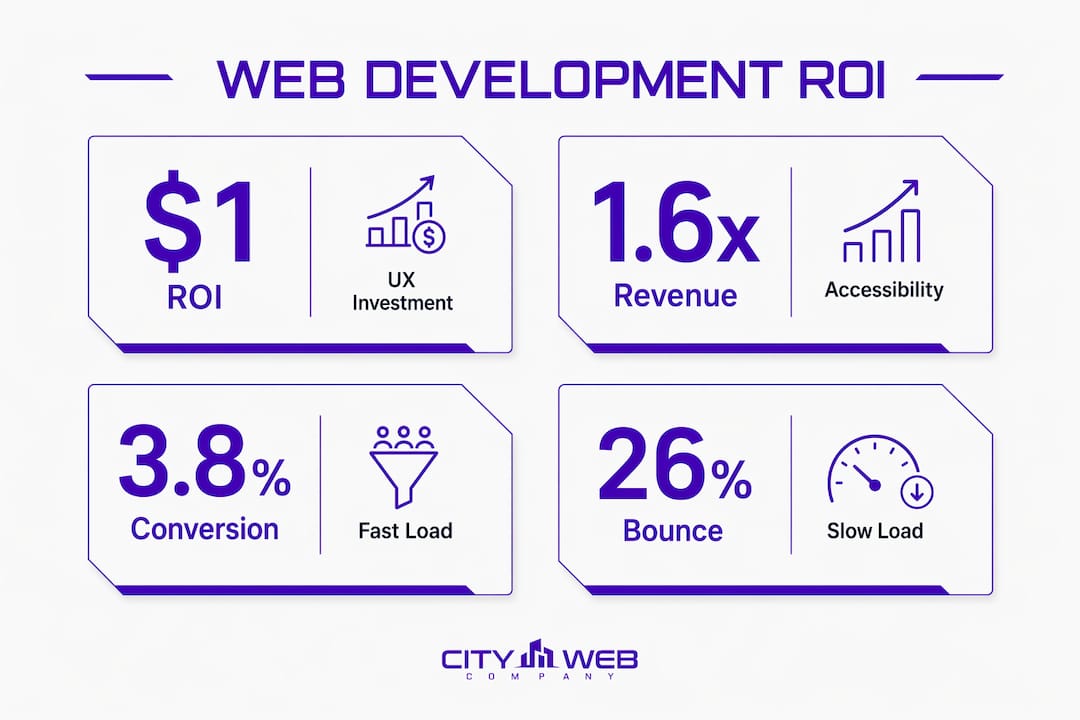

Bounce rate tells the same story. At LCP under 1.5 seconds, the average bounce rate sits around 26%. At LCP between 2.5 and 4.0 seconds, it climbs to roughly 41%. Visitors leave before they convert, and no amount of ad spend recovers that lost opportunity.
| LCP Speed | Avg. Bounce Rate | Median Conversion Rate |
|---|---|---|
| Under 1.5s | ~26% | ~3.8% |
| 2.5s to 4.0s | ~41% | ~2.4% |
Amazon and Walmart have both documented the revenue impact of page load time internally. The pattern is consistent: every second of delay costs measurable revenue. For a local HVAC company or moving business, the stakes are proportionally just as high. A slow site loses the call to a faster competitor.
Technical performance improvements that move the needle include image compression, browser caching, lazy loading, and server response time reduction. These are not glamorous. They are the kind of work that separates a website that converts from one that just exists. Investing in website design best practices from the start prevents the expensive rebuild cycle that slow, template-built sites create.
Cheap templates create technical debt. Technical debt is the accumulated cost of shortcuts taken during development that must be paid later, usually at a much higher price. A site built on a bloated template with unoptimized code will eventually require a full rebuild. Investing in clean, scalable architecture from the beginning avoids that outcome.
Pro Tip: Use Google’s PageSpeed Insights to benchmark your site’s Core Web Vitals score today. Focus first on your homepage and any service or landing pages where visitors make contact decisions.
Why does ongoing website maintenance matter after launch?
A website is not a finished product at launch. It is the start of an ongoing investment cycle. WordPress VIP’s 2026 analysis identifies owned media, including your website, as the top marketing investment for businesses that want predictable, compounding returns. The key word is “owned.” Unlike paid ads, your website builds equity over time when maintained properly.
The most common mistake small and medium business owners make is treating the website launch as the finish line. Without a governance plan, sites degrade. Security vulnerabilities go unpatched. Content grows stale. Performance scores drop as third-party scripts accumulate. Each of these problems erodes the ROI the initial investment was meant to generate.
A practical post-launch maintenance plan covers four areas:
- Security updates. Apply CMS, plugin, and theme updates on a regular schedule. Unpatched software is the leading cause of website breaches for small businesses.
- Performance monitoring. Check Core Web Vitals monthly. A score that drops after a plugin update can quietly cost you conversions for weeks before anyone notices.
- Content freshness. Update service pages, pricing, and team information at least quarterly. Stale content signals to both visitors and search engines that the business is inactive.
- Conversion testing. Run A/B tests on your highest-traffic pages. Small changes to headlines, button placement, or form length can produce measurable conversion lifts without additional ad spend.
Building governance into your web investment from day one keeps the site functioning as a strategic asset rather than a depreciating liability. Budget for maintenance the same way you budget for equipment upkeep. It is not optional if you want the asset to hold its value.
Pro Tip: Set a recurring calendar reminder every 90 days to audit your top five pages for outdated content, broken links, and load speed. This simple habit prevents the slow decay that kills website ROI.
In-house vs. freelancer vs. agency: which approach delivers the best ROI?
Choosing how to build and maintain your website is as important as deciding to invest in it. The three main options for small and medium businesses are doing it yourself, hiring a freelancer, or working with a full-service agency. Each has real trade-offs.
Doing it yourself gives you full control and the lowest upfront cost. The hidden cost is time. Learning web development well enough to build a fast, accessible, conversion-optimized site takes hundreds of hours. For most business owners, that time has a higher value elsewhere.
Hiring a freelancer offers more expertise than DIY at a lower cost than an agency. The risk is scope. A freelancer who excels at design may not have deep expertise in performance optimization or ADA compliance. You often get one skill set, not a complete solution. Coordination across multiple freelancers adds management overhead that many SMBs underestimate.
Working with a professional agency costs more upfront but delivers integrated expertise across design, development, SEO, accessibility, and performance. For businesses where the website is a primary lead source, the cost of a weak site far exceeds the cost of professional development.
| Approach | Cost | Control | Expertise | Scalability |
|---|---|---|---|---|
| DIY | Low | High | Limited | Low |
| Freelancer | Medium | Medium | Specialized | Medium |
| Agency | Higher | Shared | Broad | High |
The advantages of web development done by a professional team show up most clearly in three areas: accessibility compliance, Core Web Vitals performance, and long-term maintenance. These require coordinated expertise that a single person rarely covers. Understanding what a marketing agency actually does for small businesses clarifies why the integrated model produces better outcomes than piecing together individual contractors.
For SMBs with limited budgets, the right starting point is not the cheapest option. It is the option that produces the fastest measurable return. Prioritizing conversion-critical pages, such as the homepage, service pages, and contact page, delivers ROI faster than a full site overhaul. Start there, measure the results, and expand the investment based on what the data shows.
Key Takeaways
Web development is the highest-return digital investment available to small and medium businesses when it combines UX quality, accessibility compliance, technical performance, and ongoing maintenance.
| Point | Details |
|---|---|
| UX delivers measurable ROI | Every $1 in UX investment can return up to $100 through higher conversions and lower support costs. |
| Accessibility expands revenue | ADA-compliant sites reach more customers and reduce legal risk, with ROI of 37%–100% in year one. |
| Speed directly drives conversions | Sites with LCP under 1.5s convert at 3.8% vs. 2.4% for slower sites. |
| Maintenance protects your investment | Post-launch governance keeps security, performance, and content from degrading over time. |
| Professional teams outperform DIY | Agencies deliver integrated expertise in design, performance, and compliance that single contractors rarely match. |
The uncomfortable truth about cheap websites
I have worked with enough small business owners to recognize a pattern. They spend months agonizing over logo colors and almost no time thinking about page speed or accessibility. Then they launch on a $29 template, call it done, and wonder why the phone is not ringing.
The truth is that a cheap website is not a savings. It is a deferred cost. The technical debt accumulates quietly. The site slows down. The accessibility gaps attract legal notices. The conversion rate sits at 1% when it could be 3% or 4%. By the time the business owner realizes the problem, a full rebuild costs three times what a proper build would have cost originally.
My advice to any SMB owner is to start with your highest-traffic pages and fix those first. You do not need a perfect website. You need a fast, accessible, clearly written homepage and service page that loads in under two seconds and tells visitors exactly what to do next. That alone will outperform most competitor sites in your local market.
Track the outcomes from the start. Use Google Analytics 4 and Google Search Console together. Watch your website conversion rate before and after any development change. When you can show that a $2,000 development investment produced 15 additional leads per month, the next investment decision becomes easy. The businesses that treat web development as a cost stay stuck. The ones that treat it as a revenue system keep investing and keep growing.
— Matt
How City Web Company builds websites that generate real results
City Web Company designs and develops websites built specifically for local service businesses that need leads, not just an online presence.
Every site City Web Company builds is optimized for Core Web Vitals performance, ADA accessibility compliance, and local SEO from day one. That means faster load times, broader audience reach, and stronger search rankings without requiring a costly rebuild six months after launch. The agency’s team covers design, development, and ongoing maintenance under one roof, so nothing falls through the cracks between contractors. If you are ready to turn your website into a consistent lead source, explore City Web Company’s web design and development services or review the full digital marketing services available for local businesses.
FAQ
Why invest in web development instead of just running ads?
Ads stop generating leads the moment you stop paying. A well-built website compounds in value over time through SEO, organic traffic, and improved conversion rates, making it a more durable investment.
What is the ROI of UX improvements for a small business?
Research shows that $1 invested in UX design can return up to $100 through higher conversion rates, lower customer support costs, and reduced churn.
How does website accessibility affect my bottom line?
Companies leading on accessibility generate 1.6x more revenue than peers and reduce legal exposure from ADA Title III claims, with documented ROI of 37%–100% in the first year.
How fast does my website need to load to convert visitors?
Sites with an LCP under 1.5 seconds convert at a median rate of 3.8%. Sites that load between 2.5 and 4.0 seconds drop to 2.4%, a gap that adds up to significant lost revenue at scale.
How much should a small business budget for ongoing website maintenance?
A practical maintenance budget covers security updates, performance monitoring, content refreshes, and conversion testing. The exact amount varies by site complexity, but treating maintenance as a fixed operational cost prevents the far larger expense of emergency fixes or full rebuilds.
Recommended
These articles were popular with other readers too: