
Pass Google Business verification with a video-first checklist. Film one continuous 30 second take, fix flagged issues, and know when to hire help.
What Is Social Media Advertising and Why It Matters
Every Marketing Manager knows the challenge of connecting with homeowners right when they need your service most. Social media advertising makes this possible by offering precise targeting and measurable results on platforms like Facebook, Instagram, LinkedIn, YouTube, and TikTok. For small and medium-sized American home service businesses, understanding these basics unlocks new ways to engage your local audience, drive quality leads, and maximize your ad spend.
Table of Contents
Table of Contents
- Defining Social Media Advertising Basics
- Types of Social Media Ads and Platforms
- How Social Media Ad Targeting Works
- Costs and Budgeting for Social Media Ads
- Common Pitfalls and How to Avoid Them
Key Takeaways
| Point | Details |
|---|---|
| Effective Targeting is Crucial | Narrow your audience to specific buyer personas to maximize ad performance and minimize wasted budget. |
| Data-Driven Optimizations | Regularly analyze ad performance data to refine targeting and budget allocation for better results. |
| Understand Ad Formats | Choose the appropriate ad format based on your marketing goals and audience behavior to enhance engagement. |
| Set Clear Campaign Goals | Define measurable objectives for each campaign to guide strategy and track success accurately. |
Defining Social Media Advertising Basics
Social media advertising is paid promotion on platforms where your customers already spend time. You create targeted ads on Facebook, Instagram, LinkedIn, YouTube, TikTok, and similar platforms to reach specific audiences and drive real business results.
Unlike organic social posts, ads cost money but reach people actively searching for what you offer. The trade-off is simple: you pay for visibility, targeting precision, and measurable results.
What Makes Social Media Advertising Different
Social media advertising works because it combines detailed targeting with visual storytelling. Using social media platforms to promote products involves paid ads that leverage massive user bases across demographics, interests, and behaviors.
For a home service business, this means showing plumbing ads to homeowners searching for emergency repairs, or HVAC ads to people in your service area before the heating season starts. You pay only for the audience you want.
Core Elements You Need to Understand
Every successful social media ad campaign relies on these foundational components:
- Platform selection – Different platforms reach different audiences; Facebook reaches older homeowners, TikTok reaches younger audiences
- Audience targeting – Use demographics, interests, location, and behavior to narrow who sees your ads
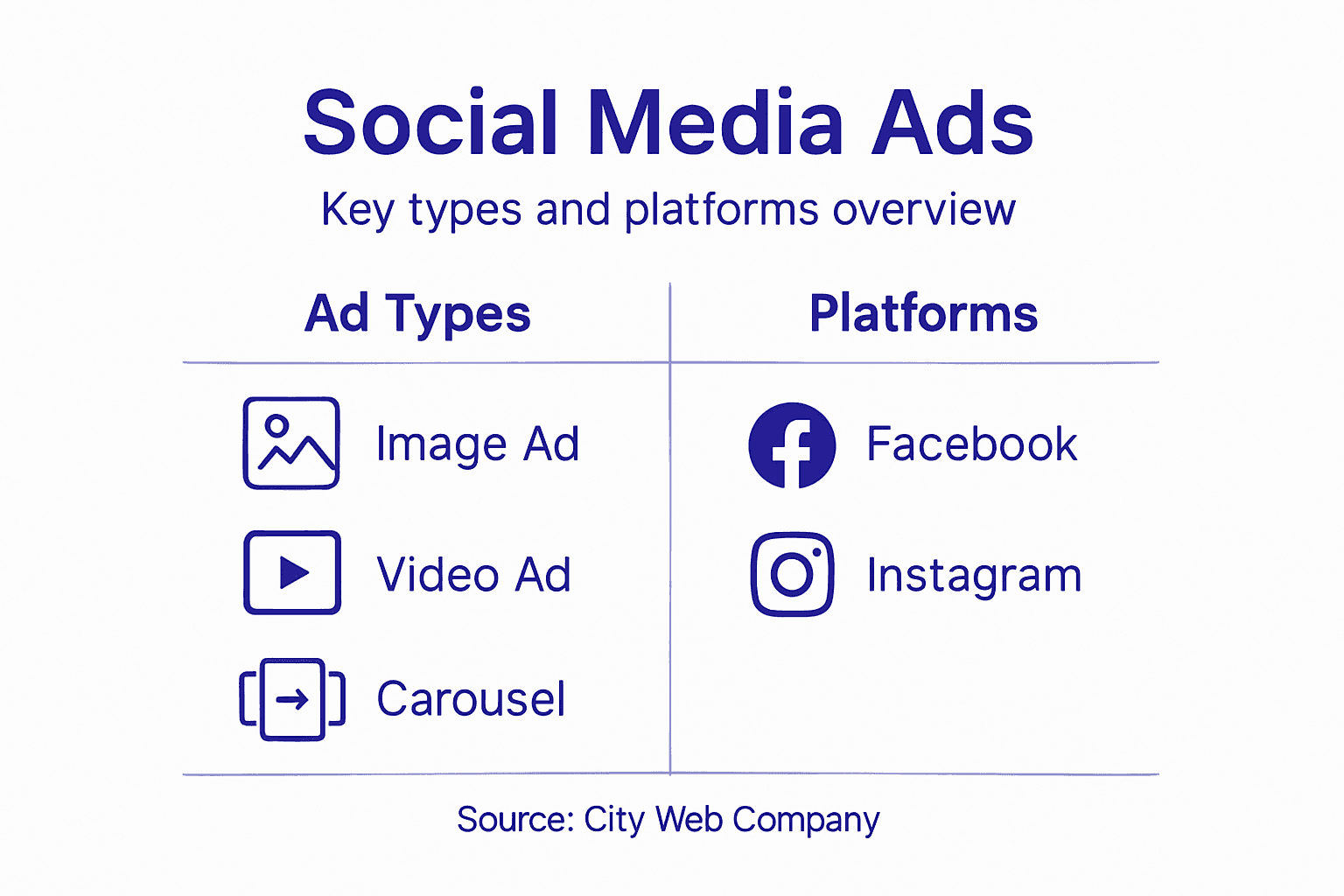
- Ad formats – Image ads, video ads, carousel ads, and stories each work differently for different goals
- Messaging and creative – Your headline, copy, and visuals must match what your audience needs right now
- Budget allocation – You control exactly how much you spend daily and where that money goes
Why Targeting Matters Most
Targeting separates wasted ad spend from profitable campaigns. You define buyer personas with specific details: a 45-year-old homeowner in your zip code who recently searched for roof repairs and owns a house valued above $300,000.

Creating targeted content using buyer personas helps define detailed target groups based on demographics, interests, and behaviors. This lets you deliver exactly the right message to exactly the right person.
Without targeting, your ad budget disappears into irrelevant audiences. With it, you attract leads ready to hire.
How You Measure Success
Every dollar spent on social media ads produces measurable data. You see how many people viewed your ad, clicked it, filled out a form, or called your business.
This data lets you optimize continuously:
- Run your ad for one week and collect data
- Identify which audience segments respond best
- Shift budget toward top-performing audiences
- Pause underperforming ads
- Repeat weekly or monthly
Social media advertising succeeds because you can measure everything and improve based on real performance, not guesses.
You know exactly which ads generate calls versus website visitors versus form submissions. This transparency makes it one of the most accountable advertising channels available.
Pro tip: Start by tracking one clear goal for each campaign, whether that’s phone calls, appointment bookings, or website leads, so you can measure what actually drives your business forward.
Types of Social Media Ads and Platforms
Not all social media ads look the same, and not all platforms reach the same audiences. Understanding the differences between ad formats and platforms helps you choose where to spend your budget for maximum impact.
Your plumbing business has different needs than a lawn care service. The platform that works best depends on who you’re trying to reach and what action you want them to take.
Ad Formats That Drive Results
Each ad format serves a specific purpose. Choosing the right one shapes how people respond to your message.
- Image ads – Single photo with headline and description; best for awareness and straightforward offers
- Video ads – Short clips showing your service in action; best for demonstrating quality and building trust
- Carousel ads – Multiple images or videos in a swipeable format; best for showcasing before/after results or different services
- Stories ads – Full-screen vertical ads that appear between user stories; best for mobile users scrolling quickly
- Collection ads – Multiple products or services in a grid format; works well for businesses offering varied services
The format you choose matters less than matching it to your audience’s behavior and your specific goal.
A homeowner scrolling Instagram Stories will engage differently than someone browsing Facebook on a desktop. Choose formats that fit where your customers actually are.
Here’s a quick comparison of common social media ad formats and their typical business outcomes:
| Ad Format | Best Use Case | Audience Response | Business Impact |
|---|---|---|---|
| Image Ads | Brand awareness | Quick viewing, low engagement | Low-cost broad reach |
| Video Ads | Service demonstration | Higher engagement, trust built | Boosts conversion rates |
| Carousel Ads | Showcasing multiple offerings | Interactive swiping | Drives upsells/cross-sells |
| Stories Ads | Mobile engagement | Immediacy, quick attention | Reaches younger audiences |
| Collection Ads | Promoting multiple services | Browsing products/services | Increased service bookings |
Platform Selection for Home Service Businesses
Different platforms attract different demographics and behaviors. Facebook reaches older homeowners actively searching for services. Instagram catches homeowners interested in home improvement and design. LinkedIn works for B2B and service contract leads. TikTok reaches younger homeowners and their families.
For most home service businesses, Facebook and Instagram deliver the best return because they allow precise geographic targeting and reach homeowners in your service area.
Where to Start
If you’re new to social media advertising, begin with one platform. Role of social media ads for local service brands shows how to leverage these channels effectively for your specific market.
Facebook is the obvious first choice because it offers:
- The largest user base of homeowners
- Precise geographic targeting down to zip codes
- Affordable minimum budgets, starting at five dollars daily
- Detailed audience insights showing who responds
- Integration with Instagram for expanded reach
Once Facebook is performing, expand to Instagram to reach different age groups, or test TikTok if you want younger homeowners and their families.
Pro tip: Start with Facebook, run the same ad for two weeks to gather performance data, then duplicate your top-performing ad on Instagram to reach the same message to a slightly different audience without starting from zero.
How Social Media Ad Targeting Works
Social media targeting is the reason your plumbing ads reach homeowners who need plumbing, not everyone scrolling Facebook. The platform collects data about users and matches your message to people most likely to hire you.
Without targeting, you waste money showing ads to people who will never call. With it, every dollar goes toward qualified leads.
How Platforms Collect Your Data
Facebook and Instagram know a lot about you. They track what you search for, which posts you like, which ads you click, and even websites you visit outside their apps.
They use this information to build a profile. A homeowner might be categorized as age 45, married, owns a home worth $400,000, recently searched “roof repair,” and watched home improvement videos.
Platforms sell access to these profiles to advertisers like you. You don’t see the person’s name or contact information, but you can say “show my ad to people matching this profile.”
The Targeting Categories You Control
When you create an ad campaign, you choose which people see it. Audience planners use demographic, behavioral, psychographic data to build precise segments targeting exactly who you want to reach.
You control these targeting options:
- Location – Show ads only to people in your service area
- Age and gender – Target specific age ranges or genders
- Interests – Reach people interested in home repair, real estate, or gardening
- Behaviors – Target people who recently searched for your service or visited competitor websites
- Income level – Focus on homeowners with disposable income for your service
Building Buyer Personas for Better Results
Buyer personas develop detailed customer profiles based on demographics, interests, and behaviors to capture attention and increase engagement. Instead of showing ads to millions of people, you narrow your audience to thousands of qualified prospects.
Example: Your HVAC business targets people aged 35 to 65, homeowners in your zip code, with household income above $60,000, who searched for “furnace replacement” in the last 30 days.
This specificity costs less and converts better. You’re not paying to reach people who will never call.
Why Precision Beats Broad Reach
A broad campaign showing your ad to everyone is cheaper per impression but wastes money. A targeted campaign costs more per person but reaches only qualified prospects.
Precision targeting costs less overall because fewer people see your ad, but far more of them become leads.
You could show 10,000 people a generic ad and get 5 calls. Or show 500 targeted people the same ad and get 5 calls for one-twentieth the cost.
Pro tip: Start with one specific buyer persona, run ads for two weeks, then analyze which people actually called, and use those characteristics to refine your targeting for better results in future campaigns.
Costs and Budgeting for Social Media Ads
Social media advertising doesn’t require a massive budget to work. You can start with five dollars per day and scale up as you see results. Understanding costs helps you spend smarter, not necessarily more.
Most home service businesses find that social media ads deliver better returns than traditional advertising once they understand pricing and where money actually goes.
How Social Media Pricing Works
Platforms charge you based on what happens with your ad. CPM and CPC metrics measure cost per thousand impressions and cost per click to help you understand true spending efficiency.
You choose how to pay:
- Cost Per Click (CPC) – Pay only when someone clicks your ad; typical range $0.50 to $3.00 per click
- Cost Per Thousand Impressions (CPM) – Pay per 1,000 times your ad displays; Facebook and Instagram average $6 to $14 CPM
- Cost Per Lead (CPL) – Pay when someone completes a desired action like filling a form
For a plumbing business getting five calls per week, CPC usually works best. You pay only for clicks, and many clicks convert to calls.
Platform Cost Differences
Not all platforms cost the same. Facebook and Instagram offer lower costs than LinkedIn because their audiences are broader. LinkedIn targets professionals and charges premium rates for that access.
For home service businesses targeting homeowners, Facebook and Instagram deliver the lowest cost per lead. YouTube and TikTok work well if you want younger homeowners but typically cost more.
To help guide budget decisions, here’s a summary of typical social media ad costs by platform and best fit:
| Platform | Avg Cost per Lead | Ideal Audience | Typical Minimum Budget |
|---|---|---|---|
| $20–$40 | Older homeowners, local users | $5 daily | |
| $25–$50 | Design-focused, younger adults | $5 daily | |
| $60–$100 | B2B clients, professionals | $10 daily | |
| TikTok | $40–$80 | Families, young homeowners | $10 daily |
| YouTube | $50–$90 | DIY enthusiasts, broad reach | $10 daily |
Beyond Ad Spend
Effective budgeting requires accounting for content creation, tools, and community management beyond paid ads alone. Your total social media cost includes more than just what platforms charge.
Consider these expenses:
- Ad spend on the platform
- Time to create ad graphics or videos
- Tools for scheduling and analytics
- Someone to monitor and respond to messages
- Testing multiple ad variations
A realistic budget for a small home service business starts at $500 to $1,000 monthly to cover platform costs plus content creation.
Building Your First Budget
Start small. Allocate $150 to $200 weekly on Facebook. Run the same ad for two weeks, track results, then adjust based on performance.
If you get five calls per week at $150 spend, your cost per lead is $30. If that call converts to $2,000 in revenue, you have a sustainable model.
Budget allocation matters less than measuring what actually generates calls and leads for your business.
Scale what works. If one ad generates calls, increase its budget. If another generates clicks but no calls, pause it and redirect funds.
Pro tip: Set a daily budget limit you can afford to lose, run ads for exactly two weeks without changing anything, track every call and lead, then calculate your actual cost per lead before deciding to spend more.
Common Pitfalls and How to Avoid Them
Most home service businesses fail at social media advertising not because the channel doesn’t work, but because they make predictable mistakes. Learning what goes wrong helps you avoid wasting money and time.
The good news: these mistakes are preventable once you know what to watch for.
Pitfall 1: Running Ads Without a Clear Goal
You launch an ad and hope something happens. No specific target, no measurable result, no way to know if it worked. This wastes money fast.
Instead, define exactly what success looks like before spending a dollar. Success might be phone calls, appointment bookings, form submissions, or website visits. Pick one metric per campaign.
Common pitfalls in social media advertising include lacking clear strategy aligned with overall marketing goals and not setting measurable KPIs to track performance. Without goals, you cannot optimize or know what’s actually working.
Pitfall 2: Targeting Too Broadly
Showing your ad to everyone in your state costs more and converts worse than targeting your specific service area. Broad targeting means paying to reach people who will never call.
Narrow your audience ruthlessly:
- Geographic location within your service area
- Age range of typical customers
- Income level of homeowners you serve
- Specific interests related to your service
A tight audience of 5,000 qualified people converts better than 50,000 random people.
Pitfall 3: Not Monitoring or Adjusting Campaigns
You launch an ad, set it, and forget it for three months. By then, you’ve wasted thousands on underperforming creative. Effective campaigns require active management.
Check your ads weekly:
- Look at which ads generate clicks
- See which clicks convert to calls or leads
- Identify your best-performing audience segment
- Increase budget for winners, pause underperformers
- Test new creative based on what’s working
Campaigns improve when you pay attention and adjust continuously.
Pitfall 4: Making False or Unsubstantiated Claims
Brands must ensure transparency and honest disclosures to avoid risks of misleading claims and truth-in-advertising violations. Saying “emergency plumbing fixed in 30 minutes guaranteed” when you can’t deliver creates legal risk.
Use only claims you can actually fulfill. If you say same-day service, you must deliver same-day service every time.
Truthful ads might convert slightly less, but they generate customers who won’t sue you or leave bad reviews.
Pitfall 5: Ignoring Budget Limits
You set no daily budget limit and wake up to a $500 charge after two days of testing. Budget controls protect you from overspending while learning.
Always set a daily budget you can afford to lose. Five dollars per day is fine for testing. Twenty dollars per day is reasonable for early campaigns.
Pro tip: Set a daily budget you can lose, run ads for exactly two weeks without changing targeting, then review results and adjust only the underperforming ads instead of pausing everything.
Unlock the Power of Targeted Social Media Advertising for Your Home Service Business
Struggling to reach the right customers and turn clicks into real leads? The article “What Is Social Media Advertising and Why It Matters” highlights the crucial role of precise targeting and measurable results in making social media ads work. Avoid wasting your budget on broad campaigns by leveraging buyer personas, platform selection, and clear goals that put your message directly in front of homeowners ready to hire.
Take control of your digital marketing with expert help from City Web Company, a trusted digital marketing agency specializing in paid advertising campaigns, local SEO, and lead generation for service-based businesses. We tailor strategies that maximize your ad spend and generate real growth. Don’t wait to start turning social media ads into appointments and sales. Contact us today to get started with a campaign designed for measurable success and increasing revenue. Visit our contact page now and let’s build a targeted advertising plan that works for your business.
Explore how our paid media management and search optimization solutions can elevate your online presence and deliver the calls your company needs.
Frequently Asked Questions
What is social media advertising?
Social media advertising refers to paid promotions on platforms like Facebook, Instagram, LinkedIn, and TikTok, aimed at reaching specific audiences to drive business results through targeted ads.
How does targeting work in social media advertising?
Targeting allows advertisers to define specific audience parameters, such as demographics, interests, location, and behaviors, ensuring ads are shown to individuals most likely to engage with the content.
What are the different ad formats available for social media advertising?
Common ad formats include image ads, video ads, carousel ads, stories ads, and collection ads, each serving different purposes and engaging audiences in unique ways.
Why is measuring success important in social media advertising?
Measuring success helps advertisers optimize their campaigns by tracking key metrics such as views, clicks, leads, and conversions, allowing for data-driven adjustments that improve performance and return on investment.
Recommended
These articles were popular with other readers too: