

See how plumbers can turn Facebook scrollers into booked jobs with clear offers, local targeting, a 30 day test budget, fast follow up, and a path to scale.
What Is Paid Search Advertising? A Guide for Marketers
Paid search advertising is the practice of paying search engines like Google and Bing to display your ads on search engine results pages (SERPs) when users type in queries that match your chosen keywords. The dominant payment model is pay-per-click (PPC), meaning you pay only when someone clicks your ad, not simply when it appears. Platforms like Google Ads and Microsoft Advertising (formerly Bing Ads) run these auctions billions of times per day. For business owners and marketers, paid search marketing delivers something organic SEO cannot: immediate, controllable visibility in front of people who are actively searching for exactly what you offer.
Table of Contents
What is paid search advertising and how does it work?
Paid search operates through a real-time keyword auction. Every time a user types a query into Google or Bing, the search engine runs an automated auction among advertisers who have bid on keywords matching that query. The winner does not simply go to the highest bidder. Ad rank depends on both bid and ad quality, which includes relevance of the ad copy, expected click-through rate, and the quality of the landing page experience.
This quality-based system exists because search engines profit from user trust. Google ranks ads using a quality score that rewards relevance, so a well-written ad targeting a specific search intent can outrank a competitor spending twice as much per click. A plumbing company bidding on “emergency plumber Denver” with a tightly written ad and a fast, relevant landing page will consistently beat a generic home services ad with a higher bid but a poor user experience.

Once the auction resolves, paid search ads appear as sponsored listings at the top or bottom of the SERP, clearly labeled to distinguish them from organic results. Users see these ads before any organic content on the page, which is why the placement commands a premium.
Here is what happens in sequence during a paid search auction:
- A user types a search query into Google or Bing
- The platform identifies all advertisers bidding on matching keywords
- Each advertiser’s ad rank is calculated using bid amount multiplied by quality score
- Ads are placed in order of ad rank, with top positions going to the highest-ranked ads
- The advertiser pays per click only when a user clicks the ad, not per impression
Pro Tip: Set your keyword match types deliberately. Broad match captures volume but burns budget on irrelevant clicks. Exact match controls spend but limits reach. Most campaigns perform best with a mix of phrase match and exact match keywords, especially when starting out.
What are the main types of paid search ads?
Paid search ads fall into three primary categories: local ads, text ads, and shopping ads. Each format serves a different business goal and appears differently on the SERP. Choosing the right format depends on what you sell, who you are targeting, and what action you want the user to take.
| Ad type | Best for | What it shows | Typical use case |
|---|---|---|---|
| Text ads | Service businesses, lead generation | Headline, display URL, description copy | HVAC companies, law firms, moving services |
| Shopping ads | E-commerce and product sellers | Product image, price, store name | Retailers, online stores, product-based businesses |
| Local ads | Brick-and-mortar and service-area businesses | Business name, location, phone number, reviews | Restaurants, plumbers, pest control, med spas |
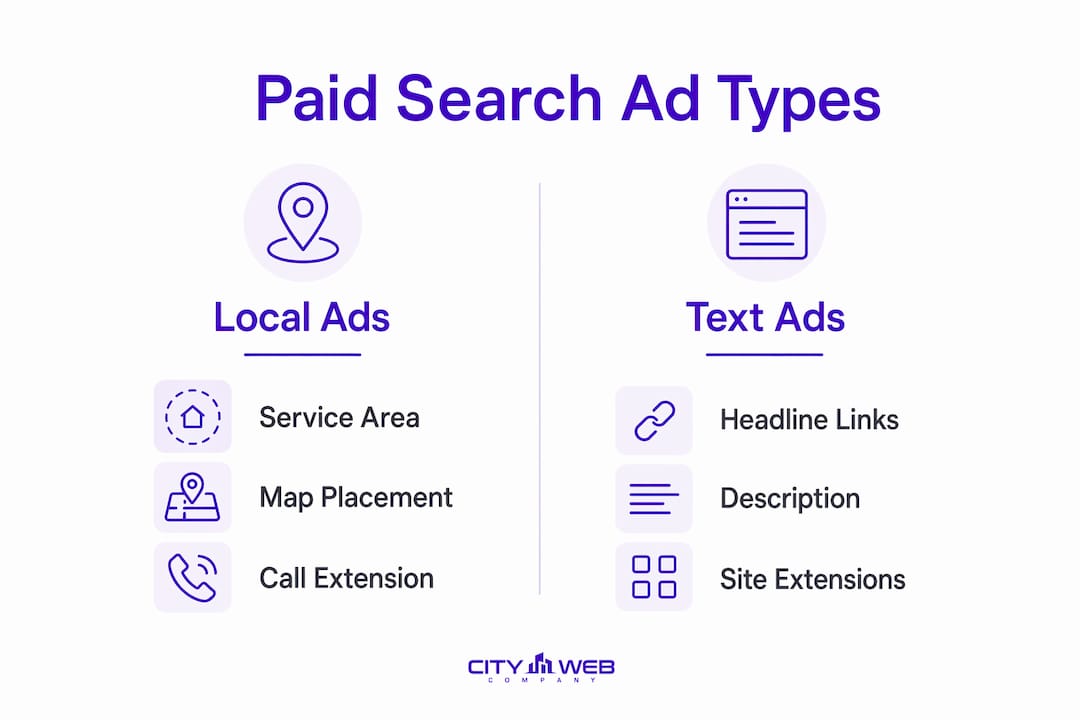
Text ads are the most common format in paid search campaigns. They appear at the top and bottom of the SERP and consist of a headline (up to three parts), a display URL, and two lines of description copy. For service businesses like landscapers or disaster restoration companies, text ads are the workhorse format because they target high-intent queries like “water damage repair near me” and drive phone calls or form submissions.
Shopping ads are product-focused and pull data directly from a product feed submitted to Google Merchant Center. They display an image, price, and store name before the user even clicks. This format is less relevant for pure service businesses but critical for any company selling physical products online.
Local ads, sometimes called Local Services Ads on Google, are purpose-built for service-area businesses. They appear above standard text ads and display your business name, star rating, number of reviews, and a click-to-call button. For a pest control company or a plumber, local ads showing contact info and reviews can generate leads at a lower cost per acquisition than traditional text ads because the trust signals are built directly into the ad unit.
What are the real benefits of paid search?
The most direct benefit of paid search is speed. Paid search provides immediate visibility the moment a campaign goes live, while SEO can take months to produce ranking results. For a new business or a seasonal promotion, that speed is not just convenient. It is often the difference between capturing revenue and missing it entirely.
Beyond speed, here are the core benefits that make PPC advertising worth the investment:
- Precise intent targeting. You reach users at the exact moment they are searching for your service. A query like “roof repair after hail storm” signals immediate buying intent that no social media ad can replicate.
- Measurable cost per result. Because advertisers pay per click, every dollar spent is tied to a user action. You can calculate cost per lead, cost per call, and cost per sale with precision.
- Full conversion tracking. Paid search platforms connect clicks to downstream outcomes. Tracking ROI from click to final sale lets you identify which keywords generate customers, not just traffic, and cut the ones that do not.
- Budget control. You set daily and monthly spending caps. A local HVAC company can run a $500-per-month campaign and know exactly what it spent and what it produced.
- Brand visibility even without clicks. Impressions on high-intent queries build recognition. Users who see your ad three times before clicking are more likely to convert when they do.
Pro Tip: Do not optimize paid search campaigns for clicks alone. Set up conversion tracking in Google Ads from day one so you can see which keywords and ad variations are producing actual leads or sales. Clicks without conversions are just expenses.
The search intent foundation behind every query is what makes paid search uniquely powerful. Unlike display advertising or social ads, you are not interrupting someone. You are answering a question they already asked.
How does paid search compare to SEO, and should you use both?
Paid search and SEO are not competitors. They are tools with different time horizons and different strengths. Understanding the distinction helps you allocate budget and effort more effectively.
Paid search delivers instant visibility but requires ongoing spend to maintain that presence. The moment you pause a campaign, your ads disappear. SEO, by contrast, builds compounding authority over time. A well-optimized page can generate traffic for years without additional spend, but it takes months to reach that point.
Here is how the two strategies differ in practice:
- Time to results: Paid search produces traffic on day one. SEO typically takes three to six months to show meaningful ranking improvements for competitive keywords.
- Cost structure: Paid search has a direct cost per click. SEO requires investment in content, technical work, and link building, but the marginal cost of each additional visitor decreases over time.
- Control: Paid search gives you precise control over messaging, targeting, and budget. SEO is subject to algorithm changes and competitive shifts you cannot fully control.
- Visibility type: SEM reaches active searchers instantly, while SEO builds persistent organic presence that compounds incrementally.
- Data feedback: PPC campaigns generate keyword performance data within days. That data, including which search terms convert, can directly inform your SEO content strategy.
The most effective approach for most local service businesses is to run paid search campaigns while simultaneously building organic rankings. Use PPC to capture demand now, especially for high-value services like emergency repairs or seasonal work. Use SEO to reduce your long-term cost per acquisition as organic rankings improve. When both are aligned around the same keywords and search intent signals, the combined effect is greater than either channel alone.
For businesses just launching or entering a new market, paid search is the faster path to visibility. For businesses with established sites and content, SEO becomes increasingly cost-efficient over time. The smart play is not choosing one over the other. It is knowing when to lean on each.
Key takeaways
Paid search advertising works because it combines real-time intent targeting with measurable cost control, giving businesses immediate visibility that SEO alone cannot provide.
| Point | Details |
|---|---|
| PPC model drives cost efficiency | You pay only when a user clicks, making every dollar traceable to a specific action. |
| Ad rank rewards quality, not just spend | Google scores ads on relevance and landing page experience, not bid amount alone. |
| Three ad formats serve different goals | Text ads drive leads, shopping ads move products, and local ads generate calls and visits. |
| Paid search and SEO work together | PPC delivers instant traffic while SEO builds compounding organic visibility over time. |
| Conversion tracking is non-negotiable | Connecting clicks to sales is what separates profitable campaigns from expensive ones. |
Why most businesses underuse paid search’s full potential
Most business owners I talk to treat paid search as a simple on/off switch. They set up a Google Ads campaign, pick some keywords, write a headline, and wait. When results disappoint, they conclude that PPC does not work for their industry. That conclusion is almost always wrong. The campaign was just built without the fundamentals.
The single biggest mistake I see is a mismatch between ad copy and landing page. A user searches “emergency furnace repair,” clicks an ad that says “Emergency Furnace Repair Available Now,” and lands on a homepage that talks about the company’s 25 years in business. The intent was urgent. The landing page was generic. That disconnect kills conversions before the user even reads a word.
The second mistake is treating bid management as a set-and-forget task. Auction dynamics shift constantly. Competitors enter and exit. Seasonal demand spikes. A campaign that performed well in October may be bleeding money by January without adjustments. The businesses that get the best results from Google Ads optimization treat their campaigns as living systems that need weekly attention, not monthly check-ins.
My honest view is that paid search rewards specificity above everything else. Narrow keywords, specific ad copy, and dedicated landing pages consistently outperform broad campaigns with bigger budgets. A pest control company running ads for “termite inspection [city name]” with a page built specifically for that service will outperform a competitor running “pest control services” to a generic homepage, even if the competitor spends three times as much. Specificity is the multiplier that most businesses leave on the table.
— Matt
How City Web Company can help with your paid search campaigns
City Web Company builds and manages paid search campaigns specifically for local service businesses, including HVAC companies, plumbers, pest control operators, landscapers, and med spas. Every campaign is built around the specific services you offer and the geographic areas you serve, not generic keyword lists copied from a template. If you are ready to put your business in front of customers who are actively searching for what you do, explore our paid advertising services for local businesses or learn how we maximize Google Ads ROI for service companies across the country. The first step is a conversation about what your market looks like and where the real opportunity is.
FAQ
What is paid search advertising in simple terms?
Paid search advertising is paying a search engine like Google to show your ad when users search for keywords related to your business. You typically pay only when someone clicks your ad, making it a direct-response marketing channel.
What is PPC and how does it relate to paid search?
PPC stands for pay-per-click, which is the billing model used in most paid search campaigns. Every time a user clicks your ad on Google or Bing, you pay a fee to the platform. PPC and paid search are often used interchangeably, though PPC can also apply to paid ads on social media platforms.
How is paid search different from SEO?
Paid search delivers immediate placement on SERPs through paid auctions, while SEO earns organic rankings through content quality and authority over time. Paid search stops producing traffic the moment you stop spending. SEO continues generating traffic as long as your rankings hold.
Is paid search advertising effective for small businesses?
Paid search is particularly effective for small and local service businesses because it targets users with active purchase intent. A local plumber or HVAC company can compete directly with larger brands by bidding on specific, location-based keywords where intent is high and competition is manageable.
How much does paid search advertising cost?
Cost varies by industry, keyword competition, and geographic market. You control spending through daily and monthly budget caps in platforms like Google Ads. The relevant metric is not how much you spend but your cost per lead or cost per sale, which paid search tracks precisely from click to conversion.
Recommended
These articles were popular with other readers too: