Enhance your site with this website accessibility guide. Fix critical issues, reduce legal risks, and improve user experience today!
What Is a Conversion Funnel? Your Guide to Predictable Growth
Most business owners believe that getting more website traffic is the key to more sales. They pour money into ads and social media, hoping a flood of visitors will turn into a flood of business. But when the phone doesn't ring consistently, they are left wondering where all that traffic, and their money, went.
The issue is rarely a lack of traffic. It's the absence of a structured path for that traffic to follow.
Without a clear customer journey, visitors land on a website, get confused or distracted, and leave. This common scenario is the single biggest reason marketing investments fail to produce a return. It's a system designed for leaks, not conversions.
Table of Contents
The Real Cost of Unstructured Marketing
This disconnect between generating website visitors and closing a sale is where most marketing strategies fall apart. You might have an impressive website and plenty of people seeing your ads, but without a defined process to guide them, that traffic is wasted spend.
Consider how quickly a business loses potential customers when there is no clear path forward.
| Funnel Stage | Visitors Remaining | Common Reason for Drop-Off |
|---|---|---|
| Initial Website Traffic | 1,000 | Ad campaign or Google search brings visitors. |
| Visited a Service Page | 300 | Confusing navigation or a slow-loading site. |
| Considered Taking Action | 100 | Unclear information or no compelling offer. |
| Started to Contact You | 30 | Complicated contact form or hard-to-find phone number. |
| Became a Lead | 10 | Lost interest or decided to "think about it." |
In this typical scenario, 99% of the initial traffic is lost before it ever becomes a qualified lead. A conversion funnel is designed to correct this by giving every visitor a clear and logical next step.
From Random Clicks to a Predictable System
A conversion funnel, also known as a sales funnel, maps out this customer journey with intention. Think of a physical funnel: wide at the top to catch everything, then gradually narrowing to direct the flow to a specific endpoint. Your marketing should function the same way.
It starts with broad awareness and systematically guides the right people toward a single, profitable action. You can see how this process is measured across different industries by checking out the benchmarks from firstpagesage.com.
The purpose of a funnel is not just to sell. It is to create a predictable and measurable pathway that turns strangers into interested prospects, and prospects into paying customers.
Instead of hoping visitors figure out how to hire you, a funnel provides a deliberate route. Each stage is engineered to build trust and answer questions at the precise moment they arise, moving them closer to a decision.
This is the transition from a collection of disconnected marketing activities to a reliable system for growth. It plugs the financial leaks, ensuring the time and money spent attracting an audience actually generates a return. Without it, you are simply collecting visitors, not creating customers.
Breaking Down the Four Stages of a Modern Conversion Funnel
Turning a stranger into a paying customer is not an accident. It is a process. To build a marketing system that works, you must understand the path your customers take and the questions they have at each step.
A practical framework for a local business is a four-stage process known as AIDA: Awareness, Interest, Desire, and Action. This is not abstract theory; it is a direct map of your customer's mindset, from "I have a problem" to "You are the right choice."
Imagine a homeowner in Dallas whose air conditioning unit fails on a hot summer evening. Their journey through your funnel begins in that moment.
Stage 1: Awareness
The Awareness stage is the "I need help" moment. A potential customer realizes they have a problem and begins searching for a solution. They are not comparing brands yet; they are simply looking for options.
For the Dallas homeowner, this is when they search "emergency AC repair near me" or "24-hour HVAC service Dallas." Your only job is to be visible. You need to appear through a well-optimized website, a strong Google Business Profile, or a targeted local ad. If they cannot find you, you do not exist to them.
Stage 2: Interest
Once they find you, the Interest stage begins. They have landed on your website from a list of search results and are making a quick judgment. Their question shifts from "Who can help?" to "Can this company help?"
They are scanning for immediate proof that you are a credible, professional choice. They need to see that you handle their exact problem and serve their area. You have only a few seconds to capture their interest before they click the back button.
This is where the "funnel" concept becomes tangible. You begin with many visitors, but only a fraction will move to the next stage.
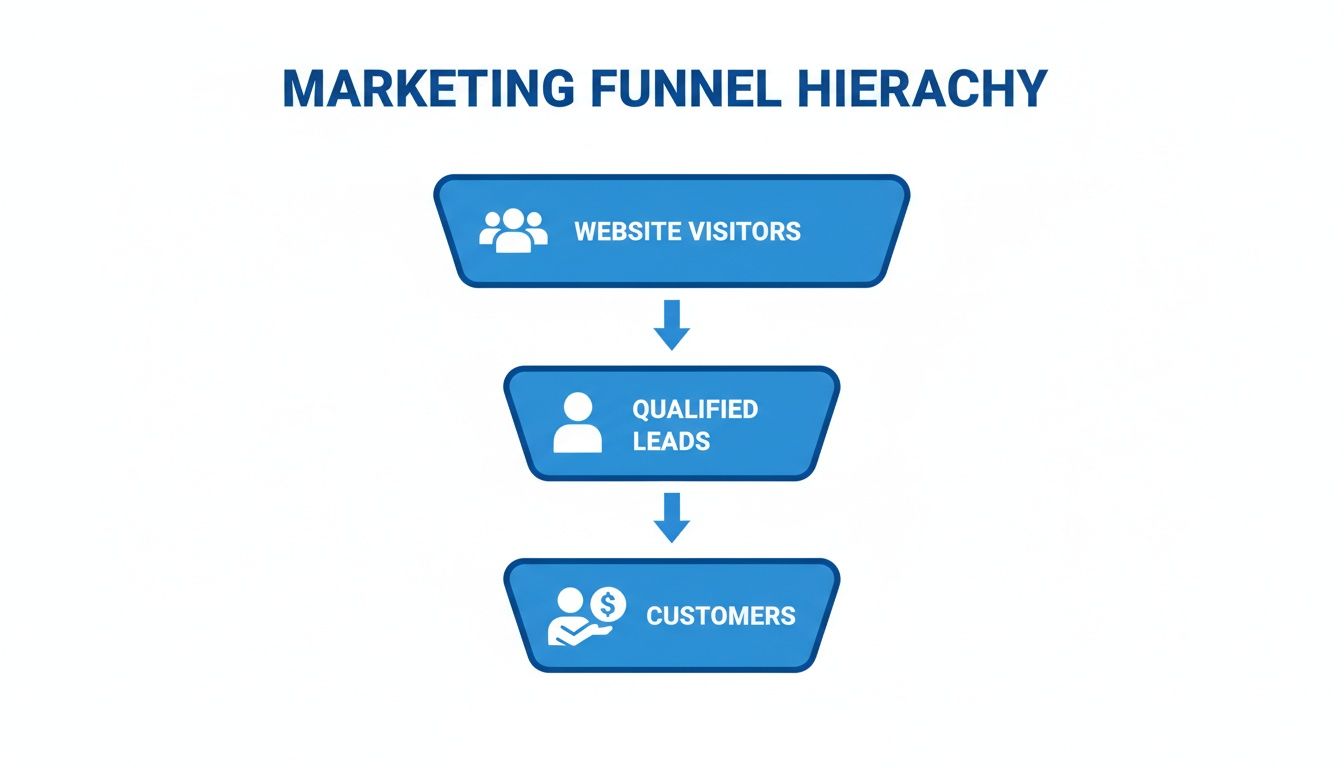
The group becomes smaller and more qualified at each step. This is by design. The goal is to guide the right people to the final action.
Stage 3: Desire
In the Desire stage, you have made the shortlist. The prospect has decided you are a legitimate contender. Now, they are actively looking for reasons to choose you over the other options. This is where you build trust and create preference.
The homeowner is now digging deeper. They are reading your five-star reviews, looking at photos of your team, and seeking testimonials from other satisfied customers. They are thinking, "They seem capable, but are they the best choice for me?"
Case studies, customer reviews, and a professional website design do the heavy lifting here, turning initial interest into a genuine desire to work with you.
Stage 4: Action
Finally, we have the Action stage. This is the moment of commitment. After moving from awareness to interest to desire, the prospect is confident, convinced, and ready to make contact.
For our homeowner, this is the moment they see your phone number and press the "Call Now" button. Their problem is urgent, and your funnel has done its job. You answered their questions, earned their trust, and made it simple for them to take the final step. Every part of your marketing should be engineered to lead to this single, valuable action.
How to Pinpoint Leaks in Your Funnel Using Data
A common frustration for business owners is driving traffic to a website but not getting a steady stream of qualified leads. The problem is usually not about getting more traffic; it is about the system in place to guide it. When a marketing funnel underperforms, it has "leaks," which are specific points where potential customers leave before taking action.
Without data, finding these leaks is guesswork. With the right numbers, it becomes a straightforward diagnostic process. Every stage of your conversion funnel has key performance indicators (KPIs) that tell a story. By tracking these metrics, you can see exactly where your strategy is breaking down and costing you money.
Diagnosing Top-of-Funnel Problems
The Awareness stage is where many businesses lose prospects before they get a real chance. A classic leak at this stage is a high bounce rate, which occurs when users visit a single page and then leave almost immediately. This is a significant red flag.
Often, it signals a disconnect between your ad copy and your landing page. For example, if your ad promises a "Free Emergency Estimate" but your website buries that offer, visitors will feel misled and click away. This wastes ad spend and hurts your credibility. The solution is not more traffic; it is ensuring your message and user experience are perfectly aligned.
Identifying Middle-of-Funnel Drop-Offs
In the Interest and Desire stages, a low conversion rate from a general lead to a marketing qualified lead (MQL) is a clear warning sign. This indicates your value proposition is not compelling, or you have not built enough trust to convince them you are the right choice. They are on your site, but they are not sold.
Industry benchmarks are helpful here. In the construction industry, a typical conversion rate from lead to MQL is around 17%. As trust is built, that number jumps to 37% for MQLs becoming sales qualified leads (SQLs), and then to 54% for the final opportunity-to-close rate.
If your numbers fall short, it points to specific problems like a lack of convincing testimonials, confusing service descriptions, or a slow website. To pinpoint technical issues that hurt conversions, a deeper review with specialized SEO audit services is often necessary.
A funnel is a system of trust. Each stage must successfully answer a prospect's unasked questions and remove friction, or they will find a competitor who does.
This methodical, data-driven approach shifts you from guessing to knowing. You can dive deeper into using Google Analytics to analyze customer behavior in our related guide. Once you understand the numbers, you can stop wasting money on traffic that leaks out and start investing in a system that reliably turns visitors into paying customers.
Practical Funnel Examples for Local Service Businesses
Theory is one thing, but seeing how a funnel works in a real-world context is what makes the concept clear. This is not a rigid, one-size-fits-all formula. The best funnels are built for a specific service, an ideal customer, and the marketing channels where they spend their time.
The goal is always the same: create a logical path that guides a person from their first encounter with your brand all the way to becoming a paying customer.
Let's look at two concrete examples for local businesses. These scenarios show how different marketing tactics can work together to turn a stranger into a scheduled appointment.
Example 1: The Local Plumber
Imagine a plumbing contractor who needs to generate more high-value emergency calls. They build a funnel that blends modern advertising with trust-building communication.
Awareness: They run a focused Streaming TV ad campaign on services like Hulu and Disney+. The ad is shown only to households in their direct service area with a simple message: "Fast, Reliable Emergency Plumbing." This puts their brand in front of local homeowners before a problem occurs.
Interest: The ad's call-to-action directs them to a dedicated landing page with one purpose: a "Get a Free, No-Obligation Estimate" form. This makes it easy for an interested homeowner to take the next step.
Desire: As soon as someone submits the form, an automated email sequence begins. The emails offer real value, like a "Homeowner's Guide to Preventing Pipe Bursts." This positions the plumber as a helpful expert and builds trust.
Action: The final email in the sequence makes a direct offer to book a service call with a clear "Book Now" button. After being nurtured with valuable content, the homeowner feels confident and ready to schedule the job.
Example 2: The Multi-Location Dental Practice
Now consider a dental group with several offices trying to attract new patients to each location. Their funnel is built to capture local search intent and provide a seamless booking experience.
Awareness: The practice focuses on Local SEO. They work to ensure their Google Business Profiles appear at the top for searches like "dentist near me" and "best dentist in [City]." This visibility is crucial for capturing prospects actively looking for a provider.
Interest: When someone clicks from a search result, they land on a page dedicated to that specific office. These pages are built to convert, featuring photos of the office, bios of the dentists, and a prominent online booking tool. The design of these pages is critical, a topic we cover in our guide on the anatomy of a high-converting local website.
A conversion funnel transforms your marketing from a collection of separate tactics into a cohesive system. Each piece has a purpose, guiding the right customer to the right action at the right time.
Desire: To build immediate trust, the pages are loaded with social proof. They show video testimonials from happy patients and a gallery of before-and-after smile makeovers. This visual evidence helps potential patients feel confident in the practice's quality of care.
Action: With trust established, the simple online booking system allows the prospect to schedule their new patient appointment directly on the page. This removes all friction, turning a curious searcher into a booked appointment in just a few clicks.
Actionable Strategies to Optimize Each Funnel Stage
Knowing your funnel has leaks is one thing; plugging them is another. Many businesses either do not know where to start or apply random tactics, hoping something works. Real optimization is a focused, stage-by-stage approach where every action targets a specific drop-off point.
This is not about a massive marketing overhaul. It is about making smart adjustments to the website and assets you already have to guide more prospects from one stage to the next.
Top of Funnel (TOFU) Optimization
At the top of the funnel, the goal is to attract the right people. It is better to get 10 highly qualified visitors than 100 who will never become a customer. Your strategy should focus on capturing high-intent search traffic.
- Google Business Profile: Ensure every section is complete. This includes services, hours, photos, and Q&As. For a local customer, your profile is often their first interaction with your brand.
- Search Box Optimization: Aim to appear in the auto-complete suggestions on Google. When someone types "plumber for…" and your company name appears, it builds instant authority and drives clicks from people ready to hire.
Middle of Funnel (MOFU) Optimization
Once visitors land on your site, you must build trust quickly. This is where most funnels leak. A nice design is not enough. You need to provide credible proof and create a frictionless experience.
Prospects at this stage are not looking for more marketing. They are looking for clear, credible reasons to choose you over your competitors.
To do this, you need compelling case studies and client testimonials on your service pages. Your website must be fast, simple to navigate, and provide clear answers to their most urgent questions. If they have to search for your phone number or cannot figure out what you do, they are gone.
Bottom of Funnel (BOFU) Optimization
This is the finish line, where an interested prospect becomes a paying customer. Even the smallest amount of friction can stop a conversion. The goal is to make taking the final step as easy as possible.
You need clear, direct calls-to-action on every page. Use simplified contact forms that only ask for essential information. For anyone who leaves without converting, a well-planned retargeting campaign can bring them back. To drive immediate action from your most engaged leads, explore targeted lower funnel marketing strategies.
Building a Growth System Instead of Just Running Campaigns
Many business owners treat marketing as a series of disconnected events. They run a Google Ads campaign one month and boost social media posts the next, hoping something works. This campaign-first approach is expensive and inconsistent.
The problem is that it is all tactics with no strategy. Running an ad that points to a generic homepage is like inviting a customer into a disorganized warehouse instead of a clean showroom. They get lost, confused, and leave. This is why so many marketing dollars are wasted.
Shifting from Campaigns to a System
A properly built conversion funnel changes the entire approach. It replaces disconnected tactics with a single, cohesive growth system. Every piece works together in a logical sequence, creating a predictable and repeatable process for generating qualified leads.
This system is built from core parts working in unison:
- A High-Performance Website: The central hub designed to convert visitors.
- Consistent Local SEO: The engine that attracts a steady stream of people already searching for your services.
- Strategic Content: The proof that builds trust and answers customer questions.
- A Simple CRM: The tool that ensures no lead is forgotten.
When these pieces are connected, you are no longer just renting traffic. You are building a valuable asset that produces qualified leads and sustainable growth for the long term.
This shift from running short-term campaigns to building a long-term growth system is the key to gaining clarity and control over your marketing. It ends the cycle of wasted ad spend and creates a predictable path to winning new customers.
At City Web Company, we build these integrated growth systems for local service businesses. If you are ready to trade guesswork for a real strategy, schedule a discovery call with our team. We will discuss your goals and map out a structured plan to deliver the results you need.
Frequently Asked Questions About Conversion Funnels
Once you start thinking in terms of funnels, a few practical questions often arise. We hear them from business owners all the time.
What Is a Good Conversion Rate for a Funnel?
There is no single magic number. A "good" rate depends on your industry, service price, and traffic source. While benchmarks like 3-5% exist, focusing on your own stage-by-stage improvements is a much more effective strategy.
For example, a contractor might see a 5% conversion from website visitor to lead. But if they convert 30% of those leads into appointments, their funnel is very strong where it counts. The goal is not to hit a generic target but to establish your own baseline and improve each step.
How Is a Conversion Funnel Different From a Customer Journey?
The customer journey is the broad, often unpredictable map of every touchpoint someone has with your business. It includes everything from seeing your truck in traffic to getting a referral from a neighbor.
A conversion funnel, on the other hand, is the specific, intentional path you build within that journey. It is a structured process designed to guide a prospect toward one critical action, like booking a service. The funnel brings structure and measurement to the most important parts of the customer's path to purchase.
Can I Build a Conversion Funnel on a Small Budget?
Absolutely. A conversion funnel is a strategic approach, not a pile of expensive software. You can create a highly effective funnel by improving the marketing assets you already have.
The most effective funnels are built on strategic clarity, not a large budget. Simple, focused improvements to existing assets often yield the greatest returns.
For example, optimizing your Google Business Profile, making the call-to-action on your homepage impossible to miss, and creating a simple follow-up email for inquiries are all core funnel activities. These steps require focused effort, not a huge financial investment, and can dramatically improve your results.
At City Web Company, we specialize in turning disconnected marketing efforts into a cohesive system for growth. If you’re ready to build a strategic funnel that delivers predictable results, schedule a discovery call with our team.
These articles were popular with other readers too: