

See how plumbers can turn Facebook scrollers into booked jobs with clear offers, local targeting, a 30 day test budget, fast follow up, and a path to scale.
The Role of Video Ads for Attorneys: Win More Clients
Video ads for attorneys are defined as paid visual content placements designed to attract, educate, and convert legal prospects across digital platforms before they ever pick up the phone. The role of video ads for attorneys goes far beyond brand awareness. Video marketing drives 67% more consultations compared to text-only ads, according to an American Bar Association 2025 Legal Technology Survey. That gap exists because video builds trust faster than any other format. Attorneys practicing family law, personal injury, immigration, and criminal defense all benefit from video’s ability to humanize complex legal situations and pre-qualify prospects who are ready to act. Understanding how to deploy video ads correctly, across the right channels and within ethical boundaries, separates law firms that grow from those that stagnate.
Table of Contents
How do video ads influence client decision-making and trust for attorneys?
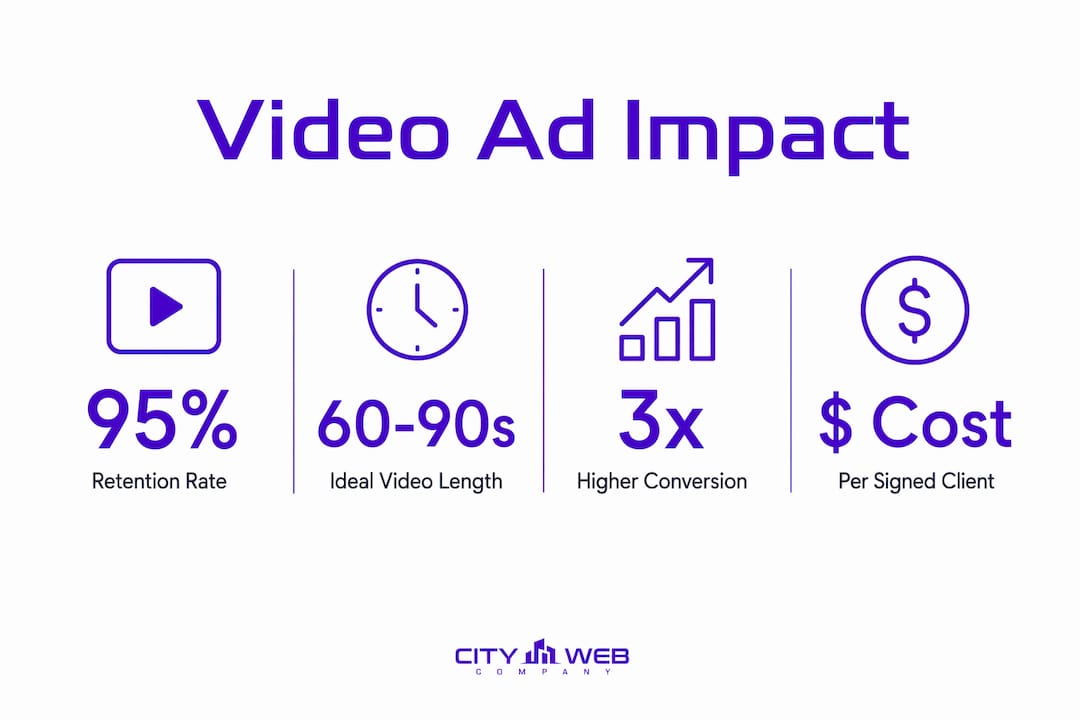
Video ads work because they replicate the experience of meeting an attorney in person. A prospect watching a 90-second introduction video sees body language, hears tone of voice, and forms a judgment about trustworthiness before the first consultation. That judgment matters enormously in legal services, where clients are often frightened, confused, or facing life-changing decisions.
The retention gap between video and text is not marginal. Video viewers retain 95% of a message compared to just 10% for text, according to Walker Advertising. That difference translates directly into more click-throughs, more form submissions, and more signed clients. When a prospect remembers your firm’s name, your practice area, and your core promise after watching a 60-second ad, the conversion math changes completely.


Types of video content that build trust
Three video formats consistently outperform others in legal marketing:
- Attorney introduction videos show the attorney speaking directly to camera, explaining their background, their approach, and who they help. These are the highest-converting video assets a law firm can produce.
- FAQ videos address the questions prospects ask before they call. A personal injury attorney answering “How long does a settlement take?” removes a major objection before the consultation.
- Client testimonial videos let real clients describe their experience in their own words. These carry more credibility than any copy a firm could write about itself.
Tone matters as much as format. A criminal defense attorney’s video should feel calm and authoritative, not aggressive or sales-driven. A family law attorney’s video should feel empathetic and clear. Mismatching tone to practice area destroys the trust video is supposed to build.
Pro Tip: Film your attorney introduction video in the office where clients will actually meet you. Familiar surroundings signal stability and professionalism without a word of scripting.
Video ads position your firm as an authority before a prospect ever makes direct contact. That pre-qualification effect means your intake team spends less time with unqualified leads and more time with prospects who already trust you.
What are the best strategies for deploying video ads across channels?
Video advertising strategy for law firms depends entirely on where a prospect sits in the decision process. A person who has never heard of your firm needs a different video than someone who visited your website last week. Treating all video placements as identical wastes budget and produces weak results.
The funnel breaks into two clear stages:
- Awareness stage: Platforms like Facebook, Instagram, YouTube pre-roll, and connected TV (CTV) reach prospects who are not yet searching for an attorney. These placements use short, emotionally resonant videos that introduce the firm and the problem it solves. The goal is recognition and recall, not immediate conversion.
- Consideration and conversion stage: Prospects who have already searched for legal help respond to longer, more detailed content. YouTube channel videos, website landing page videos, and retargeting ads on Facebook work here. These videos go deeper into process, outcomes, and what working with the firm looks like.
Short videos of 60 seconds or less are preferred on Instagram and TikTok, per NYC Bar Association guidance. LinkedIn supports slightly longer formats and works well for business law, employment law, and corporate attorneys targeting decision-makers rather than individual consumers.
- Landing page alignment: Sending video ad traffic to generic pages causes bounce rates to spike. Dedicated landing pages that feature the same attorney from the ad, with a clear intake form above the fold, convert at significantly higher rates.
- YouTube long-form content: Educational videos of 5–10 minutes on topics like “What to expect in a workers’ compensation claim” build search authority and keep prospects engaged long enough to trust the firm.
- CTV and streaming ads: Connected TV placements reach local audiences during prime viewing hours. These work especially well for personal injury and family law firms targeting specific geographic markets.
Pro Tip: Track cost per signed client, not cost per view. Vanity metrics like impressions tell you nothing about whether your video budget is producing revenue.
A well-structured marketing funnel for attorneys maps each video format to a specific stage of the client journey. Firms that skip this mapping end up with awareness-stage videos running to conversion-ready prospects, and vice versa. Both scenarios waste money.
How do legal advertising ethics and compliance shape video ads for attorneys?
Legal advertising ethics are not optional constraints. They are the framework inside which every video ad must be built. Attorneys who ignore compliance rules risk bar complaints, fines, and reputational damage that no marketing budget can repair.
The core prohibition is clear. Florida Rule 4-7.13 bars misleading statements and outcome guarantees in attorney advertising. Most state bar rules follow similar logic. An attorney cannot say “We win every case” or “You will receive compensation.” These statements are deceptive because legal outcomes depend on facts no attorney controls.
Compliance requirements for attorney video ads
- Mandatory disclaimers: Phrases like “Results may vary” and “Past results do not guarantee future outcomes” are required in attorney video ads and must appear conspicuously, not buried in fine print at the end of a fast-scrolling credit sequence.
- Platform-specific disclaimer placement: A disclaimer that works on YouTube (on-screen text overlay) may not satisfy requirements on Instagram (where text overlays can be skipped). Video disclaimers must adapt to where the video appears, including on-screen text, captions, and description fields.
- Client testimonial consent: Testimonial videos require written consent from the client. Scripts or suggested language provided by the firm must be disclosed in some jurisdictions.
- No specific outcome promises: Avoiding specific outcome promises is not just ethical. It protects the firm from claims of deceptive advertising if a future client’s case produces a different result.
| Compliance area | Requirement |
|---|---|
| Outcome claims | Prohibited; no guarantees of results |
| Disclaimers | Must be conspicuous and platform-appropriate |
| Testimonials | Require written client consent |
| Misleading statements | Barred under rules like Florida Rule 4-7.13 |
| Platform adaptation | Disclaimers must match each platform’s display format |
Short-form video is both a marketing tool and a compliance exercise, because confidentiality and solicitation rules apply even during casual sharing. A 30-second Instagram Reel is subject to the same bar advertising rules as a full television commercial. Treating each video creative as a channel-specific compliance object, built and reviewed for the platform it will run on, keeps the firm protected without sacrificing creative quality.
Which types of video ad content are most effective for attorneys?
The most effective video content for attorneys prioritizes authenticity over production polish. High-stakes legal categories, including personal injury, criminal defense, and immigration, respond better to real attorney presence and honest process explanations than to cinematic production values. Prospects facing serious legal problems want to see a real person, not a polished advertisement.
Proven video formats for legal marketing
- Attorney introduction videos: These are the single highest-converting asset in legal video marketing. A 60–90 second video where the attorney speaks directly to camera, explains their focus area, and describes who they help produces more consultations per dollar than almost any other format.
- FAQ and explainer videos: A personal injury attorney explaining “What happens after you file a claim” or a divorce attorney walking through “How property division works in our state” addresses objections before they become barriers. These videos reduce the time intake staff spend answering basic questions.
- Video case stories: These are not traditional testimonials. A video case story follows a client’s situation from problem to resolution without promising specific outcomes. The format builds credibility while staying within ethical boundaries.
- Process walkthrough videos: Showing what the first consultation looks like, what documents a client needs to bring, and how the firm communicates during a case reduces the fear of the unknown that stops many prospects from calling.
Pro Tip: Film FAQ videos in batches. Record 10 questions in a single afternoon session, then release one per week across YouTube, your website, and social media. The content investment is low; the trust-building effect compounds over time.
Common production mistakes cost law firms real money. Generic stock footage of courtrooms and gavels signals inauthenticity immediately. Weak calls to action, such as “Contact us for more information,” produce fewer responses than specific ones like “Call us today for a free 30-minute consultation.” Scripts that sound like legal briefs rather than conversations push prospects away instead of drawing them in. Visual content drives significantly more engagement than text alone, but only when the content feels genuine.
The production bar for legal video is lower than most attorneys assume. A well-lit office, a quality microphone, and a clear script outperform an expensive studio shoot with a stiff, over-coached attorney. Clients hire people, not productions.
Key takeaways
Video ads for attorneys build trust and drive consultations by placing the right content in front of the right prospect at the right stage of the decision process, with full compliance at every step.
| Point | Details |
|---|---|
| Retention drives conversion | Video viewers retain 95% of a message vs. 10% for text, producing more form submissions and calls. |
| Funnel alignment is required | Awareness-stage videos belong on social and CTV; conversion-stage videos belong on landing pages and YouTube. |
| Compliance is non-negotiable | Every video must include conspicuous disclaimers and avoid outcome guarantees per bar advertising rules. |
| Authenticity outperforms polish | Real attorney presence and honest process explanations convert better than high-production generic ads. |
| Measure cost per signed client | Impressions and views are not success metrics; cost per signed client is the only number that matters. |
What I’ve learned about video ads that most legal marketers get wrong
After working with attorneys across practice areas, the pattern I see most often is this: firms invest in video production and then treat the finished video as a single asset to be posted everywhere. That approach fails every time.
The attorneys who get the best results from video treat each platform as a separate audience with separate needs. The 90-second introduction video that works on a landing page gets cut to 30 seconds for Instagram and reformatted with captions for LinkedIn. The FAQ video that performs on YouTube gets clipped into 15-second answer snippets for social retargeting. The content is the same. The packaging is different. That distinction is where most of the ROI lives.
The second mistake I see constantly is measuring the wrong things. A firm will celebrate 50,000 video views on YouTube and then wonder why the phone isn’t ringing. Views are not clients. The metric that tells you whether your video strategy is working is cost per signed client, tracked from the first ad impression to the signed retainer. Everything else is noise.
Compliance is the third area where attorneys consistently underinvest. Bar advertising rules are not a one-time checkbox. They require ongoing review as platforms change their display formats and as your state bar updates its guidance. A disclaimer that was conspicuous on a desktop YouTube ad in 2024 may not meet the standard on a mobile Instagram Story in 2026. Build compliance review into your production process, not as an afterthought.
The firms I’ve seen grow fastest with video share one trait: they commit to a consistent publishing schedule rather than producing one polished video and waiting for results. Six authentic FAQ videos released over six weeks outperform one expensive brand film every time. Consistency builds the kind of familiarity that converts prospects into clients.
For attorneys considering law firm marketing strategies that go beyond video, the same principle applies. Consistency across channels, with each channel doing the job it is best suited for, produces compounding results that no single campaign can match.
— Matt
How City Web Company helps attorneys get results from video ads
Attorneys who want video ads that actually produce signed clients need more than a camera and a script. They need a strategy that connects video content to the right platforms, the right audiences, and the right intake process.

City Web Company builds paid advertising campaigns for law firms that integrate video placement with search, local SEO, and conversion-focused landing pages. The approach starts with your practice area and your market, then maps video content to each stage of the client journey. Compliance review is built into the production process, not added at the end. City Web Company also offers local SEO services that amplify the reach of your video campaigns by ensuring your firm appears in local search results when prospects are ready to act. Contact City Web Company to build a video ad strategy that produces consultations, not just views.
FAQ
What is the role of video ads for attorneys?
Video ads for attorneys attract and pre-qualify prospects by building trust before the first consultation. They increase consultation rates and lower client acquisition costs compared to text-only advertising.
How long should attorney video ads be?
Short videos of 60 seconds or less perform best on Instagram and TikTok, per NYC Bar Association guidance. Longer educational videos of 5–10 minutes work well on YouTube and firm websites.
Are there ethical rules governing attorney video advertising?
State bar rules, including Florida Rule 4-7.13, prohibit misleading statements and outcome guarantees in attorney ads. Disclaimers like “Results may vary” must appear conspicuously in every video.
What video format converts the most clients for law firms?
Attorney introduction videos are the highest-converting video asset in legal marketing. A 60–90 second video of the attorney speaking directly to camera consistently produces more consultations per dollar than other formats.
How should attorneys measure video ad success?
Cost per signed client is the correct metric for legal video campaigns. Impressions and view counts do not indicate whether a video ad is producing revenue for the firm.
These articles were popular with other readers too: