
See how plumbers can turn Facebook scrollers into booked jobs with clear offers, local targeting, a 30 day test budget, fast follow up, and a path to scale.
The Role of Custom Branding in Local Business Growth
Custom branding is the practice of building a consistent, recognizable identity across every customer touchpoint your business controls. For local service businesses, plumbers, landscapers, HVAC companies, and restoration contractors alike, the role of custom branding is not cosmetic. It directly shapes whether a potential customer calls you or your neighbor. Consistent brand presentation can lead to up to a 33% revenue increase and 3.5 times higher brand visibility compared to inconsistent branding. That gap is the difference between a business that grows and one that stalls. The American Marketing Association defines branding as the creation of a clear brand voice and authentic purpose that connects across every channel, and that definition holds just as much weight for a local HVAC company as it does for a national retailer.
Table of Contents
How does custom branding improve customer engagement?
Custom branding improves customer engagement by giving people a consistent, emotionally resonant reason to return. When your logo, messaging, truck wrap, and website all tell the same story, customers recognize you faster and trust you sooner. Recognition reduces friction. Friction is the silent killer of repeat business.
The emotional connection built through consistent brand storytelling drives reputation, trust, engagement, and revenue. It also turns loyal customers into ambassadors who refer friends and family. For a local pest control company or moving service, word-of-mouth referrals are often the highest-converting lead source available.

Loyalty programs are one of the most measurable ways branding converts engagement into revenue. 72% of consumers say loyalty programs increase their spending, and 56% say those programs make them more likely to spend with preferred brands. That data comes from Deloitte’s 2025 Consumer Loyalty Program Survey. It means a branded loyalty card or referral reward tied to your company identity is not a nice-to-have. It is a revenue mechanism.
Engagement also depends on channel consistency. When a customer sees your Google Business Profile, then visits your website, then receives a branded invoice, each touchpoint should feel like the same company. Omnichannel brand coherence makes it easier for customers to stay engaged because they never feel confused about who they are dealing with.
Pro Tip: Apply your brand colors, logo, and tagline to every document a customer touches, including estimates, invoices, and follow-up emails. These are often the most-read materials your business produces.
Here are the key engagement mechanisms that custom branding activates:
- Recognition: Repeated exposure to consistent visuals builds memory. Customers recall your name when they need your service.
- Trust: A polished, consistent identity signals professionalism before a single word is spoken.
- Loyalty: Branded experiences create emotional attachment that makes switching to a competitor feel like a loss.
- Referrals: Customers who identify with your brand share it more readily because it reflects on their own judgment.
- Retention: True loyalty is declining globally, with the SAP Customer Loyalty Index showing a 5-point drop from 2024 to 2025. Consistent brand engagement is the most reliable defense against that trend.
What measurable business benefits does custom branding deliver?
Consistent branding delivers concrete, trackable business outcomes. The 33% revenue increase linked to brand consistency is not a theoretical ceiling. It reflects what happens when customers recognize, trust, and prefer your business over an unbranded or inconsistently branded competitor. For a local service business generating $500,000 annually, that gap represents $165,000 in additional revenue.
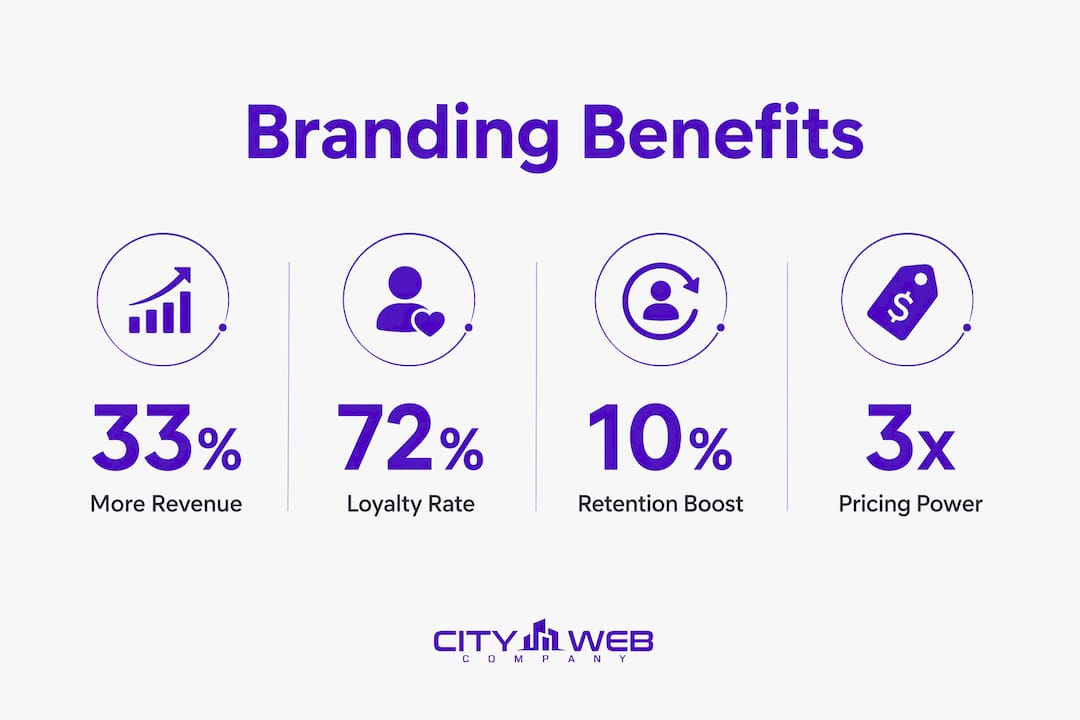

Branding also supports pricing power. A well-branded landscaping company can charge more per job than an unbranded one because the customer perceives higher value. The brand signals quality, reliability, and professionalism before the crew arrives. That perception is built through every visual and verbal element the customer encounters.
| Business Benefit | What It Looks Like in Practice |
|---|---|
| Revenue growth | Consistent branding linked to up to 33% higher revenue |
| Brand visibility | 3.5 times higher visibility versus inconsistent presentation |
| Customer retention | Loyal customers spend more and refer others |
| Pricing power | Branded businesses justify premium rates more easily |
| Employee alignment | Branded merchandise increases staff belonging and ambassador behavior |
Customer retention is where branding compounds. A customer who identifies with your brand does not shop around every season. They call you first. For HVAC companies and pest control services that depend on annual contracts and repeat visits, retention is the foundation of predictable revenue.
Branded merchandise extends that retention effect to your team. Branded merchandise increases employee belonging and turns staff into brand ambassadors, extending brand reach beyond paid advertising. When your technician wears a branded shirt and drives a branded truck, every neighborhood they work in becomes a passive marketing channel.
Pro Tip: Track your customer return rate before and after a branding refresh. A 10% improvement in retention often outperforms a 20% increase in new leads because retained customers cost far less to serve.
Operationally, consistent branding reduces internal confusion. When your team knows exactly what the brand sounds and looks like, they make faster, better decisions about communications, proposals, and customer interactions. That clarity speeds up execution and reduces errors in customer-facing materials.
How to evaluate and optimize your custom branding impact
Measuring branding impact requires connecting brand elements to customer behavior, not just awareness. The U.S. Small Business Administration recommends that small businesses evaluate branding effectiveness through consumer feedback on logos, messaging, and buying experience changes. That feedback establishes a competitive baseline and reveals where your identity is working and where it is not.
The most reliable measurement approach links specific brand elements to specific customer metrics. Logo clarity connects to brand recall. Branded packaging connects to survey-reported recognition. Consistent messaging connects to repeat purchase rates. Each link can be tested and validated.
Here is a practical four-step process for evaluating your branding impact:
-
Establish a baseline. Survey a sample of current customers. Ask them to describe your business in three words, rate your logo clarity, and report how they found you. Record the results before making any changes.
-
Identify your highest-traffic touchpoints. For most local service businesses, these are the website homepage, the estimate document, and the first service call. Key customer moments like the first website visit and estimate calls are where branding inconsistency most directly reduces conversion. Focus measurement there first.
-
Run controlled before/after tests. Change one brand element at a time. Update your website header, then measure contact form submissions for 30 days. Redesign your estimate template, then track close rates for 60 days. Single-variable testing gives you clean data.
-
Focus on conversion signals, not vanity metrics. Page views and social media likes tell you little. Repeat purchase rate, referral volume, and quote-to-close ratio tell you whether your branding is actually influencing decisions. These are the numbers worth tracking.
The goal is not perfection on the first attempt. Small businesses that succeed with branding treat it as an ongoing feedback loop, not a one-time project. Ongoing listening and adjustment builds the emotional connection that converts first-time buyers into repeat customers. That conversion is the real measure of branding success.
Best practices for small local service businesses
Small local service businesses get the most from custom branding when they treat it as a system rather than a collection of assets. A logo alone is not a brand. A brand is the sum of every experience a customer has with your business, from the first Google search to the final invoice.
The following practices produce the strongest results for service businesses in competitive local markets:
-
Align your brand voice across all channels. Your website, social media posts, phone scripts, and email replies should all sound like the same company. The American Marketing Association identifies a clear brand voice as the foundation of scalable marketing. Write down three to five words that describe how your brand speaks, then share them with everyone on your team.
-
Invest in visual consistency. Your logo, primary color palette, and typography should appear identically on your website, truck wrap, uniforms, business cards, and invoices. Visual inconsistency signals disorganization to customers, even when the service itself is excellent. A local business branding guide can help you build that consistency from the ground up.
-
Use branded merchandise to extend your reach. Branded hats, shirts, and pens given to customers and worn by employees create passive impressions in the communities you serve. For a landscaping or pest control company, a branded shirt on a technician is a walking referral in every neighborhood they enter.
-
Prioritize your highest-impact touchpoints. Not every brand element deserves equal attention. Focus first on the moments where customers make decisions: your website homepage, your estimate document, and your first service call. These three touchpoints carry the most weight in the customer’s evaluation of your business.
-
Integrate branding into your sales process. A branded proposal with a clear value statement closes more jobs than a generic quote. Customers are comparing you to competitors who may offer similar prices. Your brand is often the deciding factor when price is equal.
The benefits of branded content compound over time. Each consistent interaction adds to the customer’s mental image of your business. That image is what they share when they recommend you to a neighbor.
Pro Tip: Create a one-page brand standards document with your logo files, color codes, and approved fonts. Share it with every vendor, employee, and contractor who produces materials for your business.
For businesses ready to connect branding with broader marketing strategies for growth, the next step is aligning your brand identity with your digital presence, including your website, Google Business Profile, and paid advertising creative.
Key Takeaways
Custom branding delivers measurable growth when applied consistently across every customer touchpoint, from your website to your service vehicles.
| Point | Details |
|---|---|
| Revenue impact | Consistent branding is linked to up to 33% higher revenue and 3.5 times greater visibility. |
| Engagement mechanism | Loyalty programs and consistent brand stories increase repeat spending and referrals. |
| Measurement approach | Link specific brand elements to conversion metrics and test changes one variable at a time. |
| Highest-impact touchpoints | Website homepage, estimate documents, and first service calls drive the most branding ROI. |
| Branding as a system | Treat brand identity as an ongoing process, not a one-time asset, to build lasting customer trust. |
What I’ve learned about branding that most guides won’t tell you
Most branding advice focuses on logos and color palettes. That is the wrong starting point for a local service business. The real leverage is in the moments customers are already paying attention.
I have worked with enough local service businesses to know that the estimate document is the most underused branding asset in the industry. Customers read estimates carefully. They compare them. A branded, well-organized estimate with a clear value statement and professional design signals competence before the job starts. An unbranded estimate signals the opposite, regardless of how good the price is.
The second thing most guides miss is the internal dimension of branding. Brand consistency reduces confusion and builds trust across channels, but it also aligns your team. When employees understand what the brand stands for, they make better decisions in the field. They answer the phone differently. They present themselves differently. That internal coherence shows up in customer reviews.
The third insight is about timing. Branding investments pay off most when they happen before a growth push, not during one. If you are about to run Google Ads or launch a new service area, your brand needs to be ready to receive that traffic. A weak or inconsistent brand wastes paid media spend because it fails to convert the attention you are buying.
The power of storytelling in branding is real, but it only works when the story is consistent. Pick one clear message about why your business exists and what it delivers. Then repeat it everywhere, every time.
— Matt
How City Web Company supports your branding and local growth
Local service businesses that want branding to drive real leads need more than a logo refresh. They need a digital presence that reflects their brand at every customer touchpoint, from search results to their website to paid ads.
City Web Company builds digital marketing strategies specifically for local service businesses, including HVAC companies, landscapers, pest control operators, and restoration contractors. The team aligns your brand identity with your website design, local SEO, Google Ads, and promotional products so every channel tells the same story. If your branding is ready to work harder for your business, City Web Company has the tools and experience to make that happen.
FAQ
What is the role of custom branding for small businesses?
Custom branding creates a consistent identity that builds customer recognition, trust, and loyalty across every touchpoint. For small local service businesses, it directly influences conversion rates, referral volume, and pricing power.
How does branding affect customer loyalty?
True loyalty is declining globally, with the SAP Customer Loyalty Index showing a 5-point drop from 2024 to 2025. Consistent brand engagement across all customer interactions is the most reliable way to maintain and grow loyalty.
Can custom branding increase revenue for local service businesses?
Consistent brand presentation is linked to up to a 33% revenue increase. That outcome results from higher customer recognition, stronger trust, and the pricing power that comes with a professional, cohesive identity.
How do I measure the impact of my branding?
The U.S. Small Business Administration recommends gathering customer feedback on logos, messaging, and buying experiences, then tracking changes in repeat purchase rates and conversion metrics after each brand update.
What branding touchpoints matter most for service businesses?
The website homepage, estimate documents, and first service calls carry the most weight in customer decision-making. Ensuring brand consistency at these three points produces the highest return on branding investment.
Recommended
These articles were popular with other readers too: