
Use website DNI, connect call reports to Google Ads and your Google Business Profile, then tie calls to booked jobs. City Web Company can handle setup.
Unlocking Revenue from Social Media: A Guide to Customer Relationship Management
For many business owners, social media feels like shouting into a void. You post content, reply to comments, and run ads, yet the effort rarely translates into tangible revenue. The problem isn't a lack of activity; it's the absence of a system connecting those digital interactions to your bottom line.
This disconnect means you are likely attracting attention but failing to capture customers, a common frustration that silently drains marketing budgets.
Table of Contents
Why Your Social Media Attracts Clicks But Not Customers
Most businesses treat their social media profiles like a broadcast station. They push out content, gather likes, and respond to direct messages as they appear. This feels productive, but this reactive approach creates an expensive gap between marketing activity and sales results.
Every interaction exists in isolation, completely severed from that person's full history with your business.
A comment on a Facebook post, an Instagram direct message, and an inquiry from your website's contact form are handled as separate events. This fragmented process is precisely where revenue is lost. Without a central system, your team has no memory of past conversations and no context for new ones.
The Hidden Cost of Scattered Conversations
This lack of a unified system generates real, measurable business problems. A potential customer who requested a quote on Instagram three months ago might ask a follow up question on Facebook today. To your team, they appear as a new inquiry. This forces the customer to repeat their story, creating friction and a poor experience that often sends them to a competitor.
This operational gap leads to costly outcomes:
- Missed Leads: A promising lead sent via direct message can be easily buried or forgotten, especially if the person managing the account is juggling other responsibilities. That opportunity goes cold within hours.
- Wasted Ad Spend: You might be spending money on ads to acquire new customers without realizing you are targeting people who have already engaged with you but were never tracked properly.
- Inconsistent Service: One team member might promise a callback from a Facebook comment, but another is completely unaware of that commitment. The result is a broken promise and a lost customer.
The core issue is structural. Your social activity generates valuable signals, but without a system to capture and organize them, they simply disappear. This is the exact challenge that an integrated social media customer relationship management strategy is designed to solve.
It marks the transition from being merely active on social platforms to being truly strategic with every interaction. It is the difference between a busy storefront with no cash register and a well-oiled machine where every conversation becomes an opportunity for measurable growth.
What Is Social Media Customer Relationship Management?
The term "customer relationship management" often brings to mind large corporations with complex sales teams and expensive software. Many local business owners see it as a tool for tracking enterprise deals, not for their own operations. The reality is, if you talk to customers, you are already managing relationships. The only question is whether you are doing it effectively.
Social media customer relationship management (Social CRM) is the process of preventing valuable customer conversations from getting lost. It involves connecting every comment, direct message, and brand mention from your social channels into a single, organized system. This process turns scattered interactions into a complete, usable customer history.
From Digital Chatter to a Centralized Memory
Think of the classic neighborhood shopkeeper who knew every customer by name, remembered their last purchase, and asked about their family. A Social CRM provides your business with that same capability, but at the scale of modern social media. It gives you a perfect memory.
Instead of a Facebook message being a forgotten, one-off interaction, it becomes a permanent part of that person's record. A prospect who asked for a quote on Instagram three months ago is instantly recognized when they comment on your Facebook ad today. That context is what separates an excellent customer experience from a frustrating one.
A Social CRM is not about adding another tool to your workload. It is about building a foundation that captures the value you are already creating with every social media interaction. It transforms digital chatter into business intelligence.
The Core Components of a Social CRM
To understand what a Social CRM does, it helps to review the fundamentals of effective relationship management with customers. A Social CRM applies these timeless principles to the digital world through several key functions:
- Interaction Tracking: It automatically logs every public and private conversation from platforms like Facebook and Instagram directly into a customer’s profile. This ends the need to manually search through direct messages.
- Centralized Database: All your customer information, including contact details, service history, and social media handles, resides in one easily accessible place.
- Workflow Automation: A Social CRM can create tasks based on social media triggers. For example, a direct message containing the word "quote" can automatically create a new lead and assign it to your team for follow up.
- Sentiment Analysis: Advanced systems can analyze the tone of comments, helping you prioritize an unhappy customer or identify a satisfied one you can ask for a review.
For a local plumber, this means knowing a prospect first inquired about a water heater on Facebook six months ago. For a dental practice, it means seeing a patient's positive review and being able to send a personalized thank you. This is how you convert fleeting online moments into measurable customer loyalty and revenue.
How a Social CRM Drives Revenue for Local Businesses
For local service and healthcare businesses, a Social CRM is not just about better organization. It is about constructing a system that directly converts online conversations into measurable revenue. A scattered, disorganized approach to social media leaves money on the table. A strategic one captures it.
This represents a shift from reactive problem solving to proactive opportunity finding. Instead of scrambling when a complaint arises, you have a process to turn that unhappy customer into a loyal advocate. Instead of letting a casual direct message get lost, you have a workflow to convert it into a scheduled, high-value appointment.
Turning Conversations into Conversions
A social media customer relationship management system acts as the central nervous system for your marketing. It is the bridge connecting activity on your social media pages directly to your business operations. For a local company, this means every interaction, including every comment, message, and mention, has a purpose and a clear path toward a sale.
Consider a multi-location HVAC company. Without a Social CRM, a lead from a Facebook message in one city might be handled completely differently than one in another. It might even be missed entirely. With a system in place, every inquiry is logged, standardized, and assigned for follow up, ensuring no opportunity is lost. This single change can significantly improve lead conversion rates.
This connection between social media activity and business outcomes is more critical than ever. In fact, research shows that a majority of consumers are prepared to switch to a competitor if a brand does not respond quickly on social platforms. Platforms like Instagram and Facebook are no longer just for posting images; they are front-line channels where people research and make buying decisions.
Here is how a Social CRM can reshape the daily operations of a local business, turning common problems into strategic advantages.
Impact of Social CRM on Key Business Metrics
| Business Metric | Without Social CRM (Common Approach) | With Social CRM (Strategic Approach) |
|---|---|---|
| Lead Management | Inquiries are scattered across DMs, comments, and emails. Follow-up is inconsistent and often missed. | All inquiries are captured in a central system, assigned to the right person, and tracked until resolved. |
| Customer Service | Responses are slow and reactive. It is difficult to track a customer's history or previous issues. | Fast, informed responses are possible. Teams see the full conversation history, leading to better service. |
| Reputation | Positive feedback goes unnoticed, and negative comments can escalate publicly without a quick resolution. | Happy customers are prompted for reviews. Negative feedback is handled privately and swiftly. |
| Ad Targeting | Ad campaigns rely on broad demographic data, leading to wasted spend on uninterested audiences. | Ads are targeted to warm audiences based on actual engagement, like past DMs or positive comments. |
This table illustrates a clear contrast: one approach is chaotic and leaves the business vulnerable, while the other is organized, proactive, and built for growth.
Enhancing Local SEO and Reputation
A powerful but often overlooked benefit of a Social CRM is its direct impact on local search rankings. Google's algorithm favors businesses with a strong online reputation and a steady flow of positive reviews. A Social CRM provides the ideal structure to improve both.
A Social CRM is your engine for reputation management. It allows you to systematically identify happy customers and guide them toward leaving reviews, while also catching and resolving negative feedback before it becomes a public complaint.
Imagine a local dental practice using a Social CRM to track patient sentiment online. When a patient posts a positive comment about their recent cleaning, the system flags it. Your team can then send a personalized message thanking them and providing a direct link to leave a Google review. This simple workflow creates a consistent stream of positive reviews, which is essential for improving local rankings.
Conversely, if a negative comment appears, the system alerts you immediately. This provides an opportunity to reach out, address the issue privately, and resolve a bad experience, often preventing a one-star review from ever being posted.
Stopping Wasted Ad Spend
Many businesses exhaust their ad budgets by showing ads to the wrong people. A Social CRM provides a wealth of first-party data, allowing you to build highly targeted and efficient ad campaigns. This moves you beyond broad demographic targeting to something far more precise.
- Create Custom Audiences: You can build ad audiences from people who have actually interacted with your brand. For example, create a list of everyone who sent you a direct message in the last 90 days and show them a special offer.
- Personalize Ad Creative: When you know a customer's history, your messaging can be much more relevant. If someone asked about roof repairs a month ago, you can show them an ad focused on storm damage services instead of a generic brand ad.
- Improve Retargeting: Instead of retargeting every person who visited your website, you can focus your budget on those who have actively engaged with you on social media, a much stronger signal of interest. To see how these pieces fit together, check out our guide on using a social media advertising workflow for lead generation.
Ultimately, a Social CRM transforms your social media from a simple content publishing tool into a core part of your revenue generating engine. It provides the structure to ensure every interaction is an opportunity, every happy customer can become an advocate, and every ad dollar is spent with purpose.
Connecting Social CRM With Your Website and Marketing
A Social CRM that operates in isolation is like a powerful engine sitting on a garage floor. It has potential, but until it is connected to the rest of the vehicle, it provides no forward momentum. The true value is realized when your Social CRM is fully integrated with your other core business tools, especially your website and broader marketing efforts.
This connection is what transforms your social media presence from a simple broadcast channel into a customer acquisition machine. It creates a smooth, automated pipeline for information, ensuring no leads fall through the cracks and every marketing dollar is spent with purpose. Without it, you are left manually piecing everything together, which is slow, inefficient, and prone to costly mistakes.
Creating a Unified Lead Capture System
The most powerful and immediate benefit of integration is building a single, reliable path for every potential customer. This workflow guarantees that whether someone sends a Facebook message, leaves an Instagram comment, or fills out a form on your WordPress website, their information lands in the same place, ready for your team to act.
A direct message on Facebook asking for a price quote can automatically trigger a new lead record in your CRM. That lead is instantly tagged "Facebook Inquiry" and assigned to a specific team member for immediate follow up. This automation closes the gap where most leads are lost: the manual handoff between seeing a message and acting on it.
This flow is designed to turn a simple social media interaction into a confirmed business opportunity, step by step.
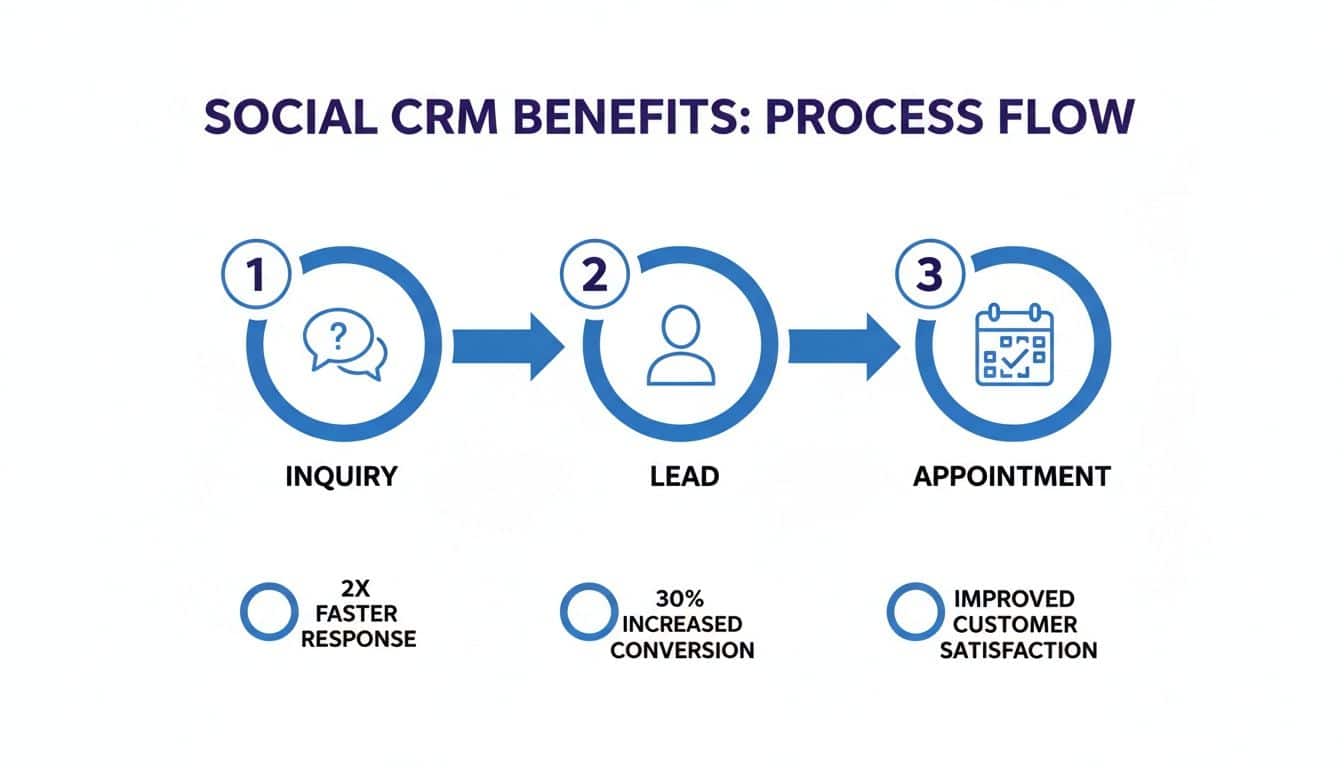
As shown, what begins as a casual question on a social platform can be systematically converted into a scheduled appointment. This process eliminates manual data entry and the potential for human error at every stage.
Powering Smarter Marketing Campaigns
When you connect your Social CRM to other marketing tools, you unlock data that fuels highly personalized and effective campaigns. Instead of guessing what your audience cares about, you can build marketing campaigns based on their actual behaviors and stated interests.
This is where your website becomes the central hub, especially if it is built on a flexible platform like WordPress. By using plugins that link your CRM directly to your site, you can merge data from social media with on-site behavior, giving you a complete view of each customer.
This unified data allows for more sophisticated marketing tactics:
- Smarter Email Lists: You can create hyper-segmented email lists based on social interactions. Imagine sending a special offer only to people who have commented positively on your posts in the last six months.
- Refined Ad Targeting: For businesses running Google Ads or Streaming TV Advertising, these insights are invaluable. You can build custom audiences of people who have already engaged with you on social media, ensuring your ad budget is spent on a warm, interested audience.
- Personalized Website Experiences: With the right setup, you can even alter what a visitor sees on your website based on their previous social media interactions with your brand.
The trend toward social selling only makes this integration more critical. Data from HubSpot and other sources show that social platforms are central to modern brand research and purchasing decisions, making them prime channels for building relationships and closing sales.
Measuring Social CRM Success with the Right Metrics
It is easy to get distracted by numbers that look impressive but lack substance, such as likes, shares, and follower counts. While these "vanity metrics" may provide a temporary sense of accomplishment, they do not help with payroll or inform strategic marketing investments.
An effective social media customer relationship management strategy focuses on metrics that demonstrate real business impact. Instead of celebrating a post with 100 likes, you need to ask questions that connect directly to your bottom line. It is time to move beyond measuring simple visibility and start measuring what actually generates revenue.
From Vanity Metrics to Revenue Metrics
To gain a true understanding of what is working, you must connect your social media activity to tangible results. The right metrics reveal the cause and effect relationship between your online conversations and your financial outcomes.
This requires a different way of looking at data. For instance, do not just count your total direct messages. Measure how many of those messages converted into a scheduled job. A local roofing contractor, for example, should track exactly how many Instagram messages about an "emergency repair" become signed contracts.
The most important metrics are the ones that trace a direct line from a social media interaction to a business outcome. This is how you move from guessing what works to knowing what works.
This performance-based view provides the clarity needed to make smart, profitable decisions. You can stop wasting money on tactics that only create noise and double down on those that bring in paying customers.
Key Performance Indicators for Social CRM
Here are the metrics that truly matter for a local service or healthcare business. These are the numbers that should be on your dashboard.
- Cost Per Lead from Social Channels: This tells you exactly how much you are spending to acquire one qualified lead from platforms like Facebook or Instagram. It allows you to compare the efficiency of your social efforts against other channels like Google Ads.
- Customer Lifetime Value (CLV) by Channel: By tracking where your best, most loyal customers originate, you can determine if clients who find you on social media are more valuable in the long run. This data justifies future investment.
- Response Time Impact on Conversion: Measure how your team's response speed to direct messages and comments affects your lead conversion rate. You will almost certainly find that faster responses lead directly to more booked appointments.
- Lead-to-Appointment Rate: What percentage of social media inquiries actually turn into a scheduled service call or consultation? This is a critical indicator of both your social media effectiveness and your internal sales process.
Properly measuring your Social CRM strategy requires a solid foundation. That means understanding social media impressions before progressing to these advanced, business-focused KPIs. A clear view of the entire funnel is essential. For more on this topic, see our guide on enhancing social media marketing with web analytics.
When you implement this disciplined, data-driven approach, you finally gain a true understanding of your social media ROI. You can allocate your budget with confidence, train your team effectively, and build a marketing system that produces predictable, sustainable growth.
Building an Integrated Growth System
Adding another piece of software to your business is not a strategy; it is just another login to manage. The real objective is to build a unified growth system where every component, from social media to your website, works together seamlessly.
Many local businesses fall into the trap of a fragmented approach. Social media operates in one silo, lead management in another, and the systems do not communicate. This creates complexity, not clarity.
You might be sold a tool that promises to solve one problem, but without a strategy connecting it to your business goals, it just becomes another task on your to-do list. Technology should serve strategy, not the other way around.
From Disconnected Tools to a Cohesive System
Sustainable growth does not come from a collection of disconnected tools. It comes from a single, cohesive system where your social media activity, website, lead management process, and marketing efforts are all in constant communication.
For a local plumber in Denver, this means a direct message on Instagram about a leaky faucet should automatically create a task in their central system for immediate follow up.
For a regional clinic in Miami, it means a positive Facebook comment can be tracked, leading to a request for a Google review that boosts their local search visibility.
This integrated approach ensures:
- No lead is left behind: Every inquiry, regardless of its origin, enters a defined workflow so you never miss an opportunity.
- Data flows seamlessly: Insights from social media conversations can inform your website content and ad targeting.
- ROI becomes clear: You can finally connect specific marketing activities directly to the revenue they generate.
The Strategic Partner vs. The Vendor
Many business owners attempt to build this system themselves, purchasing different tools and hoping they work together. This almost always results in wasted time, frustration, and lost revenue. The alternative is to partner with a team that specializes in building these comprehensive systems.
A vendor sells you a tool. A strategic partner builds you a growth engine.
The objective is not just to implement software, but to build the strategic framework that makes the software produce measurable results. This ensures every component, from search visibility to social engagement, works in concert to generate predictable growth.
At City Web Company, we architect these integrated systems. We connect your social media management to your website's lead capture and your overall marketing strategy, whether that includes Pay-Per-Result SEO or Streaming TV Advertising.
We build and manage the entire underlying marketing infrastructure for you. This frees you to focus on running your business, confident that your marketing is a finely tuned system designed for one purpose: to produce measurable, long-term results.
Frequently Asked Questions About Social CRM
You see the potential in using social media to manage customer relationships, but you have practical questions. What does this look like day to day? Is it only for large corporations?
We hear these questions often from business owners. Let's address the real-world answers.
Is Social CRM Only For Large Companies?
Absolutely not. A social CRM can be even more powerful for a local service business than for a large, faceless corporation.
Personalized service is your competitive advantage. A social media customer relationship management system is the tool that sharpens it. This approach amplifies your greatest strength, allowing you to provide responsive, personal service that builds local loyalty and converts social media chatter into scheduled appointments.
How Much Time Does This Take To Manage?
The purpose of a social CRM is not to add another task to your plate but to save you time and make your current efforts more profitable. It works by organizing chaos.
Instead of manually checking direct messages and comments across multiple apps, everything flows into one central hub. Tedious data entry is automated, and common questions can be answered with pre-built templates. While there is an initial strategy and setup phase, daily management becomes far more efficient. A strategic partner can even manage the entire system for you.
What Is The Difference Between a Social CRM And a Social Media Manager?
This is a critical distinction. Think of it like a restaurant. Your social media manager is the "front of house" host who creates engaging content, starts conversations, and sets the atmosphere. They are essential for bringing people in.
A social CRM strategy is the "back of house" kitchen and point of sale system. It captures the value from those conversations, connecting your manager's work directly to your sales pipeline. It ensures the leads they generate do not get lost.
A social media manager creates opportunities. An integrated social CRM system converts them. You need both to turn engagement into revenue.
Without that connection, you are leaving money on the table. An effective strategy integrates both roles, turning likes and comments into measurable business.
How Do I Measure The ROI Of Social CRM?
This is where a social CRM truly demonstrates its value. It ends the guesswork and allows you to track exactly how social media interactions translate into real-world business outcomes.
You measure your return on investment with concrete, bottom line metrics, not vanity numbers. We are talking about:
- The total number of qualified leads generated from social media each month.
- The conversion rate of those leads into paying customers.
- The cost to acquire a customer from social media versus other channels like paid ads.
- The increase in customer lifetime value for clients who came from social platforms.
An integrated system stops being an expense and becomes a profit center. It provides clear, data-backed proof of how much revenue your social media is actually generating.
A well-built social media customer relationship management system is not just another marketing tool. It is the foundation for predictable, sustainable growth. At City Web Company, we specialize in building these integrated systems that connect every part of your marketing to generate real, measurable results.
If you are ready to move from guessing to building a true growth engine, let's talk. Schedule your free discovery call with us at citywebcompany.com.
These articles were popular with other readers too: