

Pass Google Business verification with a video-first checklist. Film one continuous 30 second take, fix flagged issues, and know when to hire help.
Why Brand Consistency Is Important for Growth and Trust
Brand consistency matters because it builds recognition, earns trust, and creates the kind of loyalty that lowers what you spend to win each new customer. Repeated exposure to the same colors, message, and tone strengthens memory encoding in a consumer’s brain, so people recognize you faster and trust you sooner, and 64% of consumers say value alignment drives their trust in a company. Three outcomes follow directly from getting this right:
- Faster recognition, deeper trust, and stickier loyalty, all of which compound as your marketing spend goes further over time.
Table of Contents
Key Takeaways
Brand consistency works because repeated, aligned exposure builds memory encoding faster, which drives recognition, trust, and loyalty while cutting acquisition costs.
| Point | Details |
|---|---|
| Consistency drives revenue | Consistent brand presentation can lift revenue by 10% to 20% across channels. |
| Trust follows alignment | 64% of consumers say value alignment is a top driver of trust in a brand. |
| Six elements need rules | Visual identity, messaging, tone, product experience, website UX, and listings all need locked standards. |
| Governance beats good intentions | Centralized assets, templates, and a review owner prevent drift as teams grow. |
| City Web Company closes the gap | City Web Company pairs brand audits with local SEO and web design to fix inconsistency and visibility together. |
Table of Contents
- Why Brand Consistency Is Important: The Business Case
- What Elements of Your Brand Need to Stay Consistent?
- Which Brands Prove Consistency Actually Works?
- How to Create and Maintain Brand Consistency
- How Do You Measure the ROI of Brand Consistency?
- What Mistakes Break Brand Consistency Fastest?
- Agency Checklist and Audit Template for Service Businesses
- Where Businesses Actually Lose Consistency
- Get Your Brand Consistency Audited by City Web Company
- Sources
- FAQ
Why Brand Consistency Is Important: The Business Case
Consistency is not a design preference. It’s a revenue lever. Companies that present their brand consistently across every channel report a measurable lift, and Adobe’s guide to brand consistency puts that range at 10% to 20% in revenue when the visuals, message, and experience line up wherever a customer encounters you.
Two out of three companies report at least a 10% revenue lift from maintaining consistent branding, according to Shopify’s research on content consistency. That’s not a rounding error. That’s a direct line from “looks the same everywhere” to “sells more everywhere.”
The mechanism behind this is straightforward. Every time a customer sees your logo, hears your tone, or lands on your website, their brain files that experience under one mental folder. Do it consistently and that folder fills fast, which means less repetition is needed before someone recognizes and trusts you. Do it inconsistently and every touchpoint starts from zero, forcing you to reintroduce yourself again and again, usually at a higher acquisition cost.
The benefits split into three buckets:
- Customer-facing gains: faster recognition, higher perceived trustworthiness, and stronger word-of-mouth referrals because people can describe you clearly to others.
- Performance gains: lower cost per acquisition, higher conversion rates on ads and landing pages, and better retention because customers know what to expect.
- Internal efficiency gains: fewer revision cycles, faster campaign approvals, and less time wasted rebuilding assets that should have been reusable in the first place.
That last point gets overlooked constantly. Marketing teams obsess over the external payoff of consistency and ignore the internal one. A documented operational cost of inconsistency is the review cycle: when nobody has a locked set of templates, every asset gets debated, redesigned, and re-approved, and that friction adds up across a year of campaigns.
What Elements of Your Brand Need to Stay Consistent?
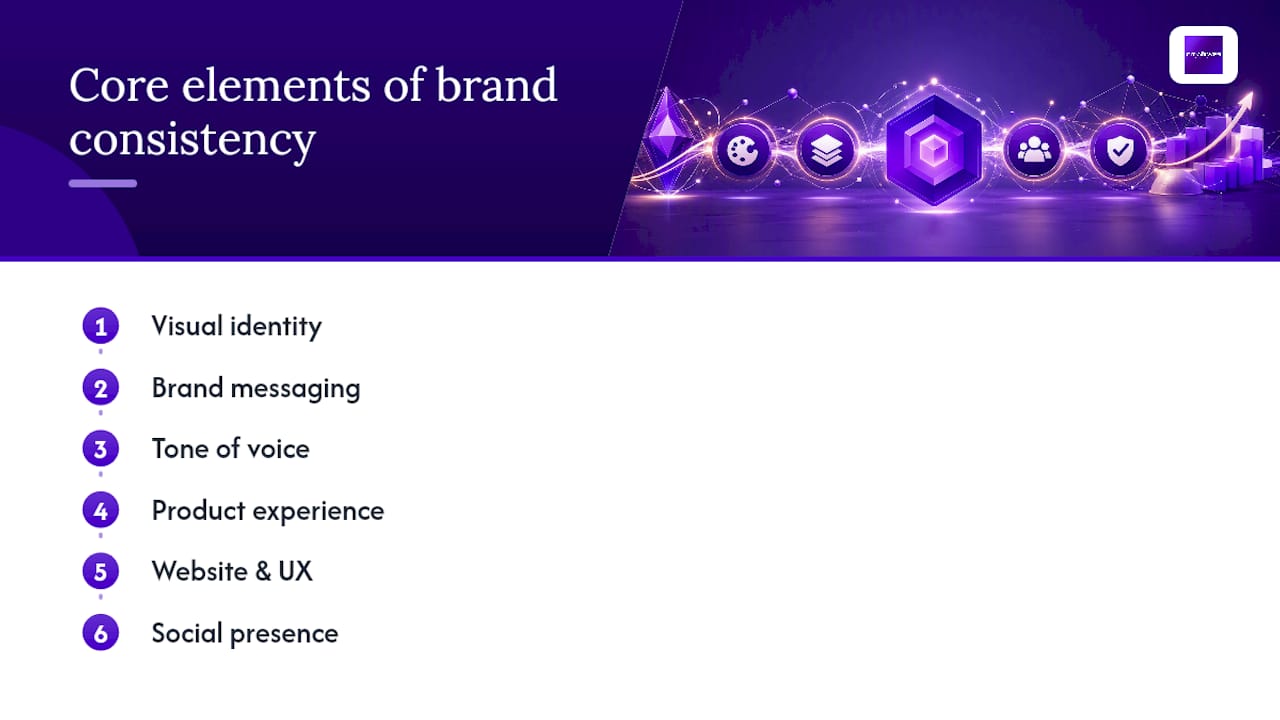
Not everything needs the same level of lockdown. Some elements are foundational, and letting them drift damages recognition immediately. Others allow more flexibility as long as the core stays intact. Here’s the priority order, based on how university branding research at Lassonde frames the discipline.
- Visual identity. Logo, color palette, typography, and imagery style. This is usually owned by design or marketing, and it needs a locked asset library, not a folder of “final_v2” logo files scattered across four laptops.
- Brand messaging. The core value proposition and key claims you repeat across ads, your website, and sales conversations. Marketing leadership typically owns this, backed by a one-page messaging document everyone can reference.
- Tone of voice. How you sound: formal or casual, playful or authoritative. A pest control company and a med spa should sound nothing alike, and that difference needs to be written down, not left to whoever is writing that week’s social post.
- Product or service experience. What a customer actually gets when they buy. Operations and customer service own this, and it needs to match the promise made in your marketing.
- Website and UX. Layout, navigation, and mobile experience. This matters more than most business owners assume, since most web traffic now comes from mobile devices, meaning your site has to look and feel like the same brand whether someone lands on a desktop or a phone.
- Social presence and listings. Profile photos, bios, hours, and business descriptions across every platform and directory. This is often owned by whoever manages local SEO, and it’s the element most likely to drift because nobody audits it regularly.
Which Brands Prove Consistency Actually Works?
Airbnb rebuilt its entire visual identity around a single symbol, the “Bélo,” and applied it with the same rounded typography and warm photography style across the app, the website, and every listing photo treatment. The result: a brand that feels identical whether you’re browsing a cabin in Vermont or an apartment in Lisbon, which builds trust with strangers renting out their own homes to other strangers.
Google runs dozens of products, from Search to Maps to Workspace, yet the same four colors, the same rounded sans-serif type, and the same friendly, plain-language tone show up everywhere. That discipline is why a Google product feels recognizable within a second, even one you’ve never used before.
Coca-Cola has run the same red, the same script logo, and a version of the same emotional message (togetherness, happiness) for over a century, adjusting execution for each decade without ever abandoning the core identity.
The lesson across all three: consistency does not mean sameness in every asset. It means an unbreakable core (color, symbol, tone) that every execution builds on, rather than reinvents.
How to Create and Maintain Brand Consistency
Getting consistent takes a process, not good intentions. Here’s the sequence that works for most service businesses:
- Audit your current state. Pull every touchpoint: website, social profiles, Google Business Profile, email templates, print materials, vehicle wraps if you have them. Note where the logo, colors, or message have drifted.
- Define your identity on paper. Lock the logo files, the exact color hex codes, the typography, and a one-paragraph description of who you are and what you promise customers.
- Write actual brand guidelines. Not a mood board. A document with rules: logo minimum size, approved color combinations, tone-of-voice examples (“say this, not that”), and photography style.
- Build templates for everything repeatable. Social posts, email signatures, quote sheets, proposal decks. If your team recreates something from scratch more than twice, it should be a template.
- Centralize the assets. One shared drive or brand portal, not five people’s desktops. Everyone pulls from the same source.
- Set up governance and training. Assign someone to approve new materials before launch, and run a short onboarding session for new hires and contractors so the guidelines actually get used.
Pro Tip: If you manage multiple locations or franchisees, build a “locked and flexible” system: lock the logo, colors, and core message company wide, but leave a small flexible zone (like a local promotion banner or a location-specific photo) so local teams don’t feel boxed in and stop following the guidelines out of frustration.
Pro Tip: Distributed teams break consistency fastest through email signatures and social bios, not big campaigns. Audit those two first. They’re the cheapest fix with the most visible payoff.
Recommended assets to have on hand before you start: a one-page brand brief, a logo usage file with clear space and minimum size rules, three to five tone-of-voice example sentences, and a folder of pre-built social templates sized for each platform.
How Do You Measure the ROI of Brand Consistency?
Track five things: brand awareness (unaided recall and search volume for your business name), engagement rate across social and email, conversion rate on landing pages, customer satisfaction or Net Promoter Score, and direct branded search volume in Google Search Console.
The cleanest way to prove impact is a simple experiment: run the same offer through two ad sets, one using your locked brand templates and one using an ad-hoc design, over an identical budget and time window. Compare conversion rate and cost per lead. Most businesses that run this test see the templated version outperform, reinforcing the 10% to 20% revenue range Adobe reports for consistent execution.
- Pull awareness and recall data from branded search volume and social reach reports.
- Pull conversion data from your ad platforms and landing page analytics.
- Pull loyalty signals from repeat purchase rate, NPS surveys, and review sentiment.
Review these numbers monthly for the first quarter after implementing guidelines, then shift to quarterly reporting once the numbers stabilize.
What Mistakes Break Brand Consistency Fastest?
The most common failure is version chaos: three different logo files floating around, none labeled as the “current” one. Fix it with a single locked asset folder and one person with edit access.
Loose governance is next. Nobody reviews new materials before they go live, so drift creeps in campaign by campaign. A lightweight approval step, even just one person eyeballing new assets against the guidelines, catches most of it.
Over-centralization causes the opposite problem: local teams wait days for sign-off on a simple flyer and eventually stop asking. Template libraries with pre-approved flexible zones solve this without sacrificing control.
Unclear tone-of-voice rules leave every writer guessing. Written examples fix this faster than a style guide full of adjectives.
In regulated or compliance-sensitive industries like healthcare or legal services, an off-brand or off-message asset is not just embarrassing. It can create liability, so review cycles there need extra scrutiny, not less.
Agency Checklist and Audit Template for Service Businesses
Use this priority order if you’re starting from scratch:
- Immediate fixes: correct logo files everywhere, standardize social bios and Google Business Profile listings, lock your color palette.
- 30-day actions: write a one-page tone-of-voice guide, build core templates (social, email, proposals), centralize all assets in one shared location.
- 90-day governance: assign an approval owner, schedule quarterly brand audits, run a training session for new hires and contractors.
| Touchpoint | Current State | Off-Brand Risk | Owner | Next Step |
|---|---|---|---|---|
| Website | Outdated logo version | High | Marketing lead | Replace with locked asset |
| Google Business Profile | Inconsistent hours/photos | Medium | Local SEO manager | Standardize listing |
| Social bios | Mixed tone across platforms | Medium | Social media manager | Apply written voice guide |
| Sales proposals | No template | High | Sales manager | Build branded template |
Pro Tip: Add a two-minute brand check to every campaign review meeting: does this asset match the locked logo, color, and voice guide? Catching drift before launch is far cheaper than fixing it after a client or customer notices.
Where Businesses Actually Lose Consistency
In review after review of local service business marketing, the gap rarely starts with bad design. It starts with no owner. Nobody is responsible for catching the outdated logo on the truck wrap or the different tone on the Instagram bio. Templates and a clear governance owner close that gap fast, freeing up creative time that used to go into rebuilding the same graphic for the fifth time.

Get Your Brand Consistency Audited by City Web Company
Most local service businesses lose consistency in the same three places: an outdated logo on Google Business Profile, a website that looks nothing like the truck wrap, and social bios written by three different people over three years. City Web Company runs brand audits alongside its local SEO services for small businesses, so the fix touches both your brand presentation and your search visibility at the same time, instead of treating them as separate problems.


Beyond the audit, City Web Company builds the templates and creative assets that keep a brand consistent long after the initial cleanup, including website design and development that matches your locked brand identity and custom promotional merchandise that reinforces it offline. For home services, med spas, HVAC companies, and other local providers juggling multiple channels without a dedicated design team, that consistency is often the difference between a lead that recognizes you and one that scrolls past.
Ready to see where your brand is losing recognition? Get your Google Business Profile and local listings optimized and start closing the gaps this quarter.
Sources
- Consistency in Marketing: Benefits, Elements, and Tips (2026) – Shopify
- Brand Consistency: Why It’s Important and How to Achieve It – G2
- The ultimate guide to brand consistency – Adobe
- Brand consistency—the competitive advantage and how to achieve it – Marq
- Share of website traffic coming from mobile devices – Statista
FAQ
Why Is Consistency Important in a Business?
Consistency lets customers recognize and trust a business faster, since repeated exposure to the same visuals, message, and experience builds memory recognition and confirms that a company’s values match what it promises.
Why Is Consistency Good in Marketing?
Consistent marketing lowers acquisition costs because customers need fewer exposures to recognize and trust a brand, and research shows it can lift revenue by 10% to 20% when applied across every channel.

What Are the Core Elements of Brand Consistency?
The core elements are visual identity, brand messaging, tone of voice, product or service experience, website and UX, and social presence and directory listings.
How Do I Measure Brand Consistency ROI?
Track branded search volume, engagement rates, conversion lift from A/B tests comparing templated versus ad-hoc creative, and customer satisfaction scores like NPS.
Can a Local Service Business Afford to Build Brand Guidelines?
Yes. A one-page brand brief, a locked logo file, and a short tone-of-voice guide cost little to produce, and City Web Company builds these as part of its local SEO and branding services for service-based businesses.
Recommended
- Why Branding Is Important for Your Business Growth
- Local Business Branding Guide: Build Trust and Win Locally
- How to Make Your Website More Trustworthy (And Why That Matters) – City Web Company | Digital Marketing Agency
- Your Brand, Everywhere: Keeping One Voice Across Every Social Platform – City Web Company | Digital Marketing Agency
These articles were popular with other readers too: