

Pass Google Business verification with a video-first checklist. Film one continuous 30 second take, fix flagged issues, and know when to hire help.
How to Enhance Client Engagement: a 5-Step Playbook
The fastest way to enhance client engagement is a five-step plan that centralizes communication into one hub, personalizes every touchpoint, and tracks three or four KPIs closely enough to catch a slipping account before it churns. Skip the scattered spreadsheets and the once-a-quarter check-in call. Clients today interact across many channels on average, and a strong majority expect a consistent experience no matter which one they use, according to Talkdesk. If your team can’t see the whole relationship in one place, you’re already behind.
Here’s where to start, in order of impact:
- Build a single client hub (CRM plus shared reporting dashboard) so no touchpoint gets lost.
- Set a fixed onboarding cadence for the first 90 days, when most early churn happens.
- Send proactive insights before clients ask for updates, not just when something breaks.
- Personalize reports and check-ins around each client’s actual goals, not a generic template.
- Track engagement score, Net Promoter Score, and churn rate regularly, not just annually.
One thing you can do in the next hour: pull your last 10 client interactions and check whether each one referenced that specific client’s goals by name. If most didn’t, you’ve found your first fix.
Table of Contents
Key Takeaways
Client engagement improves conversions when businesses centralize communication, personalize every touchpoint around specific client goals, and track churn and engagement score monthly to catch problems early.
| Point | Details |
|---|---|
| Centralize first | Build one client hub before adding new tools so no touchpoint or channel gets lost. |
| Personalize with specifics | Reference each client’s actual goals and data in reports, not generic templates. |
| Protect the first 90 days | Set a written onboarding cadence, since early churn concentrates in this window. |
| Track a small KPI set | Watch engagement score, NPS, and churn rate monthly, not quarterly. |
| Get implementation help | City Web Company builds the CRM integration and reporting systems that make this playbook run without manual effort. |
Table of Contents
- What Client Engagement Means and Why It Drives Conversions
- Proven Client Engagement Strategies, Ranked by Impact
- Building the Engagement Plan: a 5-Step Playbook
- Measuring Success and Auditing Your Tech Stack
- A Practical Checklist and What Results Actually Look Like
- How City Web Company Helps You Put This Playbook to Work
- Sources
- FAQ
What Client Engagement Means and Why It Drives Conversions
Client engagement is the ongoing, two-way exchange of value between a business and a customer, measured by how often, how deeply, and how consistently that customer interacts with you across the relationship. It’s not the same as customer service. Service is reactive: a client has a problem, you solve it, the interaction ends. Engagement is proactive and continuous. It’s the difference between waiting for a support ticket and sending a client a heads-up that their campaign performance dipped before they noticed.
That distinction shows up directly in revenue. Engaged clients spend more over the life of the relationship, refer new business more often, and stick around longer, which is why Vendasta points to centralized communication and goal-linked reporting as core levers for reducing agency churn. Three business outcomes tie directly to engagement quality:
- Higher client lifetime value. Engaged clients renew contracts and add services rather than shopping around at renewal time.
- Lower churn. Clients who hear from you proactively rarely feel surprised or ignored when problems appear.
- Stronger referrals. People recommend businesses that make them feel like a priority, not a line item.
To know whether engagement is actually working, track a handful of metrics with a clear purpose each: Net Promoter Score (measures likelihood to refer), engagement score (composite of logins, opens, replies), churn rate (percentage of clients lost per period), usage rate (how much of your service or platform they actually touch), and response rate (how quickly and how often clients reply to your outreach).
Proven Client Engagement Strategies, Ranked by Impact
These are the tactics that move the needle first, in the order most businesses should tackle them.
1. Personalization at scale
Generic monthly reports get skimmed and forgotten. Reports built around a specific client’s stated goals get read and discussed. Start by pulling each client’s top one or two business objectives into your CRM as fields, not notes. Measure how often clients reply to personalized versus templated communications, then compare engagement scores over 90 days.
Pro Tip: Personalization fails when it’s just a mail-merge with the client’s name inserted; choosing the right tool can help achieve genuine personalization, as explained in Omnisend vs Klaviyo: Best Email Platform for Ecommerce. The real signal is referencing something specific to their business, like last month’s lead volume or a seasonal trend in their industry.*
2. Omnichannel and a unified client view
Clients text, email, call, and message on social media, often about the same issue. Without a shared record, three team members might give three different answers. Build a single dashboard that logs every touchpoint regardless of channel, and assign one owner per account who sees it all. Learn more about building a multi-channel marketing strategy that keeps every channel pointed at the same client journey.

Pro Tip: Don’t just log the channel used. Log the intent behind the message. A client texting “quick question” often means something urgent is brewing.
3. Structured onboarding and cadence
The first 90 days set the tone for the entire relationship, and that’s when most early churn happens, according to ChatbotGen’s client engagement research. Map out weekly touchpoints for month one, biweekly for month two, and monthly after that, with clear milestones at each stage.
Pro Tip: Put the cadence in writing and share it with the client during kickoff. Ambiguity about “when will I hear from you next” is a leading cause of early frustration.
4. Feedback loops that actually close
Surveys that go nowhere train clients to stop responding. Every piece of feedback needs a visible action or a documented reason it wasn’t actioned. Send a short pulse survey quarterly and report back what changed because of it.
Pro Tip: Close the loop publicly when you can. Telling a client “you mentioned X, so we changed Y” does more for trust than any survey score.
5. Segmentation by value and risk
Not every client needs the same attention. Segment accounts by revenue, growth potential, and churn risk, then assign engagement intensity accordingly. High-risk, high-value accounts get a human check-in; low-touch accounts get automated nurture.
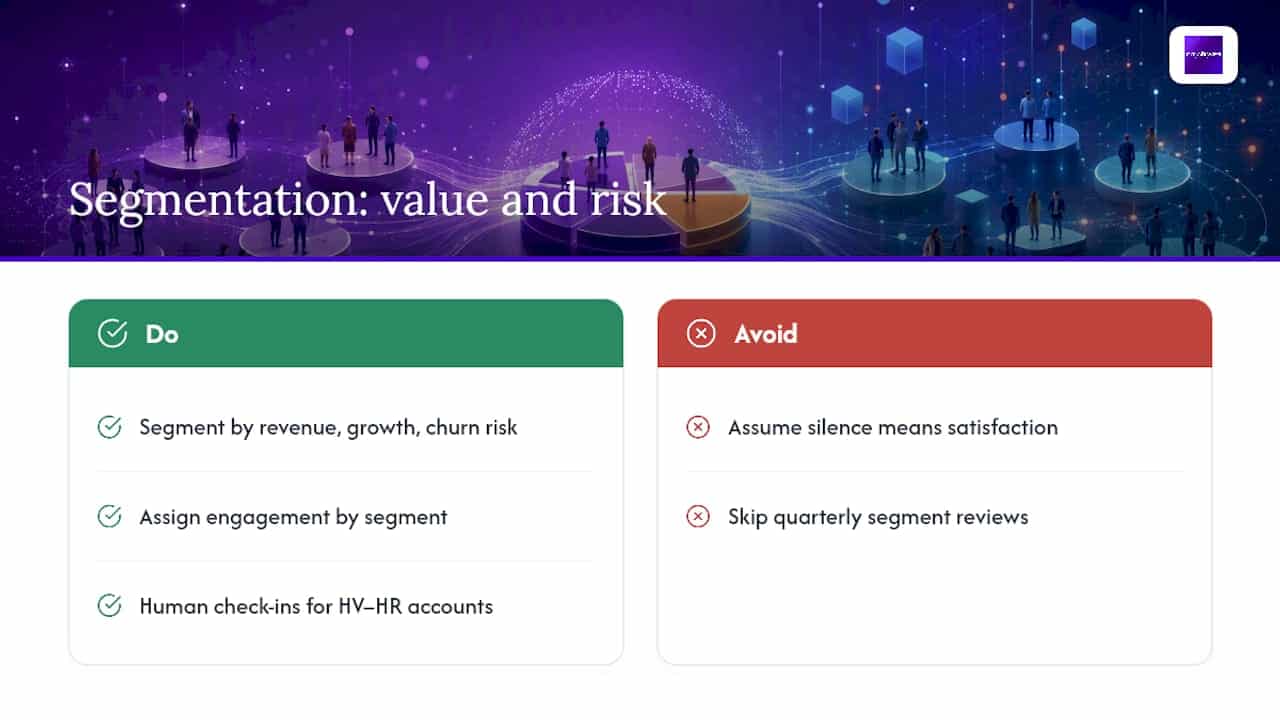

Pro Tip: Revisit segments quarterly. A quiet client isn’t always a stable one, sometimes silence means disengagement, not satisfaction.
6. Conversational marketing and chatbots
Chatbots handle repetitive questions instantly, which frees your team for the conversations that need judgment. Deploy a chatbot for FAQs and appointment scheduling, but route anything emotional or complex straight to a human.
Pro Tip: Never let a chatbot be the only path to a human. A dead end frustrates clients faster than slow service does.
7. Loyalty and rewards programs
Points, tiered perks, and referral bonuses give clients a tangible reason to stay engaged beyond the service itself. Even simple gamification elements like badges or milestone recognition can increase repeat engagement, per SmallBizTrends.
Pro Tip: Tie rewards to behaviors you actually want repeated, like referrals or reviews, not just tenure.
8. Storytelling in communications
Clients remember narratives, not bullet points. Frame monthly reports as a story: here’s where you started, here’s what we changed, here’s what happened next.
Pro Tip: Use before-and-after framing sparingly but consistently. Overused, it starts to feel like a sales pitch instead of a status update.
9. Employee training on relationship skills
Tools don’t build relationships, people do. Train account teams on active listening and proactive communication, not just product knowledge.
Pro Tip: Role-play a difficult client conversation quarterly. Teams that practice handling pushback respond faster when it happens for real.
Building the Engagement Plan: a 5-Step Playbook
Turning strategy into practice takes structure. Here’s a compact playbook you can adapt this quarter.
- Audit and set goals. Review current touchpoints, response times, and churn data. Set one measurable engagement goal per client segment.
- Map segments and journeys. Group clients by value and risk, then chart the touchpoints each segment should experience from onboarding through renewal.
- Build the hub and automate the basics. Centralize records in one CRM, and automate low-value repetitive touches like appointment reminders. Explore marketing automation basics if your team hasn’t started yet.
- Run a pilot with clear success criteria. Test the new cadence on one segment before rolling out company-wide.
- Scale and govern. Once the pilot proves out, expand it and assign an owner to review engagement metrics monthly.
Checklist under step 4, the pilot itself:
- Hypothesis: A structured 90-day onboarding cadence reduces early-stage churn.
- Primary metric: Churn rate at day 90.
- Secondary metrics: Engagement score, response rate, NPS.
- Timeline: One full quarter.
- Sample selection: 10 to 15 mid-value accounts, enough to see a trend without risking your top clients on an untested process.
Measuring Success and Auditing Your Tech Stack
The KPIs worth watching monthly are engagement score, NPS, churn rate, client lifetime value movement, and time-to-first-value, the gap between signing a client and delivering their first measurable win. Each reveals something different: engagement score shows activity, NPS shows sentiment, churn shows outcomes, and time-to-first-value shows how fast you’re proving worth. Indeed’s guide to customer loyalty notes that tracking these together lets teams spot at-risk accounts before they cancel, not after.
Before adding new software, run a quick audit:
- Confirm every client data source (email, CRM, ad platforms) actually connects and syncs.
- Check CRM hygiene: duplicate records and stale fields quietly wreck personalization.
- Map integration points between your CRM, messaging tools, and analytics dashboard.
- Set a reporting cadence everyone actually follows, not just the one written in a doc.
- Confirm data privacy and consent practices are current, especially for automated messaging.
Automate the repetitive: reminders, report generation, basic FAQ handling. Keep humans on judgment calls: renewals, complaints, and anything emotionally charged. Review your digital marketing metrics regularly so the numbers you’re chasing still map to what clients actually care about.
A Practical Checklist and What Results Actually Look Like
Print this and hand it to whoever owns client relationships:
- Every client has a named owner and a documented goal on file.
- Onboarding cadence is written down and shared with the client at kickoff.
- Feedback from the last quarter has a visible action attached.
- Engagement score and churn rate are reviewed monthly, not quarterly.
- At least one proactive insight per client goes out before they ask for it.
Resolving a client’s problem quickly and transparently is one of the strongest loyalty drivers available, since it proves the relationship holds up under pressure, not just when things go smoothly, according to EY’s research on trust and loyalty. A home services client of an agency using this exact approach, unified hub, 90-day cadence, and monthly KPI reviews, saw meaningful churn reduction within two quarters after switching from ad hoc reporting to a structured cadence.
Copy this template for a proactive check-in email:
Author’s Note: Common Pitfalls We See Repeatedly
Most engagement programs fail from over-automation or inconsistent cadence, not from a lack of tools. Two fixes matter most. First, automating every touchpoint strips out the human judgment clients actually value, so keep escalations and renewals manual. Second, sending updates sporadically undoes months of trust, so a written, followed cadence beats an ambitious one that slips, a point CX Dive’s research on resolution and loyalty backs up directly: speed and consistency matter more than sophistication.
How City Web Company Helps You Put This Playbook to Work
Running this five-step plan without dedicated systems is where most local service businesses stall out, not from lack of strategy but from lack of time to build the hub, automate the cadence, and report on it monthly. City Web Company builds that infrastructure for home services, med spas, HVAC companies, law firms, and other local service businesses: CRM integration, automated reporting tied to your actual goals, and campaign tracking that connects engagement directly to leads and revenue.
If you’re ready to stop patching together spreadsheets and start running a real engagement system, City Web Company’s team can map out where your current setup breaks down and what to fix first. Visit the digital marketing services page to schedule a consultation and get a clear look at what a centralized, measurable engagement program would look like for your business.
Sources
- Customer Interaction Management: Definition, Methods, and Benefits | Talkdesk
- Client Engagement Strategies to Build Lasting Loyalty | Vendasta
- Customer engagement techniques | SmallBizTrends
FAQ
What Are the 3 C’s of Customer Engagement?
Definitions vary across sources, but a common framing centers on consistency, communication, and connection: showing up reliably, staying in touch proactively, and building a relationship that goes beyond transactions.
How Do You Drive Positive Client Engagement?
Center on proactive, personalized communication delivered through a centralized system, then back it with fast, transparent problem resolution when issues come up. Businesses using structured onboarding and monthly KPI reviews, like the approach City Web Company builds for local service clients, see engagement stick rather than fade after the first few months.
What Does It Mean to Enhance Customer Engagement?
Enhancing customer engagement means increasing the frequency, depth, and consistency of two-way interactions between a business and its clients, measured through metrics like engagement score, NPS, and churn rate rather than one-off satisfaction snapshots.
Recommended
These articles were popular with other readers too: