

Pass Google Business verification with a video-first checklist. Film one continuous 30 second take, fix flagged issues, and know when to hire help.
SEO for attorneys: boost visibility and win more leads
Most attorneys still believe their next client will come from a handshake or a referral. That assumption is costing law firms real revenue. Today, potential clients search Google before they ever call a friend for a recommendation, and if your firm isn’t showing up on page one, you simply don’t exist to them. 83% of law firms now outsource SEO and treat it as a primary driver of client intake. This guide breaks down exactly how search engine optimization works for attorneys, which strategies move the needle, and how to avoid the mistakes that waste time and money.
Table of Contents
Table of Contents
- Why SEO matters for attorneys
- Core components of legal SEO
- SEO strategies that drive attorney leads
- Common pitfalls and how to avoid them
- How to get started with attorney SEO
- Boost your law firm’s leads with expert SEO support
- Frequently asked questions
Key Takeaways
| Point | Details |
|---|---|
| SEO powers attorney growth | Effective SEO helps law firms attract more clients and stand out locally. |
| Long-term commitment pays off | Results from SEO often take 6-12 months but deliver lasting benefits. |
| Specialists maximize ROI | Outsourcing SEO usually generates better returns than doing it alone. |
| Local SEO delivers quick wins | Focusing on local presence and reviews gets attorneys noticed faster. |
Why SEO matters for attorneys
The legal industry has changed faster than most firms realize. Clients no longer flip through directories or wait for a neighbor’s recommendation. They open a browser, type “divorce attorney near me” or “personal injury lawyer in [city],” and call whoever appears at the top. If your competitors are investing in SEO and you aren’t, they are capturing those clients every single day.
SEO, or search engine optimization, is the process of improving your website and online presence so that search engines rank you higher for relevant searches. For attorneys, that means showing up when someone in your city needs your specific practice area. Higher rankings translate directly into more website visits, more phone calls, and more consultations booked.
“Law firms that commit to SEO as a long-term strategy consistently outperform those that rely solely on referrals or paid ads for client acquisition.”
The benefits go beyond just traffic. A strong SEO presence builds credibility. When your firm appears at the top of search results alongside positive reviews, prospective clients perceive you as the authority in your field before they even read a word of your bio. That trust is hard to manufacture any other way.
Here is why SEO deserves a place in every law firm’s growth plan:
- Long-term lead generation at a lower cost per lead than paid advertising
- Brand authority built through consistent visibility in search results
- Competitive advantage over firms that still rely on referrals alone
- 24/7 visibility so prospects can find you at any hour
The catch is patience. A 6-12 month SEO commitment is the baseline before most firms see significant results. Attorneys who understand this invest early and enjoy lasting growth with SEO while competitors are still waiting to “see if it works.” Explore how digital marketing for law firms fits into a broader growth strategy to get the full picture.
Core components of legal SEO
SEO is not one single tactic. It is a system of interconnected strategies that work together to improve your firm’s visibility. Understanding each component helps you prioritize where to focus your effort and budget.
Website optimization is the foundation. This includes on-page SEO elements like page titles, meta descriptions, header tags, and the actual written content on each page. Your site also needs to load fast, work perfectly on mobile devices, and be technically sound so search engines can crawl and index it without issues.

Local SEO is where most attorneys see the fastest wins. This focuses on your Google Business Profile (the listing that appears in map results), local citations (your firm’s name, address, and phone number listed consistently across directories), and client reviews. A well-optimized Google Business Profile alone can put your firm in front of hundreds of local searchers every month.
Off-page SEO refers to signals outside your website, primarily backlinks. When reputable websites link to your firm’s site, search engines interpret that as a vote of confidence. Legal directories, bar association listings, local news mentions, and guest articles on legal publications all build this authority over time.
Here is how the three pillars stack up:
| SEO component | What it covers | Impact timeline |
|---|---|---|
| On-page SEO | Content, keywords, page speed, technical setup | 3-6 months |
| Local SEO | Google Business Profile, citations, reviews | 1-3 months |
| Off-page SEO | Backlinks, authority signals, PR mentions | 6-12 months |
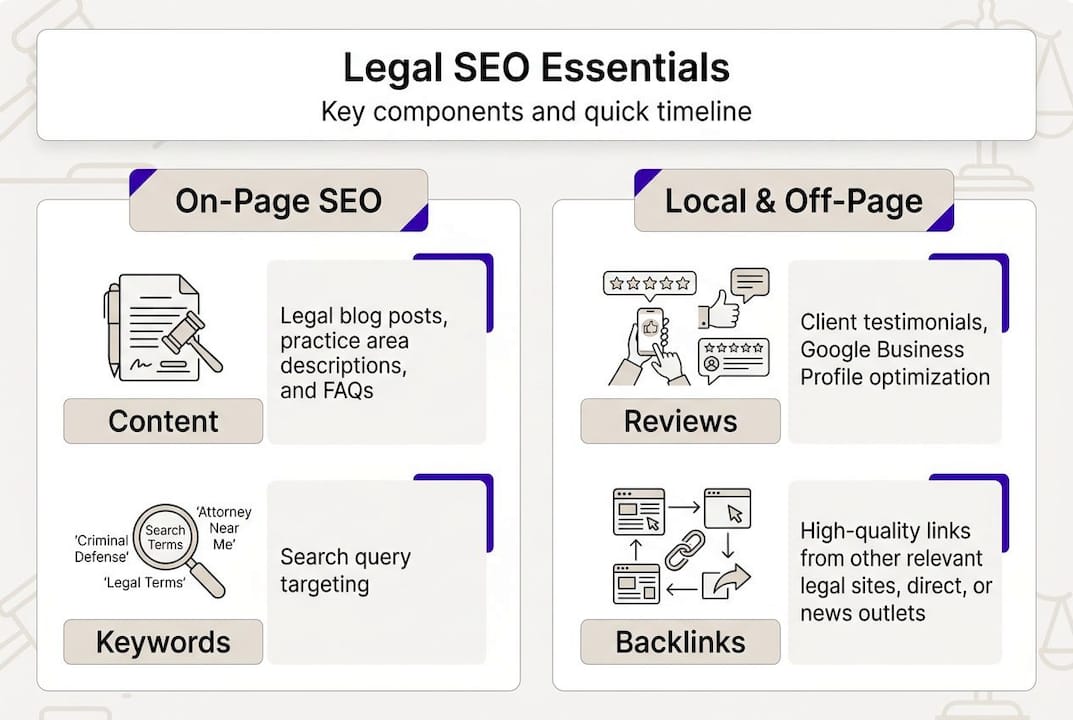

These components do not work in isolation. Successful SEO starts with website optimization and extends outward to local listings and authority building. Skipping any one of them creates gaps that limit your overall rankings. If you want to get familiar with the terminology before diving deeper, this SEO terminology explained resource is a practical starting point.
Here is the order in which to tackle these components:
- Fix technical website issues (speed, mobile, indexing)
- Optimize existing practice area pages with targeted keywords
- Claim and fully complete your Google Business Profile
- Build consistent local citations across major directories
- Earn backlinks from legal directories and local publications
SEO strategies that drive attorney leads
Knowing the components is one thing. Knowing which specific tactics generate actual client leads is where most attorneys need the clearest guidance.
Practice area pages are your most powerful SEO asset. Each service you offer, family law, criminal defense, estate planning, deserves its own dedicated page optimized for local keywords. A single generic “our services” page will not rank for competitive searches. Specific, detailed pages signal to search engines exactly what you do and where you do it.
Google Business Profile management is non-negotiable for local visibility. Complete every field, add photos, post updates regularly, and respond to every review. Positive reviews are a direct ranking factor for local search results, and they also convert skeptical prospects into callers.
Authoritative backlinks from legal directories like Avvo, Justia, and FindLaw are easy starting points. From there, look for opportunities to contribute expert commentary to local news outlets or write guest posts for legal publications. Each quality link strengthens your domain authority.
Pro Tip: Before you invest heavily in SEO, audit your intake process. Intake process optimization is critical to converting incoming SEO leads. If your phone goes to voicemail during business hours or your contact form takes days to get a response, SEO traffic will not translate into clients.
Here is a quick comparison of SEO approaches for attorneys:
| Approach | Best for | Typical cost | Speed to results |
|---|---|---|---|
| DIY SEO | Solo practitioners with time | Low | Slow |
| Freelance SEO | Small firms, limited budget | Medium | Moderate |
| Agency SEO | Growth-focused firms | Higher | Fastest |
The tactics that matter most for lead generation:
- Optimize every practice area page for city-specific keywords
- Collect and respond to Google reviews consistently
- Build citations in legal and local directories
- Use schema markup (structured data) to help search engines read your pages
- Create locally relevant blog content that answers common client questions
For a deeper look at location-based tactics, the local SEO for attorneys guide covers the specifics. If you are unsure whether local or traditional SEO is the right focus, this breakdown of local vs. traditional SEO will clarify the difference. You can also explore top local SEO services designed specifically for attorneys.
Common pitfalls and how to avoid them
Even firms that invest in SEO often make mistakes that undermine their results. Recognizing these pitfalls early saves months of wasted effort.
Here are the most common errors law firms make with SEO:
- Neglecting website basics. Slow load times, broken links, and poor mobile experience tank rankings before any content strategy can help.
- Chasing keywords without context. Targeting high-volume keywords without matching them to your actual practice areas and location leads to irrelevant traffic that never converts.
- Ignoring intake. 83% of law firms outsource SEO, but many still neglect intake and measurement, meaning leads arrive and disappear without a trace.
- Expecting instant results. Stopping SEO after three months because “it isn’t working” is one of the most expensive mistakes a firm can make.
- Not tracking the right metrics. Ranking reports are vanity metrics. What matters is calls, form fills, and booked consultations tied to organic search.
Pro Tip: Set up call tracking and form tracking from day one. Knowing exactly which search terms and pages are generating consultations lets you double down on what works and cut what doesn’t.
“SEO without measurement is just guessing. Law firms that track calls, form fills, and consultations from organic search make smarter decisions and see better returns.”
Measuring real ROI from SEO means connecting your website analytics to your intake data. Tools like Google Analytics, Google Search Console, and a basic CRM can show you the full picture from search click to signed client. Review this resource on SEO and lead generation marketing to understand how SEO fits within a broader marketing funnel. Also make sure your site covers the law firm website essentials that convert visitors into inquiries.
How to get started with attorney SEO
Starting SEO does not require a massive budget or a team of specialists on day one. It requires a clear audit of where you stand and a prioritized plan to improve.
Begin with these foundational steps:
- Audit your current website. Check page speed using Google PageSpeed Insights, confirm your site is mobile-friendly, and identify any broken pages or missing meta descriptions.
- Claim your Google Business Profile. If you haven’t already, claim and verify your listing at business.google.com. Fill out every field completely.
- Check your local citations. Search your firm’s name online and confirm your name, address, and phone number are consistent across all listings.
- Identify your target keywords. List the practice areas you want to rank for and combine them with your city or region. These become the foundation of your content strategy.
- Create or update practice area pages. Each page should target a specific service and location, include a clear call to action, and answer the questions your prospective clients are actually asking.
- Start collecting reviews. Ask satisfied clients to leave a Google review. Even five or ten reviews can meaningfully improve your local rankings.
Most firms benefit from outsourcing SEO to specialists once the foundational work is in place. A specialist agency brings tools, experience, and dedicated time that most attorneys simply cannot replicate while running a practice. When evaluating agencies, ask for case studies from legal clients, ask how they measure success, and expect a realistic timeline of six months or more before significant results appear. For a broader view of growth tactics, explore online marketing for law firms and review this search engine ranking guide to understand what it takes to climb the rankings.
Boost your law firm’s leads with expert SEO support
Attorneys who invest in SEO now are building a pipeline that pays dividends for years. The firms ranking at the top of Google in your city didn’t get there by accident. They committed to a strategy, tracked their results, and kept improving. If you’re ready to stop leaving leads on the table, the right support makes all the difference.

City Web Company specializes in results-driven SEO for law firms across the United States. Whether you’re starting from scratch or looking to improve an existing strategy, our team builds campaigns around your specific practice areas and local market. Start by reviewing the SEO basics for attorneys to get grounded, then check out our search ranking for law firms resource to see what top rankings actually require. When you’re ready to move forward, our professional SEO services are built to generate real client leads, not just traffic numbers.
Frequently asked questions
How long does it take to see SEO results for attorneys?
Most attorneys see measurable SEO results within 6 to 12 months, provided they maintain consistent effort and avoid major strategy changes mid-campaign.
Is it better to hire an agency or do law firm SEO in-house?
83% of firms outsource SEO because specialist agencies deliver better ROI than most in-house efforts, especially for practices where attorneys’ time is better spent on clients.
Which SEO tactic has the biggest impact for attorneys?
Local SEO, especially a fully optimized Google Business Profile paired with consistent client reviews, typically delivers the fastest visibility gains and the most direct lead impact.
How can attorneys measure return on SEO investment?
Track phone calls, contact form submissions, and booked consultations that originate from organic search traffic using Google Analytics and a call tracking tool.
Is SEO still important if my practice gets referrals?
Absolutely. Even referral-based clients search your name online before calling, and a strong SEO presence ensures new prospects who don’t know you yet can still find and trust your firm.
Recommended
These articles were popular with other readers too: