Learn how attorney SEO drives client leads, improves local search rankings, and helps law firms outpace competitors. Practical strategies for U.S. attorneys.
A Contractor’s Guide to Online Advertising That Actually Works
The biggest myth in marketing is that a bigger ad budget guarantees more jobs. Many contractors treat their marketing spend like a vending machine: put money in, get leads out. But when the results are inconsistent clicks and a handful of low-quality calls, it becomes clear the machine is broken. The problem is rarely the ad itself. It's the disconnected process between the click, the website, and the final booked job.
Table of Contents
Why Your Ad Budget Feels Like a Black Hole
If you feel like your advertising dollars are vanishing without a trace, you are not imagining it. It’s a common scenario: you run ads, see some clicks, and maybe the phone rings a few times. But when you try to connect that spending to actual, profitable jobs, the line goes cold. The frustration is valid.

The issue usually isn't a lack of effort. It is a lack of a connected system. Funneling cash into online advertising for contractors without a clear plan to turn a click into a paying customer is like trying to fill a bucket with a hole in the bottom. You can keep pouring, but it will never be full.
The Real Cost of a Disconnected System
This gap between an ad click and a final sale creates practical business problems that go beyond a wasted budget. It shows up in a few distinct ways:
- High Cost-Per-Acquisition (CPA): You are paying too much to land each new customer because your conversion process is inefficient.
- Low-Quality Leads: Your ads bring in clicks from tire-kickers, price-shoppers, or people outside your service area.
- Missed Revenue: Every qualified lead lost to a confusing website or slow follow-up is a job you could have booked.
- Inaccurate ROI: Without end-to-end tracking, you have no real idea if your ad spend is profitable, making it impossible to scale what works.
This isn't just a spending problem; it's a structural one. The opportunity cost is significant. U.S. ad spend is projected to jump by 9.5% in 2026, and for contractors, paid search can deliver an average 200% ROI. That is turning every dollar spent into two. But that return is only possible with the right system in place. You can find more data on advertising growth over at IAB.com.
The core issue isn't Google or Facebook. It's the absence of a deliberate, measured system connecting that ad click to a booked job in your CRM.
This guide provides a playbook for building a strategic, system-driven approach to online advertising. It is about creating a predictable engine for growth, not just buying clicks and hoping for the best.
This shift from random spending to a connected system is what provides clarity. Your ad budget stops being a liability and becomes a measurable investment. You gain a clear understanding of what’s working, why it’s working, and where to allocate resources for maximum profit. This is how you build a campaign that makes sense and delivers results you can see on your bottom line.
Picking the Right Channels for Qualified Leads
The advice to "be everywhere online" is a fast track to a wasted budget. For contractors, success is not about likes or shares; it's about attracting customers with an immediate problem who are ready to hire. Spreading a budget too thin across every new platform is a classic mistake that leads to weak results and a frustrating lack of real job leads.
This failure often comes down to a mismatch between the channel and the customer's mindset. Not all online platforms are created equal. Some are designed to capture the attention of someone actively looking to hire, while others are better for showcasing work and building trust over time. Understanding this distinction is how you build an ad strategy that brings in profitable jobs.
Advertising Channel Selection for Contractors
To get the right leads, you must appear in the right place at the right time. This table breaks down the main channels, showing where to find immediate jobs versus where to build your brand for future ones.
| Channel | Primary Use Case | Lead Intent | Strategic Goal |
|---|---|---|---|
| Google Ads (PPC) | Targeting users actively searching for your specific services. | High | Capture Immediate Demand |
| Local Service Ads | Top-of-page ads for verified local service pros. | Very High | Get Phone Calls Now |
| Social Media Ads | Showcasing project portfolios and building brand recognition. | Low | Generate Future Demand |
| Streaming TV/OTT | Reaching a local audience with TV-style video commercials. | Low | Build Brand Awareness |
Each channel has a specific role. A powerful strategy does not just pick one; it blends them to create a system that captures leads today while building a pipeline for tomorrow.
High-Intent vs. Awareness-Building Channels
Many contractors make the mistake of treating a Facebook ad like a Google ad. This is a fundamental error. One platform catches a customer who is actively searching for a solution, while the other interrupts someone scrolling through personal photos. This is precisely why a campaign that only runs on social media might not bring in immediate work. It’s missing the high-intent piece of the puzzle.
High-Intent Channels (Demand Capture): These platforms connect you with customers who know they have a problem and are looking for a professional to solve it. The lead quality is almost always higher because the customer initiated the search. Think Google Ads and Google Local Service Ads.
Awareness-Building Channels (Demand Generation): This is where you build your brand and stay top-of-mind. The intent is lower, but these platforms are excellent for visual storytelling, building trust, and retargeting people who have shown interest. Facebook, Instagram, and Streaming TV ads fit here.
To consistently attract quality prospects, it's crucial to understand how effective digital marketing for roofers and other service trades works. This knowledge helps you put your money where the results are.
Match the Channel to the Job
Let's make this practical. Imagine a hailstorm just rolled through town. A roofer running Google Ads targeting "emergency roof repair" is positioned for success. Homeowners are actively searching for help, and the ad appears right when they need it most. That is a high-intent strategy in action.
Now, think about a kitchen and bath remodeler. They will likely find more success using Facebook and Instagram. The goal here is not to capture an emergency but to plant a seed for a future project. By showing a portfolio of before-and-after photos, the remodeler builds desire and becomes a familiar, trusted name. When that homeowner decides it's time to renovate, they are more likely to remember the remodeler's work.
The most effective strategies do not pit one channel against another. They use a smart mix of high-intent and awareness-building platforms, with each playing a specific, calculated role.
Social media advertising is a powerful tool for contractors, with spending on platforms like Facebook and Instagram projected to surpass $317 billion globally by 2026. It's an excellent medium for visual proof, allowing you to showcase finished projects that can turn browsing homeowners into future customers.
This is where you stop wasting ad spend and start seeing a real return. It is about making deliberate choices based on your business goals. When you align your channel with the specific type of lead you're after, you create a focused, efficient system that drives qualified inquiries, not just empty clicks.
Building Your Campaign and Conversion System
You have ads running and clicks are coming in. But is your phone ringing? Or are you just burning through your budget?
Getting clicks is the easy part. The real challenge is turning that click into a profitable, booked job. A great ad is only the first step. You must guide that potential customer on a clear path from their first tap to the final agreement.
The single most common mistake is sending expensive ad traffic straight to the company homepage. Your homepage is a generalist. It tells your story, lists every service you offer, and has a generic contact form. An ad campaign needs a specialist.
The Critical Role of the Landing Page
A dedicated landing page has one job: convert a visitor from a specific ad into a lead. That is it. It’s a focused environment built for a single action. All distractions are stripped away. There is no main navigation to tempt them into browsing and no mention of services they are not interested in.
Picture this: a homeowner’s basement is flooding. They search for an emergency plumber and click your ad. The last thing they want is to land on a page that also talks about kitchen remodels. They need immediate confirmation that you solve their exact problem, a clear reason to trust you, and a prominent button to call you immediately.
Sending ad traffic to your homepage is like asking a potential customer to find a needle in a haystack. A dedicated landing page hands them the needle.
This is about understanding the customer's journey from awareness to decision.
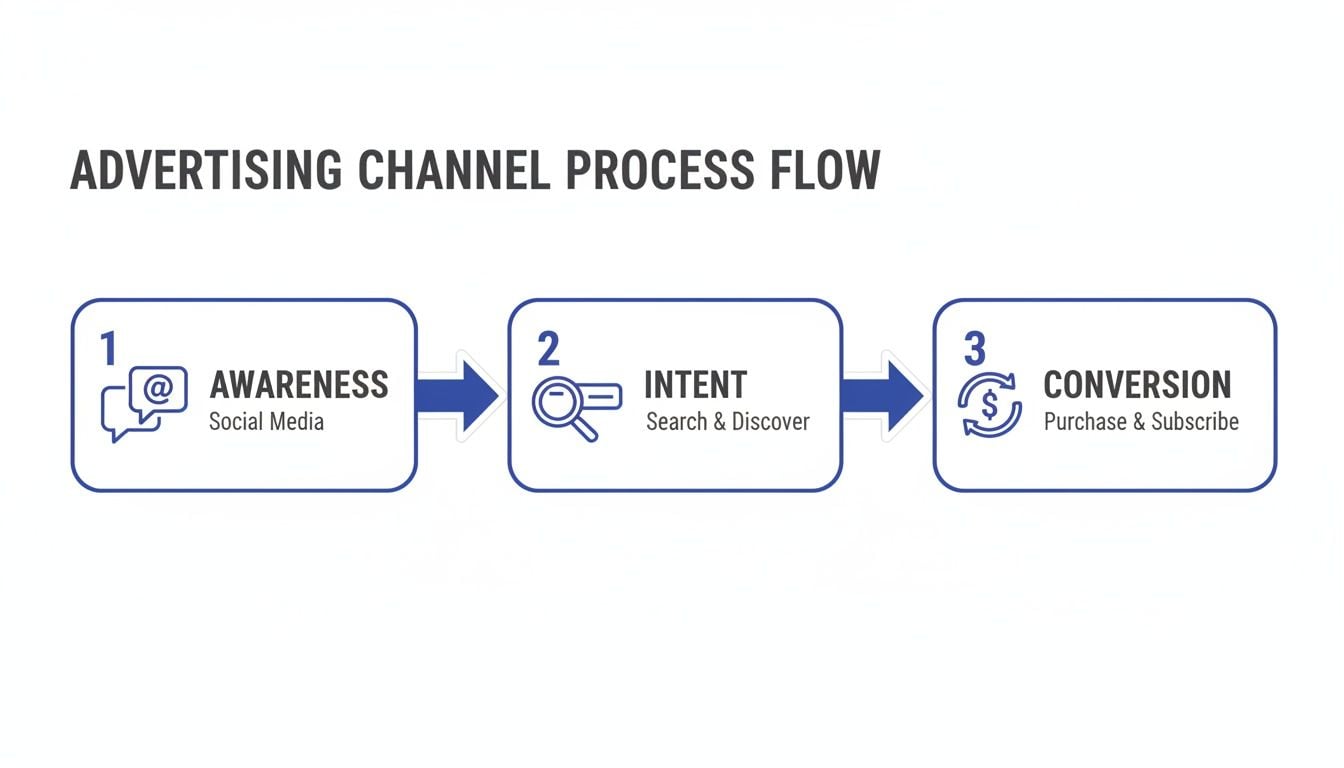
As you can see, different channels guide a prospect from awareness to intent. Your conversion system is what secures the job at that final, critical step.
Crafting Ad Copy That Connects
Your ad and your landing page must be perfectly aligned. The promise that earned the click has to be the first thing a visitor sees on the page. We call this message match, and it is essential for preventing visitors from leaving and wasting your ad spend.
For contractors, effective ad copy does two things well:
- It speaks directly to the problem. Instead of a generic "Your Local Electrician," use "Emergency Electrical Repair, Available 24/7." You are not just an electrician; you are the solution to their immediate crisis.
- It includes a clear call to action. Tell them exactly what to do next. "Call Now for a Free Estimate" is direct, simple, and action-oriented.
Your goal is to stop a frantic searcher and provide instant relief that they have found the right person for the job. To keep your messaging sharp and consistent, tools that generate AI UGC can help craft compelling ads that work.
Connecting the Dots With Lead Tracking
This is the final, non-negotiable piece. Without proper tracking, you are operating blindly. An effective online advertising for contractors campaign means knowing precisely which ads, keywords, and landing pages are actually making your phone ring and generating form submissions.
This goes beyond basic Google Analytics. You need to implement call tracking numbers and conversion tracking on your forms. When this is set up correctly, you can look at your dashboard and see that a specific ad for "roof leak repair" generated five phone calls and two new jobs last month, bringing in $8,000 in revenue.
Suddenly, you are not guessing anymore. You know. You can confidently double down on the ads that deliver profitable jobs and cut the ones that do not. This closes the loop, turning your ad spend from a mysterious expense into a predictable, measurable investment in your company’s growth.
Budgeting and Measuring What Truly Matters
Effective advertising is not about how much you spend. It is about how smart you are with your money. For many contractors, setting an ad budget feels like throwing darts in the dark, leading to a cycle of spending without knowing if it is actually bringing in profitable work.
The real problem is most people track the wrong numbers. Clicks, impressions, and even website traffic are just noise if you cannot connect them directly to your revenue. These "vanity metrics" show activity, but they say nothing about profitability.
True clarity comes when you stop focusing on what you spend and start measuring what you get back.
Moving Beyond Vanity Metrics
A click is just a click until it turns into a lead. And a lead is just a name until it becomes a paying customer. To build a predictable growth engine with online advertising for contractors, you must track the numbers that impact your bottom line.
This means tuning out the distracting, top-level data and focusing on a few Key Performance Indicators (KPIs) that tell the real story of your campaign’s health.
Here is a quick overview of the KPIs that every contractor should be watching. These are the metrics that move you from guessing to knowing, showing you the true performance and profitability of your ad campaigns.
Key Performance Indicators (KPIs) for Contractor Ads
| KPI | What It Measures | Why It's Important for Contractors |
|---|---|---|
| Cost Per Lead (CPL) | Total ad spend divided by the number of leads generated (phone calls, form fills). | This tells you exactly what it costs to make your phone ring. It’s the first step in understanding campaign efficiency. |
| Cost Per Acquisition (CPA) | Total ad spend divided by the number of new paying customers you landed. | This is the true cost of booking a job from your ads. It connects your marketing spend directly to a new customer. |
| Return on Ad Spend (ROAS) | Total revenue from ads divided by the total cost of those ads. | This is the ultimate measure of success. It shows you the direct ROI of your ad spend in dollars and cents. |
These are the numbers that matter. They provide the data you need to make smart, informed decisions instead of emotional ones. You can dive deeper into these numbers in our guide on the 5 essential paid advertising metrics to track.
A Practical Scenario: Putting ROAS to Work
Let's see how this works in the real world. Imagine you are a plumber running a Google Ads campaign for "emergency drain cleaning."
You spent $1,000 on ads last month. Those ads brought in 20 qualified phone calls, giving you a Cost Per Lead (CPL) of $50.
Your team is solid, and you convert 25% of those calls into booked jobs. That means you landed 5 new customers. Your Cost Per Acquisition (CPA) is therefore $200 per job ($1,000 spent / 5 jobs).
If your average revenue for an emergency drain cleaning job is $800, those five jobs generated a total of $4,000 in revenue.
Your Return on Ad Spend (ROAS) is $4,000 in revenue divided by $1,000 in ad spend. That's a 4:1 ROAS.
With this clarity, your ad budget is no longer a mysterious expense. It's a strategic investment with a provable return. You now know with confidence that putting another $1,000 into this campaign is likely to generate another $4,000 in revenue. This is how you scale your business predictably.
Setting a Budget Based on Goals
It is time to stop picking a budget out of thin air. The most effective way to set your ad spend is to work backward from your revenue goals.
Figure out how much new business you want to generate. Know your average job value. Understand your lead-to-customer conversion rate. With those numbers, you can set a target CPA that guarantees every dollar you spend is profitable.
This simple shift changes the entire conversation. You stop asking, "How much should I spend?" and start asking, "How much do I need to invest to hit my growth target?" That is the strategic clarity needed to build a true growth system for your business.
Optimizing for Profit, Not Just Clicks
Getting an ad campaign live is just the first step. Many contractors see a few clicks or calls and assume the job is done. But this is where the real work begins and where the most successful businesses separate themselves.
A campaign left on autopilot is a campaign bleeding money. The difference between breaking even and driving serious profit comes down to one thing: continuous, hands-on optimization.
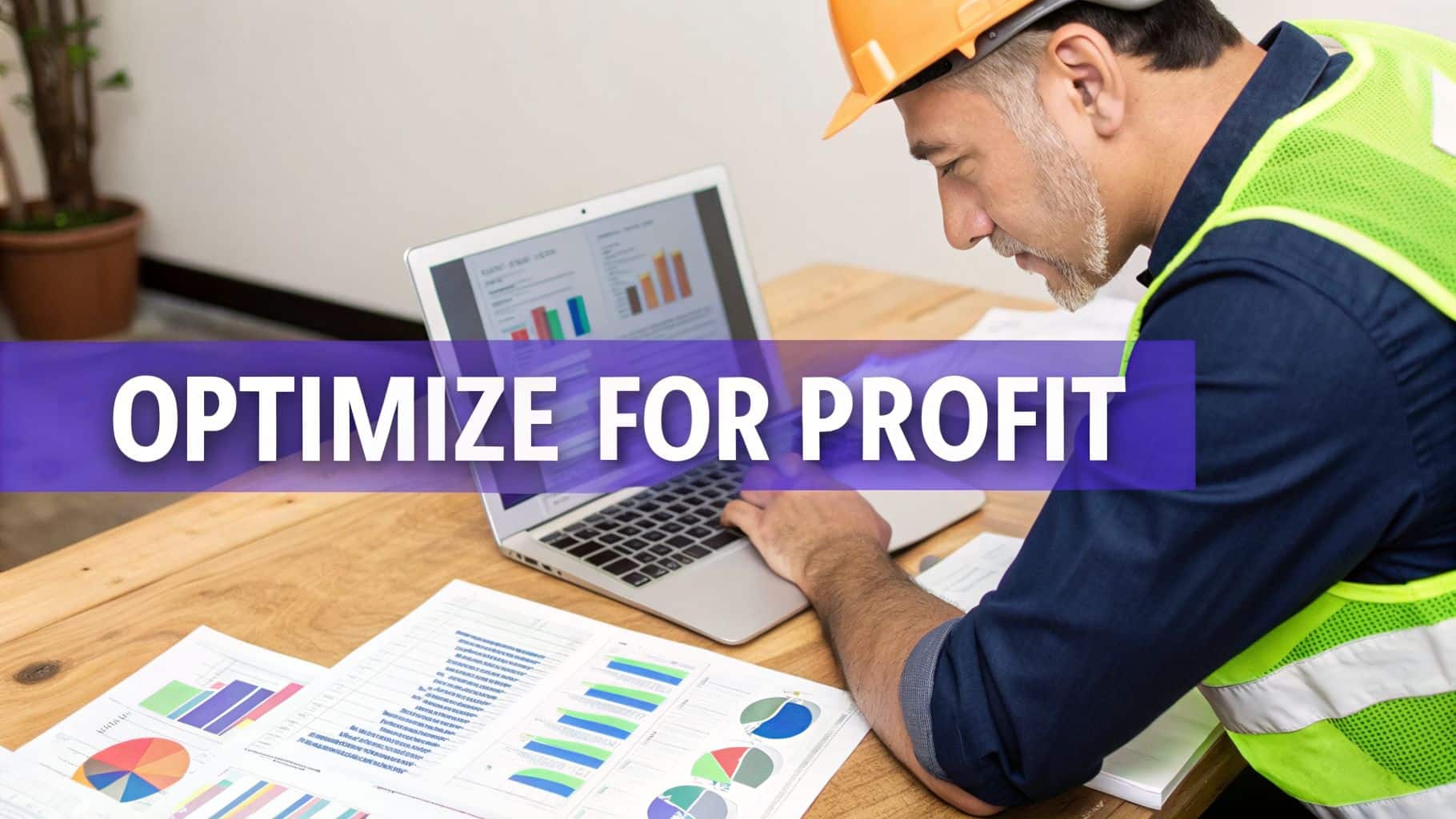
This is the missing piece for most service businesses. It is easy to get caught up in the activity of running ads, but the real money is made in the systematic work of refining that activity. This is not about a few random tweaks. It's a constant cycle of testing, learning, and improving that makes your ad dollars work harder over time.
Stop Paying for Worthless Clicks
The fastest way to drain your ad budget is paying for clicks that have zero chance of turning into a job. If you are a residential plumber, you have no business paying for clicks from someone searching for "plumbing school" or "plumbing supply store jobs."
This is where your negative keyword list becomes invaluable. You are essentially telling Google which search terms to ignore, stopping budget waste before it happens.
Here are some categories to add right away:
- Job Seekers:
jobs,careers,hiring,salary - Students:
school,classes,training,certification - DIY Crowd:
how to,DIY,parts,tutorial - Wrong Locations: Any cities, states, or zip codes you do not service
Adding these terms ensures your ads are shown only to people actually looking to hire a professional. It is a simple move that has a massive impact on your lead quality and cost per qualified lead.
Let the Data Guide Your Next Move
Optimization is not about gut feelings; it is a story told by your campaign data. The numbers show you exactly what is working and what is not. This goes beyond just seeing which ad got the most clicks.
For instance, your data might reveal that ads running between 8 AM and 11 AM bring in the most high-value emergency calls. Meanwhile, your evening ads generate more quote requests for larger projects. That is a clear signal to adjust your bidding, pushing more budget toward the times of day that produce your most profitable work.
The point of optimization is to shift from broad assumptions to precise, data-backed decisions. It is the engine that connects your ad spend directly to your bottom line.
Digging into which specific services, ad headlines, or even neighborhoods are giving you the best Return on Ad Spend (ROAS) provides a clear roadmap. You will know exactly where to double down and where to pull back. This is how an average campaign becomes a high-performance growth machine, and it's what makes effective online advertising for contractors a game-changer.
The Power of A/B Testing
Never assume your first idea is your best one. With A/B testing, or split testing, you can stop guessing and start knowing. The process is simple: run two slightly different versions of an ad or landing page at the same time to see which one performs better.
You can test almost anything. Try testing:
- Different Headlines: "24/7 Emergency Roof Repair" vs. "Trusted Local Roofing Experts"
- Varying Calls to Action: "Call for a Free Estimate" vs. "Book Your Inspection Online"
- Alternative Images: A shot of your crew in action vs. a photo of a beautiful finished project
The key is to change only one element at a time. That way, you can measure its exact impact on your click-through rate or conversion rate. It is a methodical approach, but those small, incremental wins add up to massive improvements over the life of a campaign.
Optimization is not a one-time task; it is an ongoing, strategic part of your business. It demands consistent attention and a sharp eye for detail. This is often where it pays to have a specialist in your corner, someone who can turn your ad spend from a necessary cost into a predictable engine for profitable growth.
Contractor Advertising FAQs: Your Toughest Questions Answered
When it comes to spending money on ads, every contractor has the same questions. Am I spending enough? Am I spending too much? And the big one: is any of this actually working?
You are right to be skeptical. Pouring money into a campaign without a clear plan is a recipe for frustration. We are cutting through the noise to give you the straight answers you need, based on years of getting real results for businesses just like yours.
How Much Should a Contractor Spend on Online Advertising?
There is no magic number. A truly effective budget is not based on a generic benchmark like 5-10% of revenue. It is built backward from your goals.
First, we determine how many new jobs you want to land each month. Then, we look at your numbers: what's your average job value? What is your team's closing rate on leads? Armed with that data, a strategist can calculate a target Cost Per Acquisition (CPA) and build a budget designed to hit that number profitably.
The question is not "How much do I spend?" It is "How much must I invest to get a specific, predictable return?" This shifts your advertising from an expense into a calculated investment in your growth.
This is how you ensure every dollar has a purpose and is tied to a measurable result.
Is PPC or SEO Better for My Contracting Business?
This is not an "either/or" question. Thinking of it that way is a strategic mistake. For market leadership, you need a "both/and" approach. PPC and SEO are two different tools that work together perfectly.
PPC (Pay-Per-Click) Ads: This is for immediate lead generation. PPC gets you in front of customers who are actively searching for your services right now. It is predictable, scalable, and gets the phone ringing almost immediately.
SEO (Search Engine Optimization): This is your long-term strategy for building brand authority. SEO creates a sustainable online presence that lowers your cost-per-lead over time. It is a durable asset that keeps generating leads without you paying for every click.
A winning strategy uses PPC to drive revenue today while simultaneously investing in SEO to build the foundation for cheaper, more consistent growth tomorrow. Together, you capture demand now while securing your market for the future.
Why Are My Social Media Ads Not Generating Customers?
This common frustration almost always comes down to a mismatch between the tool and the job. Platforms like Facebook and Instagram are discovery platforms, not intent platforms.
People are scrolling through photos of friends and family. They are not there to hire a roofer in that exact moment. While social media is a fantastic place to build your brand, show off project photos, and tell your company’s story, it is a tough place to generate immediate, high-intent leads.
The problem usually is not your ad. It is the expectation you are placing on it.
Successful contractors use social ads to build an audience or to retarget people who have already shown interest by visiting their website from a high-intent channel like Google Search. It is for nurturing future customers, not hunting for current ones.
What Is the Most Important Part of an Online Ad Campaign?
While every piece matters, from the ad copy to the keywords, the single most critical element is what happens after the click. This is where most campaigns fail.
Many contractors make the costly mistake of spending good money on ads, only to send that valuable traffic to their generic homepage. Your homepage is a digital brochure; it is not built to convert ad traffic.
The most important part of your campaign is the dedicated landing page. This page has one job: to convert that visitor into a lead. It should align perfectly with your ad, feature a compelling offer, showcase social proof like customer reviews, and have a simple way for them to contact you.
This element, combined with a solid system to track that lead from the first click to the final booked job, is what turns ad spend into a profitable growth machine. It is the glue that holds the entire strategy together.
Understanding these strategic details is what separates contractors who spend money on ads from those who build a predictable system for growth. If you are ready to move past guesswork and implement a marketing strategy that delivers measurable results, the team at City Web Company is here to bring the clarity and expertise you need. We partner with businesses like yours to turn advertising investments into profitable, long-term customer relationships.
Schedule a no-obligation discovery call with us to see how we can build a growth plan for your business.
These articles were popular with other readers too: