

Use website DNI, connect call reports to Google Ads and your Google Business Profile, then tie calls to booked jobs. City Web Company can handle setup.
A Contractor’s Playbook to Winning Local Jobs with SEO
Many contractors believe a professional website and a consistent ad budget are the keys to landing local jobs. Yet, this approach often leads to unpredictable lead flow and a constant fight for visibility against competitors in the same trade.
The issue is not the individual tactics. The problem is that effective local SEO for contractors is not about running a few isolated plays. It is about building a connected system that sends powerful trust signals to Google, making your business the clear choice in its service area.
Table of Contents
The Visibility Gap Most Contractors Overlook

Most service businesses do not fail from a lack of effort. They fail because they misunderstand how local customers find and hire contractors today. Pouring money into ads without a solid organic foundation is like building a house on sand. It might stand for a short time, but it lacks the stability for long-term, profitable growth.
This creates a frustrating cycle. When the ad campaign is active, the phone rings. The moment the budget is paused, the calls stop. This dependency on paid traffic results in missed revenue and prevents the development of a true business asset that generates leads independently.
An Uncoordinated Digital Presence
At the core of this instability is an uncoordinated online presence. A contractor often has a collection of digital tools operating in isolation, never working together to build momentum.
These disconnected pieces typically look like this:
- A well-designed website that is invisible to Google for local search terms.
- A Google Business Profile that was never claimed or is incomplete.
- Inconsistent business name, address, and phone number scattered across the web.
- A handful of old, unanswered customer reviews.
When these elements are not aligned, they send mixed signals to search engines. Google's primary function is to reward businesses that appear trustworthy, authoritative, and relevant to a specific geographic area. A disjointed presence achieves the opposite, diminishing your chances of ranking in the local map pack and organic results where your best customers are looking.
The True Cost of Invisibility
Consider this scenario. A roofer invests heavily in advertising. They secure jobs from their paid campaigns but have no organic visibility. A major storm then hits the area, and a homeowner searches for "emergency roof repair near me."
The call goes to a competitor with a refined local SEO strategy who appears in the top three map results.
The first contractor paid for their leads. The second earned a high-value, urgent lead at no cost because they invested in building a trusted digital foundation.
This is the visibility gap: relying on expensive, temporary advertising while the competition builds a permanent, cost-effective lead generation machine with smart local SEO. Over time, the ad-dependent contractor's customer acquisition cost remains high, while the SEO-focused business sees its costs decrease as its online authority grows.
Closing this gap requires a complete playbook. For a deeper look, this detailed guide to local SEO for contractors provides more context. Recognizing this disconnect is the first step toward building a marketing system that delivers predictable results and secures sustainable growth.
Your Digital Foundation: Mastering Google Business Profile

Most contractors treat their Google Business Profile like a static digital advertisement. This is a significant and costly mistake.
Your GBP is not just another online listing. It is the single most powerful tool for attracting high-intent local leads. It functions as your digital storefront, the first impression a potential customer has within Google's search and map results.
A correctly optimized profile answers a customer’s primary questions before they visit your website. It is the foundation upon which the rest of your local SEO structure is built. A poorly executed GBP will render all subsequent efforts unstable.
Moving Beyond the Basic Setup
Simply claiming your profile and adding your business name is insufficient. The difference between the contractor who receives calls and the one who remains invisible lies in the strategic details within their GBP.
These details are direct signals to Google, proving your relevance, authority, and trustworthiness for specific services in specific locations.
The opportunity is substantial. A reported 46% of all Google searches have local intent. For a contractor, this means nearly half of Google's users are looking for local services. They are homeowners with urgent needs, searching for "emergency plumber Denver" with intent to hire. Your profile's details determine whether your phone rings or your competitor's does.
The objective is to provide Google with such a complete and compelling picture of your business that it becomes a top result.
Optimizing Your Categories and Service Areas
One of the first areas where contractors make mistakes is with business categories. Your primary category must be the broadest, most accurate description of your core service. For an HVAC company, the primary category should be "HVAC contractor," not the more specific "Air conditioning repair service."
Use secondary categories to detail all other services. An electrician who also installs home EV chargers and landscape lighting should have secondary categories for "Electric vehicle charging station installer" and "Lighting contractor."
Key Insight: The primary category holds the most weight for rankings. Choosing a niche category as your main one can limit your visibility for broader, more valuable search terms that drive qualified leads.
Defining your service area correctly is equally important. Many contractors list only their office address, which is ineffective for a service-area business that travels to clients. You must specify the cities, counties, or zip codes you cover. This is how you appear when a customer in that zone is searching. For a closer look, you can explore the impact of a Google Business Profile on local SEO in our guide.
Leveraging GBP Features for Maximum Impact
An optimized profile is an active profile. Google's algorithm rewards businesses that consistently use its features to provide fresh information and engage with customers.
GBP Posts: Use these for project updates. Post a photo of a finished job, mention the neighborhood, and briefly describe the work. A simple post like, "Just finished an electrical panel upgrade for a family in Arvada," reinforces both your service and location authority.
Services Section: Never leave this blank. List every service you provide with a clear description. Instead of "Plumbing," break it down into "Drain Cleaning," "Water Heater Installation," and "Sewer Line Repair." This helps you rank for specific, high-value searches.
Q&A Section: Proactively add questions to this section. Identify the top 3-5 questions you receive from new customers. Post these questions and provide clear answers. This assists customers and provides another opportunity to include important keywords naturally.
A complete, active Google Business Profile is the core of lead generation for any modern contractor. It is the central hub of your local presence that directly influences whether you get the call.
Building Authority With Reviews And Citations
A well-optimized Google Business Profile is the starting point, but it is only the foundation. To truly command your local market, you must build digital trust. This is where many contractors' strategies fall short.
Real authority in local search is not just about a complete profile. It is determined by what customers say about you and the consistency of your business information across the web. These two components, reviews and citations, work together to prove to Google and potential clients that you are a legitimate, trustworthy professional.
The Real Impact of Customer Reviews
Many business owners focus on a single metric: the total number of five-star reviews. While a high number is beneficial, focusing on it alone is an incomplete strategy. The recency and consistency of your reviews often matter more than a large volume of old ones.
A steady stream of new, positive feedback signals to Google that your business is active, relevant, and delivering quality work today. A profile with 100 reviews but no new ones in the last eight months appears stale. It is less trustworthy than a competitor with only 30 reviews, ten of which were posted last month. This momentum is a significant ranking signal.
Reviews are now a cornerstone of local SEO for contractors. I have seen a landscaper with 150 five-star reviews lose rankings after six months of inactivity. After we helped him secure just ten fresh reviews in two weeks, he returned to the top three in the map pack.
This demonstrates the power of fresh review signals. For trades like HVAC and roofing, review quality and recency can be more influential than many traditional ranking factors. You can find more data in this detailed 2026 local SEO breakdown on fitzdesignz.com.
A Practical System for Generating Reviews
Getting consistent reviews does not require aggressive tactics. It requires a simple, repeatable process integrated into your workflow.
- Timing is Everything: The best time to ask is immediately after the job is completed and the customer is satisfied.
- Make it Effortless: Send a direct link to your Google review page via text or email. Do not make the customer search for it.
- Use Simple Scripts: A statement like, "We're glad you're happy with the new installation. Would you mind sharing your experience on Google? It helps other people find us," is professional and effective.
This consistent effort compounds over time, building a level of social proof that is difficult for competitors to overcome.
Demystifying Citations and NAP Consistency
Beyond customer feedback, Google seeks proof of your business identity across the web. It scans for citations, which are mentions of your business's Name, Address, and Phone number (NAP). These appear on directories like Yelp, Angi, and the Better Business Bureau.
The guiding principle here is NAP consistency. Every listing must exactly match the information on your Google Business Profile and your website.
A common mistake is to overlook minor differences. "Street" versus "St." or "Suite 100" versus "#100" may seem insignificant, but to a search algorithm, they are inconsistencies. Each discrepancy reduces Google's confidence in your data and can negatively affect your ranking potential.
Let's compare some common SEO activities to illustrate where focus is most effective.
Local Ranking Factors Comparison
| High-Impact Tactic | Rationale & Business Outcome | Low-Impact Tactic |
|---|---|---|
| Consistent Review Generation | Signals current relevance and trust to Google, directly influencing map pack rankings and convincing new customers to call. | Chasing a High Review Count |
| NAP Citation Cleanup | Builds foundational trust with search engines, ensuring they see your business as a legitimate, stable local entity. | Submitting to Hundreds of Directories |
| Replying to All Reviews | Shows active management and customer care, which Google rewards. It also encourages more customers to leave feedback. | Ignoring Negative Reviews |
| Targeted Service Page Content | Attracts high-intent customers searching for specific solutions, leading to more qualified leads and sales. | Generic, Keyword-Stuffed Content |
The first step is a citation audit. Search for your business name and list every directory where it appears. Correct any mistakes one by one. This cleanup process ensures you are sending clear, unified signals to Google. Our guide explains why consistent NAP citations are key to local SEO.
By combining a steady flow of recent, positive reviews with a clean citation profile, you build an undeniable foundation of digital trust. This authority separates the contractors who are merely listed online from those who own their local market.
Creating Website Content That Ranks in Your Service Area
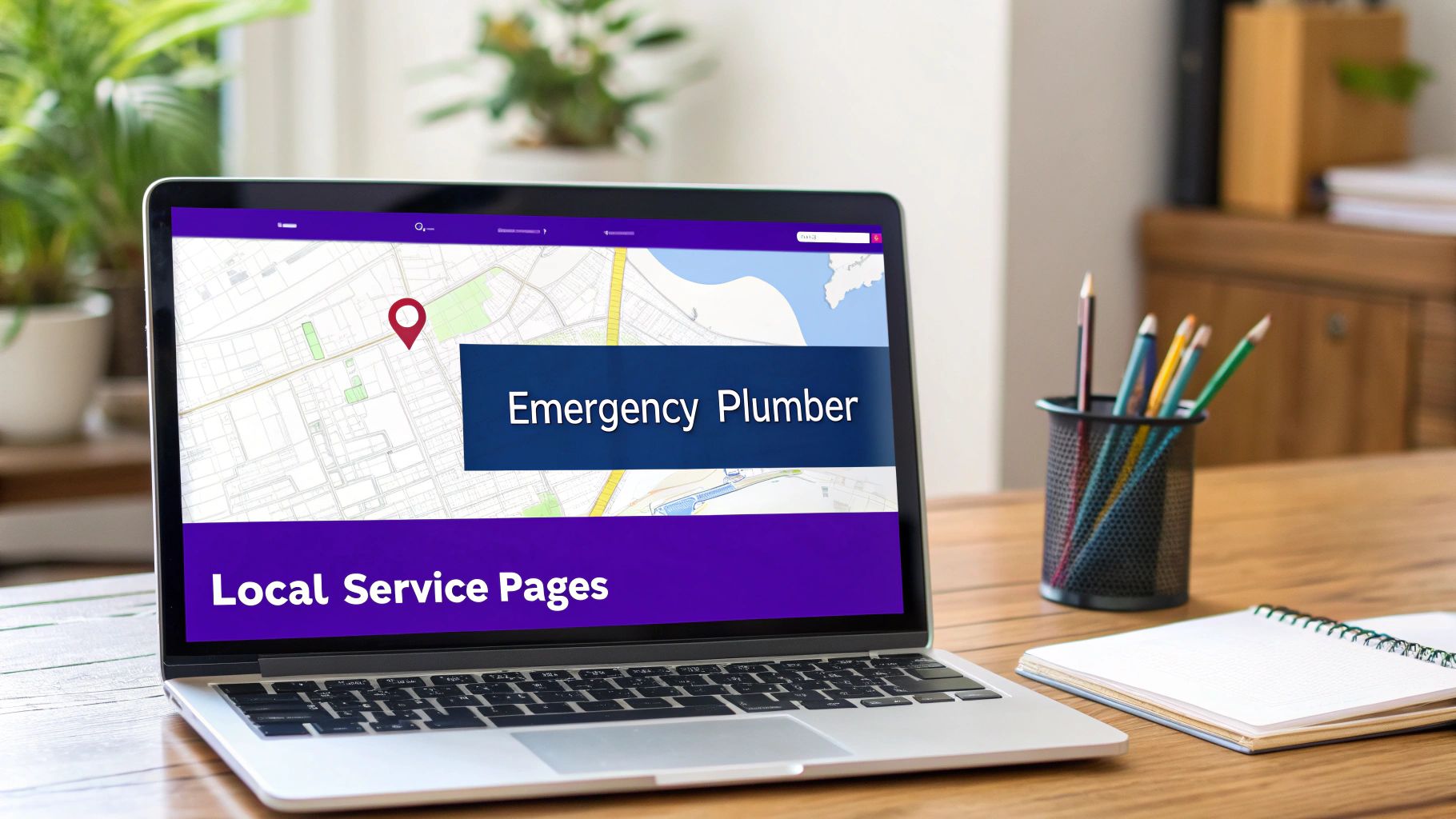
Many contractors invest in a professional website, only to find it fails to generate a single qualified lead. They treat their site like a digital brochure, a static placeholder that serves little purpose.
A high-performing website, however, is a dynamic tool. Its job is to substantiate every claim made on your Google Business Profile.
If your GBP is the sign on your digital storefront, your website is the expert sales floor inside. A generic "Services" page fails to connect with a homeowner in a specific town looking for a specific solution. This forces you to compete in a crowded field and miss high-intent customers ready to hire.
The missing element for most contractor sites is a clear architecture built around location and service. Without this, your site remains invisible for the most valuable local searches. This is the point where we transition from a static site to a lead-generating machine.
Building Your Digital Service Territory
A general services page cannot rank for specific, local searches. A customer in a suburb is not searching for "plumber"; they are searching for "emergency plumber in Littleton." To secure that call, you need a page on your website dedicated to that exact service in that exact location.
This strategy involves creating two critical types of pages:
- Service Pages: These are detailed explanations of each core service you offer, such as "Roof Replacement," "HVAC Repair," or "Kitchen Remodeling." They establish your expertise.
- Location Pages: These pages are created for every city, suburb, or neighborhood you serve. They send a powerful signal to Google that you are an active business in that community.
The real effectiveness comes from combining them. A generic page is ineffective for a plumber serving multiple suburbs. A hyper-focused page titled "Emergency Plumber in Aurora" that addresses that community's specific needs is how you attract qualified traffic from that area.
Anatomy of a High-Ranking Location Page
This is not about copying content and swapping city names. That approach will be ignored by Google. Each page must be unique and provide real local value. This is how you demonstrate to search engines and potential customers that you are the local expert.
A powerful location page must include:
- Localized Titles and Headers: Your page title and H1 header need to include both the service and location. For example, "Expert Electrical Panel Upgrades in Golden."
- Area-Specific Content: Mention local landmarks, specific neighborhoods, or common issues in that area. A roofer might reference damage from a specific storm or the architecture of a local housing development.
- Embedded Local Map: Include a Google Map showing your service area boundary or the specific city being targeted.
- Local Testimonials: Feature reviews from customers who live in that town. This provides immediate and undeniable social proof.
This targeted approach does more than improve rankings. It speaks directly to the customer's needs, building instant trust by demonstrating your understanding of their local context. You are no longer just another contractor; you are the contractor for their town.
Achieving this level of detail is fundamental to succeeding with local SEO for contractors. The next step is to incorporate essential on-page SEO elements to ensure Google can find and rank this content. To learn more, see our guide on creating location-specific landing pages that convert.
By transforming your website from a simple brochure into a network of targeted local resources, you build a sustainable system for attracting the best jobs in every part of your service area.
Connecting Your SEO Efforts to Real Revenue
For many contractors, marketing feels like a black box. Money is invested, and some activity is observed, but it is difficult to determine what is actually working. This leads to running a business on intuition rather than data, treating the marketing budget as an expense instead of a strategic investment.
The problem is a focus on vanity metrics. Clicks, traffic, and rankings look good on a report, but they do not generate revenue. Effective marketing is about generating profitable growth. Without a clear system connecting your online presence to revenue, you are operating without a clear view.
Moving Past Vanity Metrics
The shift from guessing to knowing occurs when you stop tracking activity and start tracking outcomes. A solid local SEO strategy for contractors is incomplete until you can draw a direct line from a customer's Google search to a signed contract.
The missing link is a simple, effective tracking system. You do not need complex software. All that is required is intentionality and a few basic tools to connect your digital efforts to your financial results.
This system is built on three core components:
- Dedicated Call Tracking: Assign a unique phone number to your Google Business Profile and another to your website. This tells you exactly how many calls came from organic search.
- Specific Contact Forms: Create a separate contact form for your website's organic traffic to attribute web leads to their source.
- Basic CRM Integration: When a new lead comes in, tag it in your CRM with its source, such as "Google Organic." This provides a clear view of which channels are delivering your most valuable customers.
Creating a Clear Line to ROI
Imagine a roofing contractor implementing this system. A homeowner searches "roof repair near me," finds the contractor’s optimized Google Business Profile, and calls the unique number. That call is automatically logged as an organic search lead.
Another client lands on the contractor’s service page for "roof replacement in [City Name]," fills out the dedicated contact form, and the lead is tagged in the CRM. At the end of the month, the owner can see that organic search generated 15 qualified leads, resulting in 6 booked jobs and $48,000 in new revenue.
This is the clarity that turns marketing from an expense into a predictable growth engine. You are no longer wondering if your SEO is working; you have hard data proving its value.
This insight allows for smarter decisions. You can confidently invest more in what works and refine your strategy based on real performance. For a deeper dive, see our article on from clicks to calls turning traffic to action.
When you can tie real dollars back to your efforts, you stop relying on hope as a strategy. You gain the control and confidence needed to scale your business predictably.
Think of local SEO as building a powerful, lead-generating asset for your business. This is a systematic effort that, over time, creates a reliable stream of jobs without the constant expense of paid ads. When executed correctly, all pieces work together to make your business highly visible online.
Your Google Business Profile becomes your digital storefront. A constant flow of new reviews builds trust. Clean, consistent directory listings signal your legitimacy to Google, and a website built to convert turns traffic into high-quality leads.
From Search To Revenue
When these elements are synchronized, you create a predictable pipeline that takes a local homeowner from a Google search to a signed contract. The visual below illustrates how that works, connecting visibility to revenue growth.
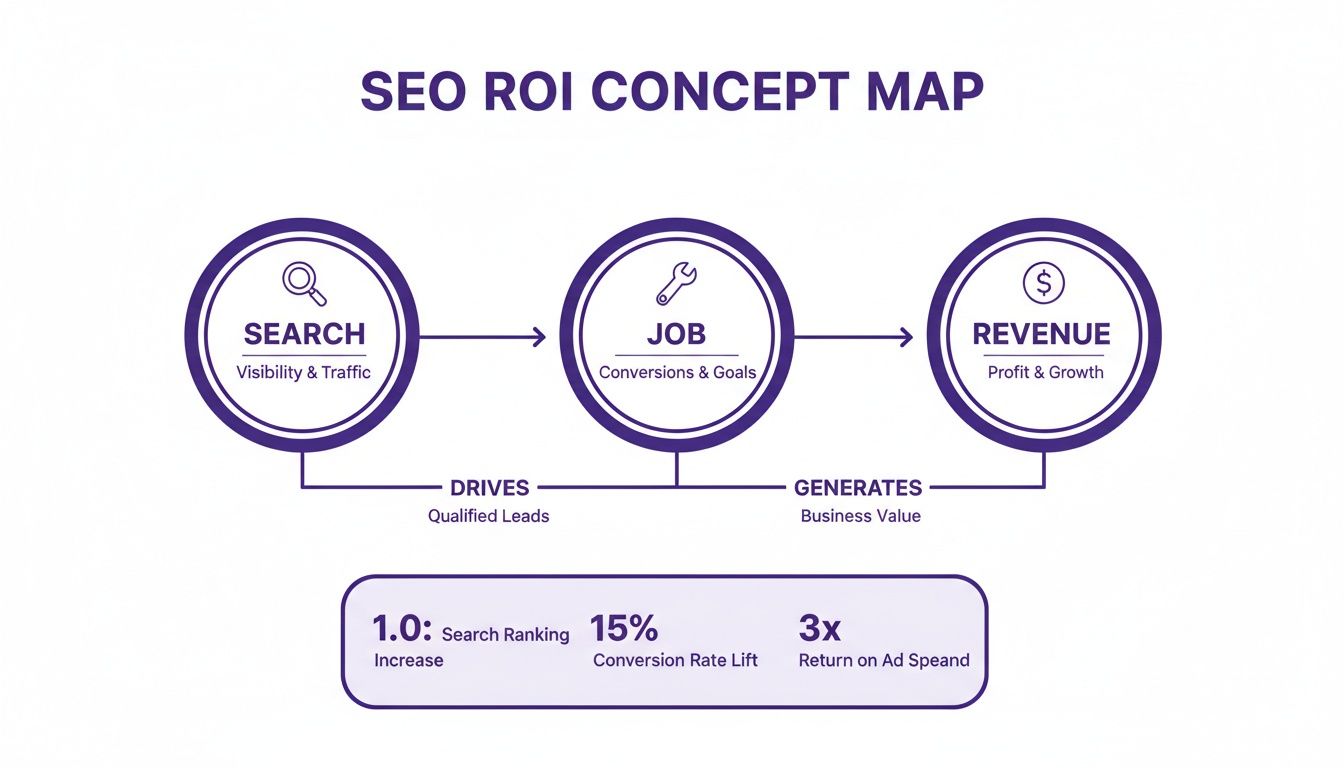
This flow makes it clear: the goal of local SEO for contractors is not just about getting more website visitors. It is about driving profitable action. To refine your strategy, see a comprehensive guide on how to improve local SEO for service businesses.
An integrated system like this breaks the dependency on expensive, short-term ads. You are building an asset that works for you 24/7.
If you can see the gaps in your marketing and recognize the power of a strategic system, the next logical step is to create a plan.
At City Web Company, we partner with contractors to build custom growth systems focused on their business goals. If you are ready for clarity and measurable results, we invite you to schedule a discovery call with our team.
Got Questions About Local SEO? We've Got Answers.
Many contractors have similar questions about local search. Here are straightforward answers to help clarify what truly impacts your business.
How Long Does Local SEO Take To Work For Contractors?
The answer depends on several factors.
While you can see results from optimizing your Google Business Profile in a few weeks, a comprehensive local SEO strategy is a long-term investment. Most contractors begin to see significant, sustainable traction, such as more calls and better rankings, within 3 to 6 months.
The timeline is influenced by the competitiveness of your local market, your starting point online, and the consistency of your efforts. The goal is not a temporary spike in rankings but a solid foundation that provides lasting value.
Should I Spend Money On Local SEO Or Google Ads?
This is not an "either/or" question. It is a "when and why" question.
Google Ads are like a faucet for immediate leads. They are effective for targeting specific high-value services or capitalizing on seasonal demand.
Local SEO is like building a well. It requires time and effort, but once established, it provides a steady, organic flow of leads without paying for every click.
The Smartest Play: A balanced approach is almost always best. Use Google Ads for immediate lead flow while your SEO foundation is being built. Over time, as your organic presence strengthens, you can reduce your ad spend because SEO is doing the heavy lifting, delivering a higher return on investment.
Do I Need A Physical Address In Every City I Serve?
No, this is a common misconception.
For a service area business, your Google Business Profile should be set up with a clearly defined service area, not a physical address, unless you meet clients at your office. Attempting to use fake addresses can lead to your listing being suspended.
To rank in other towns, your website does the work. By building specific service pages for each location ("Roofing in Springfield"), gathering reviews from customers in those areas, and creating localized content, you send the right signals to Google. This strategy proves your relevance across your entire service region without requiring multiple physical locations.
Executing a local SEO strategy that drives growth requires consistent effort and a clear plan. If you see the value in a system designed for predictable results, the next step is a growth plan built for your business.
At City Web Company, we partner with contractors to build the digital marketing systems that generate more leads and revenue. If you're ready for a clear path forward, we invite you to schedule a discovery call with our team.
These articles were popular with other readers too: