

Pass Google Business verification with a video-first checklist. Film one continuous 30 second take, fix flagged issues, and know when to hire help.
How to Write SEO-Friendly Blog Posts That Drive Business Growth
Most business owners view their blog as a marketing chore. They write, publish, and hope for the best, only to see minimal traffic and no new leads. This isn't a failure of effort; it's a failure of strategy. The common belief that more content equals more business is a misconception that costs time and money.
The real issue is that blogging without a clear system is a cost center, not a growth engine. It's activity without a direct line to revenue. When a blog post doesn’t target a specific customer problem with a direct path to a solution you sell, it’s just digital noise, contributing nothing to your bottom line.
This guide explains how to write SEO-friendly blog posts that are engineered to attract qualified customers. It is not about writing more, but about building a strategic framework where every article serves a distinct business purpose, turning your blog from an expense into a reliable source of leads.
Table of Contents
The Real Reason Your Blog Isn't Generating Business
You have likely spent considerable time and resources creating blog posts, following the common advice that content is essential for SEO. Yet, the results are often disappointing: a flat line in analytics and a complete lack of qualified leads.
This is a familiar and frustrating scenario for many business owners. The problem is not your writing ability. It is the absence of a strategic system that connects your content directly to business objectives.
When content is created simply to meet a publishing schedule, it becomes a significant drain on resources. This approach provides a false sense of marketing progress while failing to attract a single potential customer, representing a missed opportunity for real growth.
From Digital Noise to a Strategic Asset
The core issue is that random blog posts fail to address the specific, urgent problems your customers are trying to solve through search engines. For example, an HVAC company writing a generic article on "tips to save energy" is unlikely to attract a customer in need of immediate service.
A customer with a pressing need is not searching for abstract advice. They are searching for specific solutions, such as "furnace repair cost denver" or "best AC unit for a small home." These searches represent a clear opportunity for your business to provide a direct answer.
Learning how to write SEO friendly blog posts with strategic intent is the key to transforming your blog from a passive expense into a lead-generation asset. This is less about becoming a better writer and more about implementing a system where each article has a clear purpose.
The difference between a blog post that yields no results and one that generates customers is intent. The first is written to fill a content calendar. The second is engineered to solve a specific problem for a specific person at the moment they need a solution.
This strategic shift turns content from a cost into an asset that works for your business 24/7. Data supports this approach. Organic traffic drives nearly half of all website visits, and leads from SEO have a 14.6% close rate, a significant increase from the 1.7% for outbound marketing. Businesses that blog effectively generate 67% more leads per month.
Furthermore, a top-ranking Google result captures almost 40% of all clicks for that search term. These are not vanity metrics; they represent tangible revenue opportunities. You can discover the latest SEO findings and research to review the data.
Ultimately, effective blogging is about creating a library of optimized, high-value resources that attract qualified leads long after publication.
Build Your Content Blueprint Before You Write
Most business blogs fail because they follow a broken process: choose a topic, write the post, publish, and then wait for results that never arrive. This "write and pray" method is inefficient and produces no tangible business outcomes.
It is a model that prioritizes activity over results.
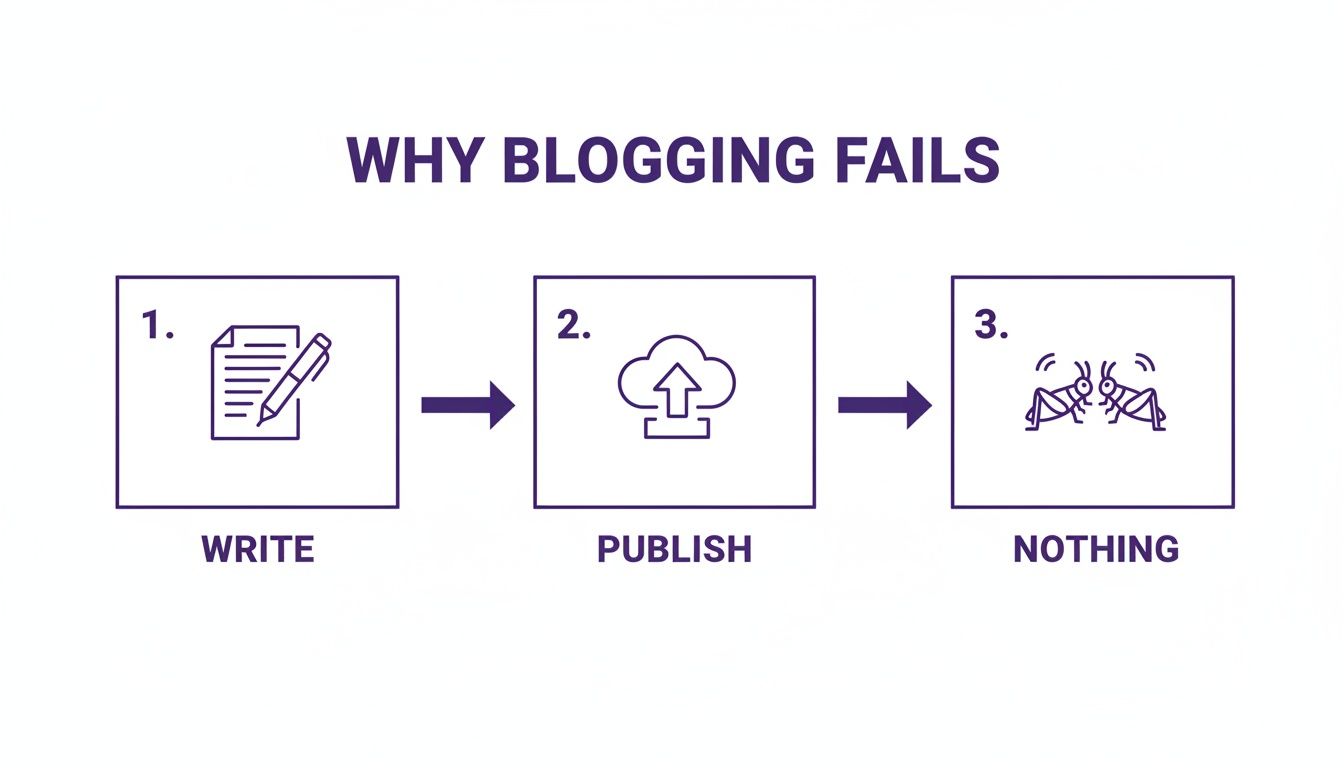
To achieve meaningful traction, this process must be inverted. Effective SEO content is not about writing more; it is about front-loading the strategic work and planning intelligently.
The solution is to build a content blueprint before you begin writing. This blueprint serves as your strategic plan, ensuring every article has a clear purpose, targets the right audience, and directly supports a business goal.
Identify Your "Money" Keywords First
A solid blueprint begins with keyword research. The goal is to find "money keywords," which are phrases that signal clear commercial or transactional intent. These are the queries your best potential customers use when they are ready to make a purchase.
Consider the difference for a Denver-based electrician:
- Generic Keyword: "electrical safety tips." This may attract traffic, but the audience is broad and not necessarily looking to hire a professional. The commercial value is low.
- Money Keyword: "rewire knob and tube denver cost." This search comes from a homeowner in your service area with a specific, high-value problem, actively seeking a professional solution.
Focusing your blog posts on these high-intent keywords is the first practical step in learning how to write SEO friendly blog posts that drive revenue. Before you can target keywords, you need strong topics. To help, learn how to generate endless blog post ideas that align with your services.
Map Keywords to the Customer Journey
Once you have a list of valuable keywords, map them to the customer's buying journey. Not everyone who finds your blog is ready to buy immediately. Your content must meet them at their current stage.
The journey typically involves three stages:
- Awareness: The individual knows they have a problem but is not yet exploring solutions. A search might be, "why does my circuit breaker keep tripping?"
- Consideration: They are now actively researching options. Searches look more like "best electricians near me" or "cost to replace electrical panel."
- Decision: They are ready to choose a provider. Searches may include "reviews for [Your Company Name]" or "[Your Company Name] free estimate."
A successful content blueprint includes topics for all three stages. This strategy allows you to capture potential customers early, build trust with helpful information, and become the logical choice when they are ready to act.
Understand the Underlying Search Intent
Beyond the journey, it is critical to understand the intent behind a keyword. What type of answer is the user seeking? Google excels at determining this and rewards content that provides the most relevant response.
There are four main types of search intent:
- Informational: The user wants to learn something (e.g., "how to install a ceiling fan").
- Navigational: The user is trying to find a specific website (e.g., "City Web Company blog").
- Commercial: The user is researching before a purchase (e.g., "Generac vs Kohler generator reviews").
- Transactional: The user is ready to act now (e.g., "schedule electrical inspection denver").
Building a blueprint forces you to align your content with user intent from the start. An informational query requires a detailed guide, while a commercial query needs a comparison article. This strategic alignment is the core of writing a blog post that will rank and convert.
Structure Your Post for Readability and Rankings
Having target keywords is only the first step. Simply inserting them into text and publishing will not lead to visibility. A successful article is not just well-written; it is strategically structured.
This framework guides both customers and search engines through your content. Without it, your ideas will not have the intended impact, costing you traffic and customers. The architecture of your post is fundamental to knowing how to write SEO-friendly blog posts that work.


Headlines and Headings: The Blueprint for Readability
The skeleton of your article is built with headlines and subheadings (H1, H2, H3 tags). These elements create a logical hierarchy that communicates importance to Google and provides a clear roadmap for readers.
- Your H1 Title: This is the main headline. It must include your primary keyword and make a clear promise to the reader about the problem you will solve.
- Your H2 Subheadings: These act as the main sections of your post. Each should address a major sub-topic related to your core keyword.
- Your H3 Subheadings: Use these to break down your sections into specific, digestible points, adding detail without creating large blocks of text.
Using this hierarchy makes your content scannable, which is critical for retaining reader attention. It also helps Google understand the depth of your expertise on the subject.
A Practical Example: A Local Roofer's Post
Imagine you are a roofer in Colorado Springs targeting "storm damage roof repair colorado springs." A generic article will not be effective. A strategically structured post, however, is built to rank.
Here is what a winning structure looks like:
- H1 Title: A Homeowner’s Guide to Storm Damage Roof Repair in Colorado Springs
- H2: First Steps: How to Identify Hail Damage on Your Roof
- H3: What to Look for on Shingles and Gutters
- H3: Documenting Damage for Insurance Purposes
- H2: Navigating The Complex Insurance Claim Process
- H3: Understanding Your Policy and Deductible
- H3: Common Mistakes to Avoid When Filing a Claim
- H2: Choosing a Local Roofing Contractor You Can Trust
- H3: Questions to Ask Before Hiring Any Roofer
- H3: Checking for Licenses, Insurance, and Local Reviews
This structure creates a complete resource. It answers the user's initial query and addresses subsequent problems they may not have considered. This is how you build authority and convert readers into leads. Once you have this blueprint, understanding how to write SEO articles that consistently rank is the next piece of the puzzle.
The Intro and Conclusion: Your Hook and Call-to-Action
Your structure is framed by a strong introduction and a clear conclusion, each with a specific function.
The introduction’s sole purpose is to hook the reader. Acknowledge their problem or frustration immediately and promise a clear, actionable solution within the article. This confirms they are in the right place and gives them a reason to continue reading.
The conclusion's function is to drive action. Do not simply end the article. Summarize the key takeaways and pivot to a specific call to action. Tell the reader exactly what to do next, whether it is calling for an inspection, downloading a checklist, or contacting you for an estimate.
Optimizing On-Page Elements for Maximum Visibility
A well-written article is a good starting point, but optimizing the smaller, technical details is what separates top-ranking content from the competition.
Many business owners believe their work is finished once the text is complete. This is a critical oversight. They skip the refinement of technical signals that Google and customers use to judge content relevance and trustworthiness. It is like building a new storefront but forgetting to install a sign.
The Strategic Power of Internal and External Links
Links function as the pathways of the internet, guiding both users and search engine crawlers. How you use them directly impacts your site's authority and the user's journey from reader to customer.
-
Internal Links: These are links that point from one page on your site to another. A blog post about "signs of a failing water heater" should always link to your "Water Heater Repair & Installation" service page. This creates a direct path to a conversion and distributes authority across your site, signaling to Google which pages are most important.
-
External Links: These are links that point to other websites. When you link to credible, non-competing sources, such as a manufacturer's manual or a local building code authority, you add a layer of credibility to your content. It demonstrates thorough research and reinforces the trustworthiness of your information.
A smart linking strategy keeps users on your site longer and shows search engines how your content connects to your core services, a vital part of writing blog posts that generate leads.
Image Optimization for Local Search
Images are more than just visual breaks; they are searchable assets. Many local customers use Google Image Search to find work examples or identify a problem. If your images are not optimized, you are invisible in these searches.
Proper optimization involves two simple steps:
-
Descriptive File Names: Before uploading, change the file name from a generic
IMG_2501.jpgto something descriptive and keyword-focused. For an HVAC company in Denver, denver-hvac-furnace-repair-2024.jpg is far more effective. -
Alt Text: This short description explains an image to visually impaired users and search engines. Your alt text should be a natural description that includes your target keyword and location where appropriate. For example:
Technician performing furnace repair on a Trane unit in a Denver basement.
These small adjustments provide Google with powerful context about your content's local relevance, increasing your visibility in both regular and image search results.
Demystifying Schema Markup for Local Businesses
Schema markup is one of the most powerful yet underutilized SEO tools for local businesses. It is code you add to your website that translates your content into a language search engines can perfectly understand. It tells Google not just what your page says, but what it is.
By using schema, you can explicitly tell Google: "This section of my article is a frequently asked question," "This is a review with a 5-star rating," or "This is a how-to guide with five steps."
The result is that Google can display this information as a "rich snippet" directly on the search results page. These include FAQ dropdowns, star ratings next to a business name, or event details.
For a local business, this is a significant advantage. A rich snippet makes your listing larger, more eye-catching, and more trustworthy. It helps you occupy more real estate on the search results page, pushing competitors down and boosting click-through rates. You can learn how to improve clicks with better meta descriptions and other on-page tactics.
Adding schema is a strategic move that turns a standard search listing into a compelling advertisement for your expertise.
Turning a Published Post Into a Lead Generation Asset
Many business owners assume the work is finished upon publication. They publish the post and move on, expecting leads to follow automatically.
This is a significant misstep. Publishing is not the finish line; it is the starting point.
An article on your website is an undiscovered asset. Without a plan to promote it, even the best content will not produce a single lead.

Transforming a published article into a lead-generating tool requires a deliberate post-publication strategy. This does not need to be complex or costly. For a local service business, a few high-impact actions can place your content in front of the right audience.
A Simple Promotion Strategy for Local Businesses
The goal is not to broadcast your new post everywhere, but to place it where potential customers are already seeking answers. This involves focusing on a few key, low-cost channels that build momentum over time.
A smart promotion workflow includes:
- Google Business Profile Posts: This is your primary local marketing channel. Create a new "Update" post on your GBP that links to your new article. This immediately showcases your expertise to people finding you on Google Maps and in local search.
- Email Newsletter: Your email list consists of past customers and warm leads. Send a brief, value-focused email announcing the new resource. Frame it as helpful advice, not a sales pitch.
- Targeted Social Sharing: Share your article in relevant online communities. For example, a post about "choosing the right HVAC system" is well-suited for a local homeowners' Facebook group.
This disciplined approach puts your content in front of a qualified audience, giving the post the initial traction needed to climb search rankings. This is a core part of how to write SEO friendly blog posts that deliver results.
Measuring What Actually Matters
The final piece is tracking results. Many businesses focus on "vanity metrics" like page views or social media likes. These metrics do not correlate with business success.
True content performance is measured in leads and revenue, not clicks and impressions. Your blog is a business tool, and its success should be judged by its direct contribution to your bottom line.
To measure performance correctly, you must focus on conversion metrics. Using a tool like Google Analytics, you can track the outcomes that matter. This is what shifts your blog from a creative project to a performance-driven marketing channel. You can learn more by reading our guide on the role of content marketing in lead generation.
Here is what you should be measuring:
- Contact Form Submissions: How many people read a specific blog post and then completed your contact form? This is a direct link from content to lead.
- Phone Calls from Blog Posts: With call tracking software, you can attribute phone calls directly to the article that prompted the call.
- Service Page Click-Throughs: How many readers clicked from a blog post to a high-value service page? This indicates the content is effectively warming up prospects.
Tracking these specific actions provides clear evidence of what is working. You will see which topics drive the most valuable leads, allowing you to focus your efforts and stop wasting time on ineffective content. This data-driven clarity turns your blog into a predictable engine for business growth.
From Strategy to Execution
A blog that drives business growth is not built on random acts of content. It is built on a cohesive, strategic system. We have outlined the process from identifying the right keywords to structuring articles and promoting your work to turn it into a genuine business asset.
This is the distinction between a business that thrives online and one that merely exists. It is the difference between building a long-term asset that generates leads 24/7 and simply renting temporary attention with paid ads.
From Knowing to Doing
Understanding these steps is one thing; consistently implementing them is another. This is often the biggest challenge for busy business owners. The gap between knowing what to do and having the time and resources to do it correctly can be significant.
This is where City Web Company provides value. We do not just deliver blog posts. We build the entire growth engine for local and service-based businesses, acting as a strategic partner to execute a content plan tied directly to your revenue goals.
A vendor sells you a blog post. A partner builds a content machine that drives predictable growth, turning your website from a simple brochure into your best salesperson.
If you are ready to move past guesswork and build a content strategy that delivers measurable ROI, it is time for a different conversation. Let’s discuss your business goals and map out how a structured content system can become the engine for your long-term success.
Schedule Your Strategic Discovery Call with City Web Company Today.
Common Questions About SEO Blogging
Once business owners understand the potential of a strategic blog, a few practical questions typically arise. Here are the most common ones.
How Often Should I Publish a New Blog Post?
The answer is straightforward: consistency is more important than frequency.
For a local service business, publishing one high-quality, fully optimized post every two to four weeks is more effective than producing several shallow posts each week. The objective is to build a library of genuinely helpful resources that solve your customers' problems. A small collection of authoritative articles will always outperform a large volume of mediocre content.
Can I Use AI to Write My Blog Posts?
AI tools can be useful assistants for brainstorming, outlining, and creating first drafts. However, they should not be the final author.
Search engines and customers value real Experience, Expertise, Authoritativeness, and Trustworthiness (E-E-A-T). AI cannot replicate real-world experience. Use AI to accelerate your process, but a human expert must always edit, add unique insights, incorporate local context, and share the real-world examples that build trust.
How Long Does It Take for a Blog Post to Rank?
SEO blogging is a long-term strategy. The time it takes for a new post to gain traction depends on your website's authority, keyword competitiveness, and local market. It is common for a new article to take three to six months to start ranking for valuable search terms.
Think of each blog post as a digital asset that can generate qualified leads for years, delivering a compounding return on your initial investment.
Executing a content strategy that drives growth requires time and expertise that most business owners do not have. City Web Company acts as your strategic partner, building and managing the entire content system for you, from keyword research to lead tracking.
If you’re ready to turn your blog into a predictable source of new business, let’s talk. Schedule Your Strategic Discovery Call today.
These articles were popular with other readers too: