

Use website DNI, connect call reports to Google Ads and your Google Business Profile, then tie calls to booked jobs. City Web Company can handle setup.
How to Improve Local SEO: A Playbook for Sustainable Growth
Most local marketing advice is a checklist of disconnected tasks. Business owners are told to "claim your profile," "get reviews," and "post on social media," with little explanation of how these actions connect to actual revenue. This approach treats symptoms, not the underlying cause of poor visibility.
The real issue is often a structural one. Many businesses invest in a decent website or run paid ads, yet they remain invisible to the most valuable customers: those in their immediate service area who are searching with an urgent need. This isn't a failure of effort, but a failure of strategy. The cost of this gap is measured in missed phone calls and lost market share to competitors who appear first in local search results.
This guide provides a systematic framework for how to improve local seo, focusing on building a connected digital presence that translates directly into predictable business growth. We will move beyond isolated tactics to construct a system that makes your business the clear, authoritative choice for customers nearby.
Table of Contents
The Local Visibility Gap Costing Your Business

Many service business owners operate under the assumption that a good website and a few positive reviews are sufficient to compete. This perspective fails to account for a critical shift in consumer behavior. Customers are no longer just browsing; they are using mobile devices to find immediate, hyper-local solutions to urgent problems.
When a competitor appears in the Google Map Pack and your business does not, the consequence is direct and measurable. This is not just a missed website click; it is a customer you never had the opportunity to serve, representing a direct loss of revenue.
This visibility gap creates several compounding business problems:
- Wasted Ad Spend: To compensate for low organic visibility, many businesses resort to expensive paid advertising. While ads can provide a temporary lift, they are an inefficient crutch without a strong local SEO foundation to support long-term visibility.
- Lost Market Share: The most motivated, ready-to-buy customers find and hire the businesses that appear first. Over time, this systematically erodes your market share and solidifies your competitors' local dominance.
- Diminishing Returns: Efforts like occasional social media posts or infrequent blog updates often yield poor results because they are not integrated into a cohesive strategy that aligns with how local customers actually search for services.
The fundamental issue is that disconnected marketing tactics fail to build the digital authority required for Google to rank a business in local search. Without an integrated system, you are essentially relying on chance for customers to find you.
This is the point where a strategic shift is necessary. The focus must move from chasing rankings to building a system that consistently captures the attention of high-intent local customers. Understanding the key benefits of local SEO for service businesses is the first step toward building this durable growth engine.
Master Your Digital Storefront: Google Business Profile

Many business owners treat their Google Business Profile (GBP) as a static, one-time setup, similar to a traditional phone book listing. This is a significant strategic error. Your GBP is your primary digital storefront and often the first point of interaction a potential customer has with your business. It is arguably the single most powerful tool for attracting high-intent local clients.
Allowing a GBP to become outdated or incomplete is a common mistake that directly benefits more diligent competitors. An unmanaged profile, with unanswered questions or outdated photos, creates a void that another business will fill. This is precisely how they secure the first call when a customer has an immediate need. A systematic approach to how to improve local seo always begins here.
Beyond Basic Profile Completion
A complete profile is now the baseline expectation, not a competitive advantage. The objective is to transform the static listing into an active, engaging hub that signals relevance and authority to both Google and prospective customers. This requires consistent management and a high level of detail.
Consider a plumbing business in Denver. A basic profile might list "Plumber" as the primary category. An optimized profile is far more specific.
- Hyper-Specific Categories: Instead of stopping at "Plumber," the optimized profile includes secondary categories like "Water Heater Installation," "Drain Cleaning Service," and "Emergency Plumber." This precision allows the business to appear for specific, high-value search queries.
- Service Area Precision: Rather than just listing "Denver," the business meticulously defines its service area by specific neighborhoods or zip codes. This is how it wins searches for a "plumber in Highlands Ranch."
This level of detail provides clear signals to Google about the exact services you offer and the specific locations you serve. A comprehensive approach to Google Business Profile optimization is essential for dominating a local market.
GBP Optimization Checklist: Foundational to Advanced
This table outlines the necessary actions for a fully optimized Google Business Profile, progressing from essential basics to the advanced strategies that create a competitive advantage.
| Optimization Level | Key Actions | Impact on Visibility |
|---|---|---|
| Foundational | Verify your profile. Ensure 100% completeness (NAP, hours, website). Select a primary category. Upload initial photos. | High |
| Intermediate | Add specific secondary categories. Define your exact service areas. Pre-populate the Q&A section with common questions. | High |
| Advanced | Publish Google Posts weekly. Actively request and respond to all reviews. Add service-specific photos and videos. | Very High |
Completing every item on this checklist transforms your profile from a passive listing into a powerful customer acquisition tool.
Actively Managing GBP Features
An optimized profile leverages every available feature to build trust and provide value before a customer visits your website. These features are designed for interaction and require proactive management.
The Q&A section, for example, is a prime opportunity. Instead of waiting for customers to ask, seed this section with answers to your most frequently asked questions, such as "Are you licensed and insured?" or "Do you offer 24/7 emergency services?" This removes friction and demonstrates transparency.
Google Posts function as direct, no-cost advertisements on your profile. Use them to announce special offers, showcase completed projects, or share useful tips. A new Post each week signals to Google that you are an active, operational business. For more detail, our guide on the impact of a Google Business Profile on local SEO provides further analysis.
The connection is direct: a meticulously maintained profile is the key to appearing in the Google Map Pack. Data shows that the local pack receives 44% of all clicks in local search results. Securing this prime digital real estate is not a matter of luck; it is the direct result of a superior GBP strategy.
Build Your Authority with On-Page SEO Signals

While your Google Business Profile acts as the initial hook, your website is where you confirm your expertise and secure the customer. Many businesses invest heavily in their GBP only to direct users to a poorly structured or unoptimized website. This disconnect frustrates potential customers and sends conflicting signals to search engines.
An unoptimized website can undermine an otherwise effective GBP strategy. The authority and trust established by your profile must be immediately reinforced when a user clicks through to your site. This is where you anchor your expertise and prove you are the right choice. Structuring your website to send clear geographic and service signals is a critical step in learning how to improve local SEO for sustainable growth.
Architecting Your Site for Local Intent
Your website's structure must clearly answer two questions for Google: What do you do, and where do you do it? A generic "Services" page is no longer sufficient. The key to winning in local search is creating dedicated pages that address specific customer needs in specific locations.
For example, a roofing company's generic "Services" page is far less effective than individual pages for "Asphalt Shingle Repair in Boulder" and "Metal Roof Installation in Longmont." This is because customers search with specific intent.
Potential customers rarely search for "roofing services." They search for a solution to their immediate problem in their specific town. The core of effective on-page local SEO is aligning your website's pages with that precise search intent.
This targeted structure allows you to optimize each page with relevant keywords, content, and testimonials for that specific service and location. It demonstrates to Google that you are an authority in each community you serve. Effective execution of this strategy requires a solid grasp of mastering localized keyword research.
Speaking Google’s Language with Local Schema
Beyond visible content, a layer of code known as schema markup communicates directly with search engines. For a local business, this is a powerful tool for reinforcing your relevance.
Local business schema is a standardized code format added to your site that explicitly tells Google critical details about your business, including your official name, address, phone number, hours of operation, and service type. Implementing this code eliminates ambiguity for search engine crawlers.
This structured data allows you to define specific properties like address, telephone, and openingHours. You are essentially providing search engines with the exact information needed to verify who you are and where you operate. This technical precision builds trust in your location data, which can provide a significant advantage in map-based search results.
Maintaining Foundational Consistency
The bedrock of on-page authority is consistency. Your NAP (Name, Address, Phone number) information must be identical across all platforms.
The NAP listed in your website's footer, on your contact page, and within your schema markup must be an exact character-for-character match with the information on your Google Business Profile.
Even minor variations, such as using "St." on your website and "Street" on your GBP, can create confusion and erode Google's trust in your location data. This consistency is a simple yet crucial signal. Our guide on what makes a website search engine friendly explores these foundational elements in greater detail.
When your on-page signals are perfectly aligned with your GBP, you create a cohesive digital presence that both customers and search engines can rely on.
Earn Digital Trust with Citations and Reviews
For a local business, trust is the ultimate currency. In the physical world, it is built through quality work and direct interaction. Online, trust is established through digital consistency and reputation, primarily through business citations and customer reviews.
Many business owners treat these elements as afterthoughts, passively hoping for good reviews and getting listed in a few online directories. This is a missed opportunity. Google’s algorithm functions like a skeptical customer, cross-referencing information to verify your legitimacy. Inconsistent data or a lack of customer feedback are risk signals that can negatively impact your visibility.
The Power of a Consistent Digital Footprint
A local citation is any online mention of your business's Name, Address, and Phone number (NAP). These are found on platforms like Yelp, Angi, and various industry-specific directories. Each citation serves as a third-party verification of your business's location and existence.
Problems arise when this information is inconsistent. An old address on one directory, a slightly different business name on another, and an incorrect phone number elsewhere create a fractured digital identity. For an algorithm designed to deliver accurate results, this inconsistency is a major red flag. It reduces confidence in your business, causing the algorithm to favor a competitor with a clean, consistent profile.
Think of it as a background check. If all references provide a consistent story, the subject is deemed trustworthy. If the stories conflict, trust is diminished. Your digital citations function in the same manner.
The objective is not just to be listed, but to ensure every listing is a perfect mirror of the information on your Google Business Profile and website. This requires a proactive strategy for building new citations and methodically correcting old, inaccurate ones. For a deeper analysis, learn more about why consistent NAP citations are key to local SEO.
Turn Customer Feedback into a Strategic Asset
While citations build foundational trust with search engines, customer reviews build trust with potential customers. They are the most powerful form of social proof available. Research shows that 95% of consumers read reviews before making a purchasing decision.
A passive approach to collecting reviews is insufficient. An effective review strategy is an active, systematic process integrated into your customer service workflow. The goal is to make it simple and natural for satisfied customers to share their positive experiences.
- Systemize the Request: Implement an automated email or text message that is sent after a service is completed. It should include a brief thank you and a direct link to your Google review page to remove any friction.
- Empower Your Team: Train your staff to mention the importance of reviews when concluding a service with a clearly satisfied customer. A personal, low-pressure request can be highly effective.
Managing Your Online Reputation
Acquiring reviews is only half the process. How you manage them, both positive and negative, is what truly differentiates your business. Responding to every review demonstrates engagement and accountability. A thoughtful reply to a positive review reinforces the customer's good experience. A calm, professional response to a negative review can mitigate the situation and show prospective customers that you take feedback seriously.
A negative review is not a crisis; it is an opportunity. A public response that acknowledges the issue and offers a resolution can often retain that customer and, more importantly, prove your commitment to service for everyone else who reads it.
This approach transforms reviews from a simple star rating into a dynamic, trust-building asset. When your business presents a consistent digital footprint through clean citations and proves its credibility with well-managed reviews, you establish a layer of digital trust that is difficult for competitors to overcome.
Connect with Your Community Through Local Links
The term "link building" often sounds technical and disconnected from the day-to-day operations of a local business. However, the most effective links are not a result of technical maneuvering, but of genuine community engagement.
Links from other local websites act as digital endorsements. When another trusted local organization, such as a charity, event, or business partner, links to your website, it sends a powerful signal to Google that you are a legitimate and respected member of the community. This strategy is not about manipulating algorithms; it is about making your real-world reputation visible online.
Turn Local Relationships into Digital Authority
Your best link-building opportunities are often already present in your offline activities. The gap exists in failing to connect community involvement with a digital strategy. Instead of pursuing "backlinks," focus on participating in your community in ways that naturally earn these digital verifications.
For example, when a local electrician sponsors a youth soccer league, the value extends beyond a logo on a jersey. The true SEO value comes from the link on the league's "Our Sponsors" webpage. That single, contextually relevant link from a local organization's website is more valuable than dozens of generic directory listings because it proves authentic community integration.
Practical Ways to Earn Local Links
Building these valuable connections is more straightforward than it may seem. It involves identifying opportunities to partner with, contribute to, and get involved with other organizations in your service area.
Here are a few actionable ideas:
- Sponsor a Local Event: Charity runs, school fundraisers, and local festivals typically have websites with sponsor pages. This is often one of the most direct ways to obtain a high-quality local link.
- Host a Free Workshop: An HVAC company could host a "Winter Furnace Preparation" workshop at a local community center. This provides genuine value and often results in links from the venue's website and community calendars.
- Partner with Non-Competing Businesses: A landscaper and a pool installation company can feature each other as "trusted partners" on their respective websites. This is a mutually beneficial arrangement that provides a valuable referral for customers.
The key takeaway is to be an active and visible member of your local business community. When you do, the digital endorsements, or links, will follow naturally, cementing your authority in Google's view. These actions strengthen your local relevance, a key piece of the puzzle when determining how to improve local SEO effectively.
Capture High-Intent Mobile Customers
Much of the discussion around local marketing occurs from behind a desk, yet the most critical customer interactions happen on a smartphone. When the need is urgent, the search is mobile. This is a fundamental shift in consumer behavior that service businesses must address.
Your highest-value customer is often someone with a problem that requires immediate attention. When a pipe bursts or an air conditioner fails, they are not using a desktop computer. They are on their phone searching for "emergency plumber near me" or "HVAC repair now."
If your website is slow or difficult to navigate on a mobile device at that critical moment, it is a significant barrier. Every second a potential customer spends struggling to find your phone number is a second they are closer to calling your competitor. This is a common point where potential revenue is lost.
The Mobile Experience Is the Customer Experience
Optimizing your website for mobile is not just a technical requirement; it is a core component of customer service. The goal is to eliminate all friction between a customer's urgent problem and your solution. An effective mobile experience is built on two principles: speed and simplicity.
Your site must load almost instantly, even on a weak cellular connection. The most critical information, such as your phone number, must be immediately visible. This means large, "click-to-call" buttons on every page and a simple menu that allows users to find key services with a single tap.
The principle is straightforward: a customer in need has no patience for a poor user experience. Your mobile site must be designed to convert an urgent need into a phone call in less than ten seconds.
This is a structural issue many businesses overlook. They invest in advertising and SEO to attract mobile visitors but fail to provide a functional path to contact them. This disconnect is a primary reason why many marketing campaigns fail to deliver a positive return on investment.
Connecting Mobile Optimization to Revenue
The data confirms the dominance of mobile search in local markets. A remarkable 84% of all local searches now occur on mobile devices. Furthermore, searches containing "near me" or "close by" have grown by over 900% in recent years. This provides concrete evidence that search intent is overwhelmingly local and immediate. You can discover more insights about these local SEO statistics to understand the magnitude of this shift.
This data creates a direct line from a seamless mobile experience to your bottom line. Capturing these high-intent mobile customers requires a purpose-built approach. Every element, from site load speed to button size, must be engineered to serve the user who needs immediate assistance. This is not about aesthetics; it is about ensuring your business is the fastest, easiest solution in a moment of urgent need.
Building Your Local Growth System
Viewing local SEO as a one-time project is a common misconception. It is the ongoing management of a growth system where each component works in concert to produce measurable results.
All the elements discussed, from Google Business Profile management and on-page signals to review generation and local links, are interconnected. A weakness in one area, such as a slow website or a lack of recent reviews, undermines the effectiveness of the entire system.
Most business owners understand what needs to be done. The challenge is finding the time and expertise to execute consistently. This gap between knowledge and implementation is where many strategies fail. Sustainable visibility is not accidental; it is the result of a deliberate, professionally executed strategy.
From Disconnected Tactics to a Cohesive Strategy
The ultimate goal is to build an integrated system that converts online visibility into service requests. This involves creating a seamless path for a customer, from their initial mobile search to the moment they contact your business.
For high-intent local searches, that journey must be fast and frictionless.
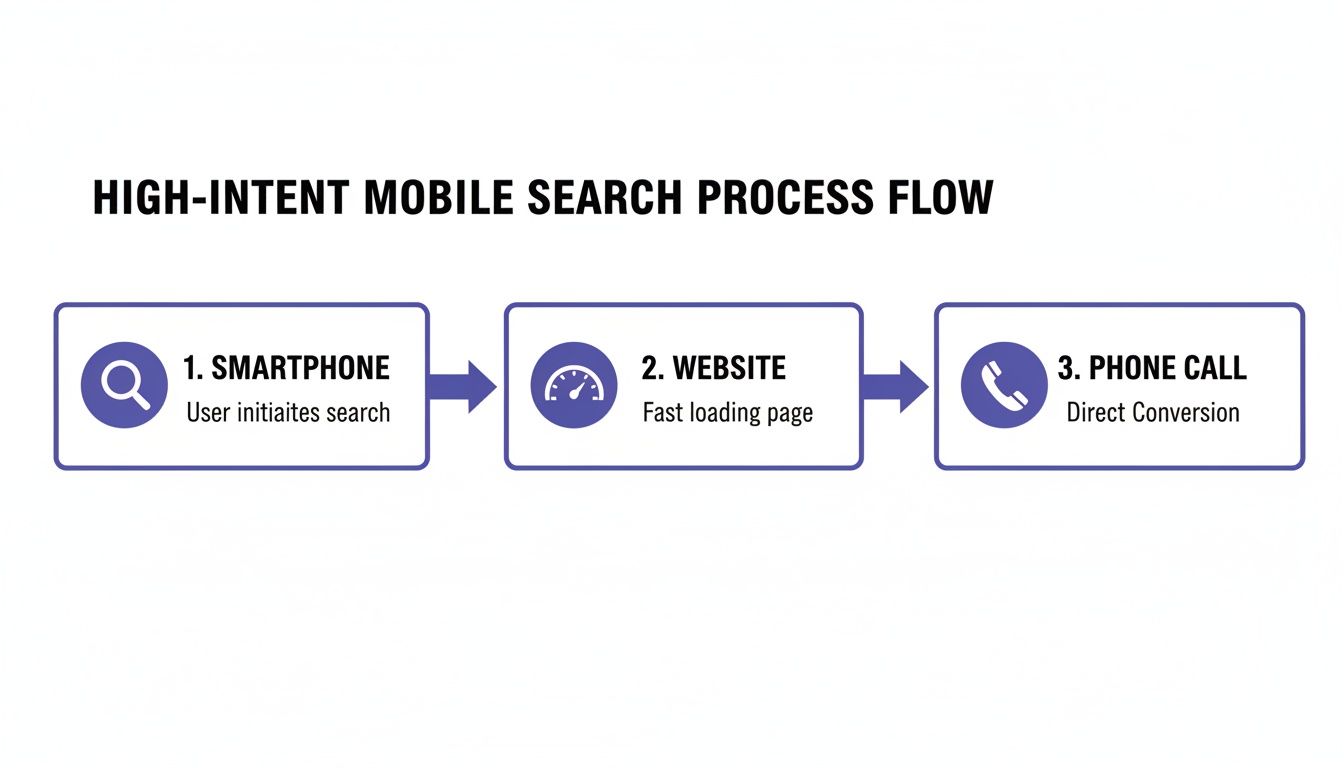
Each step in this process must be optimized. If you appear in search results but your website is slow to load, the lead is lost. If your site loads quickly but the "call now" button is difficult to find, the lead is lost. A cohesive system ensures no potential customer is lost due to a failure at any point in this journey.
When each component reinforces the others, you build momentum that drives predictable, long-term growth. Learning how to improve local SEO is fundamentally about constructing this system for your business.
If you are ready to move from disconnected tactics to building a true growth system, the team at City Web Company can provide the strategic direction and execution needed. We build the systems that transform an online presence into a business's most valuable asset.
These articles were popular with other readers too: