

Discover practical steps to enhance client engagement by centralizing communication, personalizing experiences, and proactively managing relationships.
How Local SEO Works: A Guide for Service-Based Businesses
Many business owners believe a great website is the key to attracting local customers. They invest in design and content, yet remain invisible to potential clients just a few blocks away. The issue is not the website itself, but a fundamental misunderstanding of how local customers actually find services online. Showing up online is not the same as showing up locally.
Table of Contents
The Real Reason Your Business is Invisible to Local Customers
Having a website is a prerequisite, but being found by a customer with an urgent need is a different challenge entirely. Business owners often pour money into general marketing or social media posts, then wonder why the phone isn't ringing. The effort isn't wasted, but the strategy is incomplete. The missing element is a precise focus on local search intent.
Your customers are not just typing "plumber" into Google. They are searching for "emergency plumber near me" or "best plumber in Denver." Without a strategy engineered to answer these specific, location-based queries, your business will not appear in the search results that drive immediate revenue.
The Tangible Cost of Local Invisibility
This lack of visibility has a direct financial cost. It is the missed call from a homeowner with a burst pipe. It is the lost project from a commercial property manager who needed your services yesterday. The most motivated buyers, those ready to make a decision now, find their solution in one specific place on Google.
That block of three businesses shown with a map is called the Google "Map Pack," and it captures an estimated 44% of all clicks in a local search. If you are not in that space, you are handing your most valuable leads directly to your competitors. Failing to appear there is not a marketing problem; it is a revenue problem that impacts your business daily.
This is the point where a business must shift from random marketing activities to building a system for predictable, local growth. The solution is to view local SEO not as a technical chore, but as the engine that connects your services to the immediate needs of your community. It is about building a direct path between a customer's problem and your solution, right when and where they are looking.
The Three Pillars of Local Search Rankings
To generate a consistent flow of local customers, your business must align with Google's evaluation process. The local search algorithm is built on three logical principles: Proximity, Relevance, and Prominence.
Imagine Google as a helpful concierge. When someone asks for the best roofer, the concierge recommends the one who is closest, has a proven history of fixing the exact problem they have, and holds the best reputation in the area.
To win at local SEO, your strategy must send clear signals to Google in each of these three areas. Neglecting one is like trying to build a three-legged stool with only two legs; the entire structure becomes unstable.
Pillar 1: Proximity
This is the most straightforward factor. Proximity answers the question, "How close is this business to the person searching?" When someone types "emergency HVAC repair near me" into their phone, Google’s priority is finding the closest available professional who can solve the problem.
This is a geographic calculation based on the searcher's location and your business's registered address or defined service area. While you cannot change your location, you can ensure Google knows precisely where you operate through a perfectly optimized Google Business Profile.
This profile is the bridge connecting your business to customers in your service area.
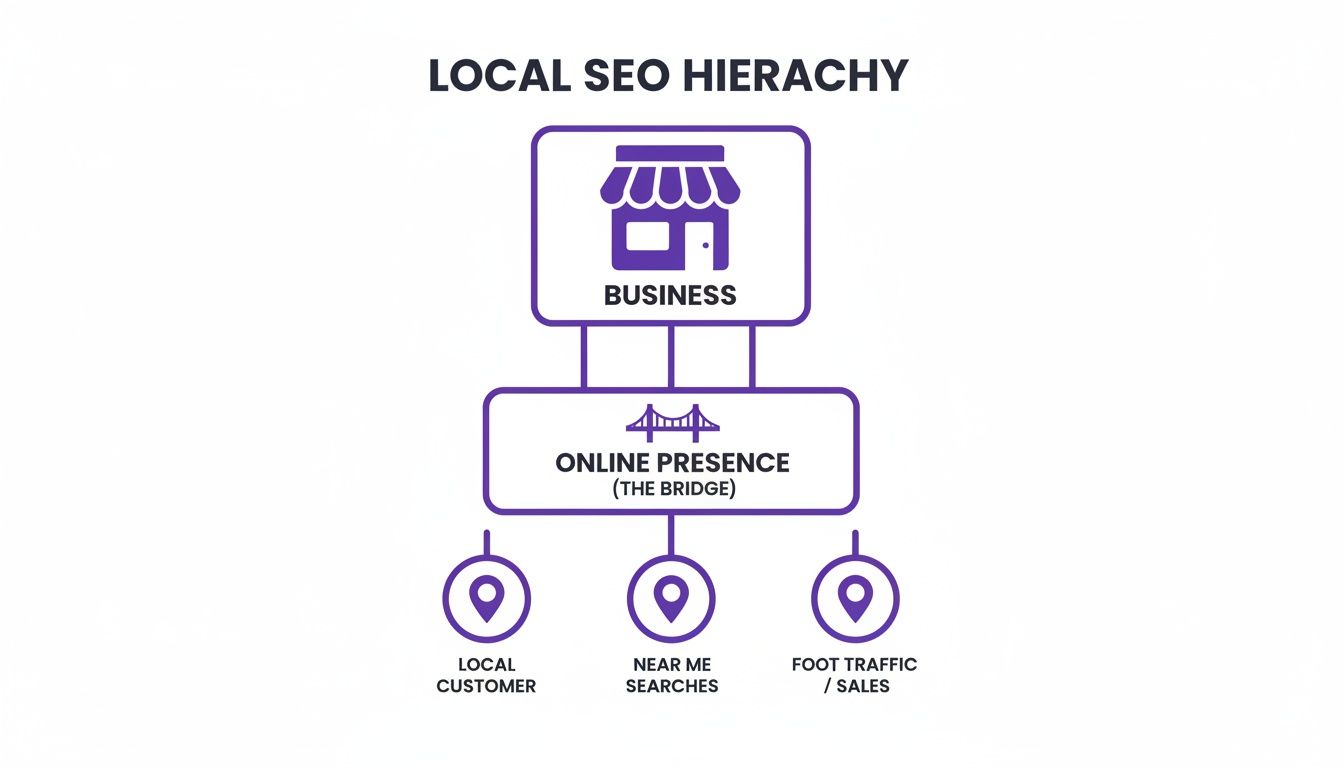
A strong local SEO strategy connects you to the customers right outside your door, turning "near me" searches into profitable jobs.
Pillar 2: Relevance
Next is Relevance, which answers, "Is this business a good match for what the user is looking for?" If a user searches for "commercial electrical contractor," Google will not show them a company that vaguely lists "electrical services." It looks for an expert.
Google determines relevance by analyzing the language on your website, the service categories you select on your Google Business Profile, and even the content of customer reviews. Specificity is critical.
Google rewards precision. Vague marketing renders your business irrelevant to a customer with a specific, urgent need. The more accurately you can describe what you do and where you do it, the more confident Google becomes in recommending you.
Many businesses fail here. They attempt to be everything to everyone and, as a result, become the ideal choice for no one. True progress requires mastering SEO of a company at a foundational level.
Pillar 3: Prominence
Finally, there is Prominence. This is Google’s method for measuring your authority and reputation. It answers the question, "How well-known and trusted is this business?" It is your digital word-of-mouth.
Google assesses prominence by looking at several key signals:
- Reviews: A consistent flow of recent, positive reviews on Google and other platforms demonstrates that you are a trustworthy choice.
- Citations: Mentions of your business's Name, Address, and Phone number (NAP) must be identical across credible directories like Yelp, Angi, and others. Consistency is non-negotiable.
- Local Links: When other local businesses, community organizations, or local news sites link to your website, it serves as a powerful vote of confidence.
Prominence is earned over time through excellent service and consistent strategic effort. Without it, you could be the most relevant business located next door to a customer and still be overlooked for a competitor with a stronger reputation.
Local Ranking Pillars and Their Business Impact
| Pillar | Google's Interpretation | Business Action Required |
|---|---|---|
| Proximity | "Is this business physically close to the searcher?" | Optimize your Google Business Profile with a precise address or service area. |
| Relevance | "Does this business offer the specific service the user needs?" | Use clear, descriptive language on your website and GBP. Match your services to what customers are searching for. |
| Prominence | "Is this business a well-known, trusted leader in the community?" | Actively collect reviews, build consistent citations, and earn links from other local entities. |

Mastering these three pillars is not about pleasing an algorithm. It is about proving to both Google and your future customers that you are the most reliable choice for the job.
Optimizing Your Digital Storefront on Google
Your Google Business Profile (GBP) is the single most important asset for local search. It is your digital storefront. Yet, many businesses claim their profile, add a phone number, and then neglect it.
This is a significant strategic error. It is equivalent to locking the front door of your physical shop and expecting customers to find their way inside.
An incomplete or inactive profile signals to Google that you may not be the most relevant or trustworthy option. The result is that your competitors, those who actively manage their profiles, appear in the valuable Local Pack, while you remain unseen.
Your GBP Is More Than Just a Listing
It is time to treat your Google Business Profile not as a static directory listing but as a client-generation tool. This requires a methodical approach, providing Google with every detail necessary to prove your relevance and prominence when a local customer searches.
Optimizing your GBP directly influences two of the three local ranking pillars. Every photo you upload, every service you detail, and every update you post reinforces that you are an active, authoritative business in your service area. This is where the abstract concepts of local SEO translate into tangible results.
Research shows that 44% of all clicks in local search go to the Local Pack, while only 29% go to the traditional organic results below it. Securing a top spot is like owning the best real estate in town.
Core Optimizations for Maximum Visibility
A fully optimized profile is built with purpose. The objective is to leave no doubt for Google about what you do, where you do it, and why you are the best choice.
These are the non-negotiable elements:
- Precise Business Categories: Select a primary category and add relevant secondary categories. An HVAC contractor, for example, should add "AC repair," "furnace installation," and "air duct cleaning" to appear for those specific service searches.
- A Compelling Business Description: Use this 750-character space to explain your unique value, highlight core services, and naturally include your main location and keywords.
- High-Quality, Geo-Tagged Photos: Images are a powerful trust signal. Regularly upload high-resolution photos of your team, completed work, and branded service vehicles. Geo-tagging them adds another layer of location data.
A complete and active Google Business Profile is the foundation of local search visibility. It is not just about being listed; it is about providing the most helpful and comprehensive answer to a potential customer's problem.
Activating Your Profile to Engage Customers
Optimization is an ongoing process. An active profile shows both Google and potential customers that you are open, engaged, and reliable. This is a key differentiator that competitors often ignore.
Consistent activity improves rankings and drives direct customer interactions. The impact of a Google Business Profile on local SEO is significant, and keeping it current is critical.
Here is how to maintain an active and engaging profile:
- Utilize Google Posts: These are essentially free advertisements on your search listing. Share special offers, showcase recent projects, or post company news. They expire every seven days, so consistent updates signal activity.
- Manage the Q&A Section: Proactively ask and answer common customer questions. This allows you to control the narrative and provide helpful information immediately, positioning you as an expert.
- Detail Your Products and Services: Do not just list your services, describe them. Use the Products and Services sections to add detailed descriptions, photos, and even pricing for your core offerings. This eliminates guesswork for potential customers.
By treating your Google Business Profile as the active hub of your online presence, you transition from being another name in a directory to becoming the go-to authority in your service area.
Building Trust and Authority Across the Web
A well-maintained website and Google Business Profile tell Google your side of the story. To truly convince the search engine of your prominence in the local market, it needs corroboration from other trusted sources. Many local SEO strategies fail because they do not build this web of trust beyond their own digital properties.
Even if you are the best electrician in a 50-mile radius, Google will remain skeptical if it cannot find mentions of you on other credible websites. Building this "off-site" authority is a non-negotiable step to prove your business is a legitimate and respected part of the community.
The Power of Consistent Business Citations
A fundamental way to build authority is through citations. A citation is any online mention of your business’s Name, Address, and Phone number (NAP). These are found on business directories like Yelp, Angi, and other industry-specific platforms.
Every time Google finds your exact NAP on a reputable directory, it acts as a small vote of confidence, confirming your business data is accurate.
However, inconsistency undermines this trust. A common mistake is having different versions of your business information online, such as an old address, a tracking phone number, or a slight name variation. If one directory lists "123 Main St." and another says "123 Main Street, Ste 4," it creates confusion and erodes Google's confidence.
Ensuring 100% NAP consistency across all online directories is a structural requirement for local SEO. It is the digital equivalent of making sure every map in town points to the correct address for your physical storefront.
How Reviews Shape Your Digital Reputation
While citations confirm your data, online reviews define your reputation. Reviews are a major local ranking factor because they provide unfiltered social proof from actual customers. A steady stream of 4- and 5-star reviews sends a powerful signal to Google: "This business delivers quality work and is trusted by its customers."
Many business owners are hesitant to ask for reviews. This passive approach often results in a reputation shaped by the most motivated customers, who are frequently the unhappy ones. This is a strategic error that allows competitors with a proactive system to gain an advantage.
A proactive approach does not need to be complex. It involves making the request for a review a natural part of your process immediately after a job is completed, when the customer's satisfaction is highest.
- Make It Easy: Send customers a direct link to your Google review page via text or email. The fewer clicks required, the higher the completion rate.
- Time It Right: The best moment to ask is immediately after you have solved their problem, when the value you provided is fresh in their mind.
- Respond to Everything: Dedicate time each week to reply to every review, both positive and negative. Thanking customers for positive feedback reinforces the relationship, while responding professionally to criticism demonstrates accountability.
Shifting from hoping for good reviews to systematically earning them is what separates thriving businesses from those that merely survive. You are not just managing a reputation; you are actively building it into a competitive advantage.
Turning Your Website into a Local Authority
Positive reviews and accurate directory listings are essential, but they are insufficient if your website fails to perform its role. While off-site signals confirm your legitimacy, your website must prove you are the local expert for a specific service.
A common mistake is assuming a single "Services" page is adequate. This approach leaves both Google and potential customers unclear about what you do and where you do it. Your website must be the definitive confirmation of your local relevance.
When someone searches for a specific service in a specific town, Google's mission is to find the single best web page that answers that exact need. If your site is not structured to provide those precise answers, you will remain invisible.
From Generalist Brochure to Local Problem-Solver
The most frequent error is the generic website that attempts to be everything to everyone. A single "Services" page listing all your offerings may seem efficient, but to Google, it appears shallow. It fails to answer the specific, localized questions that high-intent customers are asking.
The solution is to build dedicated pages for each core service you offer in each main city or neighborhood you serve. This simple structural change transforms your website from a vague online brochure into a valuable resource for motivated local buyers.
Consider this example:
- Instead of: A single "Roofing Services" page.
- You create: Separate, targeted pages like "Commercial Roof Repair in Denver," "Residential Roof Replacement in Aurora," and "Emergency Storm Damage Tarping in Lakewood."
This structure allows you to speak directly to a customer's immediate problem in their specific area, which aligns perfectly with how people actually search. For a deeper analysis, see our guide on choosing the right keywords for local SEO.
On-Page Signals That Prove You Belong
Once your site is structured correctly, you must layer in clear on-page signals. These elements work together to leave no doubt in Google's mind about who you are, what you do, and where you do it.
Key optimizations include:
- Localized Page Titles and Headings: The title of your page should clearly state its purpose (e.g., "Expert Drain Cleaning Services in Boulder, CO"). Your main headings (H1, H2) should reinforce this.
- Embedded Google Maps: Embedding a map of your service area or office location directly onto your contact and location pages is a powerful "local" signal to Google.
- Locally-Focused Content: Write naturally about the neighborhoods you serve. Mention local landmarks or projects you have completed nearby. This proves you are an active part of the community.
This targeted approach is non-negotiable. Data shows that 46% of all Google searches are for local information, and 76% of people who search on their phone for something nearby visit a business within 24 hours.
Schema markup is an effective tool for your website. It is a piece of code added to your site's backend that acts as a structured business card for search engines. It explicitly tells them your business name, address, phone number, hours, and services offered, removing all guesswork.
By meticulously aligning your website with the specific problems of your local customers, you create a direct path from their search query to your business. This is not about manipulating a system; it is about providing absolute clarity.
Your Prioritized Local SEO Action Plan
Understanding how local SEO works is one thing; implementing a step-by-step system is what drives growth.
Many business owners become overwhelmed by the number of tasks. They try various tactics sporadically, resulting in efforts that fail to produce meaningful results. The problem is not a lack of information but the absence of a clear, prioritized plan.
This is your strategic roadmap. Focus on the highest-impact actions first to turn abstract concepts into a real growth engine for your service business.
Phase 1: Foundational Integrity
Before anything else, you must establish a correct digital foundation. Inconsistencies here will undermine all future efforts, making this a non-negotiable starting point.
- Google Business Profile (GBP) Audit: Review your profile thoroughly. Every field must be complete, from primary and secondary service categories to detailed descriptions for each service. Add high-quality, geo-tagged photos. Treat this as your digital storefront.
- Citation Consistency Check: Use a tool or manual search to find every online mention of your business's Name, Address, and Phone Number (NAP). Correct every inconsistency, no matter how minor. The goal is absolute consistency.
Phase 2: Building Authority and Trust
With a solid foundation, it is time to build social proof and send the right authority signals. This phase is about showing Google and potential customers that you are a trusted, active part of your local community.
- Implement a Review Generation System: Do not passively wait for reviews. Create a simple, repeatable process to ask every satisfied customer for feedback. After a job is complete, send a direct link via text or email. Make it easy for them.
- Identify Core Service Keywords: Pinpoint the most valuable search terms for your key services combined with your main service areas. Think like your customers: "emergency plumbing denver," or "hvac repair aurora." These terms will become the backbone of your website's content strategy.
If the technical details become a barrier, considering dedicated WordPress SEO services can be a practical way to maintain momentum.
By executing this plan, you shift from a reactive position to a deliberate growth strategy.
Frequently Asked Questions About Local SEO
Business owners need direct answers to key questions about timelines, definitions, and strategy without technical jargon. This section provides clear answers to common inquiries.
Our goal is to demystify the process so you can move forward with a clear understanding of what is required to build a local marketing strategy that generates results.
How Long Does It Take to See Results from Local SEO?
The honest answer is that local SEO is a long-term strategy. While some initial optimizations, such as a thorough update of your Google Business Profile, can generate activity within a few weeks, true local SEO involves building a lasting asset. Earning trust, generating a steady flow of reviews, and ensuring data consistency across the web requires commitment.
Most businesses begin to see a meaningful increase in local rankings and qualified traffic within 3 to 6 months. The crucial difference is that unlike paid ads, which disappear when you stop paying, these results are sustainable and compound over time, creating a powerful growth engine.
What Is the Difference Between the Local Pack and Organic Results?
The "Local Pack" (or "Map Pack") is the prime real estate at the top of Google search results, featuring a map and three business listings. Placement here is heavily influenced by your Google Business Profile's relevance, your proximity to the searcher, and your overall prominence (reviews and authority).
Below the Local Pack are the organic results, the classic "blue link" website listings. Your website's own authority and on-page SEO play a much larger role in these rankings. An effective local SEO strategy aims to appear in both. Dominating the Map Pack and the organic results maximizes visibility and captures the most clicks from customers ready to hire.
Do I Need a Physical Storefront for Local SEO?
No. Local SEO is essential for service-area businesses (SABs), such as plumbers, electricians, and mobile detailers who travel to their customers.
Your Google Business Profile is designed for this model. Instead of listing a physical address, you define your service area by cities, counties, or zip codes. This hides your address from the public map while informing Google of the geographic areas you serve. From there, the same principles of relevance, prominence, and proximity apply within that defined territory.
At City Web Company, we provide the strategic clarity and expert execution required to master local search. We build performance-focused digital marketing systems designed to get your business found, trusted, and chosen by the local customers you need to reach.
Ready to turn your local visibility into a predictable growth engine? Schedule a free discovery call with us today.
These articles were popular with other readers too: