
Use website DNI, connect call reports to Google Ads and your Google Business Profile, then tie calls to booked jobs. City Web Company can handle setup.
Stop Wasting Your Ad Budget: A Strategic Guide to Google Ads Management in Denver
Most Denver business owners believe that success with Google Ads comes from having a bigger budget than the competition. This is a fundamental misunderstanding, and it's the primary reason why so many campaigns generate high costs but produce no meaningful business. The path to a positive return isn't paved with more spending. It's built on a smarter strategy.
Effective google ads management denver isn't about outspending others; it's about out-thinking them. Without a clear system for managing the investment, your ad budget becomes a source of recurring cost rather than a driver of predictable revenue.
Table of Contents
The Real Problem: Why Google Ads Feels Like a Gamble
The frustration many business owners feel stems from a disconnect between platform activity and business results. An ad campaign can be active, generating clicks and impressions, yet fail to produce a single qualified lead. This is the core issue: running ads without a strategic framework to guide them.
When a campaign is launched without precise local targeting, disciplined keyword selection, and clear conversion goals, it inevitably wastes money. Your budget is spent on clicks from people outside your service area, researchers with no commercial intent, or even competitors.
This isn't a flaw in the Google Ads platform itself. It's the absence of a management system that causes the financial drain. The campaign lacks the structural integrity to turn clicks into customers, making the cost per lead unsustainable and creating the perception that "Google Ads doesn't work."
The frustration of watching your ad budget vanish without new customers is a common experience. It originates from the gap between simply being active on the platform and implementing a strategy designed for a measurable return.
This is the point where a shift in thinking is required. A professionally managed Google Ads campaign is not a digital slot machine; it is a predictable growth engine. Most unmanaged campaigns are missing the critical components that make this possible.
- Precise Local Targeting: Many campaigns waste funds targeting the entire Denver metro when the ideal customer is located in a specific area like Washington Park or Cherry Creek.
- Negative Keyword Filtering: Without actively blocking irrelevant searches, a local plumber’s ad budget is consumed by clicks from DIY enthusiasts searching for "how to fix a leaky faucet."
- Conversion-Focused Ad Copy: Generic ads that fail to address a local resident’s specific problem are easily ignored. An effective ad connects by acknowledging their immediate need and location.
Understanding these missing elements is the first step toward transforming an ad account from a financial liability into a system that delivers measurable, predictable results.
Why Your Current Google Ads Campaign Is Wasting Money
Many business owners treat Google Ads like a digital faucet. When customers don't flow in, the instinct is to increase the budget, assuming more volume will fix the problem. This approach rarely works.
The issue is almost never the amount you spend. It is how and where that budget is allocated.
An unmanaged campaign is like fishing with a net full of holes. You may catch a few inquiries, but the most valuable opportunities, the customers ready to make a purchasing decision, are slipping through. Your budget is not just underperforming; it is actively being wasted on clicks from individuals who will never become customers.
The Anatomy Of A Failing Campaign
A primary pitfall is a lack of understanding of where the money is actually going. Learning to start navigating Google paid search costs for local services is essential, but without a tight strategy, your budget will bleed out through three common gaps.
These are the core failures that drain the most cash:
- Broad Keyword Targeting: Using vague keywords like "hvac repair" is a recipe for wasted spend. It attracts clicks from across the country, from people looking for DIY videos or homeowners in another state. A strategic campaign, by contrast, targets high-intent local phrases like "emergency furnace repair in Highlands Ranch" to capture immediate buyer interest.
- Generic Ad Copy: An ad that does not speak directly to a Denver local is effectively invisible. When your ad copy mentions a specific local pain point, like preparing a home for a sudden Front Range snowstorm, it connects on a different level. That local relevance is what converts a click into a phone call.
- No Conversion Tracking: This is a critical failure. Without precise tracking, you cannot distinguish between a click that led to a booked appointment and one from a casual browser. It is the equivalent of driving blindfolded. You have no data to guide your decisions, so you cannot allocate more budget to what is actually working.
This flowchart illustrates how these common issues lead to poor outcomes for a business.
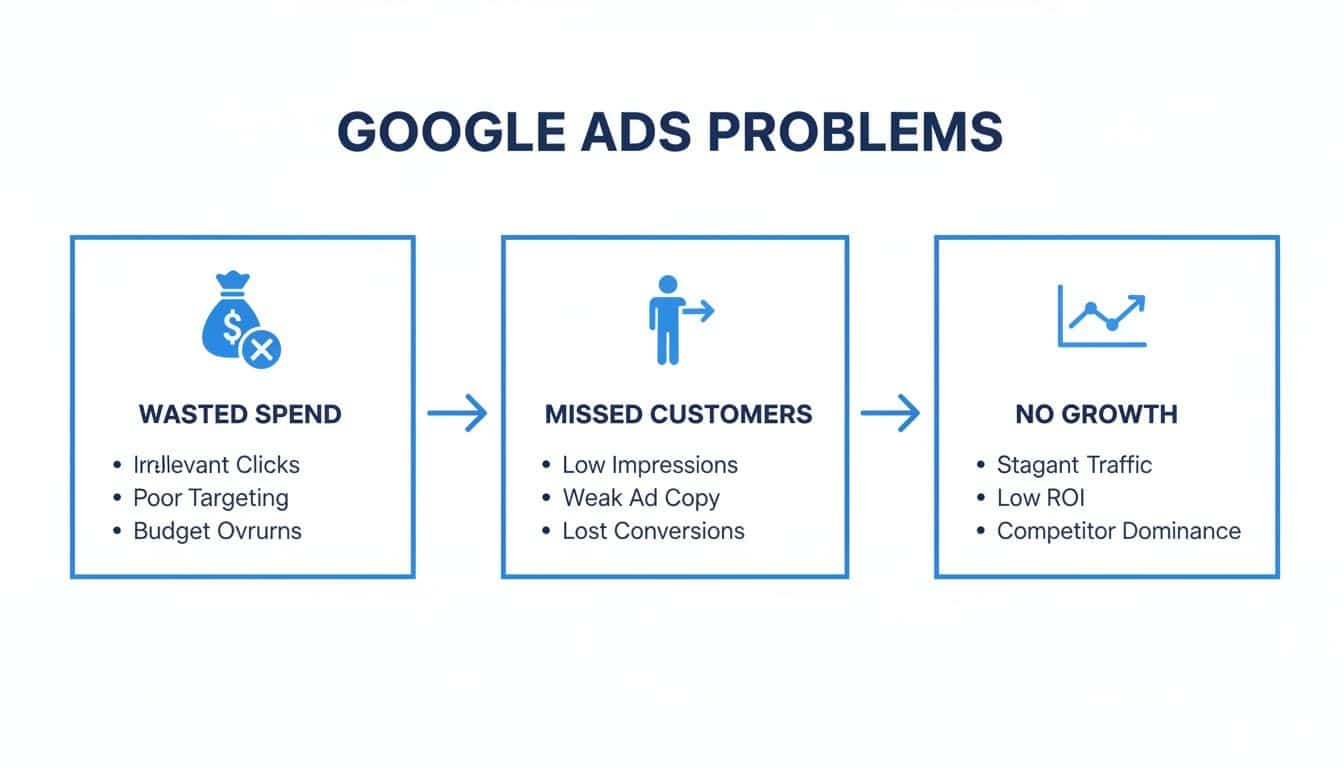
These are not abstract concepts. They represent real dollars wasted, real customers lost, and real growth that never materialized.
Comparing DIY Management With A Strategic Agency Approach
The gap between a DIY setup and a professional strategy is often wider than business owners realize. It appears in everything from keyword selection to the actual business results generated. This table illustrates the difference in outcomes.
| Element | Common DIY Approach | Strategic Agency Approach |
|---|---|---|
| Targeting | Broad keywords attracting low-quality clicks. | Hyper-local keywords capturing high-intent leads. |
| Ad Copy | Generic messaging that gets ignored. | Relevant, localized copy that speaks to Denver customers. |
| Tracking | No conversion tracking; "gut-feel" decisions. | Precise conversion tracking measures every lead and call. |
| Budget | Budget is wasted on irrelevant searchers. | Budget is focused on clicks that generate revenue. |
| Optimization | "Set it and forget it," with no adjustments. | Continuous, data-driven optimization to improve ROI. |
| Result | A frustrating expense with no clear return. | A predictable source of profitable customer growth. |

The DIY approach often leaves you guessing where the money went. A strategic approach provides clarity, showing you exactly how your ad spend is turning into new business.
The difference between a campaign that costs you money and one that makes you money is not the platform. It is the strategic framework built to manage it.
Recognizing these gaps is the crucial first step. It transitions the objective from "running ads" to building a system engineered for a measurable return on investment. The purpose of professional Google Ads management in Denver is to close these gaps, ensuring every dollar spent is aimed at acquiring a profitable new customer. This clarity transforms an ad budget from a source of frustration into a predictable driver of growth.
The Pillars Of A High-Performing Denver Ad Campaign
A Google Ads campaign that generates consistent new business is not a result of luck. It is built on a few non-negotiable foundations. This is where strategic google ads management denver moves beyond guesswork and into a structured, deliberate process.
The first pillar is hyper-local keyword research. Instead of pursuing a broad term like "plumber," which can attract anyone, a strategic approach gets specific. It targets the exact phrases your ideal Denver customers are typing when they need immediate help, such as “emergency plumber Highlands Ranch” or “water heater replacement Stapleton.” This focus ensures your ad spend reaches people in your service area who are ready to hire.
The second pillar is selecting the right campaign types. For most Denver service businesses, a combination of Search campaigns and Google Local Service Ads is effective. Search campaigns capture people actively looking for a solution. Local Service Ads add the "Google Guaranteed" badge, which acts as an instant signal of trust for homeowners.
Mastering Your Campaign Structure
These pillars are only as strong as the structure supporting them. That starts with an often overlooked element: negative keywords. A negative keyword list functions as your campaign’s filter, blocking your ads from showing for irrelevant searches that waste your budget. For a Denver roofer, this means filtering out terms like “roofing jobs,” “DIY roof repair,” or “free estimates” to stop clicks from job seekers and non-commercial searchers.
A well-structured campaign is not an optional extra. It is the fundamental architecture that determines whether your ad spend produces a positive return on investment or becomes a sunk cost.
Without this solid foundation, even a large budget is likely to fail. The objective is to create a tightly controlled system where every dollar works to attract qualified, local customers. For a deeper analysis of this structure, our guide on Google Ads for local businesses provides a detailed breakdown.
Finally, a smart structure depends on logical ad group segmentation. Instead of grouping all your services into one large, disorganized ad group, a professional approach separates them. For an HVAC company, this means creating distinct ad groups for "AC Repair," "Furnace Installation," and "Duct Cleaning." Each group receives its own highly specific keywords and ad copy.
This level of organization accomplishes two things. It creates highly relevant messaging, which Google rewards with higher Quality Scores and lower costs per click. It also ensures that the person searching for "AC repair in LoDo" sees an ad about exactly that, making them far more likely to click and make contact. This methodical process turns the complexity of Google Ads into a predictable system for generating new business.
Targeting Strategies That Win In The Denver Metro Area
Casting a wide, generic net across the entire Denver metro is one of the fastest ways to exhaust an ad budget with minimal results. Meaningful returns demand precision. The difference between a campaign that accumulates clicks and one that delivers a steady stream of paying customers comes down to targeting the right people in the right place.
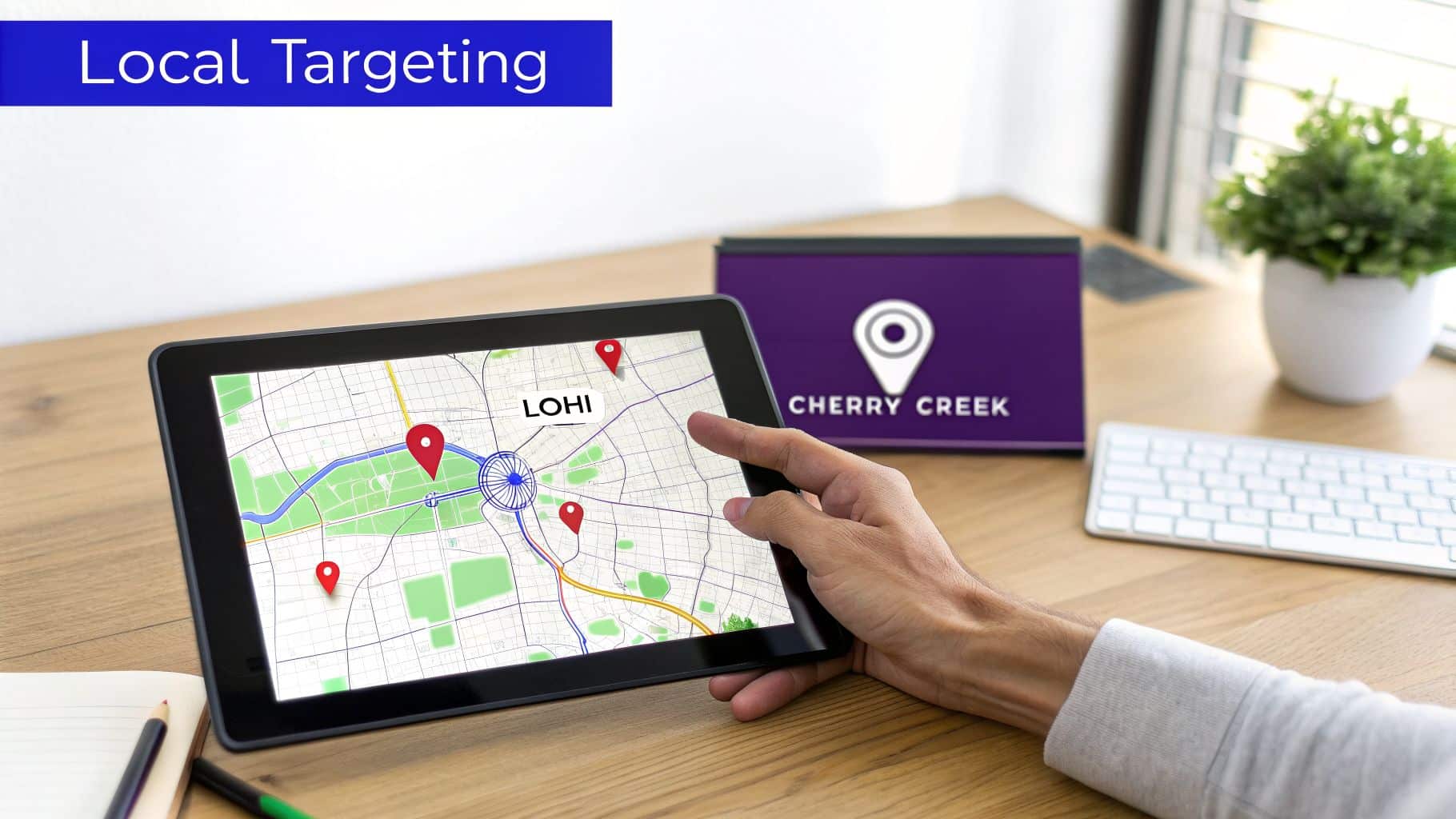
This is where expert google ads management denver moves beyond default settings. It requires a deep, practical understanding of the local market and the use of every available tool to reach your ideal customer.
Geographic And Demographic Precision
The Denver market is not a single, uniform customer pool. A client seeking a high-end interior designer in LoHi has different search behaviors than a family with a burst pipe in Centennial. Smart targeting allows you to tailor your message and allocate your budget where it will be most effective.
- Neighborhood Targeting: Instead of spending your budget across "Denver," you can focus on specific, high-value neighborhoods. A luxury landscaping company, for example, might concentrate its ad spend in Cherry Hills Village and Washington Park.
- Radius Targeting: This is essential for service-area businesses. You can draw a digital boundary around your address, showing ads only to people within a realistic 15-mile radius or your specific service area.
- Income-Level Targeting: Google allows targeting based on the average household income of specific ZIP codes. This is powerful for businesses selling premium services, from custom home remodeling to specialized financial planning.
This level of detail ensures your budget is spent attracting people who can actually become your customers.
A Practical Scenario: Hail Damage In The Suburbs
Imagine a hailstorm moves through Arvada and Lakewood. A generic roofer campaign running across the entire metro will continue wasting money showing ads in unaffected areas like Parker and Aurora. This is inefficient.
A strategically managed campaign, however, can pivot within minutes. An experienced ad manager will immediately launch a new campaign targeting only the ZIP codes impacted by the storm. The ad copy is updated to speak directly to the urgent need: "Hail Damage in Arvada? Fast, Free Roof Inspections."
This is the power of hyperlocal advertising. It’s not just about being present; it is about being relevant at the exact moment of need. This timeliness transforms your ad from an interruption into a welcome solution.
A high-performing Denver ad campaign must consistently deliver tangible results, like a steady stream of new roofing leads in Denver. The goal is to connect a specific solution to a specific problem in a specific location. That is the core of local advertising that works.
Re-Engaging Potential Customers
Not every person who clicks your ad is ready to buy on the first visit. Remarketing is a fundamental strategy for showing targeted ads to people who have already visited your site. It is a cost-effective way to remain top-of-mind while they are making a decision and bring them back to complete a form or make a call.
Google's platform is dominant. It controls roughly 80% of the global PPC market share, handling nearly 8 billion searches daily. For Denver service businesses, this means expert management is a key component of customer acquisition. This is supported by the 79% of marketers who call PPC vital to their business. You can explore the full research on Google Ads trends for more context.
Understanding The ROI Of Professional Ad Management
Every business owner asks the same question before making an investment: “What is my return?” It is the correct question. When it comes to professional Google Ads management, however, the conversation often focuses on the monthly fee or a percentage of ad spend.
This frames the service incorrectly, as a cost rather than a strategic investment. The true value is not measured in clicks or impressions. It is measured by the tangible impact on your bottom line. Shifting focus from what it costs to what it returns is key to understanding its actual value.
The fee for professional management is not just another marketing expense. It is the engine that converts raw ad spend into a predictable system for acquiring profitable new customers.
From Cost To Value
The metrics that truly matter are tied to business outcomes, not vanity numbers. While you can explore our full guide on the 5 essential paid advertising metrics to track, these are the two that drive business growth:
- Cost Per Qualified Lead (CPQL): This tells you exactly what you are spending to get a legitimate potential customer on the phone or to submit a contact form. It filters out the noise of irrelevant clicks and focuses on real opportunities.
- Customer Lifetime Value (CLV): This number helps you understand the total revenue a new customer will generate for your business over the course of your relationship. When your CLV is significantly higher than your CPQL, your campaigns are profitable.
A professional management team's entire job is to widen the gap between those two numbers. They work to ensure every dollar you invest in ads generates a multiple of that in return. This provides a clear, data-backed method for setting budgets and forecasting growth. It is a fundamentally different approach from just "running some ads."
The scale of the platform confirms its power. With worldwide Google ad spend projected to reach $318 billion by 2026, up from $237.9 billion in 2023, it is clear where smart businesses are investing. For a Denver business, mastering this channel is one of the most direct paths to a strong ROI. You can read more in the full research about these Google Ads statistics.
This strategic approach reframes your google ads management denver from a monthly cost into a calculated investment, engineered for predictable and profitable growth.
Choosing The Right Strategic Partner For Your Denver Business
You understand the potential of Google Ads. Now comes the critical decision: who do you trust to manage your budget? Selecting an agency is the final step, and the right choice can fuel your growth for years. The wrong choice leads back to wasted ad spend and frustration.
This decision is not about a sales pitch. It is about finding a true partner whose strategy aligns with your business goals.

A real strategic partner thinks like a business owner, not a vendor. They are focused on your outcomes, not their own vanity metrics. Forget reports filled with clicks and impressions. A true partner focuses on what matters: qualified leads, your cost to acquire a customer, and the direct impact on your revenue.
Your Agency Selection Framework
When evaluating options for google ads management denver, use this framework to distinguish between a genuine partner and a service provider. A great agency will demonstrate its ability to deliver.
A top-tier partner will bring three things to the table:
- Proven Local Market Knowledge: They must know Denver. They should understand that the competition for roofing leads in LoDo is different from attracting landscaping clients in Centennial, and they will build your campaigns around that local intelligence.
- Transparent, Outcome-Focused Reporting: You deserve reports that are clear and meaningful. The data should connect your ad spend directly to new phone calls and sales, not hide behind confusing jargon.
- A Focus on Strategic Partnership: The conversation should always be about your growth. They should ask about your customer lifetime value and long-term business goals, not just technical campaign settings.
Choosing a partner isn’t about finding someone to run your ads. It is about engaging a team to help grow your business. The right partner provides clarity and acts as an extension of your own leadership.
If you are ready for a Google Ads strategy built for tangible business growth, the next step is a conversation. We invite you to a discovery call to discuss your specific goals and determine if City Web Company is the right partner to bring predictability and profit to your marketing.
Frequently Asked Questions About Google Ads In Denver
If you run a business in Denver, you have likely heard about Google Ads. But you also have practical questions about what it costs, how it works, and whether it is a worthwhile investment. Here are answers to the questions we hear most often from local business owners.
How Much Should A Small Business In Denver Spend On Google Ads?
There is no single correct number. The right budget depends on your industry, competitive landscape, and objectives. That said, for a service business in a market like Denver, a realistic starting point for ad spend is often between $1,500 and $3,500 per month.
The specific dollar amount is less important than efficiency. A smaller, well-managed budget will always outperform a larger, poorly managed one. A smart strategy ensures every dollar is tied directly to business goals.
How Long Does It Take To See Real Results From Google Ads?
While you can see website traffic almost instantly, the primary goal, a consistent stream of qualified leads, typically takes about 60 to 90 days to establish. This initial period is a data-gathering phase where we test strategies and refine the campaign.
True success is not about immediate clicks. It is about refining targeting and bidding over time to turn initial traffic into a predictable pipeline of new customers.
Can I Run Google Ads Myself Instead Of Hiring An Agency?
You can run your own ads. The real question is whether you should. The Google Ads platform is powerful but also complex, and it is easy to spend a significant amount of money on irrelevant clicks without deep expertise. An agency specializing in google ads management denver brings both technical skill and local market knowledge.
An expert partner implements advanced conversion tracking and performs the continuous optimization required to turn your ad spend from an unpredictable expense into a profitable investment. The goal is not just to get you clicks; it is to get you customers.
If you are ready for a Google Ads strategy built for real-world business growth, the next step is a simple conversation. The team at City Web Company can help bring clarity and predictability to your marketing so you can focus on what you do best.
Schedule a free discovery call to discuss your business goals.
These articles were popular with other readers too: