
Use website DNI, connect call reports to Google Ads and your Google Business Profile, then tie calls to booked jobs. City Web Company can handle setup.
10 Actionable Digital Marketing Tips for Small Business Growth
Most local business owners feel a constant pressure to "do more marketing." You have likely tried running social media ads, boosting posts, or even paid for a new website, yet the phone does not ring any more than it did before. The common belief is that more activity equals more results, but this is a fundamental misconception.
The real issue is not a lack of effort. It is the absence of an integrated system where each marketing component works together to turn visibility into measurable revenue. Many marketing efforts fail because they are executed as isolated tactics, a Facebook ad here or a blog post there, without the strategic framework needed to guide a customer from awareness to conversion.
This fragmented approach leads to wasted ad spend, low visibility in the moments that matter, and a frustrating cycle of unpredictable growth. It leaves you with more tasks on your to-do list but no tangible impact on your bottom line.
This article provides actionable digital marketing tips for small business owners who are ready to move beyond isolated tasks. We will explore the structural elements that connect these tactics into a cohesive growth engine, creating a system that predictably attracts and converts your ideal local customers.
Table of Contents
1. Optimize Your Google Business Profile for Local Search Dominance
Many businesses treat their Google Business Profile as a simple directory listing, updating it once and then forgetting it. This is a significant missed opportunity. Your GBP is not a static entry; it is a dynamic, interactive storefront on Google Search and Maps. For a local service business, this profile is arguably your most critical digital asset.
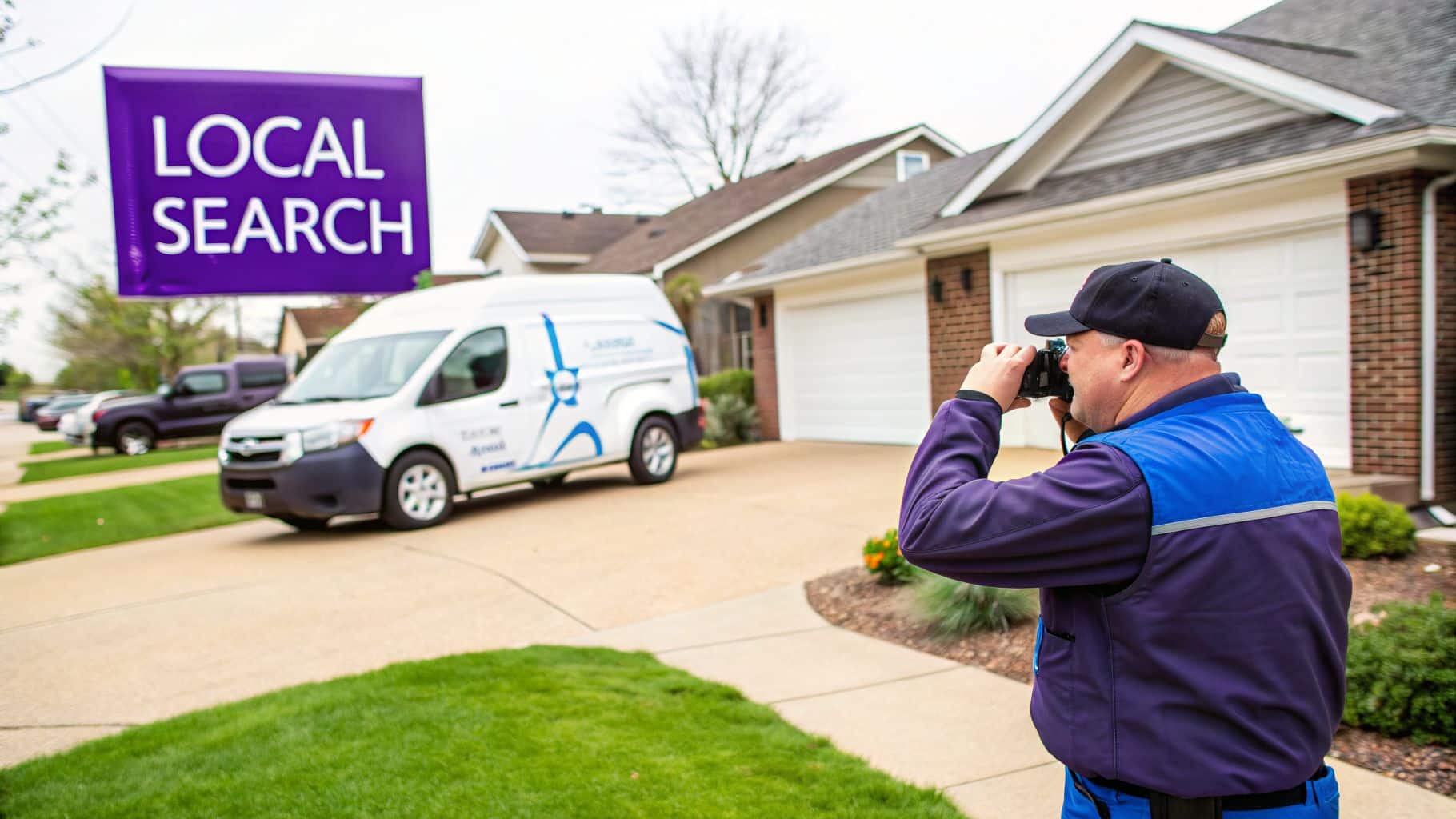
A fully optimized profile ensures you appear in the valuable “Map Pack” when customers search for terms like "emergency plumber near me" or "HVAC repair in [City]". This is one of the most effective digital marketing tips for small business because it positions you directly in front of customers at their moment of need. The goal is to provide Google with so much relevant, high-quality information that it has no choice but to show your business as the best local solution.
Actionable Steps for GBP Optimization:
- Complete Every Section: Fill out your business name, address, phone number, website, and hours with 100% accuracy.
- Select All Relevant Categories: Choose a primary category (e.g., "Plumber") and add all applicable secondary categories (e.g., "Water Heater Installation & Repair").
- Show Your Work: Regularly upload high-quality photos of your team, vehicles, and completed jobs.
- Post Weekly Updates: Use Google Posts to share promotions, seasonal tips, or company news. This signals to Google that your business is active.
- Enable Messaging: Allow customers to contact you directly from your profile for a frictionless experience.
2. Implement a Local SEO Strategy with Service Area Targeting
While an optimized Google Business Profile is foundational, many businesses stop there, leaving them invisible to valuable customers in surrounding towns. A dedicated local SEO strategy expands your digital footprint, ensuring you appear wherever your customers are searching, not just where your office is located.
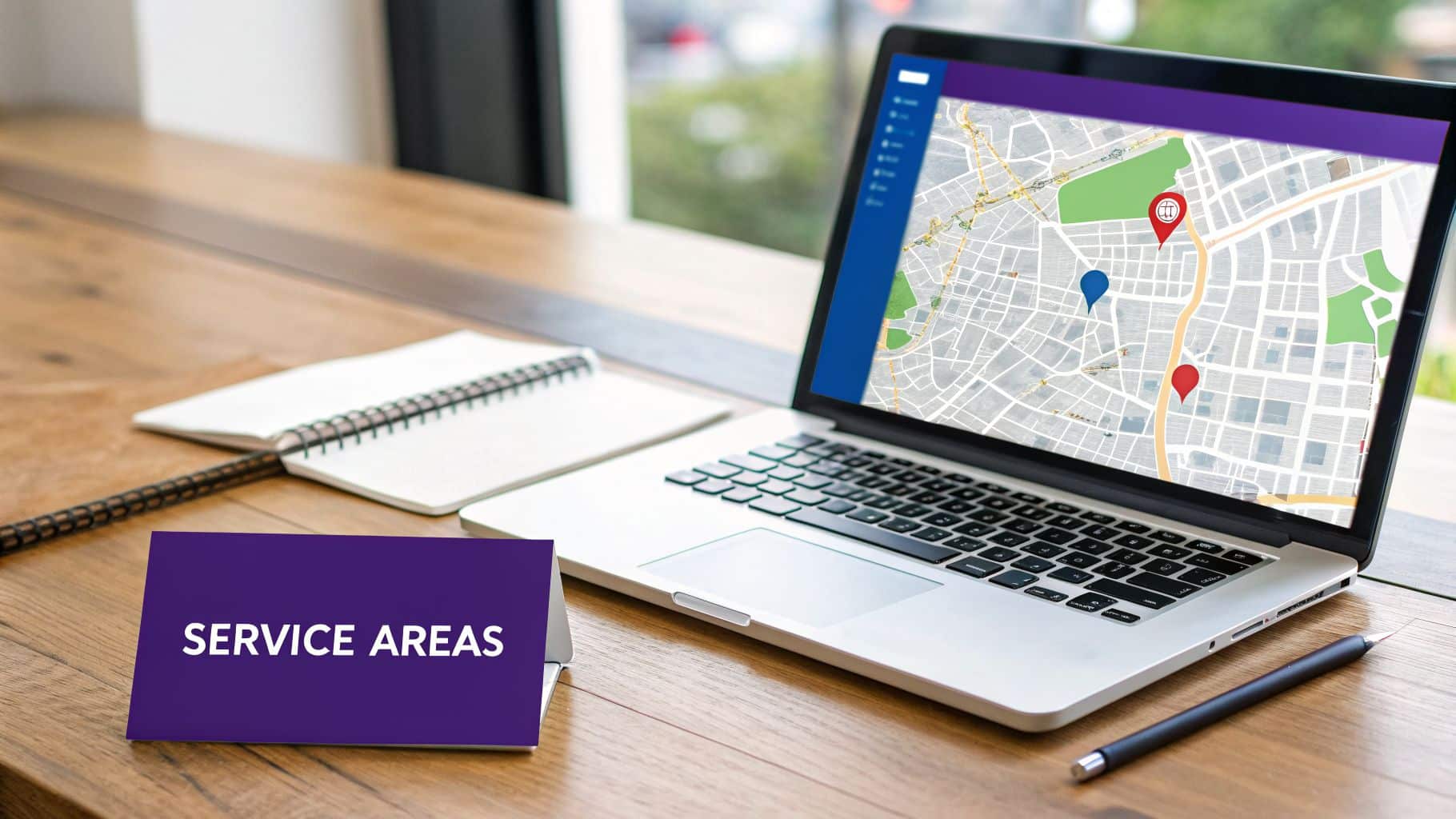

This approach builds authority across your entire service region. For a roofer in Denver, this means ranking for "roof repair Denver" and also "hail damage repair Boulder." This is an effective strategy because it systematically captures high-intent customers across multiple geographic markets. The goal is to create specific, relevant online assets for each location, making your business the undeniable choice for Google to present.
Actionable Steps for Service Area SEO:
- Create Dedicated Service Area Pages: Build a unique page on your website for each primary city or town you serve.
- Localize On-Page Content: Include local landmarks and neighborhood names in the content of each service area page.
- Build Local Citations: Ensure your business name, address, and phone (NAP) are listed consistently in relevant local directories.
- Implement Local Business Schema: Use schema markup on your website to explicitly tell search engines what services you offer and where you offer them.
- Generate Location-Specific Content: Write blog posts about projects completed in specific towns or offer tips relevant to the local climate.
3. Leverage Google Ads for Immediate Local Lead Generation
Organic SEO builds sustainable, long-term visibility, but it does not produce results overnight. Waiting months for rankings can mean lost revenue. This is where paid search advertising, specifically Google Ads, provides an immediate advantage. It places your business at the top of search results for high-intent keywords the moment your campaign goes live.
For a service business, this means you can generate qualified leads while your organic presence matures. Google Ads allows for precise geographic targeting, ensuring your budget is spent reaching customers actively searching for your exact services in your specific area. This is one of the most direct digital marketing tips for small business because it creates an instant connection with ready-to-buy customers.
Actionable Steps for Google Ads Success:
- Structure Campaigns by Service: Create separate campaigns for each core service (e.g., "AC Repair," "Furnace Installation") to improve relevance and manage budgets effectively.
- Use Local Services Ads (LSA): If available for your industry, LSAs are critical. They display a "Google Guaranteed" badge, which builds instant trust.
- Implement Conversion Tracking: Set up call tracking and form submission tracking. Without this data, you cannot accurately measure your return on ad spend.
- Build a Strong Negative Keyword List: Aggressively add irrelevant terms to stop wasting money on unqualified clicks. An HVAC company should negate terms like "free," "training," and "jobs."
- Test and Refine Ad Copy: Continuously run tests on your headlines and descriptions to identify which messages resonate most with customers.
4. Build a Conversion-Focused Website
Many small business websites function as digital brochures, offering information but failing to guide visitors toward a specific action. Your website should be a proactive sales tool, an engine built specifically to convert traffic from any source into tangible leads. It is the central hub of your entire digital marketing ecosystem.
A conversion-focused website is designed with a single purpose: to turn a visitor into a lead. For instance, a local HVAC company saw a 40% increase in qualified leads by adding a prominent ‘Schedule Service’ button above the fold. This is a critical marketing tip because it directly impacts your bottom line by maximizing the return on your marketing investment.
Actionable Steps for a Conversion-Focused Website:
- Place CTAs "Above the Fold": Your primary call-to-action (e.g., "Get a Free Quote," "Schedule Service") must be visible on every page without scrolling.
- Use High-Contrast Buttons: Make your CTAs stand out with contrasting colors and clear, action-oriented text like "Book Now" instead of "Submit."
- Minimize Form Fields: Only ask for essential information. A form with just a name, phone number, and service need is far more likely to be completed.
- Display Trust Signals: Prominently feature Google reviews, industry certifications, and guarantees to build immediate credibility.
- Implement Click-to-Call Buttons: Ensure phone numbers are clickable, allowing customers to easily contact you from their mobile devices.
5. Create a Content Strategy with Local SEO in Mind
Many business owners view blogging as a time-consuming chore with no clear return. They publish a few generic articles, see no traffic, and conclude that content does not work. This approach misses the strategic point. Content is about systematically answering the questions your customers are already asking Google, establishing your authority, and capturing search traffic that your service pages alone cannot.
A well-executed content strategy builds a long-term asset. An article on the "Cost of Roof Replacement in Denver," for example, can attract homeowners in the crucial research phase. This educational content builds trust and positions the business as the go-to expert. The goal is to own the conversation around your services in your local market.
Actionable Steps for Content Marketing:
- Research Keyword Opportunities: Use tools to find what your customers are searching for. Target a mix of high-volume terms and specific, long-tail questions.
- Create an Editorial Calendar: Plan your content topics two to three months in advance to ensure a consistent publishing schedule that aligns with seasonal trends.
- Write for Humans First: Focus on providing genuine, helpful answers to search queries. Quality writing that addresses user intent is what search engines reward.
- Localize Your Content: Naturally include local modifiers like your city or region within your articles to attract relevant local search traffic.
- Build Internal Links: Connect your blog posts to your main service pages. This passes authority and guides readers toward taking action.
6. Leverage Social Media for Brand Awareness and Lead Generation
Many small businesses view social media as a place to post occasionally without a clear strategy. This misses the core value of these platforms: building direct connections with your local community. For a service business, social media is a powerful tool to showcase expertise, build trust, and generate qualified leads.

A strategic social media presence turns your business from an anonymous service provider into a familiar, trusted local name. By consistently sharing behind-the-scenes content, project before-and-afters, and customer testimonials, you build a brand that people feel connected to. This approach warms up your audience, making them more receptive to your offers.
Actionable Steps for Social Media Marketing:
- Be Consistent, Not Constant: Aim to post 3-4 times per week on your primary platforms. Consistency signals reliability.
- Show, Don't Just Tell: Use video heavily. Post before-and-after project Reels, short videos of your team at work, and customer testimonial videos.
- Target Precisely with Ads: Use paid campaigns during peak seasons. Target ads by ZIP code, age, and interests, like a cleaning service targeting new homeowners.
- Engage with Your Community: Respond to all comments and messages promptly. Engage with other local businesses to build a community presence.
- Use Local Hashtags: Increase local discoverability by including hashtags like
#DenverPlumberor#ColoradoRoofingin your posts.
7. Implement Streaming TV Advertising for High-Value Audiences
Many small businesses dismiss TV advertising as too expensive and untargeted. However, the rise of Connected TV (CTV) and streaming platforms has changed the game. This is a highly precise, data-driven channel that allows businesses to reach specific households in their service area with the engagement of a TV commercial.
For services with high-ticket values, such as cosmetic medicine or luxury kitchen remodels, streaming ads offer a powerful way to build brand awareness directly with high-income audiences. A med spa can target affluent women on Hulu, for example. The ability to pair the impact of video with precise demographic and geographic targeting makes it an invaluable tool for reaching premium customers.
Actionable Steps for Streaming TV Ads:
- Define Your Premium Audience: Pinpoint the high-income ZIP codes and demographic profiles that match your ideal customer for high-value services.
- Create Compelling Video Ads: Produce several 15 and 30-second video variations focused on professional quality and clear messaging.
- Start with a Test Budget: Allocate a conservative budget to test platforms, creative, and targeting before committing to a larger spend.
- Track Performance: Implement conversion tracking to measure website visits or calls generated from your ad campaigns.
- Integrate with Other Channels: Use streaming ads for brand awareness and reinforce your message with retargeting on other platforms. For a comprehensive overview of how to leverage social media, explore these practical growth tactics for Social Media Marketing for Small Business.
8. Optimize for the Search Box and Voice Search
Most businesses focus their SEO efforts on ranking for a completed search, but a significant opportunity exists before the user even hits "Enter." This is the domain of Search Box Optimization (SBO), the practice of appearing in Google's autocomplete suggestions. When a potential customer starts typing a query, your business name can appear as a trusted, recommended solution.
Simultaneously, the rise of voice assistants has changed how people search. Voice queries are often longer and more conversational. For a local business, being the answer to "Hey Google, find a dentist near me that's accepting new patients" is a direct line to new business. These evolving search behaviors intercept customer intent at its earliest and most direct point.
Actionable Steps for SBO and Voice Search:
- Target Conversational Keywords: Research and create content around long-tail, question-based phrases people use in natural speech.
- Structure for Featured Snippets: Organize content using lists, tables, and direct answers in a Q&A format.
- Build Local Authority: Ensure your business name, address, and phone number are consistent everywhere online to help voice assistants confidently recommend you for "near me" searches.
- Develop a Robust FAQ Page: Directly address the most common questions your customers ask, using the exact question as a heading.
- Ensure Mobile Performance: A fast, mobile-friendly website is critical, as a majority of voice searches originate from smartphones.
9. Use Email Marketing for Lead Nurturing and Customer Retention
Many business owners view email marketing as a tool for blasting out promotions, which often leads to low engagement. This misses the core strength of email: its ability to build relationships at scale. For a service business, email is about nurturing leads through their decision-making process and retaining current customers by providing consistent value. It’s a direct, cost-effective line of communication you own.
Email marketing offers one of the highest returns on investment available because it allows you to build trust over time. It transforms cold leads into warm prospects and one-time customers into loyal advocates. By delivering helpful content directly to their inbox, you stay top-of-mind, making your business the obvious choice when they need your services.
Actionable Steps for Email Marketing:
- Grow Your List Organically: Build your email list by adding opt-in forms to your website and offering valuable lead magnets like checklists or guides.
- Create a Welcome Series: Automate a sequence of 3-5 emails for new subscribers to introduce your company and provide immediate value.
- Segment for Relevance: Group your subscribers based on their interests or past services. A roofer, for example, could send different tips to customers with new roofs versus older ones.
- Deliver Consistent Value: Send regular emails focused on educational content, seasonal maintenance tips, or company news.
- Personalize Your Communication: Use the subscriber's name and reference their location or past service interests to make the message more relevant.
10. Use Customer Reviews for Social Proof and Trust
Positive reviews are not a "nice-to-have" element; they are a fundamental requirement for converting prospects. Many business owners passively wait for reviews, missing that these testimonials are powerful trust signals that directly influence ranking and buying decisions. Without strong social proof, even the most effective marketing will struggle.
For a local service business, a collection of recent, positive reviews on platforms like Google is your digital currency. It validates your quality of work before a prospect even visits your website. This is one of the most impactful digital marketing tips for small business because it builds the credibility needed to turn a search into a phone call. A plumbing company with a 4.8-star rating and over 200 reviews will consistently convert more leads than a competitor.
Actionable Steps for Review Management:
- Systematize Your Requests: Implement a process to ask for a review via email or SMS within 24-48 hours after a service is completed.
- Make It Effortless: Provide customers with a direct link to your preferred review platform. The fewer clicks required, the higher the completion rate.
- Respond to Every Review: Acknowledge all feedback, both positive and negative. A professional response to a negative review can demonstrate excellent customer service.
- Feature Testimonials Prominently: Showcase your best reviews on your website's homepage, service pages, and in a dedicated testimonials section.
- Keep Content Fresh: Regularly update the testimonials featured on your site to ensure they are current and relevant.
From Isolated Tactics to an Integrated Growth System
Executing these tips individually will likely produce some positive, yet disconnected, results. Lasting success, however, is not found in isolated actions. It is found in their integration. True growth comes from building a cohesive system where each component supports the others, creating a powerful engine for client acquisition.
Imagine the flow: A customer searching for a local service discovers your optimized Google Business Profile. The reviews lead them to your conversion-focused website. After they submit a form, your automated email sequence nurtures their interest and builds trust. This is a system, not a series of one-off tasks.
When these pieces connect, you move away from the frantic cycle of "doing marketing" and begin building a true business asset. This integrated digital presence works for you around the clock, attracting, converting, and retaining customers. It stops being an expense line item and becomes your most reliable source of growth.
Recognizing the gaps in your current approach is the first step toward building a more effective strategy. If you are ready for a clear, unified plan that delivers measurable results, it may be time for a different kind of conversation. City Web Company acts as a strategic partner, helping local service businesses implement these integrated systems to achieve consistent growth.
Schedule a complimentary discovery call with us today to see how a connected digital presence can become your most valuable asset.
These articles were popular with other readers too: