

Pass Google Business verification with a video-first checklist. Film one continuous 30 second take, fix flagged issues, and know when to hire help.
What Is Local Lead Generation? A Guide for Local Businesses
Local lead generation is the process of converting location-based search intent into measurable customer actions — calls, bookings, and walk-ins — within a defined geographic area. For a plumber in Denver or an HVAC company in Phoenix, this is not a marketing luxury. It is the engine that keeps the schedule full. Unlike broad digital marketing campaigns targeting national audiences, local lead generation focuses on reaching people who are nearby, searching right now, and ready to hire. Tools like Google Local Services Ads and local SEO are the primary drivers of this process, and understanding how they work together is the first step toward building a predictable flow of new customers.
Table of Contents
What is local lead generation and why does it matter?
Local lead generation is defined as converting local search intent into measurable customer actions within a defined geographic area. Those actions include phone calls, appointment bookings, contact form submissions, and in-person visits. A website click does not count as a lead. A prospective customer who calls your office after finding you on Google does.
The distinction matters because it changes how you measure success. Most local service businesses — landscapers, pest control companies, med spas, moving companies — operate within a 10 to 50 mile radius. Every marketing dollar they spend should be evaluated against one question: did it produce a contact from someone nearby who is ready to buy?
The importance of local lead generation comes down to timing. Local searchers are not browsing for ideas. They have a leaking pipe, a pest problem, or a lawn that needs work. Local leads offer a timing advantage because they target buyers already ready to contact a provider, which increases conversion likelihood compared to general awareness campaigns. That intent gap is why a local business with a modest budget can outperform a national brand in its own backyard.
For small service businesses, local lead generation is not one tactic among many. It is the category that contains all the tactics worth caring about.
Key components of an effective local lead generation strategy
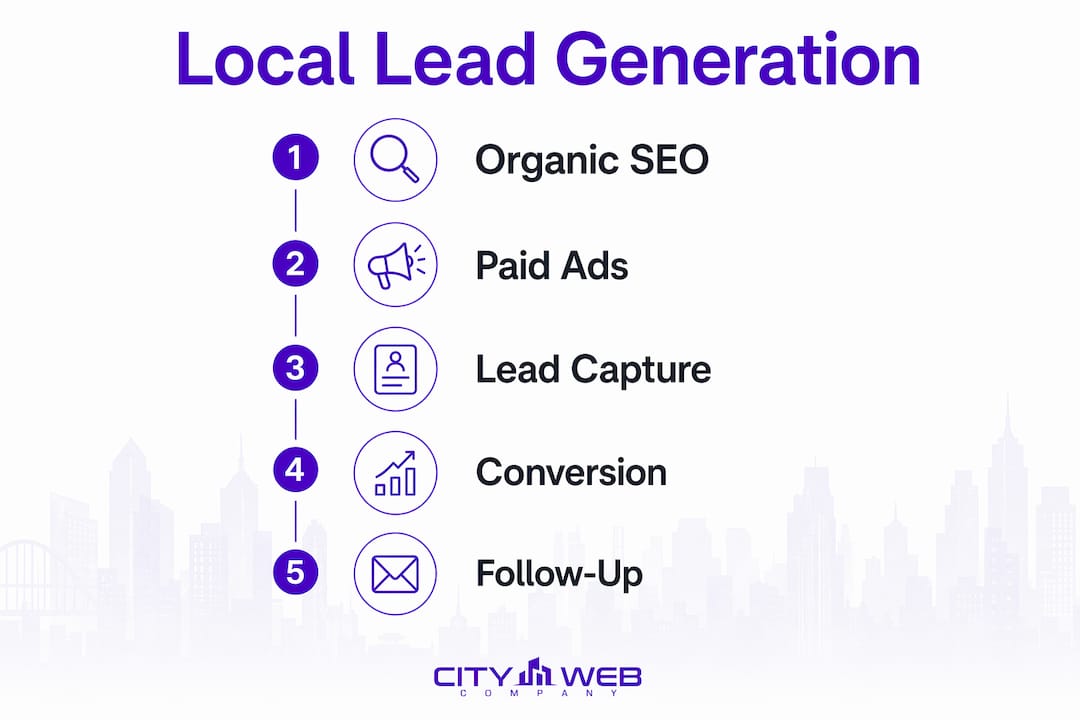
Effective local lead generation strategies combine three layers: organic visibility, paid advertising, and conversion infrastructure. Removing any one of them creates a gap that the other two cannot fill on their own.

Organic visibility through local SEO
Local SEO is the practice of optimizing your online presence so your business appears in location-specific search results. Optimizing your Google Business Profile is the single most critical task in this layer. That means accurate business name, address, and phone number; a complete service list; updated hours; and a steady stream of positive customer reviews. Google uses this data to decide whether your business appears in the local map pack, which sits above standard organic results and captures a disproportionate share of clicks.
Beyond the Google Business Profile, local SEO includes building location-specific pages on your website, earning citations from local directories like Yelp and Angi, and using keywords that reflect how nearby customers actually search. A roofing company in Columbus should target “roof repair Columbus OH,” not just “roof repair.” The geographic modifier is what separates a local lead from a visitor who will never become a customer.
Pro Tip: Keep your business name, address, and phone number identical across every online directory. Even small inconsistencies, like “St.” versus “Street,” can suppress your local search rankings.
Paid local advertising with Google Local Services Ads
Google Local Services Ads use a pay-per-lead model where businesses only pay when a customer contacts them through a call, message, or booking directly from the ad. These ads appear at the very top of Google search results for location-specific queries, above both standard Google Ads and organic results. For a service business, that placement is enormously valuable.
The pay-per-lead model also changes the economics of advertising. Payment occurs only when a qualified lead contacts the business, which eliminates the wasted spend associated with clicks that never convert. A traditional pay-per-click campaign charges you every time someone clicks your ad, whether they call you or bounce immediately. Local Services Ads charge you only for the contact itself.
- Google Local Services Ads appear at the top of search results for service queries in your area
- Businesses earn a “Google Screened” or “Google Guaranteed” badge after a background check, which builds trust with potential customers
- You set a weekly budget and Google distributes leads based on your responsiveness, reviews, and bid
- Leads are delivered directly to your phone or email and managed inside the platform dashboard
Conversion infrastructure: landing pages and lead capture
Visibility alone does not produce revenue. Localized landing pages and lead capture forms are necessary to translate local search traffic into actual sales opportunities. A landing page built for “emergency AC repair in Tucson” will convert at a higher rate than a generic homepage because it matches the exact intent of the searcher.
Lead capture forms should be short. Name, phone number, and a brief description of the problem is enough to start a conversation. Every additional field you add reduces the number of people who complete it. Pair the form with a prominent phone number and, where possible, a live chat option for visitors who prefer not to call.
Pro Tip: Add your city or service area name to the headline of your landing page. “Trusted Pest Control in Austin” outperforms “Trusted Pest Control” every time because it confirms to the visitor that you actually serve their location.
How local lead generation differs from general lead generation
The core difference between local and general lead generation is not just geography. It is intent, economics, and the metrics that define success.
| Factor | Local lead generation | General lead generation |
|---|---|---|
| Geographic scope | Defined radius, typically 10 to 50 miles | National or global audience |
| Customer intent | High intent, immediate need | Variable intent, longer consideration cycle |
| Audience size | Smaller, finite pool | Large, scalable pool |
| Primary channels | Google Local Services Ads, local SEO, Google Business Profile | SEO, content marketing, social ads, email |
| Key success metric | Calls, bookings, walk-ins | Leads, MQLs, pipeline value |
| Budget efficiency | High, due to proximity and intent | Variable, depends on funnel length |
Geographic constraints drive local lead generation metrics, which means optimizing for higher intent and proximity rather than scale is the right approach for local business profitability. A national software company needs thousands of leads to fill a sales pipeline. A local HVAC company needs 20 to 30 qualified calls per month to stay fully booked. The volume targets are completely different, and so are the strategies.
Local lead generation strategies require more targeting than general lead generation because the customer pool is smaller and the margin for wasted spend is lower. A national brand can absorb inefficiency at scale. A local business with a $2,000 monthly marketing budget cannot. Every dollar needs to reach someone within driving distance who has a real, near-term need.
This also affects how you think about competition. In general lead generation, you compete with every business in your category globally. In local lead generation, you compete with the three to five businesses that show up in the same map pack as you. That is a winnable fight, and it is why local SEO and Google Local Services Ads are worth mastering before you invest in broader channels.
How to optimize and convert local leads effectively
Generating a lead is only half the job. Generating leads is only the first step, and fast follow-ups combined with a sales management system are what convert leads into paying customers predictably. Most local businesses lose leads not because their marketing failed, but because their follow-up did.
Here is a practical process for converting local leads at a higher rate:
- Respond within five minutes. Studies across service industries consistently show that response speed is the single largest factor in whether a lead converts. A prospect who called three businesses will hire the first one that picks up or calls back.
- Use the Google Local Services Ads dashboard. Leads are tracked and managed inside the ad platform’s dashboard, which gives you a centralized view of every incoming contact, the ability to mark leads as booked or archived, and a record you can use to dispute invalid charges.
- Set up automated follow-up for missed calls. A text message sent automatically within two minutes of a missed call recovers a significant portion of leads that would otherwise go to a competitor. Tools like Jobber, ServiceTitan, or HubSpot can trigger these messages without manual effort.
- Track lead sources in your CRM. Knowing whether a lead came from Google Local Services Ads, your Google Business Profile, or an organic search result tells you where to invest more and where to cut back. Without attribution, you are guessing.
- Ask for a review after every completed job. Google emphasizes responsiveness and reviews as ranking and ad display factors for Local Services Ads. A business with 200 reviews and a 4.8 rating will receive more lead volume than a competitor with 30 reviews, even at the same bid level.
Pro Tip: Dispute invalid leads inside your Google Local Services Ads dashboard. If a lead called about a service you do not offer or was clearly outside your service area, Google will credit you for that charge. Most businesses never do this and leave money on the table.
Practical local lead generation techniques and tools for 2026
The best practices for local lead generation in 2026 reflect a market where AI-driven search results, voice queries, and zero-click searches have changed how local intent surfaces. The fundamentals still apply, but the execution has evolved.
Google Local Services Ads setup and bidding
Set your Google Local Services Ads to “maximize leads” bidding when you are starting out. This lets Google’s algorithm optimize delivery based on your responsiveness and review score. Once you have 90 days of data, switch to manual bidding to control cost per lead more precisely. Complete your business profile inside the platform fully, including every service category you offer, because Google uses this to match your ads to relevant queries.
Local SEO best practices for 2026
- Optimize your Google Business Profile with posts, photos, and Q&A responses updated at least monthly
- Build individual service area pages on your website for each city or neighborhood you serve
- Earn backlinks from local news sites, chambers of commerce, and industry associations
- Use schema markup on your website to help Google understand your business type, location, and services
- Monitor and respond to every review, positive or negative, within 48 hours
Integrating CRM and email follow-up
A CRM like Jobber, ServiceTitan, or HubSpot connects your lead sources to your follow-up workflows. When a lead comes in from your website form or Google Local Services Ads, the CRM logs it, assigns it to a team member, and triggers a follow-up sequence. Email marketing tools like Mailchimp or Klaviyo can then nurture leads who did not convert immediately with seasonal offers, maintenance reminders, or educational content.
Leveraging reviews and community engagement
| Tactic | Platform | Expected impact |
|---|---|---|
| Review request after job completion | Google, Yelp | Higher Local Services Ads ranking |
| Responding to reviews | Google Business Profile | Improved trust and click-through rate |
| Local community sponsorships | Facebook, Nextdoor | Brand recognition in service area |
| Neighborhood-targeted social ads | Facebook Ads, Instagram | Reach homeowners in specific zip codes |
Conversion assets like landing pages and lead capture mechanisms are a core part of local lead generation, not optional additions. Businesses that treat their website as a digital brochure rather than a lead capture tool consistently underperform competitors who have built pages specifically designed to convert local search traffic.
Why most local businesses get this backwards
Most local business owners I work with have the same problem. They invest in visibility and then wonder why the phone is not ringing. They have a Google Business Profile, maybe even a Google Ads campaign, but their website has no location-specific landing pages, their forms ask for seven fields, and nobody follows up on missed calls until the next morning.
The uncomfortable truth about local lead generation is that the marketing side is often the easier part. Getting your business to appear in front of the right people in your city is a solvable problem with the right tools and budget. The harder part is building the operational infrastructure to handle leads when they arrive. Speed matters more than most business owners realize. A lead that goes unanswered for two hours is, in most service categories, a lost customer.
I have also seen businesses over-invest in tactics that feel productive but do not generate leads. Posting on social media every day, running brand awareness campaigns, and building elaborate email newsletters all have their place. But for a local plumber or pest control company, none of those activities come close to the return on investment of a well-managed Google Local Services Ads account paired with a properly optimized Google Business Profile.
The businesses that win locally are not the ones with the biggest budgets. They are the ones that show up in the right place, respond fast, and ask for the review after every job. That combination compounds over time in a way that no single campaign ever will.
— Matt
How City Web Company helps local businesses generate more leads
City Web Company specializes in building the complete local lead generation system that service businesses need to grow. From Google Local Services Ads management to local SEO services designed specifically for service industries, the agency handles the technical and strategic work so business owners can focus on the job.
City Web Company works with HVAC companies, plumbers, landscapers, pest control operators, med spas, and disaster restoration firms across the country. The team builds location-specific landing pages, manages Google Business Profiles, runs paid ad campaigns, and tracks every lead back to its source. If your business needs a predictable flow of qualified local contacts, explore the full range of services City Web Company offers for local businesses.
FAQ
What is local lead generation in simple terms?
Local lead generation is the process of attracting potential customers in your geographic area and converting their interest into a contact, such as a phone call, form submission, or booking. It focuses on people who are nearby and actively searching for the services you offer.
How do Google Local Services Ads fit into local lead generation?
Google Local Services Ads appear at the top of search results for local service queries and use a pay-per-lead model, meaning you only pay when a customer contacts you directly through the ad. This makes them one of the most cost-efficient paid channels for local service businesses.
What is the difference between a lead and a website visitor?
A website visitor is anyone who lands on your site. A lead is a prospective customer who takes a specific action that signals real interest, such as calling your business, submitting a contact form, or booking an appointment. Tracking leads rather than traffic gives you a more accurate picture of marketing performance.
How quickly should I respond to a local lead?
Responding within five minutes of receiving a lead significantly increases the likelihood of conversion. Google also factors responsiveness into how frequently your Local Services Ads are displayed, so slow follow-up hurts both your conversion rate and your ad visibility.
What are the most effective local lead generation techniques for service businesses?
The most effective techniques are optimizing your Google Business Profile, running Google Local Services Ads, building location-specific landing pages, and consistently collecting customer reviews. Combining these with fast lead follow-up and CRM tracking creates a system that generates and converts leads reliably.
Key takeaways
Local lead generation works because it targets buyers with immediate, location-specific intent, and converts that intent through visibility, paid ads, and fast follow-up systems working together.
| Point | Details |
|---|---|
| Define leads correctly | Count calls, bookings, and form submissions as leads, not website clicks or page views. |
| Combine organic and paid | Local SEO and Google Local Services Ads work best together, covering both organic and top-of-page paid placement. |
| Build conversion infrastructure | Location-specific landing pages and short lead capture forms are required to turn traffic into contacts. |
| Respond fast | Replying within five minutes of a lead arriving is the single most impactful conversion action a local business can take. |
| Track and attribute every lead | Use a CRM and the Google Local Services Ads dashboard to know which channels produce the best leads and adjust spending accordingly. |
Recommended
These articles were popular with other readers too: