

Pass Google Business verification with a video-first checklist. Film one continuous 30 second take, fix flagged issues, and know when to hire help.
Why Improve Website Speed: the Business Case in 2026
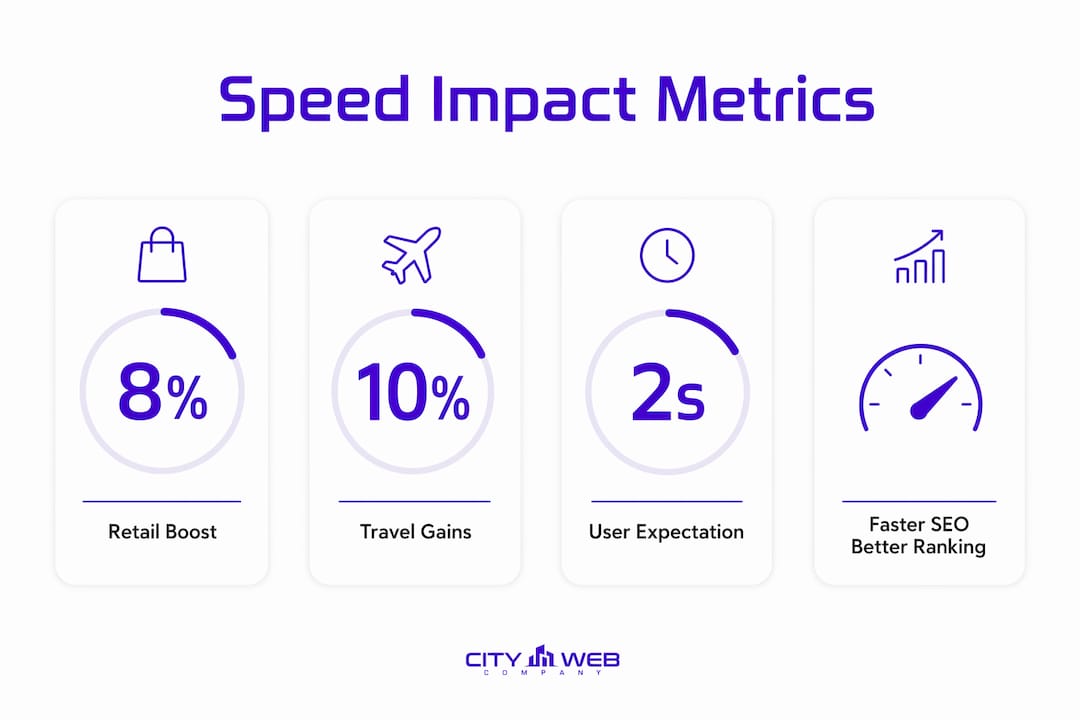
A faster website directly increases revenue. A 0.1-second improvement in load time raises conversion rates by 8% for retail sites and 10% for travel sites. That is not a rounding error. It is the kind of lift most paid ad campaigns spend thousands of dollars chasing.
Here is why site speed deserves a spot on your growth dashboard, not just your developer’s backlog:
- Google’s Core Web Vitals are direct ranking signals, meaning a slow site gets seen by fewer people before it even has a chance to convert them.
- Visitors expect pages to load in 2 seconds or less, and abandonment climbs sharply once load time crosses 3 seconds.
- 70% of consumers say page speed affects their willingness to buy from an online retailer.
- Slow pages create measurable stress responses in users, eroding brand trust before a single word is read.
- Speed improvements compound: better rankings bring more traffic, and that traffic converts at a higher rate.
Table of Contents
Table of Contents
- Key benefits of a faster website
- What actually slows your site down
- How to measure and monitor website speed
- What the research actually shows about speed and revenue
- Key Takeaways
- FAQ
Key benefits of a faster website
Speed touches every metric that matters to a business. The table below maps the core benefits to their measurable outcomes.
| Benefit | What the data shows |
|---|---|
| Higher SEO rankings | Core Web Vitals are a direct Google ranking factor; slow pages also reduce crawl frequency |
| Lower bounce rate | Bounce rate rises steadily with each second of delay, spiking sharply past 5 seconds |
| More conversions | 0.1s faster load time = +8% retail conversions, +10% travel conversions |
| Higher order value | Mobile users spent 9.2% more when site speed improved by 0.1 seconds |
| Stronger brand trust | Fast sites signal competence; slow ones signal unreliability before any interaction |
The SEO angle is easy to underestimate. Google confirmed speed as a ranking signal years ago, and in 2021 expanded that to the full Core Web Vitals framework covering load, interactivity, and visual stability. When two pages offer equally strong content, user experience metrics like speed determine which one ranks above the other. Slow pages also get crawled less often, meaning new content takes longer to appear in search results.
Stat worth knowing: B2C e-commerce pages that load in under one second convert 2.5x more than pages with a five-second load time. For B2B sites, that gap widens to 3x.
The trust dimension is just as concrete. Research shows the stress of a slow-loading page is comparable to watching a horror movie or solving a math problem, and greater than waiting in a retail checkout line. That visceral reaction happens before a visitor reads your headline or sees your offer. Speed is your first impression, and a slow one is hard to recover from.
What actually slows your site down
Most speed problems trace back to a short list of culprits. Understanding them makes the fix obvious.
- Large, uncompressed images. Oversized JPEG and PNG files are the single most common bottleneck. Switching to modern formats like WebP or AVIF, resizing images to their actual display dimensions, and lazy-loading anything below the fold can cut page weight dramatically.
- Uncompressed text files. HTML, CSS, and JavaScript sent at full size add unnecessary load time. Enabling gzip or Brotli compression typically reduces text file sizes by 60–70%, with Brotli squeezing out an additional 15–30% on static assets.
- Heavy JavaScript frameworks and third-party scripts. Every chat widget, analytics pixel, and A/B testing tag adds weight. Each one loads before your content does, and the cumulative effect is a page that feels sluggish even on a fast connection.
- Slow server response time. Front-end optimization only goes so far if the server itself is slow. Cheap or geographically distant hosting sets a performance ceiling that no amount of image compression can overcome.
- No caching or CDN. Without a content delivery network, every visitor fetches assets from the same origin server. A CDN stores copies closer to each visitor’s location, cutting the physical distance data has to travel.
Pro Tip: Audit third-party scripts every quarter. Remove anything that is not actively contributing to conversions. Load the ones you keep asynchronously so they do not block your main content from rendering.
The website design decisions you make at the start of a project set the performance baseline. Retrofitting speed onto a bloated site is harder than building for it from day one.


How to measure and monitor website speed
You cannot improve what you do not measure. These are the tools and metrics that actually matter.
Tools worth using
- Google PageSpeed Insights analyzes a URL and reports real-world Core Web Vitals data alongside lab-based diagnostics. It is free and pulls from actual Chrome user data, so the scores reflect what visitors experience.
- Lighthouse runs inside Chrome DevTools and generates a detailed performance audit with specific recommendations. It is especially useful for testing pages that require authentication or are not publicly indexed.
- GTmetrix provides waterfall charts showing exactly which resources load in what order, making it easier to spot blocking scripts or oversized assets.
- WebPageTest offers advanced testing options including multi-step transactions, geographic test locations, and filmstrip views of how a page renders over time.
Core Web Vitals: the three metrics Google tracks
Google’s Core Web Vitals framework gives you three concrete targets:
- LCP (Largest Contentful Paint): measures how long the main content takes to appear. Target: under 2.5 seconds.
- INP (Interaction to Next Paint): measures how quickly the page responds to user input. Target: under 200 milliseconds.
- CLS (Cumulative Layout Shift): measures visual stability, specifically how much content jumps around as the page loads. Target: under 0.1.
Keeping performance from drifting
Performance regresses with every new feature, plugin, or content update unless speed is tracked as an ongoing KPI. The teams that maintain fast sites treat Core Web Vitals the same way they treat revenue metrics: measured regularly, reviewed in dashboards, and tied to release decisions. A website optimization checklist built around these metrics gives your team a repeatable process rather than a one-time audit.

Pro Tip: Set up automated alerts in Google Search Console for Core Web Vitals regressions. Catching a slowdown the week it happens is far cheaper than diagnosing it three months later.
What the research actually shows about speed and revenue
The business case for improving site speed is one of the most consistently documented findings in digital marketing. A few data points stand out.
| Research finding | Source |
|---|---|
| 0.1s faster load time raises retail conversions by 8% and travel conversions by 10% | Google / Deloitte Milliseconds Make Millions |
| 70% of consumers say page speed affects their willingness to buy | Google / Deloitte Milliseconds Make Millions |
| BBC lost 10% of users for every additional second their site took to load | web.dev |
| B2C pages loading under 1 second convert 2.5x more than 5-second pages | Portent / Lumar |
| Stress from slow pages exceeds the stress of waiting in a retail checkout line | Electroiq |
The pattern is consistent: faster pages produce more conversions, higher order values, and better engagement across every industry studied.
User expectations have only tightened over time. Visitors expect a page in 2 seconds or less, and abandonment rises sharply once load time crosses 3 seconds. On mobile, where the majority of US web traffic now originates, the stakes are even higher. Mobile pages take significantly longer to load than desktop pages on average, which means most sites are underperforming for their largest audience.
Speed also compounds through SEO. A faster site earns better rankings, which brings more traffic, which converts at a higher rate because the site is fast. That compounding effect is why boosting SEO and conversions through speed improvements tends to outperform channel-specific tactics that only move one metric at a time.
The cognitive dimension matters too. Slow sites do not just frustrate users; they create a stress response that attaches to your brand. That association persists even after the page loads. Building trust online starts with the first milliseconds of a visit, and speed is the clearest signal of a site that respects its visitors’ time.
If your site speed is not already a line item on your local business growth strategy, it is costing you conversions you will never see.
City Web Company builds and optimizes websites for local service businesses that need to perform, not just look good. If your site is slow, you are paying for traffic that is not converting. Get started with City Web Company to find out exactly where your site is losing visitors and revenue.
Key Takeaways
Improving website speed is one of the highest-return investments in digital marketing because it simultaneously lifts conversions, SEO rankings, and brand trust.
| Point | Details |
|---|---|
| Speed drives conversions | A 0.1-second improvement raises retail conversions by 8% and travel conversions by 10%. |
| Core Web Vitals affect rankings | LCP, INP, and CLS are direct Google ranking signals; target LCP under 2.5s. |
| Users abandon at 3 seconds | Visitors expect pages in 2 seconds or less and leave when load time crosses 3 seconds. |
| Slow sites erode trust | Stress from slow pages exceeds the stress of waiting in a retail checkout line. |
| Monitor speed continuously | Performance regresses with every update unless speed is tracked as an ongoing KPI. |
FAQ
Why is website speed important for SEO?
Google uses Core Web Vitals as direct ranking signals, and slow pages are crawled less frequently. When two pages offer equally strong content, speed determines which ranks higher.
What is the 3-second rule in web design?
Visitors begin abandoning a site when load time exceeds 3 seconds. Research shows most users expect a page to load in 2 seconds or less, so 3 seconds is effectively the abandonment threshold.
How does page speed affect conversion rates?
A 0.1-second improvement in load time increases retail conversions by 8% and travel conversions by 10%, according to Google’s Milliseconds Make Millions research. Faster pages also produce higher average order values.
Why should I keep monitoring speed after optimizing it?
Website performance regresses with every new feature, plugin, or content update. Treating Core Web Vitals as ongoing KPIs rather than a one-time fix prevents gradual slowdowns from eroding the gains you worked to achieve.
How does slow loading affect brand trust?
Research shows the stress response to a slow-loading page is comparable to watching a horror movie and exceeds the frustration of waiting in a retail checkout line. That negative association attaches to your brand before a visitor reads a single word.
Recommended
These articles were popular with other readers too: