
Pass Google Business verification with a video-first checklist. Film one continuous 30 second take, fix flagged issues, and know when to hire help.
Why Your Business Needs a Website to Grow in 2026
A business website is the single most effective digital asset for building credibility, attracting customers, and growing revenue for local service businesses. Without one, your plumbing company, landscaping service, or HVAC business is invisible to the 8.5 billion daily Google searches processed every day. That number represents real people in your city looking for exactly what you offer. Understanding why your business needs a website is not a theoretical exercise. It is a practical decision with direct consequences for your revenue, your reputation, and your long-term survival.
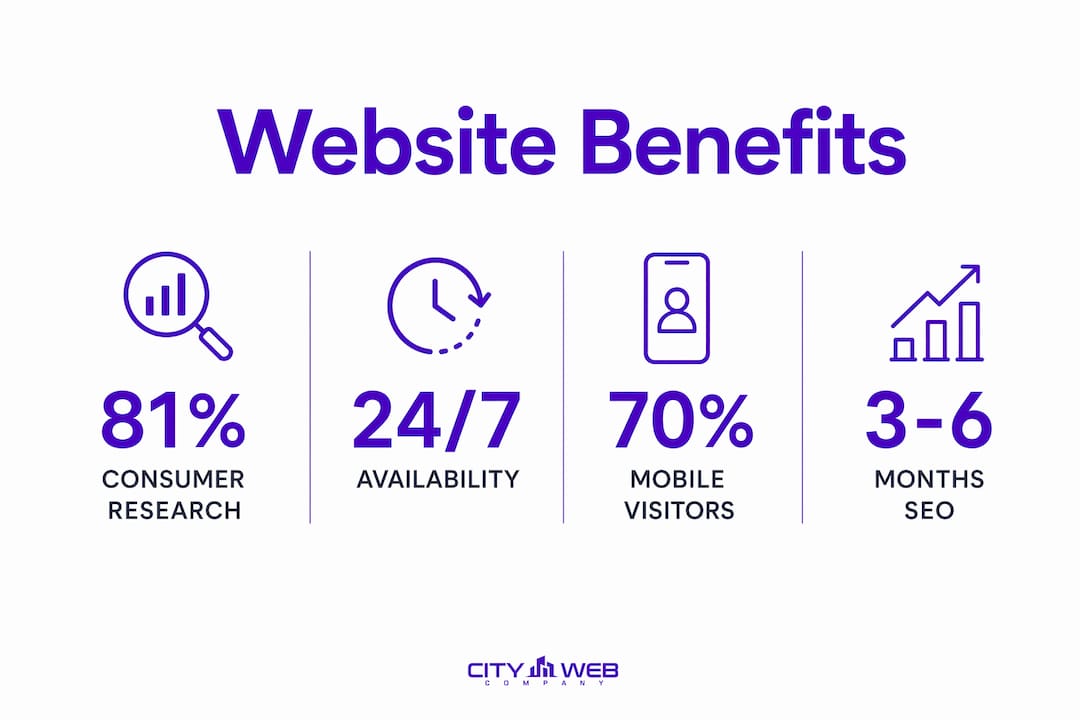
81% of consumers research products and services online before making a purchasing decision. That means the overwhelming majority of your potential customers will look you up before they ever call. A website is your owned digital real estate. Unlike a Facebook page or a Google Business Profile, no algorithm controls what you show there, and no platform can take it away.
Table of Contents
Why your business needs a website for visibility and credibility
A website makes your business discoverable to customers who are actively searching for your services. Without one, you are not just missing out on leads. You are handing them directly to competitors who do have a site.
Google processes those 8.5 billion daily searches across every category, including home services, pest control, moving companies, and med spas. Local service businesses that appear in those results capture customers at the exact moment of intent. That is the highest-value moment in any sales process.
Credibility is the second major factor. Professional websites with custom domains build significantly more customer trust than generic social media profiles or no online presence at all. A custom domain like yourcompany.com paired with a matching professional email address signals that your business is established and serious.
Here is what a credible website communicates to a first-time visitor:
- You are legitimate. A well-designed site with your license information, service area, and contact details removes doubt immediately.
- You are experienced. Testimonials, before-and-after photos, and case studies show proof of work that a Facebook post cannot replicate.
- You are reachable. A clear phone number, contact form, and address tell customers exactly how to hire you.
- You are consistent. Your branding, tone, and messaging stay the same every time someone visits, regardless of what social platforms are doing.
Businesses without websites are effectively invisible to online customers. That is not a competitive disadvantage. It is an existential one.
How 24/7 availability turns your website into a sales engine
A physical office or storefront closes at 5 p.m. Your website does not. This is one of the most underappreciated advantages of a website for businesses of any size.
A customer searching for a disaster restoration company at 11 p.m. after a pipe bursts is not going to wait until morning. They will call the first business whose website answers their questions, shows their credentials, and makes it easy to request service. If your site is not there, that job goes to someone else.
A website centralizes all customer communication channels into one place. Contact forms, live chat, appointment booking systems, and FAQ pages all work around the clock without requiring you or your staff to be available. A landscaping company can collect quote requests overnight and wake up to a full inbox. An HVAC business can let customers schedule tune-ups without a single phone call.
Site speed is the one technical factor that directly affects whether any of this works. Over 53% of mobile visitors abandon websites that load slowly. A slow site does not just frustrate visitors. It costs you real jobs.
Pro Tip: Test your site speed using Google PageSpeed Insights. A score below 70 on mobile means you are losing visitors before they ever see your services. Fix image sizes and reduce unnecessary scripts first.
The 24/7 nature of a website also builds a relationship with customers before you ever speak to them. By the time they call, they already know your services, your prices, and why they should trust you. That makes the sales conversation shorter and the close rate higher.
Why owning your website beats relying on social media
Social media platforms are useful tools. They are not a substitute for a website. The distinction matters because the two serve fundamentally different purposes.
When you post on Instagram or Facebook, the platform controls who sees it. Algorithm changes can cut your organic reach overnight with no warning and no recourse. Social media alone cannot substitute for a website because it limits your control over brand narrative, customer data, and visibility. This concept is sometimes called digital sharecropping. You are building on land you do not own.
A website gives you complete control over the following:
- Messaging and tone. You decide exactly what your brand says and how it says it, without character limits or feed competition.
- Customer data. Every form submission, phone call, and booking on your site belongs to you. Social platforms keep that data for themselves.
- Testimonials and social proof. You can curate your best reviews, display case studies, and feature before-and-after photos in a format that serves your sales process.
- User experience. Top-performing local service websites are built so customers can call or book an appointment within 2–3 clicks. That level of precision is impossible on a social profile.
The benefits of a business website extend beyond marketing. Your website is a business asset that appreciates over time as it accumulates content, reviews, and search authority. A Facebook page does not do that.
Pro Tip: Use your website as the destination for all your social media posts. Drive followers from Instagram or Facebook to your site, where you control the next step.
How a website powers digital marketing and measurable growth
A website is the foundation that every other digital marketing channel depends on. Without it, your Google Ads have nowhere to send traffic. Your email campaigns have no landing page. Your SEO has no content to rank.

Websites provide measurable insights through analytics on visitor behavior, page views, and conversion rates. That data tells you which services get the most interest, where visitors drop off, and which marketing channels are actually sending you customers. You cannot get that from a social media page.
The table below shows how a website connects to each major digital marketing channel and what it enables:
| Marketing channel | What your website enables |
|---|---|
| Local SEO | Ranks your service pages for searches like “plumber near me” or “HVAC repair [city]” |
| Google Ads (PPC) | Sends paid traffic to targeted landing pages built for conversion |
| Email marketing | Captures subscriber emails through forms and drives repeat business |
| Content marketing | Publishes blog posts and guides that build authority and attract organic traffic |
| Retargeting ads | Tracks visitors with pixels and shows them ads after they leave your site |
| Social media | Provides a destination link for every post, story, and ad you run |
City Web Company builds websites for local service businesses specifically to support this kind of full-funnel marketing. A site that is not connected to your local digital marketing strategy is leaving money on the table.
The analytics piece is particularly powerful for small businesses. Knowing that 70% of your site visitors come from mobile devices, for example, tells you to prioritize mobile design. Knowing that your “emergency services” page gets the most traffic tells you to invest more in that offering.
How a website scales your business beyond local limits
A physical business is constrained by geography. A website is not. This is one of the most direct advantages of a website for businesses looking to grow beyond their immediate area.
A moving company in Grand Junction, Colorado can use its website to target customers in surrounding cities and counties. A pest control business can rank for searches in multiple zip codes. A med spa can attract clients from neighboring towns who are willing to drive for the right provider. None of this is possible without a web presence that is optimized for those locations.
The table below illustrates the difference in reach between a traditional local business and one with an active website:
| Business type | Traditional reach | Website-augmented reach |
|---|---|---|
| HVAC company | Walk-ins and word of mouth | Ranks for searches across entire service area |
| Landscaping service | Referrals and yard signs | Captures leads from multiple zip codes via SEO |
| Disaster restoration | Local directory listings | Appears in emergency searches 24/7 across region |
| Moving company | Local ads and flyers | Attracts long-distance and cross-city bookings online |
A website also supports online sales, custom quote forms, and service booking tools that remove friction from the buying process. Customers who can request a quote at midnight are more likely to follow through than those who have to remember to call during business hours.
The importance of having a website grows as more competitors in your industry go online. Every local service business that builds a strong web presence raises the bar for everyone else in the market.
Key takeaways
A business website is not optional for local service businesses in 2026. It is the owned digital asset that drives visibility, credibility, 24/7 customer engagement, and measurable growth across every marketing channel.
| Point | Details |
|---|---|
| Visibility is non-negotiable | 8.5 billion daily Google searches mean customers are looking for you right now. |
| Credibility requires ownership | A custom domain and professional site build trust that social profiles cannot match. |
| 24/7 availability drives revenue | Contact forms and booking tools capture leads while you sleep. |
| Owned media beats rented platforms | Your website gives you full control over data, branding, and customer experience. |
| Analytics enable smarter decisions | Visitor data shows which services and channels actually drive conversions. |
What I’ve learned from watching local businesses win and lose online
I have seen the same pattern repeat itself across dozens of local service businesses. The ones that treat their website as a core business asset grow. The ones that treat it as an afterthought stagnate, even when their actual service quality is excellent.
The most common mistake I see is building a website and then ignoring it. An outdated site with a 2019 copyright notice, broken contact forms, or photos from a previous owner does more damage than no site at all. It signals neglect. Customers notice.
The second mistake is building a site that looks good but does not function well on mobile. Most local service searches happen on phones. If your site takes more than three seconds to load on a mobile connection, you are losing the customer before they read a single word. User experience optimization is not a luxury. It is the price of entry.
The businesses I have watched succeed online share one trait: they treat their website as a living part of their operation. They update their service pages when they add offerings. They add new testimonials after strong jobs. They publish content that answers the questions their customers actually ask. That consistency compounds over time into search authority, customer trust, and a steady flow of inbound leads.
The long-term value of owning your digital presence is real. A well-maintained website built today will still be generating leads three years from now. A Facebook post from three years ago is invisible. That is the difference between renting and owning.
— Matt
How City Web Company builds websites that work for local businesses
Local service businesses need websites that do more than look professional. They need sites that rank, convert, and connect to a broader marketing strategy.
City Web Company specializes in professional website design for local service businesses across industries including HVAC, plumbing, landscaping, pest control, moving, and disaster restoration. Every site is built to load fast, rank in local search, and turn visitors into paying customers. The team also connects your website to a full local lead generation strategy that includes SEO, Google Ads, and content marketing. If your current site is not generating leads, or if you do not have one yet, City Web Company can fix that.
FAQ
Does my business really need a website if I have social media?
Yes. Social media platforms limit your control over reach, data, and brand narrative. A website is owned digital real estate that no algorithm can take away.
How does a website boost sales for local service businesses?
A website captures leads 24/7 through contact forms, booking tools, and service pages that rank in local search results, converting visitors into paying customers at any hour.
What makes a business website credible to new customers?
A custom domain, professional design, visible contact information, and real customer testimonials are the core signals that build trust with first-time visitors.
How long does it take for a website to show results?
SEO results typically build over 3–6 months, while a well-designed site with paid advertising can generate leads within days of launch.
Why does site speed matter for a local service business?
Over 53% of mobile visitors abandon slow-loading websites. For a local service business where most searches happen on phones, a fast site directly determines how many leads you capture.
Recommended
These articles were popular with other readers too: