

Pass Google Business verification with a video-first checklist. Film one continuous 30 second take, fix flagged issues, and know when to hire help.
Examples of Law Firm Websites That Convert in 2026
The best examples of law firm websites share three non-negotiable traits: mobile-first performance, ADA compliance built to WCAG 2.1 AA standards, and E-E-A-T trust signals that Google’s quality raters can verify. These are not optional enhancements. They are the baseline for any law firm site that expects to rank, convert, and retain clients in 2026. This article breaks down what separates high-performing attorney website samples from the average, with specific design patterns, real criteria, and a structured comparison you can use as a blueprint for your own firm’s site.
Table of Contents
1. Mobile-first and accessible law firm website examples
More than 60% of legal website traffic arrives from mobile devices. That single fact makes mobile-first design the most consequential decision in law firm web development. A site built for desktop and then adapted for mobile will always underperform one designed mobile-first from the ground up.
The strongest law office website examples in this category share a specific set of features. Look for:
- Sticky click-to-call buttons that remain visible as users scroll on mobile
- Sub-2-second load times achieved through adaptive image loading and lean code
- Tap targets sized at 44×44 pixels minimum so thumbs can navigate without frustration
- Navigation menus that collapse cleanly into a hamburger or bottom-bar format on small screens
- Contact forms that auto-fill on mobile and require minimal typing
Accessibility is where most law firm sites fall short. True ADA compliance requires more than installing an overlay widget. The ADA mandates auxiliary aids and services, and the technical standard is WCAG 2.1 AA. That means keyboard navigability, sufficient color contrast ratios, descriptive alt text on every image, and screen reader compatibility tested by a human reviewer, not just an automated scanner.
Firms like Morgan & Morgan and Jacoby & Meyers have invested in accessibility audits that go beyond automated tools. Their sites pass keyboard navigation tests, include skip-to-content links, and use semantic HTML that screen readers can parse correctly. These are the details that separate compliant sites from sites that only appear compliant.
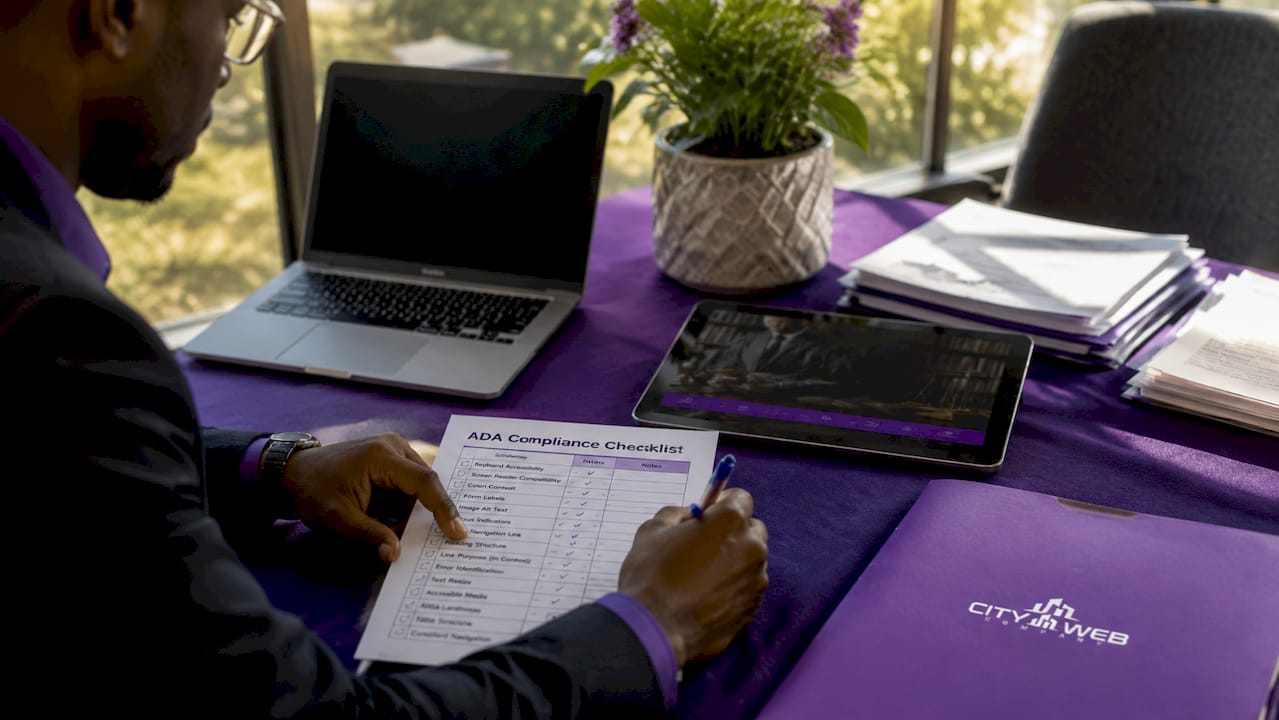
Pro Tip: Run your firm’s site through both an automated tool like WAVE and a manual keyboard-only navigation test. If you cannot reach every page element using only the Tab and Enter keys, your site is not ADA compliant regardless of what any overlay claims.
2. Law firm websites with strong E-E-A-T and trust signals
Google’s E-E-A-T framework (Experience, Expertise, Authoritativeness, Trustworthiness) applies with particular force to legal content because law falls squarely into the YMYL category. Google’s Search Quality Rater Guidelines require that YMYL legal content demonstrate verifiable credentials and real-world experience. A generic “Our Team” page with headshots and vague bios does not meet this bar.
The best law firm websites in 2026 handle E-E-A-T through a specific architecture:
- Named attorney authorship on every blog post and practice area page, with a linked bio that includes bar admission dates, state licenses, and years of practice
- Credential badges from peer recognition programs such as Super Lawyers, Martindale-Hubbell AV Preeminent, and Best Lawyers in America displayed on both the homepage and individual attorney pages
- Case results pages with specific outcomes (settlement amounts, verdict figures, charges dismissed) rather than vague success language
- Client testimonials on high-traffic pages, ideally pulled from Google Reviews or Avvo with verified attribution
Attorney bios that include media appearances, published articles, and speaking engagements produce measurably stronger trust signals than bios listing only education and bar admissions. A bio that says “Featured in Forbes, quoted in the Chicago Tribune, and speaker at the 2025 ABA Annual Meeting” tells Google and the prospective client something verifiable and specific.
Schema markup amplifies all of this. Implementing LegalService schema and Person schema on attorney pages tells search engines exactly who the attorney is, what they practice, and where they are licensed. Named author pages marked up with LegalService schema improve search visibility in ways that plain HTML cannot replicate.
Backlinks from legal directories like Avvo and Justia, as well as state bar association websites, function as third-party authority signals that reinforce the on-page trust work. Consistent NAP (name, address, phone) information across these directories is a prerequisite, not a bonus.
3. Conversion-focused design in top attorney website samples
A law firm’s homepage is a conversion system, not a brochure. CTAs placed within the first viewport combined with adjacent credibility markers significantly improve click-through rates. That means a prospective client should see a contact form or call button before they scroll a single pixel.
Here is how the best law firm homepage examples structure their conversion architecture:
| Design element | Weak implementation | Strong implementation |
|---|---|---|
| Primary CTA | Buried below the fold or in the footer | Visible in the hero section before any scrolling |
| Trust stat proximity | Awards page linked separately | Client count or case results displayed next to the CTA |
| Mobile CTA | Standard button that blends into the page | Sticky click-to-call bar pinned to the bottom of the screen |
| Contact form | Long form requiring 8+ fields | Short form with name, phone, and case type only |
| Social proof | Generic “satisfied clients” language | Specific numbers: “Over 10,000 clients represented since 1998” |
Conversion architecture in law firm web design prioritizes trust signal placement near CTAs and mobile UX patterns proven to increase contact form submissions. The firms that execute this well treat every element of the hero section as a deliberate choice. The headline addresses the client’s problem. The subheadline states the firm’s specific advantage. The CTA uses action language (“Get a Free Consultation” beats “Contact Us”). And a trust stat sits within visual proximity of the button.
Pro Tip: A/B test your hero section CTA copy with two versions: one that names the practice area (“Talk to a Personal Injury Attorney”) and one that names the outcome (“Find Out What Your Case Is Worth”). Outcome-focused language consistently outperforms practice-area language in legal verticals.
Sticky CTAs and click-to-call buttons on mobile reduce the friction between intent and contact. A mobile visitor who has to scroll back to the top to find a phone number will often leave instead. Pinning a call button to the bottom of the mobile viewport eliminates that friction entirely.
4. Design style comparison across law firm website examples
Law firm website design is not one-size-fits-all. The right aesthetic depends on practice area, client demographics, and the authority positioning the firm wants to project. The table below maps the four dominant design styles to their typical features and best-fit firm types.
| Style | Visual traits | Typical features | Best fit |
|---|---|---|---|
| Modern minimalist | White space, sans-serif fonts, bold photography | Fast load times, clean navigation, strong CTAs | Personal injury, family law, immigration |
| Classic authority | Dark navy or charcoal, serif fonts, formal imagery | Detailed attorney bios, credential displays, formal tone | Corporate law, estate planning, litigation |
| Boutique editorial | Custom illustration, muted palettes, editorial layout | Long-form content, thought leadership, niche blog | IP law, entertainment law, niche practices |
| Niche specialty | Practice-specific imagery, direct messaging, local focus | Hyper-targeted CTAs, local SEO optimization, community proof | Criminal defense, DUI, workers’ compensation |
Modern minimalist design dominates personal injury and family law because it loads fast, reads clearly on mobile, and puts the CTA front and center without visual clutter. Classic authority design works for BigLaw and estate planning firms because their clients expect gravitas and formality before they trust a firm with a complex transaction or a multi-million dollar estate.
Boutique editorial design is the fastest-growing category in 2026. Firms specializing in entertainment law, intellectual property, or startup counsel are adopting editorial aesthetics borrowed from media brands. These sites use custom illustration, long-form content hubs, and thought leadership positioning to attract sophisticated clients who research extensively before hiring.
Niche specialty sites prioritize speed and directness over aesthetics. A criminal defense firm’s homepage needs to answer “Can you help me tonight?” before it answers anything else. These sites often feature 24/7 availability messaging, local phone numbers in the header, and client testimonials from people in similar situations.
5. What makes a law firm homepage example actually work
The homepage is the highest-traffic page on most law firm sites, and it carries the heaviest conversion burden. Successful law firm homepage examples share a structure that is less about visual creativity and more about information hierarchy.
The hero section should answer three questions in under five seconds: What does this firm do? Who do they serve? How do I contact them? Firms that bury their practice area in a tagline like “Justice for All” fail the first question immediately. Firms that lead with “Chicago Personal Injury Attorneys Fighting for Maximum Compensation” pass all three.
Below the hero, the strongest homepages follow a consistent pattern. A brief firm overview with specific founding year and case volume. A practice area grid with clear, clickable categories. An attorney roster with photos and linked bios. A case results or testimonials section with specific figures. A secondary CTA before the footer. This sequence mirrors how prospective clients actually evaluate a firm: they confirm the practice area, assess the attorneys, look for proof of results, and then decide to contact.
The law firm website optimization guide from City Web Company covers this hierarchy in detail, including how to structure internal linking between practice area pages and attorney bios to maximize both SEO authority and user navigation.
Page speed is a homepage issue as much as a technical one. A homepage that loads in 4 seconds on mobile loses a significant share of visitors before they see a single word. Compressing images, minimizing JavaScript, and using a content delivery network are not developer concerns. They are conversion concerns.
6. Law firm site inspiration from niche and specialty practices
Niche law firms produce some of the most instructive examples of law firm websites because they cannot rely on brand recognition. They have to earn trust faster and more specifically than a large general practice firm.
Immigration law firms like Fragomen and Berry Appleman & Leiden use multilingual site architecture, country-specific practice area pages, and visa timeline tools that serve a highly specific client need. These tools keep visitors on the site longer and position the firm as a resource before the client ever contacts an attorney.
Workers’ compensation firms often feature injury-specific landing pages (“Forklift Accident Attorney,” “Construction Fall Lawyer”) that target long-tail search queries with high conversion intent. Each page functions as a mini-homepage with its own CTA, testimonials, and case results relevant to that specific injury type.
Criminal defense firms face a unique trust challenge. Their clients are often in crisis and searching at odd hours. The best criminal defense sites feature 24/7 live chat, prominently displayed after-hours phone numbers, and homepage messaging that addresses fear and urgency directly. Phrases like “Arrested Tonight? Call Now” outperform generic firm descriptions for this audience.
The law firm website essentials guide published by City Web Company identifies these niche-specific patterns as among the highest-leverage improvements a specialty firm can make to its site.
7. SEO and content structure in successful law firm websites
A law firm website that looks great but ranks on page three of Google is not a successful website. The technical and content structure of a site determines whether it attracts organic traffic in the first place.
Practice area pages are the workhorses of law firm SEO. Each page should target a specific, geographically qualified keyword (“Denver car accident attorney”), include a named attorney as the content author, and contain at least 800 words of substantive legal information. Thin pages with 200 words of generic text do not rank for competitive legal keywords.
Blog content authored by named attorneys with linked bios serves a dual purpose. It builds E-E-A-T signals for Google and provides shareable content for social media and email marketing. A blog post titled “What to Do After a Slip and Fall in Texas” authored by a named Texas personal injury attorney with a linked bio and bar admission date carries far more SEO weight than the same post published under a generic “Admin” username.
SEO strategies for attorneys require consistent attention to local signals: Google Business Profile optimization, consistent NAP citations across directories, and location-specific landing pages for firms serving multiple cities. A firm with offices in three cities needs three distinct location pages, not one page that lists all three addresses.
Internal linking between practice area pages, attorney bios, and blog content creates a content architecture that distributes authority across the site and helps search engines understand the firm’s topical expertise. A personal injury firm’s blog post about car accidents should link to the car accident practice area page, which should link to the lead attorney’s bio, which should link back to the practice area. This triangle of links reinforces relevance at every node.
Key takeaways
The best law firm websites in 2026 succeed because they combine mobile-first performance, verified E-E-A-T signals, and conversion architecture that removes friction between visitor intent and client contact.
| Point | Details |
|---|---|
| Mobile-first is non-negotiable | Over 60% of legal traffic is mobile; design for the phone screen first, desktop second. |
| E-E-A-T requires specificity | Named attorneys, bar admissions, case results, and schema markup are the minimum for Google trust. |
| CTAs belong above the fold | Place contact forms and call buttons in the hero section, adjacent to trust stats, before any scrolling. |
| Design style must match firm type | Modern minimalist suits personal injury; classic authority suits corporate and estate law. |
| ADA compliance needs human review | Automated overlays do not satisfy WCAG 2.1 AA; manual testing and ongoing audits are required. |
What I actually see working in law firm web design right now
I have reviewed hundreds of attorney website samples over the past several years, and the gap between firms that treat their website as a marketing asset and those that treat it as a digital business card has never been wider. The firms winning in search and in client acquisition share one mindset: they build for the prospective client’s decision process, not for the firm’s ego.
The trend I find most underutilized is video on attorney bio pages. A 90-second video of the lead attorney explaining their approach to a case does more for trust than three paragraphs of credentials. Prospective clients are hiring a person, not a firm. Video makes that person real before the first phone call.
I am also watching AI-driven content personalization become a real differentiator. Firms that serve multiple practice areas are beginning to use behavior-based content delivery: a visitor who lands on a car accident page sees a homepage experience tailored to personal injury, while a visitor from a business formation search sees a different version. This is not science fiction. It is available today through tools like Mutiny and Optimizely, and the early adopters in legal are seeing measurable conversion lifts.
The uncomfortable truth about ADA compliance is that most law firm sites are one lawsuit away from a significant problem. The volume of ADA web accessibility lawsuits has grown steadily, and law firms are not exempt. Firms that invest in genuine WCAG 2.1 AA compliance now are protecting themselves from the same type of litigation they may handle for other clients.
The balance I keep coming back to is this: a law firm website has to be beautiful enough to signal authority and fast enough to keep a mobile visitor engaged. Neither alone is sufficient. The firms that get both right are the ones worth studying.
— Matt
Build a law firm website that actually wins clients

City Web Company designs law firm websites built around the criteria that matter: mobile-first architecture, verified ADA compliance, and conversion layouts that turn visitors into consultations. The team implements E-E-A-T content structures, attorney bio optimization, and schema markup that improve both search rankings and client trust. If your current site is not generating consistent leads, the problem is almost always structural, not cosmetic. Learn more about how digital marketing for law firms works in practice, or explore City Web Company’s custom web design services to see what a conversion-focused rebuild looks like for a firm at your stage.
FAQ
What makes a law firm website effective in 2026?
An effective law firm website combines mobile-first design, WCAG 2.1 AA accessibility compliance, and E-E-A-T trust signals including named attorney bios, bar admissions, and verifiable case results. Conversion architecture with above-the-fold CTAs and adjacent trust stats is the third pillar.
How important is ADA compliance for law firm websites?
ADA compliance is both a legal requirement and a conversion factor. Sites that meet WCAG 2.1 AA standards serve a broader audience and reduce exposure to accessibility lawsuits, which have increased significantly in recent years.
Where should a law firm place its contact form?
The primary contact form or call-to-action should appear in the hero section of the homepage, visible before any scrolling. Placing it adjacent to a trust stat (client count, case results figure, or award badge) increases submission rates.
What is E-E-A-T and why does it matter for law firm sites?
E-E-A-T stands for Experience, Expertise, Authoritativeness, and Trustworthiness. Google applies it with particular rigor to legal content because law is a YMYL (Your Money or Your Life) category. Firms that publish named attorney content with verifiable credentials rank higher and convert better.
How many pages does a law firm website need?
A law firm site needs at minimum one page per practice area, one page per attorney, a homepage, a contact page, and a blog. Firms serving multiple cities need location-specific landing pages for each market to compete in local search results.
These articles were popular with other readers too: