

Pass Google Business verification with a video-first checklist. Film one continuous 30 second take, fix flagged issues, and know when to hire help.
Search engine ranking explained: a guide for local business owners
TL;DR:
- Search rankings depend on signals like relevance, reviews, proximity, and mobile usability.
- Consistent effort in GBP updates, review generation, and local content improves ranking.
- Ongoing activity and trust signals are vital; rankings are not permanent but reflect current relevance.
Most local service businesses have a website and a Google listing. But showing up in search results and actually being found by customers ready to hire are two completely different things. Search engine ranking is the process by which Google determines the order of web pages and business listings in search results, and it shapes whether a potential customer calls you or your competitor. Many owners assume that just being listed is enough. It is not. This guide breaks down exactly how ranking works, what signals drive it, and what you can do right now to climb higher in local search results.
Table of Contents
Table of Contents
- What is search engine ranking?
- Key signals that impact search ranking
- Local SEO strategies to improve search engine ranking
- Common pitfalls and misconceptions of search ranking
- A fresh perspective: What most local businesses miss about search engine ranking
- Boost your search engine ranking with expert support
- Frequently asked questions
Key Takeaways
| Point | Details |
|---|---|
| Ranking basics | Search engine ranking determines where your business appears in local search results. |
| SMB priorities | Optimizing GBP, earning reviews, and being mobile-friendly are the top strategies for local success. |
| Review impact | Consistent, quality reviews can increase your odds of appearing in the top results by 40% or more. |
| Common mistakes | Avoid keyword stuffing and neglecting proximity or review strategies, as these undermine ranking. |
| Expert support | Targeted SEO services help small business owners leap ahead in local search rankings. |
What is search engine ranking?
Search engine ranking refers to the position your business or web page holds when a user searches for a relevant term on Google or another search engine. If you run an HVAC company and someone searches “AC repair near me,” your ranking determines whether you show up first, fifth, or not at all on that results page. Position matters enormously. Studies consistently show that businesses in the top three results capture the large majority of clicks, while those on page two might as well be invisible.
Google’s algorithm uses hundreds of signals including relevance, quality, usability, and context to decide where your business lands. These signals work together, not in isolation. Relevance means how closely your content matches what the user is actually searching for. Quality refers to the credibility and trustworthiness of your website and business listing. Usability covers how easy your site is to navigate, especially on a phone. Context includes factors like the user’s location and search history.
For local service businesses, ranking happens in two distinct places. First, there is the Local Pack, sometimes called the Map Pack or 3-Pack, which displays three local businesses prominently at the top of results with a map. Second, there is the organic results section below, where traditional web pages are listed. Both matter. Winning in the Local Pack drives phone calls and direction requests. Ranking well in organic results builds long-term trust and traffic.
Here is a quick overview of the main ranking categories and what drives each:
| Ranking type | Where it shows | Primary signals |
|---|---|---|
| Local Pack (Map Pack) | Top of results with map | Google Business Profile, reviews, proximity |
| Organic results | Below the map | Website content, backlinks, usability |
| Featured snippet | Above all results | Clear, concise answers on your web page |
| Voice search results | Smart speakers, mobile | Conversational content, fast load times |
Key factors Google weighs when ranking local businesses:
- Relevance: Does your business match what the user needs?
- Distance: How close is your business to the searcher?
- Prominence: How well-known and trusted is your business online?
- Content quality: Is your website informative and accurate?
- User experience: Does your site load fast and work on mobile?
Understanding these factors is the first step. If you want to go deeper on specific vocabulary used in SEO, the SEO terms explained resource from City Web Company is a solid starting point for business owners who are new to the terminology.
The key takeaway here: ranking is not an accident or a lottery. It is the result of clear, consistent signals that tell Google your business is relevant, trustworthy, and ready to serve local customers.
Key signals that impact search ranking
Understanding ranking is key. Let’s go deeper into exactly what signals drive it for local service businesses in 2026.
Not all ranking signals carry equal weight. For local businesses, a handful of factors tend to move the needle most. Prioritizing GBP completeness, review generation, proximity-optimized pages, and mobile user experience gives local SMBs the strongest foundation for ranking improvement.
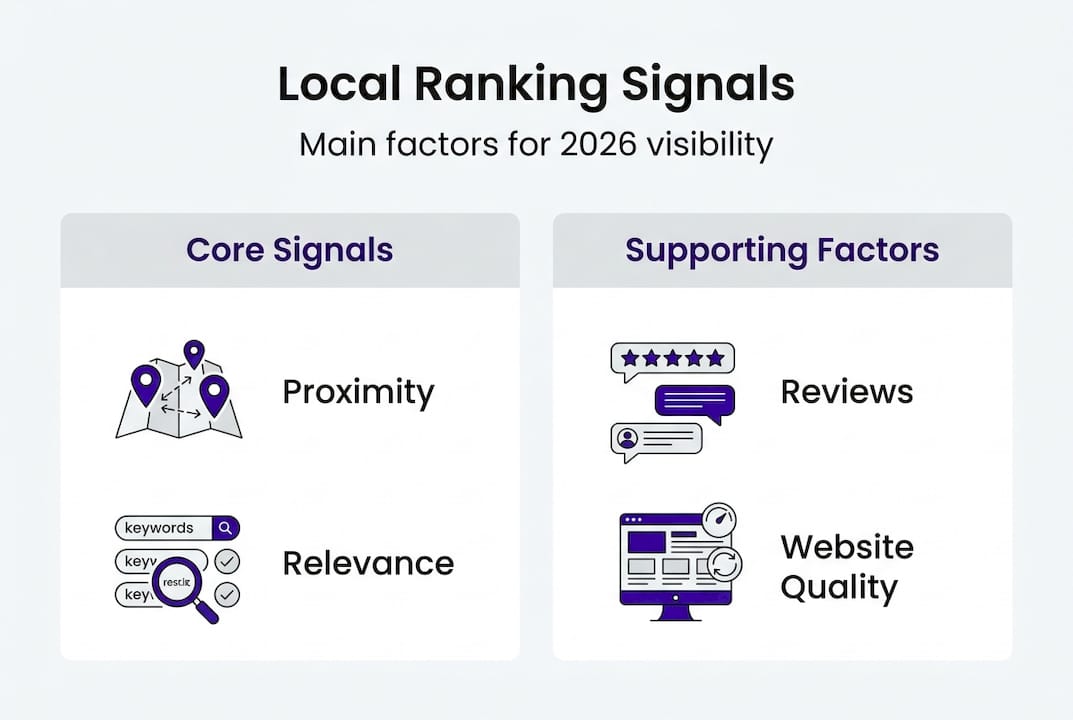
Here is a comparison of high-impact versus low-impact ranking activities for local businesses:
| High-impact activity | Low-impact activity |
|---|---|
| Completing and updating Google Business Profile | Submitting to dozens of minor directories |
| Generating fresh, keyword-rich reviews | Buying low-quality backlinks |
| Building location-specific service pages | Keyword stuffing page titles |
| Improving mobile page speed | Changing font styles on your website |
| Responding to every review | Posting on social media without a strategy |
Here are the four most critical ranking signals broken down:
-
Google Business Profile completeness. Your Google Business Profile is often the single most powerful tool you have for local ranking. A complete profile includes your business name, address, phone number, hours, service categories, photos, and posts. Leaving any of these blank is leaving ranking potential on the table.
-
Reviews: number, velocity, and keywords. The impact of reviews on local ranking goes beyond star ratings. Google looks at how many reviews you have, how recently you got them, and whether customers use relevant keywords in their feedback. A plumber who gets regular reviews mentioning “emergency drain repair” will rank better for that phrase than one with a single outdated review.
-
Proximity signals. Google heavily factors the physical distance between your business and the person searching. This is partly out of your control, but you can extend your geographic reach by creating location-specific service pages that target nearby cities and neighborhoods.
-
Mobile usability. Most local searches happen on phones. Google’s mobile-first indexing means the mobile version of your site is what the algorithm evaluates first. If your site loads slowly or is hard to navigate on a small screen, your ranking will suffer regardless of how good your content is.
Stat to know: Businesses with 25 to 50 reviews are significantly more likely to appear in Google’s top three local results compared to businesses with fewer reviews.
What Google My Business represents in 2026 is more than a simple directory listing. It is an active platform where your consistency, responsiveness, and relevance are constantly evaluated by Google’s algorithm. Treat it that way.
Local SEO strategies to improve search engine ranking
With a grasp on the key signals, let’s move to actionable strategies you can apply to your own business.
Improving your search ranking does not require a massive budget or a technical background. It requires consistent effort in the right areas. Here are the strategies that produce real results for local service businesses.
Build proximity pages for every service area. If you serve multiple cities or neighborhoods, each location deserves its own dedicated page on your website. A pest control company serving five suburbs should have five separate pages, each with unique content about pest problems in that specific area, local customer references, and the company’s service in that town. Generic “we serve the greater metro area” pages rarely rank well.


Keep your Google Business Profile active and complete. This goes beyond filling out the basics once and forgetting it. Post updates regularly, add new photos, update your hours for holidays, and respond to every question users ask. Google rewards active profiles. An updated, frequently engaged profile signals that your business is operating and relevant right now.
Generate reviews consistently, not in bursts. One of the most actionable online marketing tips for local businesses is building a simple, repeatable system to ask every satisfied customer for a review. Send a follow-up text after a job is done. Include a review link in your invoice email. Train your technicians to mention it at the end of a service call. The goal is steady, ongoing review growth throughout the year.
“Benchmarks show 25 to 50 reviews boost top-3 odds by 1.4 times compared to businesses with fewer reviews.”
Optimize every page for mobile users. Run your website through Google’s free PageSpeed Insights tool. Look for specific issues: images that are too large, slow server response times, or elements that require horizontal scrolling on a phone. Fix those issues. Even small speed improvements can lift your ranking and reduce the number of potential customers who leave your site before contacting you.
Pro Tip: Use your local marketing checklist as a monthly audit tool. Check your GBP for outdated info, confirm your review count is growing, and verify that your service pages are loading fast on mobile. Small, regular improvements compound into major ranking gains over time.
Aim for the Local 3-Pack specifically. The strategies that move your Local 3-Pack ranking differ slightly from general SEO. Proximity to the searcher, GBP activity, and review recency all matter more in the Map Pack than they do for organic results. Understanding this distinction helps you prioritize where to focus your time.
Consistency across all platforms is often the overlooked piece. Make sure your business name, address, and phone number are identical everywhere they appear online, from your website to Yelp to Facebook. Mismatched information confuses Google and weakens your ranking signals.
Common pitfalls and misconceptions of search ranking
After discussing effective strategies, it is crucial to know what to avoid. Many local business owners unknowingly make decisions that hurt their ranking rather than help it.
Keyword stuffing is counterproductive. One of the oldest myths in SEO is that cramming your web pages with the same phrase over and over will push you to the top. Google’s algorithm has recognized this tactic for years and actively penalizes it. Pages that read naturally and cover a topic thoroughly will outrank pages that repeat “best plumber in Denver” seventeen times. Quality of content, not quantity of keywords, drives results.
Ignoring mobile usability is a critical mistake. Many business owners still judge their website by how it looks on a desktop computer. But hundreds of ranking signals including usability and context are evaluated on the mobile version of your site. A site that looks great on a large screen but loads in six seconds on a phone will lose ranking to a competitor with a faster, cleaner mobile experience.
Here are the most common ranking mistakes local service businesses make:
- Inconsistent NAP (Name, Address, Phone). Different versions of your contact info across different platforms dilute your ranking signals.
- Ignoring GBP updates. An untouched profile signals an inactive or unreliable business to Google.
- Treating all reviews as equal. A batch of reviews from the same week followed by months of silence is less valuable than a steady stream over time.
- Building links without regard for quality. One link from a relevant, trusted local website beats fifty links from random directories.
- Assuming ranking is permanent. Your competitors are actively working to outrank you. Maintaining rank requires ongoing effort, not a one-time optimization.
Pro Tip: Check the importance of your GBP regularly and treat it as a living part of your marketing. Business owners who log in weekly, respond to reviews, and post fresh content consistently outperform those who set it up once and move on.
Misunderstanding proximity signals is another frequent trap. Some owners assume that because they serve a wide area, they should claim a broad service radius and list multiple cities in their GBP address. This can actually confuse Google rather than help it. Instead, use dedicated service-area pages on your website to signal your reach, and keep your GBP address accurate and specific.
Finally, underestimating the value of reviews is one of the most expensive mistakes a local business can make. Some owners assume that having 10 or 15 reviews is enough once they reach a certain age. The data disagrees. Check the Google Maps ranking tips that consistently show businesses with active, recent review activity outperforming those with stale profiles, regardless of total review count.
A fresh perspective: What most local businesses miss about search engine ranking
Here is something we see constantly working with local service businesses: owners treat ranking like it is a technical puzzle to solve once and then forget. They optimize their GBP, earn a few reviews, and expect their position to hold forever. That is not how it works, and that misunderstanding costs businesses real revenue every month.
Ranking is not a destination. It is a reflection of ongoing trust. Google is constantly asking: is this business still active, still relevant, still trusted by real customers? The businesses that rank well in 2026 are not necessarily the ones with the most polished websites. They are the ones sending the clearest, most consistent signals over time.
Review velocity is a perfect example of this. We have seen businesses with 200 total reviews lose ground to competitors with 60 reviews because the competitor was earning new reviews every week while the larger business went quiet. Authenticity and recency beat sheer volume.
Most SMB owners also underestimate the role of content relevance in their GBP optimization. Posting updates about recent jobs, seasonal services, or community involvement is not just good marketing. It is a direct ranking signal. Google reads those posts and uses them to confirm your business is active and relevant to local searchers.
The businesses that win at local ranking are not always the biggest or the oldest. They are the most consistent.
Boost your search engine ranking with expert support
Understanding the mechanics of search ranking is a powerful first step. Actually executing on all of it while running a service business is a different challenge entirely.
At City Web Company, we work specifically with local service businesses to build ranking strategies that produce measurable results. From GBP management to location-specific content and review systems, our team handles the details so you can focus on your customers. Whether you are starting from scratch or trying to break into the top three, our local ranking guide gives you a clear framework, and our SEO services are built around what actually moves the needle for businesses like yours. If you want to understand the language before we talk strategy, start with our SEO terminology guide and then reach out. We are ready when you are.
Frequently asked questions
How long does it take to improve search engine ranking for a local business?
Most SMBs see measurable changes in ranking within 1 to 3 months when actively optimizing their GBP and earning consistent reviews. Review generation significantly speeds up ranking improvements when done consistently.
Is Google Business Profile more important than a website for ranking locally?
For local searches, GBP completeness and activity often outweigh website signals in the Map Pack, but both contribute to sustained visibility. Google uses hundreds of signals including GBP activity and website quality together.
Do keywords still influence search engine ranking in 2026?
Keywords still matter, but context, reviews, and proximity now play larger roles for local rankings. Hundreds of signals including context and reviews drive how Google orders local results.
What is review velocity and why does it matter?
Review velocity is how quickly your business receives new reviews over time. Rapid, authentic review growth signals ongoing trust to Google, and review velocity and keywords together improve ranking odds measurably.
Does mobile usability affect local search engine ranking?
Yes. Google rewards mobile-friendly pages with higher local rankings because most local searches happen on phones. Usability is a direct ranking signal that Google evaluates on your site’s mobile version first.
Recommended
These articles were popular with other readers too: