

Pass Google Business verification with a video-first checklist. Film one continuous 30 second take, fix flagged issues, and know when to hire help.
What is digital branding? How local businesses build trust
TL;DR:
- Digital branding creates long-term trust and loyalty, boosting revenue by 23 percent.
- Consistency across online platforms is crucial for recognition, trust, and lead quality.
- Focusing on trust-building activities yields greater growth than short-term marketing tactics.
If you run a local service business, you have probably heard the phrase “digital branding” tossed around alongside SEO, social media, and Google ads. It is easy to assume it just means having a logo and a website. But unclear or inconsistent online branding is one of the most common reasons local businesses lose leads before a single phone call is made. Consistent digital branding increases revenue by 23%, and strong brands grow 2.5 times faster than their competitors. This guide breaks down exactly what digital branding means for a local service business, what its core parts are, and how you can use it to generate more loyal, high-value customers.
Table of Contents
Table of Contents
- What is digital branding? (core definition and context)
- The pillars of effective digital branding
- How digital branding drives leads and business growth
- Advanced digital branding: share of search, AI, and omnichannel
- Why most local businesses undervalue digital branding and what you can do differently
- Take your digital branding to the next level
- Frequently asked questions
Key Takeaways
| Point | Details |
|---|---|
| Digital branding basics | It’s how your business builds recognition, trust, and loyalty online beyond just logos or ads. |
| Consistency builds trust | Customers expect brand consistency and reward it with increased engagement and sales. |
| Proven for lead generation | Well-managed digital branding boosts revenue and delivers higher-quality leads for local service businesses. |
| Pillars you can control | Focus on your brand identity, website, social media, content, and personalization for maximum impact. |
| Advanced pays off | Investing in advanced branding tactics like AI and omnichannel strategies can multiply ROI over the long term. |
What is digital branding? (core definition and context)
Let’s clear up the confusion right away. Digital branding is the process of building and managing a brand’s identity, reputation, and consistency across digital channels. That means every place a potential customer encounters your business online, from your website to your Google Business Profile to your Facebook page, contributes to your brand. It is not just a logo or a color palette. It is the full experience someone has when they find you, research you, and decide whether to call you or move on.
Here is the distinction that trips up most business owners. Digital branding differs from digital marketing in a fundamental way: branding builds long-term emotional connections and trust, while marketing drives short-term conversions and ROI. Think of it this way. Marketing is what you say to get someone to act right now. Branding is why they trust you enough to act at all. Both matter, but confusing them leads to wasted budgets and inconsistent results.
Understanding the digital marketing strategy impact on your business starts with recognizing that branding is the foundation everything else is built on. Without it, even the best paid ads feel hollow to potential customers.
Here is what inconsistent or weak digital branding actually costs local service businesses:
- Lost trust: Customers who find mismatched information across platforms assume you are disorganized or unreliable.
- Lower-quality leads: Vague branding attracts price shoppers instead of customers who value your expertise.
- Reduced recognition: If your visuals and tone shift from platform to platform, people simply do not remember you.
- Missed referrals: Satisfied customers cannot easily recommend you if they cannot clearly describe what you do or find your information quickly.
- Slower growth: Businesses with weak brand identity spend more on marketing to get the same results.
| Factor | Digital branding | Digital marketing |
|---|---|---|
| Primary goal | Build trust and identity | Drive clicks and conversions |
| Timeline | Long-term (months to years) | Short-term (days to weeks) |
| Core tactics | Consistency, voice, visuals | Ads, email, promotions |
| Success metric | Brand recognition, loyalty | Leads, sales, ROI |
| Foundation role | Sets the stage | Performs on the stage |
Understanding why digital marketing matters becomes much clearer once you see that branding is what makes marketing stick. Without a recognizable, trustworthy brand behind your ads and content, you are paying for attention you cannot keep.
The pillars of effective digital branding
Now that you understand what makes digital branding unique, let’s look at the practical building blocks. Core pillars include brand identity such as your logo and voice, your digital presence through an SEO-optimized site and social profiles, a content ecosystem of blogs and videos, and data-driven personalization. Each of these works together to create a consistent experience for every potential customer.
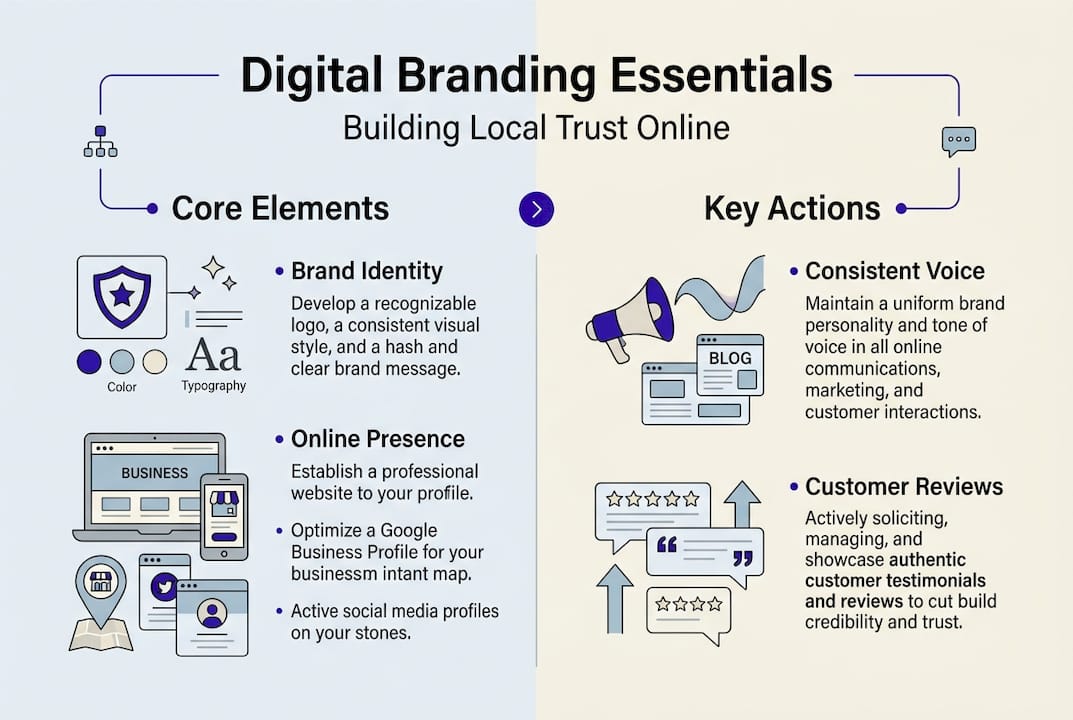
Brand identity is your starting point. This means your logo, the colors you use, the tone of your writing, and the way your team communicates with customers. A plumber who uses casual, friendly language on their website but formal corporate language on Facebook creates a disconnect that feels off to visitors, even if they cannot explain why. Pick a voice and stick with it everywhere.
Online presence covers your website, your social media profiles, and critically, your Google Business Profile. For local service businesses, your Google Business Profile is often the first thing a potential customer sees. If it has outdated hours, missing photos, or no reviews, you are losing leads before they ever visit your website. Building an online presence that works for you means treating every platform as a front door to your business.


Content ecosystem refers to the ongoing material you create and share. Blog posts that answer common customer questions, short videos showing your work, and social posts that reflect your values all contribute to how customers perceive your brand. This is not about posting constantly. It is about posting with purpose and consistency.
Personalization means responding to reviews, engaging with local community topics, and tailoring your messaging to the specific neighborhoods or customer types you serve. A roofing company that mentions local weather patterns and references specific neighborhoods feels far more relevant than one using generic national copy.
87% of consumers expect consistency across all brand touchpoints. Inconsistent branding does not just confuse people. It actively erodes the trust you have worked to build.
Maintaining one voice across platforms is one of the highest-leverage moves a local business can make. It costs nothing extra but pays dividends in recognition and trust over time.
Pro Tip: Create a one-page brand guide that lists your logo files, brand colors (with hex codes), approved fonts, and two or three sentences describing your brand voice. Share it with anyone who posts or writes for your business. This single document eliminates most consistency problems overnight.
How digital branding drives leads and business growth
Knowing the pillars is the first step. Here is how they translate into real results for service businesses. Consistent digital branding increases revenue by 23%, and companies with strong digital brands see a 20% performance advantage over competitors who neglect their brand identity. These are not abstract numbers. They represent the difference between a steady stream of inbound calls and a business that has to fight for every lead.
| Branding metric | Impact on business performance |
|---|---|
| Revenue increase from consistency | 23% higher revenue |
| Performance advantage | 20% over weaker competitors |
| Growth rate vs. competitors | 2.5x faster growth |
| Long-term ROI potential | Up to 420% over 5 years |
For local service providers, the path from brand awareness to a signed contract follows a predictable sequence. Understanding this sequence helps you invest your branding effort in the right places.
- Awareness: A potential customer sees your ad, finds your Google listing, or hears about you from a neighbor.
- First impression: They visit your website or profile. Consistent visuals and clear messaging signal professionalism.
- Research: They read your reviews, check your social media, and look for proof you deliver what you promise.
- Trust: Consistent, positive signals across every channel convince them you are reliable.
- Contact: They call, fill out a form, or request a quote. Your brand has done the heavy lifting before this moment.
- Loyalty: A great experience, followed by follow-up communication that reflects your brand, turns a one-time customer into a referral source.
The role of content marketing and lead generation in this process is significant. Every blog post, video, or social update that reflects your brand identity reinforces trust at the research stage. Customers who feel they already know you before they call are far more likely to hire you and far less likely to negotiate on price.
Exploring content marketing strategies that align with your brand voice is one of the most cost-effective ways to accelerate this cycle for a local service business.
Pro Tip: Respond to every Google review within 24 hours, positive or negative. Your response is not just for the reviewer. It is public-facing branding. A professional, empathetic response to a negative review often impresses prospective customers more than five-star reviews alone.
Advanced digital branding: share of search, AI, and omnichannel
While the basics can transform most businesses, advanced approaches offer even more leverage. Digital brand equity requires share of search, awareness, and sentiment that goes far beyond counting likes and followers. Share of search measures how often people search for your brand name compared to competitors. It is a leading indicator of market strength, and it grows when your brand is consistently visible, relevant, and trustworthy across multiple channels.
AI-driven personalization is no longer reserved for large corporations. Local businesses can use tools that personalize email follow-ups, suggest relevant service content based on browsing behavior, or automate review requests after a job is completed. These small touches create experiences that feel attentive and professional without requiring a full marketing team.
Omnichannel consistency means your brand looks, sounds, and feels the same whether a customer finds you through a Google search, a Facebook ad, a direct mail piece, or a neighbor’s recommendation. This is harder than it sounds. Most local businesses have at least one channel where their branding has drifted or gone stale.
Here are advanced branding tactics that any local service business can pilot without a massive budget:
- Monitor brand mentions: Use free tools like Google Alerts to track when your business name appears online.
- Track share of search: Compare how often your brand is searched versus local competitors using Google Trends.
- Automate review requests: Send a follow-up text or email after every completed job asking for a Google review.
- Audit your channels quarterly: Check that your logo, hours, phone number, and messaging are consistent everywhere.
- Invest in video: Even short smartphone videos of completed work build trust faster than text alone.
Long-term digital branding can yield 420% ROI over five years. Local businesses that build trust through consistent reviews and visibility capture this return while competitors chase short-term tactics.
Tracking key marketing metrics helps you measure whether your branding efforts are moving the needle. And building a multi-channel marketing strategy ensures your brand stays visible wherever your customers are looking.
Why most local businesses undervalue digital branding and what you can do differently
After working with hundreds of local service businesses, we have seen the same pattern repeat. Owners focus on tactics: running a Facebook ad this week, posting something on Instagram, updating the website when it looks outdated. These are not bad activities. But without a consistent brand identity underneath them, they produce inconsistent results and leave potential customers confused.
The uncomfortable truth is that most small businesses treat branding as a one-time task rather than an ongoing practice. They design a logo, build a website, and consider it done. But your brand lives in every interaction a customer has with your business online. A review you ignored, a social post that used a different font, a Google listing with the wrong phone number. These details accumulate and either build or erode trust.
What actually works long-term is spending roughly 80% of your branding effort on trust-building activities: collecting and responding to reviews, keeping your information accurate everywhere, communicating your values clearly, and showing up consistently. The remaining 20% is promotions and campaigns. Most businesses have this ratio flipped.
Competing with big brands as a local service provider is absolutely possible when you focus on what large companies cannot easily replicate: genuine local trust, personal responsiveness, and community relevance. Document your core values and your unique value proposition in writing, then check every digital touchpoint against them. That discipline is what separates businesses that grow from those that stay stuck.
Take your digital branding to the next level
Strong digital branding is not reserved for big companies with large marketing budgets. Local service businesses that commit to consistency, trust, and a clear identity attract more loyal customers and generate higher-quality leads over time.

City Web Company specializes in helping local service businesses build the kind of digital presence that earns trust and drives real growth. From local SEO services that put you in front of nearby customers to Google Business Profile optimization that makes your first impression count, our digital marketing services are built for businesses like yours. Ready to see what a stronger brand can do for your bottom line? Let’s talk.
Frequently asked questions
How is digital branding different from digital marketing?
Digital branding builds long-term connections and trust, while digital marketing focuses on immediate sales and conversions. Think of branding as the foundation and marketing as the activity that runs on top of it.
Why does consistent digital branding matter for local businesses?
Consistent branding boosts trust and revenue directly. 87% of consumers expect consistency across every brand touchpoint, and businesses that deliver it see measurable gains in loyalty and referrals.
Which channels should I focus on for digital branding as a local business?
Start with your website, Google Business Profile, social media, and customer reviews. Core pillars include brand identity, a strong digital presence, a content ecosystem, and personalization to maximize local trust.
Is investing in digital branding worth it for small service businesses?
Absolutely. Consistent digital branding drives 23% more revenue and creates loyal customers who return and refer others, making it one of the highest-return investments a local business can make.
Recommended
These articles were popular with other readers too: