

Discover why optimize for local search is crucial for businesses. Improve visibility and attract local customers effectively with proven strategies.
The Real Reason Your Website Fails to Generate Leads
Many business owners believe a website is a digital business card, a static online placeholder they were told they needed. This single misconception is the root cause of most failed local marketing efforts. An effective website is not a passive brochure. It is a dynamic asset, a system engineered from the ground up to generate measurable revenue.
This guide reframes the entire conversation around web design for local businesses, moving from passive digital expenses to active, revenue-generating systems.
Table of Contents
Your Website Should Be a Growth Engine, Not a Cost Center

Viewing your website as a one-time, set-it-and-forget-it expense is a costly strategic error. It positions your digital presence as a passive cost, similar to a print ad from a decade ago. It exists, but it produces no tangible results.
This mindset leads to a predictable cycle of frustration. A business invests in a website, sees no return, and concludes that online marketing is ineffective for their industry. The problem is not the channel. It is the strategy. A website built without a clear business objective is an expensive liability.
The transition from a passive online document to an active sales tool begins when you understand the structural differences between them.
A website designed as an informational brochure merely lists services and contact details. Its purpose is to exist. A website engineered as a growth engine has a different purpose entirely. It is built to systematically convert visitors into qualified leads and paying customers.
To make this shift, the first step is to improve website conversion rates. This marks the beginning of a true marketing system.
A high-performance website functions as your most effective salesperson. It operates 24/7 to answer questions, build trust, and guide potential customers toward a buying decision, all before you invest any direct sales time.
The following sections explain the real-world costs of an underperforming site and outline the foundational pillars required to build a digital presence that fuels predictable, long-term growth. This is about building a system, not just a site.
The True Cost of an Underperforming Website
An outdated or poorly constructed website does not just sit idle. It actively costs your business money in lost revenue, wasted ad spend, and diminished credibility.
This financial drain is a direct result of cause and effect. A home services website that is not mobile-friendly is effectively invisible to the 60% or more of local searchers using their phones. A site that takes more than three seconds to load does not just annoy visitors. It erodes credibility and causes them to seek out a competitor.
From Missed Clicks to Lost Revenue
The cost of an ineffective website is a slow, continuous leak in your growth potential. It creates the sense that marketing dollars are disappearing without a trace.
Consider these direct financial impacts:
- Wasted Ad Spend: Driving paid traffic from Google or Facebook to a slow, confusing website is like pouring water into a leaky bucket. You pay for each click, but the poor user experience ensures few of those clicks convert into a lead.
- Lost Local Visibility: Google’s algorithm rewards websites that provide a positive user experience. High bounce rates and low engagement times signal a poor experience, causing your site to rank lower in local search results and making you invisible to customers.
- Damaged Credibility: A difficult reality is that 75% of consumers admit to judging a company’s credibility based on its website design. An amateurish site can make even the most skilled professional appear untrustworthy.
Understanding the Investment in Growth
The cost of professional web design for local businesses can appear significant upfront, but the investment is grounded in business logic. While a freelancer might quote between $1,000 and $2,500, a strategic small business website from an agency typically falls between $2,000 and $9,000. The price difference reflects the gap between building a lead-generation machine versus a digital brochure. You can explore the full breakdown of these statistics to understand the budgeting landscape.
A professional website is not a discretionary expense. It is a fundamental investment in your company’s infrastructure, the digital equivalent of a clean, well-lit showroom in a prime location.
There is a reason 53.8% of companies hire professional designers for a custom site, despite the higher cost. They understand a strategic build focused on user experience and mobile performance delivers a greater long-term return. The real cost of a cheap website is not the initial price but the revenue you lose every month it fails to generate business.
This is the point where the perspective shifts from seeing your site as an expense to treating it as a strategic asset. Viewed through a business growth lens, professional design becomes the engine that ensures your business is found, trusted, and chosen over the competition.
The Core Pillars of a High-Performing Local Website
A successful local website is an engine built to attract local customers and drive revenue. When all components function correctly, you receive a predictable flow of inquiries. If one piece is missing, the entire system can fail, leaving you with a site that costs money instead of making it.
These pillars represent the non-negotiable foundation for a website that performs. This is where we move beyond simple online brochures and begin building a digital asset that produces measurable business results.
Let’s examine what separates a basic, brochure-style website from a strategic, performance-focused one engineered for growth.
Essential Elements of a Local Business Website
| Feature | Brochure Website Approach | Performance Website Approach |
|---|---|---|
| User Experience | Looks acceptable on desktop; mobile is an afterthought. | Engineered for mobile-first; seamless on any device. |
| Visibility | Hopes people will find it through random chance. | Built with local SEO to appear in "near me" searches. |
| Purpose | Acts as a simple online business card. | Designed with a conversion-focused architecture to generate leads. |
| Trust | Uses generic stock photos and basic contact info. | Builds confidence with customer reviews and authentic photos. |

This table illustrates the necessary shift in mindset. A performance website is not a passive document. It is an active tool designed for a specific job: growing your local business.
Mobile-First Design
For any local business, the customer journey almost always begins on a phone. Whether it is a search for an emergency plumber or a quick check for a restaurant's hours, the smartphone is the primary tool.
A mobile-first design means the site was built from the ground up for a flawless experience on a small screen, not just adapted from a desktop version. This is non-negotiable. Research from 2026 indicates 85% of adults believe a company's mobile website should be as good as or better than its desktop version.
Local SEO Integration
A visually appealing website that no one can find is worthless. Local Search Engine Optimization (SEO) is not an add-on. It must be integrated into the website’s core architecture. This involves structuring the site’s code and content to clearly signal to search engines who you are, what you do, and, most importantly, where you do it. This is the key to appearing in the Google Map Pack and on the first page when a customer searches for "HVAC repair near me."
Effective local SEO is built directly into your website's DNA. It includes location-specific service pages, customer reviews, and technical signals that prove your relevance to a geographic area.
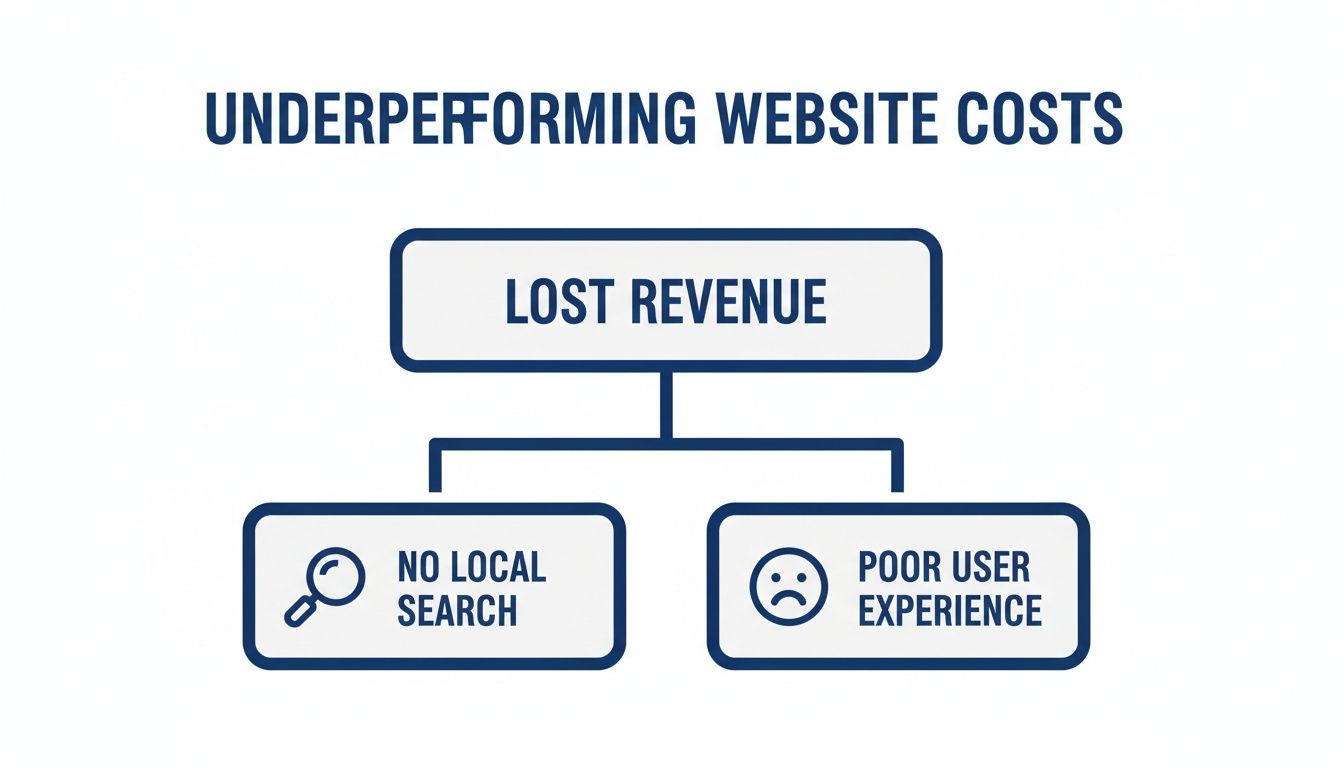
When local SEO and user experience are ignored, a website becomes a lead-generation black hole, actively costing you money in lost opportunities.
Conversion-Focused Architecture
A high-performing website guides visitors toward taking a specific, valuable action. This is achieved with a conversion-focused architecture, the science of strategically placing phone numbers, contact forms, and clear calls-to-action to make it effortless for a prospect to make contact.
It is about creating a frictionless path from visitor to lead. Key elements include:
- Click-to-Call Buttons: Essential for mobile users who want to connect immediately.
- Simple Contact Forms: Placed on service pages to capture leads who are ready to take the next step.
- Clear Service Area Maps: Visually confirms for the user that you serve their location.
Every page must have a purpose. If a visitor must hunt for your phone number, you have likely lost them. You can learn more by exploring the anatomy of a high-converting local website.
Trust and Credibility Signals
Before a customer will call or submit a form, they must trust you. Your website is your primary opportunity to build that trust. Credibility signals are the proof points that communicate you are a professional and reliable expert.
These signals turn a hesitant visitor into a confident lead. They include:
- Customer Reviews and Testimonials: Social proof is powerful. Displaying recent, 5-star reviews builds instant confidence.
- Professional Accreditations: Logos from the Better Business Bureau, local trade associations, or industry certifications signal legitimacy.
- High-Quality Photos: Authentic images of your team, work, and service vehicles make your business feel real and relatable. Avoid generic stock photos.
These pillars are not a menu of options. They are a complete system. A great mobile site with strong SEO drives traffic. A conversion-focused layout turns that traffic into leads. Powerful trust signals give those leads the confidence to become your next customer.
Integrating Your Website Into the Local Search Ecosystem

A well-designed website that no one can find is a wasted investment. True effectiveness comes from building a complete local visibility strategy with your website as the central hub, anchoring your business across all platforms where customers are looking for you.
This means your site must connect to your Google Business Profile, local directories, and social media accounts. Without that integration, your website is an isolated island, cut off from the channels that drive local leads. Smart web design for local businesses builds a digital foundation, not just a brochure.
That foundation is built on consistency. Your Name, Address, and Phone number (NAP) must be identical everywhere online. Minor variations create confusion for search engines and erode the authority needed for top rankings.
Your Website as the Central Source of Truth
Think of your website as the official record for your business. Google and other platforms use it to verify the information they show to searchers. A correctly structured site sends clear signals that confirm your identity, services, and service area.
Your website content can directly enhance your Google Business Profile. Well-written service pages can be linked from your GBP, giving customers detailed information and providing Google’s algorithm with more context. For a practical framework, see our guide on creating location-specific landing pages that convert.
Your website should be the sun in your local marketing solar system. Everything else, from your Google Business Profile to directory listings, should orbit around it, pulling information and authority from this central source.
The Power of Local Schema Markup
One of the most powerful and overlooked tools for this is local schema markup. This is a special code added to your website’s backend that functions as a translator for search engines. It explicitly tells Google important details like operating hours, service area, and customer reviews.
For example, a plumber in Denver can use schema to tell Google they offer "24-hour emergency services" within a "25-mile radius" of the city. When someone searches for that service, Google can show that plumber's business with confidence because the schema markup removed any guesswork. It is a structural advantage most competitors lack.
Building a Cohesive Digital Presence
Integrating your website creates a network of consistent, authoritative signals that all point back to your business as the best local choice. This requires a methodical approach to ensure every online mention is accurate and optimized. A comprehensive ultimate local SEO checklist can help systematize this process.
This system of integration is what separates a passive online presence from a strategic, lead-generating machine.
How to Measure Website Performance That Matters
If you are not measuring your website’s performance, you are operating without data. It is common for business owners to focus on vanity metrics like total website traffic or social media likes. These numbers feel good but often mask a core problem: the website is not generating revenue.
A strategic approach to web design for local businesses requires knowing exactly what to track. The focus must shift from abstract digital numbers to tangible business results. The goal is to measure the website's impact on your bottom line.
For a local service company, the only metrics that matter are those that lead directly to a scheduled job. These are your Key Performance Indicators (KPIs).
Moving Beyond Vanity Metrics
It is time to stop asking, "How much traffic did we get?" and start asking, "How many qualified leads did our website generate this month?" The distinction is critical. A website with many visitors but no conversions is an unprofitable asset.
Here are the KPIs that matter for a local business:
- Qualified Leads: The number of inquiries from potential customers within your service area who are interested in your offerings.
- Form Submissions: The count of completed contact or quote request forms.
- Phone Calls: The number of direct calls originating from click-to-call buttons on your website.
- Conversion Rate: The percentage of website visitors who take a valuable action, such as calling or submitting a form.
These are not just data points. They are direct signals of your website's ability to convert a visitor into a customer.
The table below breaks down the metrics that truly matter, explaining what they measure and why they are crucial for any local service business focused on growth.
Key Performance Indicators for Local Service Websites
| Metric | What It Measures | Why It Matters for Local Businesses |
|---|---|---|
| Qualified Leads | The number of legitimate inquiries from potential customers in your service area. | This is the ultimate measure of success. It proves your marketing is attracting the right people. |
| Phone Calls from Website | Direct calls initiated from click-to-call buttons on your site. | These are often high-intent leads. A caller is usually ready to book a service or get a quote immediately. |
| Form Submissions | The total count of completed contact, quote, or service request forms. | Tracks prospects who prefer to write out their needs. Each submission is a potential new job. |
| Conversion Rate | The percentage of visitors who complete a desired action (call, form fill, etc.). | This indicates the effectiveness of your website's messaging and user experience. A low rate signals a problem. |
| Cost Per Lead | The total marketing spend divided by the number of qualified leads generated. | This metric connects your marketing budget directly to results, helping you understand your true return on investment (ROI). |
By focusing on these KPIs, you move from guessing to knowing. You can see a clear line from your website's activity to new revenue, allowing you to make smarter decisions about your marketing investments.
Essential Tools for Real Measurement
Tracking these bottom-line KPIs requires the right tools configured correctly. Simply installing Google Analytics is not enough. You need a professional setup to turn raw website data into business intelligence.
A website without proper tracking is like a salesperson who never reports back. You know they are busy, but you have no idea if they are closing deals.
This is where key technologies come into play.
- Google Analytics 4 (GA4): This is the foundation. It must be configured with specific "events" and "goals" that track every form submission and button click, revealing which pages and marketing channels drive action.
- Call Tracking Software: This assigns a unique, trackable phone number to your website, allowing you to know precisely how many calls your site is generating.
- Customer Relationship Management (CRM): A CRM like HubSpot or Jobber connects all the dots. It allows you to follow a lead from their first click on your website through the entire sales process to a closed job.
When these systems work together, they provide a complete picture of your return on investment. You can finally see how a visitor landing on a specific blog post leads directly to a signed contract. This is the clarity every business owner needs.
When to Hire an Agency: Finding a Partner, Not Just a Vendor
Building a website that grows your business is a serious undertaking. While DIY platforms have their place, professional expertise is required for meaningful growth. The challenge is that not all "professional help" is equal.
Many business owners hire a vendor when what they truly need is a strategic partner. A vendor is transactional. They are paid to deliver a website based on instructions, and then the relationship ends. Their job is to deliver a product.
A strategic partner is different. Their goal is to build a system that generates leads and grows your business. They are invested in the outcome, not just the deliverable.
The Vendor vs. Partner Difference
The choice between a vendor and a partner depends on your goals. If you need a simple digital brochure, a vendor is sufficient. If you want a predictable stream of leads and a competitive edge in your local market, you need a partner.
A freelance designer is like an architect who provides a beautiful set of blueprints. A strategic partner is the general contractor who helps design the building, manages construction, ensures all systems work together, and delivers a finished, functional asset.
A vendor sells you a website. A partner delivers a revenue-generating system that includes the website, local search integration, lead tracking, and ongoing optimization.
Signs You Need a Strategic Partner
The need for a partner often becomes apparent through frustration and a lack of measurable results.
It may be time to seek a partner if you experience these issues:
- Inconsistent Leads: You have no predictable flow of new customer inquiries.
- Wasted Ad Spend: You cannot connect marketing expenditures to profitable jobs.
- Losing to Competitors: Competitors consistently appear in top search results while your business does not.
- Data Overload: You have analytics reports but no clear understanding of what the numbers mean or what actions to take.
A real partner does not just build you a new website. They solve these business problems. At City Web Company, we function as an extension of your team, transforming a company’s digital presence from an expense into an engine for predictable local growth.
Frequently Asked Questions About Local Web Design
Here are straightforward answers to the most common questions we hear from local business owners about building a website that delivers results.
How long does it take to build a local business website in 2026?
A standard professional website with essential pages typically requires four to six weeks from initial strategy to launch. More complex projects involving e-commerce, custom booking systems, or extensive content migration can take eight to twelve weeks or more. A strategic agency will invest significant time in discovery and planning to ensure the final product aligns with business goals.
What is the difference between web design and local SEO?
Web design is the process of building your digital property. It includes the architecture, visual design, and user experience, all aimed at converting a visitor into a lead. Local SEO is the ongoing process of ensuring local customers find that property when they search online. The two are distinct but interdependent. A great website is the foundation of any successful local SEO campaign.
Why is Google Business Profile important if I have a website?
Your website is your headquarters, while your Google Business Profile (GBP) is your most visible billboard. It is often the first interaction a customer has with your business, appearing in Google Maps and at the top of local search results. A well-managed GBP provides critical information and drives calls and clicks directly to you, making your website appear more credible. The GBP grabs attention, and the website closes the deal.
Do I really need a blog on my local service business website?
For most local service businesses, a blog is a powerful tool for demonstrating expertise. It allows you to move beyond simply listing services to actively proving your knowledge. More importantly, it is an effective way to rank for long, specific questions your customers are searching for, such as "cost to repair a leaking pipe in Denver." This type of content attracts high-intent customers ready to hire an expert.
Understanding these components is the first step. The next is implementation. At City Web Company, we specialize in building integrated growth systems that make your website your most valuable asset.
If you are ready to treat your website like a revenue-generating machine, let's schedule a strategic discovery call. Explore our approach at citywebcompany.com.
These articles were popular with other readers too: