

Discover what click-through rate (CTR) is, how it’s calculated, and why it’s crucial for measuring the effectiveness of your ads.
Online Marketing for Law Firms: Driving Growth and Trust
Standing out in the crowded legal market takes more than word of mouth or traditional referrals. Law firms across the United States and Canada now recognize that a visible, credible online presence is essential for staying competitive and attracting ideal clients. Digital marketing for law firms relies on websites, SEO, social media, and data tools to connect services with those actively seeking legal help while building trust and measurable results.
Table of Contents
Table of Contents
- Defining Online Marketing for Law Firms
- Core Channels and Marketing Strategies
- SEO, Paid Ads, and Social Media Tactics
- Legal Compliance and Ethical Considerations
- Risks, Costs, and Common Pitfalls
Key Takeaways
| Point | Details |
|---|---|
| Strategic Online Presence | Online marketing for law firms focuses on attracting clients actively seeking legal services rather than aggressive advertising. |
| Measurable Results | The effectiveness of online marketing can be tracked, enabling law firms to understand lead generation and adjust strategies accordingly. |
| Core Channel Integration | A successful online marketing strategy involves a coordinated mix of channels, including SEO, content marketing, and social media, to establish credibility. |
| Compliance and Ethics | Law firms must adhere to strict advertising regulations to maintain trust and avoid disciplinary actions, emphasizing transparency in all communications. |
Defining Online Marketing for Law Firms
Online marketing for law firms is fundamentally different from what most people assume. It’s not about bombarding potential clients with ads or making aggressive sales pitches. Instead, it’s a strategic approach using internet-based tools and platforms to attract clients who are actively seeking legal services, build credibility with your target audience, and establish your firm as a trusted authority in your practice areas. Digital marketing integrates websites, social media, and data tools with traditional legal practice to meet specific business goals like client acquisition, relationship building, and brand promotion while staying within professional ethical guidelines.
The practice represents a significant shift for the legal profession. Historically, law firms viewed advertising with skepticism or outright opposition. Today, the legal landscape has changed completely. Clients expect to find law firms online, and those without a visible digital presence lose business to competitors who do. The core components of online marketing for law firms typically include maintaining a professional website, optimizing for search engines so potential clients find you when they search for legal help, building a presence on social media platforms relevant to your practice, managing online reviews and reputation, and tracking which marketing efforts actually generate leads and revenue. This requires firms to understand both digital technologies and how online marketing actually works.
What makes online marketing crucial for law firms is measurability. Unlike traditional referrals or word-of-mouth, you can track almost everything. You know how many people visited your website, which pages they viewed, where they came from, and whether they contacted you. Large firms often employ dedicated marketing staff who monitor these metrics constantly, while smaller firms might manage this themselves or partner with specialized agencies. Law firms increasingly use SEO and technology tools to track marketing effectiveness and ensure they’re investing marketing dollars where they actually generate results.
The goal is straightforward: bring qualified potential clients to your firm through online channels, help them understand your services, and make it easy for them to contact you when they need legal representation. When done correctly, online marketing builds momentum over time, creating a steady stream of inquiries rather than relying on sporadic referrals or cold outreach.
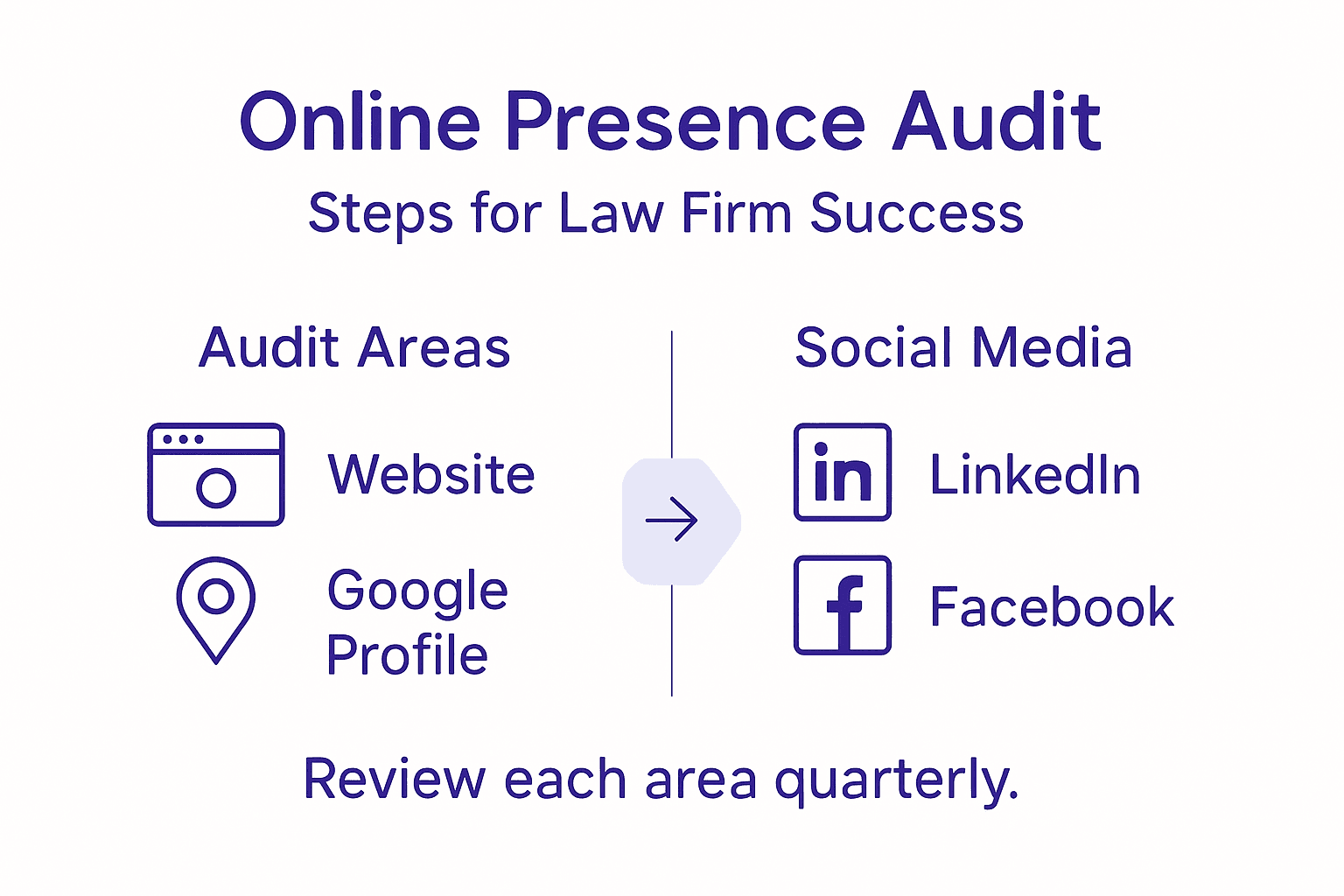
Pro tip: Start by auditing your current online presence across your website, Google Business Profile, and any social media accounts to identify gaps and quick wins before developing a comprehensive online marketing strategy.
Core Channels and Marketing Strategies
Successful online marketing for law firms relies on a coordinated mix of digital channels working together. Think of it like building a case: you need multiple pieces of evidence supporting your argument. Each channel serves a specific purpose, but they’re most powerful when they reinforce each other. The primary channels include your website as the foundation, search engine optimization to help people find you, content marketing to establish expertise, social media for client engagement, email marketing for relationship nurturing, and paid search advertising for immediate visibility. A comprehensive digital marketing plan integrates these core channels to help your firm establish credibility with potential clients actively searching for legal help online.
Your website acts as command central for all your marketing efforts. Every other channel ultimately directs people back to your website, where they learn about your services, review your credentials, and decide whether to contact you. Without a professional, mobile-responsive website, all other marketing efforts become significantly less effective. Search engine optimization ensures that when someone searches for a lawyer in your practice area and location, your firm appears in those results. Content marketing means creating valuable information like blog articles, guides, and FAQs that answer questions your potential clients are asking. This approach builds trust and positions your firm as knowledgeable before someone even contacts you.


Social media allows you to engage with current and potential clients on platforms where they already spend time. Email marketing maintains relationships with past clients and prospects who have expressed interest in your services. Paid search advertising accelerates results by placing your firm at the top of search results, particularly useful for urgent legal matters like criminal defense or personal injury. Effective law firm marketing strategies differentiate your firm in a crowded market through SEO, content, social media engagement, and strategic brand positioning, allowing you to compete more effectively than firms relying solely on referrals.
The key is selecting channels that align with your target clients and practice areas. A family law firm might prioritize content marketing and social media engagement, while a corporate litigation firm might focus heavily on paid search for business decision makers. Whatever combination you choose, ensure each channel reinforces your firm’s core message and drives qualified leads to your website.
Here is a breakdown of how core digital marketing channels support law firm business goals:
| Channel | Main Function | Typical Result |
|---|---|---|
| Website | Central info and lead capture | Builds client trust |
| SEO | Increase search visibility | More qualified web traffic |
| Content Marketing | Educates and informs clients | Establishes expertise |
| Social Media | Engages prospective clients | Expands brand awareness |
| Paid Search Advertising | Immediate top-of-page result | Quick surge in inquiries |
| Email Marketing | Nurtures client relationships | Encourages repeat business |
Pro tip: Track which channels generate the highest quality leads and adjust your budget allocation quarterly based on actual results rather than assumptions about where your ideal clients spend time online.
SEO, Paid Ads, and Social Media Tactics
These three channels operate on different timelines but work best when coordinated. SEO is the long game. You optimize your website and create content targeting keywords like “personal injury lawyer near me” or “divorce attorney in Denver,” then wait weeks or months for search engines to index and rank your pages. Paid ads are the sprint. You can launch a campaign today and get qualified leads tomorrow by targeting potential clients actively searching for legal services. Social media is the relationship builder. You engage with prospects and past clients, share valuable content, and establish your firm’s personality and expertise. The combination creates multiple pathways for clients to find you.
SEO success for law firms requires three core components. First, optimize your website structure and content for search engines using relevant keywords and clear information hierarchy. Second, build authority through backlinks from reputable sources and content that demonstrates expertise in your practice areas. Third, ensure your Google Business Profile is complete and accurate so you appear in local search results and map searches. Content marketing supports all of this by creating blog posts, guides, and FAQs that answer the questions potential clients are actually searching for. Paid search advertising complements organic SEO by placing your firm above organic results for high-intent keywords, particularly useful for competitive practice areas or urgent legal matters.
Social media tactics should be platform-specific. LinkedIn works best for B2B legal services and corporate law, where you can share thought leadership, industry insights, and case studies with business decision makers. Facebook reaches a broader audience and works well for consumer-focused practices like family law, criminal defense, and personal injury. Instagram suits practices with visual storytelling potential. The key across all platforms is strategic content sharing and genuine engagement rather than constant promotional messaging. Building brand recognition through social media engagement helps law firms connect with specific client demographics and increase qualified leads. Post educational content, respond to comments, share client testimonials (with permission), and participate in relevant legal discussions.
Effective measurement ties everything together. Track which channels generate leads and their quality. Monitor cost per lead, conversion rates, and ultimately revenue generated. Tracking metrics and adjusting your ad spend ensures continuous improvement across all channels. Some law firms find that SEO provides sustainable long-term growth but requires patience. Others see immediate ROI from paid ads but face higher costs. Most find the optimal balance involves investing in all three, with allocation depending on practice area, geographic market, and competition level.
Pro tip: Focus your initial SEO efforts on local keywords with lower competition in your geographic area rather than competing nationally, then expand once you’ve established local dominance and built content authority.
Legal Compliance and Ethical Considerations
Digital marketing for law firms operates in a heavily regulated space. Unlike most businesses, you cannot simply say whatever you want to attract clients. Every claim about your experience, credentials, and past results must be accurate and verifiable. Every testimonial and case result requires proper documentation. Client confidentiality extends into the digital realm. You cannot share a client’s story, settlement amount, or case details without explicit written consent, even if the outcome was a huge win. Bar associations and state legal ethics boards take these violations seriously. Violations can result in disciplinary action, fines, or suspension of your license. This is not something to approach casually.
Key compliance areas require specific attention. First, avoid misleading claims about your experience or results. Phrases like “guaranteed results” or “we win 100 percent of cases” violate ethical rules in most jurisdictions. You can discuss average results or typical outcomes supported by documented data, but absolute guarantees are prohibited. Second, testimonials and client reviews must be genuine and not artificially generated or manipulated. If you request reviews from clients, you must make clear disclosures about potential conflicts. Third, law firms must balance digital marketing efforts while maintaining professional integrity, client confidentiality, and compliance with legal ethics standards. Your online reputation management strategy cannot involve paying for fake positive reviews or aggressively suppressing negative ones through deceptive means.
Advertising claims about your firm itself demand equal scrutiny. If you state that you are a specialist in a particular area of law, you must actually be qualified to hold that designation in your jurisdiction. If you claim to be ranked or recognized, that ranking or recognition must be verifiable and legitimate. Contingency fee arrangements must be clearly explained. Flat fees or hourly rates must be transparent. All disclaimers required by your state bar must appear prominently on your website and marketing materials. Social media posts, paid ads, and email campaigns all count as marketing communications subject to these same rules.
Ethical digital marketing requires transparency and truthfulness in all communications to maintain public trust and avoid regulatory sanctions. This is actually good business sense. Clients who come to you based on misleading claims will be disappointed and may pursue malpractice claims. Clients attracted through transparent, honest marketing tend to have better experiences and become repeat clients and referral sources. Many state bar associations have published guidelines specifically addressing digital marketing. Some require pre-approval of marketing materials before publication. Others require clear disclaimers about what past results do not guarantee about future outcomes. Your job is to know what applies in your jurisdiction and follow those requirements exactly.
Pro tip: Create a compliance checklist for all marketing materials before publishing, including verification of credentials, accuracy of claims, client consent documentation, and required disclaimers specific to your state bar rules.
Risks, Costs, and Common Pitfalls
Online marketing for law firms requires real investment, and that investment can vanish quickly if you are not careful. The costs break down into several categories. Website development and maintenance typically runs between 2,000 and 10,000 dollars annually depending on complexity and hosting. SEO efforts, whether in-house or outsourced, range from 1,000 to 5,000 dollars monthly with results appearing after three to six months. Paid search advertising on Google and social media platforms can cost anywhere from 500 to 5,000 dollars monthly, with expenses scaling up in competitive markets like personal injury or DUI defense. Content creation, whether blog posts or video, adds another 500 to 2,000 dollars monthly. Social media management typically costs 500 to 1,500 dollars monthly. For a small to mid-sized firm, realistic monthly marketing spend starts around 2,500 dollars and grows from there. For larger firms with multiple practice areas, monthly spend often exceeds 10,000 dollars. The key risk is spending money without tracking whether it generates clients.
Here’s an overview of typical marketing costs and expected timelines for law firms:
| Marketing Activity | Typical Monthly Cost | Expected Timeline for Results |
|---|---|---|
| Website Management | $200–$800 | Ongoing, immediate updates |
| SEO Optimization | $1,000–$5,000 | 3–6 months for growth |
| Paid Ads | $500–$5,000 | 1–4 weeks for leads |
| Content Creation | $500–$2,000 | 1–2 months for engagement |
| Social Media Mgmt | $500–$1,500 | 2–3 months for presence |
Common pitfalls drain resources without producing results. Many firms launch campaigns without clear metrics for success. They spend 6 months and 5,000 dollars on paid ads but never track cost per lead or compare it against referral value. Neglecting to measure return on investment and lacking strategic planning causes firms to waste resources on ineffective campaigns. Another major mistake is inconsistent execution. A firm creates a website, runs ads for three months, then stops. Marketing requires momentum. Potential clients often need multiple touchpoints before contacting you. Stopping a campaign mid-stream wastes all previous investment. Poor content strategy also kills results. Publishing blog posts with generic information about “what is a divorce” helps nobody. Clients search for specific information relevant to their situation. Your content must answer real questions potential clients are asking in your geographic market.
Technical oversights damage both user experience and legal compliance. Many law firm websites are not optimized for mobile devices, meaning potential clients trying to contact you on their phones cannot navigate your site properly. Common pitfalls include neglecting mobile optimization, underutilizing data analytics, and inconsistency in branding that dilutes market presence. Reputation risks emerge from poor review management. A single negative review that you ignore can influence dozens of potential clients. Defensive or hostile responses to reviews damage your reputation further. Compliance failures create serious consequences. Using testimonials without consent, making unsupported claims, or violating confidentiality can result in bar association complaints. Paid advertising without proper disclaimers violates ethical rules in most jurisdictions. The reputational damage from ethical violations often exceeds the financial cost.
Budget management requires discipline. Set clear expectations about timeline before launching. Most SEO campaigns need six months minimum to show meaningful results. Paid ads can show results within weeks but require continuous optimization. Establish baseline metrics. How many leads does your firm currently receive monthly? What is their source? What is their conversion rate? This becomes your comparison point. Only then can you determine whether 3,000 dollars monthly in new marketing actually generates positive ROI. Plan to invest before seeing returns. Many firms underestimate timeline and pull the plug on promising campaigns too early.
Pro tip: Set up tracking for all marketing channels before launching any campaign, then review metrics weekly and compare against baseline to identify underperforming channels fast enough to adjust before wasting significant budget.
Elevate Your Law Firm’s Growth with Proven Online Marketing Strategies
Navigating the challenges of online marketing for law firms requires expert guidance and tailored solutions. Whether it is enhancing your SEO, managing reputation, or engaging clients through social media, the key is a strategic approach aligned with your firm’s unique goals. If your law firm needs to build trust, attract qualified leads, and maintain ethical compliance while growing your online visibility, our insights on Online Reputation Management Insights | City Web Company and Social Media Marketing Tips & Tools | City Web Company can help you start strong.

Don’t let inconsistent marketing or unclear results drain your resources. Partner with City Web Company to develop a results-driven strategy that tracks every lead, optimizes your digital presence, and accelerates growth. Take control of your firm’s future today by reaching out directly via our contact page and discover how customized online marketing solutions can transform your practice.
Frequently Asked Questions
What is online marketing for law firms?
Online marketing for law firms involves using internet-based tools and platforms strategically to attract clients seeking legal services, build credibility, and establish the firm as an authority in its practice areas.
Why is online marketing essential for law firms today?
Online marketing is essential because clients expect to find law firms online. Firms without a digital presence may lose business to competitors and miss out on potential clients actively searching for legal help.
How can a law firm measure the effectiveness of its online marketing efforts?
Law firms can measure effectiveness by tracking metrics such as website traffic, lead generation, conversion rates, and online reviews. This allows firms to understand which marketing strategies generate the best results.
What are some key channels used in online marketing for law firms?
Key channels include a professional website, search engine optimization (SEO), content marketing, social media engagement, email marketing, and paid search advertising. A combination of these channels strengthens the firm’s online presence and client acquisition strategy.
Recommended
- Why Legal Firms Need SEO for Lasting Growth
- Law Firms Marketing Company | SEO & Lead Generation
- How to Grow Your Small Business Online Successfully – City Web Company | Digital Marketing Agency
- Why Digital Marketing Matters for Local Service Businesses
- Beauty Branding: Building Impactful Natural Brands – Didis Beauty Center
These articles were popular with other readers too: