
Use website DNI, connect call reports to Google Ads and your Google Business Profile, then tie calls to booked jobs. City Web Company can handle setup.
Why Is My Business Not Showing Up On Google? A Strategic Diagnosis
Most business owners believe that building a website and running a few ads is the path to customer acquisition. Yet, when they search for their own services, they are met with silence, their business buried pages deep in Google's results. This invisibility is not a technical glitch; it is a direct and quantifiable drain on revenue.
If you are asking, "why is my business not showing up on Google?", the problem is not a lack of effort. The core issue is that your marketing activities are likely disconnected from the signals Google actually uses to trust and rank a local business.
Table of Contents
The Hidden Cost of Digital Invisibility
For a local business, being invisible on Google is a significant operational cost. It is not an abstract marketing problem; it translates directly to lost customers and wasted expenditure. Every potential customer who searches for "plumber near me" or "dentist in [Your City]" and finds a competitor represents a direct loss of revenue.
The issue is rarely the quality of your service. The problem is a lack of digital trust. Google's algorithm is designed to reward businesses that provide clear, consistent, and authoritative signals. Without these signals, your business remains a ghost in the system.
This invisibility creates several compounding costs:
- Missed Revenue: With nearly half of all Google searches having local intent, failing to appear in local results means you are absent from your most critical marketplace.
- Wasted Marketing Spend: The investment in your website or ad campaigns yields a low return because the foundational element of trust is missing. It is the equivalent of sending expensive mailers to an unverified address.
- Brand Erosion: When customers cannot find you, it subtly signals that your business may not be established or legitimate. In contrast, businesses that appear at the top of search results are immediately perceived as more credible.
The common approach of trying random tactics like posting more on social media or getting a few reviews fails because it does not address the underlying structural problem. It addresses symptoms, not the cause.
A business is invisible for a handful of core reasons. Diagnosing the correct one is the first step toward building a predictable system for attracting customers. This guide moves past surface-level advice to provide a strategic framework for identifying the root cause of your invisibility.
Understanding whether the issue lies with your Google Business Profile, your website's technical health, or your broader digital footprint allows you to apply the correct solution. This is the transition from confusion to clarity, turning an unpredictable marketing expense into a reliable growth engine.
Problem #1: Google Doesn't Trust Your Business Exists
If your business is not showing up on Google, there is a high probability the issue begins with your Google Business Profile (GBP). Many business owners invest heavily in a website, assuming it is their primary digital asset. For local search, this is a flawed premise. Your Google Business Profile is your foundational identity.
Think of your GBP as a direct line of communication with Google's local algorithm. It is the primary tool for proving you are a legitimate business operating at a specific location or within a defined service area. If this profile is missing, unverified, or incomplete, Google has little reason to trust you. If Google does not trust you, it will not recommend you to its users.
When a client reports they cannot find their business online, this is the first area I investigate. The path from invisibility to being found is a process of diagnosis, not a single fix.
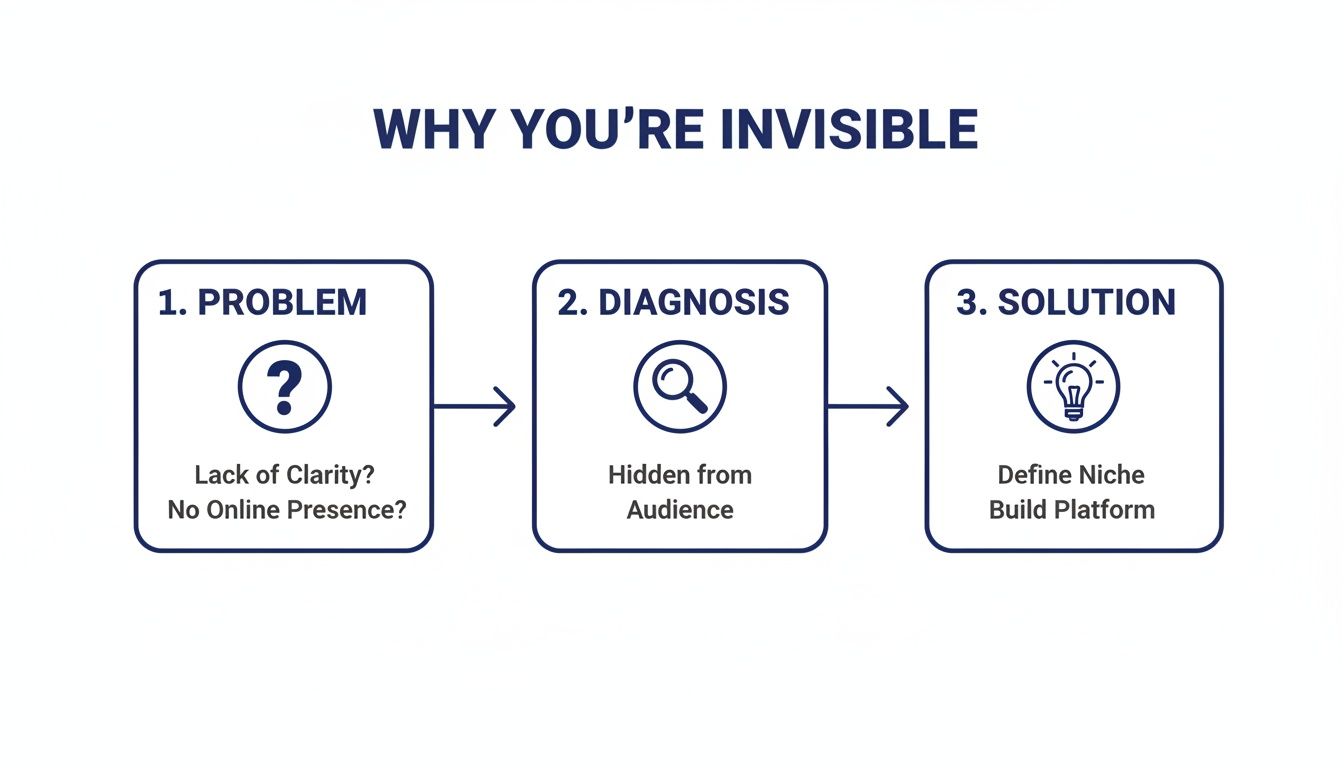
As the diagnostic path shows, identifying the "why" is a prerequisite to applying the correct "how."
The Foundational Step: Verification
Before allocating budget to advertising or content, you must claim and verify your Google Business Profile. This step is not optional; it is fundamental.
Verification is the process Google uses to confirm your business is real and that you are its authorized representative. Without it, you are a ghost in the local search ecosystem. You will not appear in the valuable Google Maps "local pack" and will struggle to rank for local service queries.
An unverified Google Business Profile is like an uncashed check. It holds potential value but is worthless until it is validated. It is the foundational act of proving your existence to the world’s largest search engine.
The status of your profile has a direct and immediate impact on your visibility and revenue potential.
GBP Status vs. Local Visibility Impact
| Profile Status | Google Maps Visibility | Local Search Ranking | Customer Inquiry Potential |
|---|---|---|---|
| Unclaimed/Unverified | None to very low | Essentially non-existent | Zero to minimal |
| Claimed & Verified | Eligible to appear | Can start ranking | Moderate |
| Verified & Optimized | High visibility in local pack | Ranks for more keywords | High (up to 2.7x more) |

The data is clear. Verification makes you eligible, but optimization is what drives inquiries and revenue.
From Verified to Optimized
Verification simply opens the door. Optimization furnishes the room. Once your profile is verified, the next step is to complete every single section with precise and accurate information.
- Accurate Business Name: This must be your real-world business name. Do not add keywords or city names, as this is a policy violation that can lead to suspension.
- Correct Categories: Your primary category has a significant impact on your rankings. Choose the single best category for your main service, then add relevant secondary categories.
- Precise Location and Service Area: Ensure your map pin is accurate for storefronts or that your service areas are correctly defined for service-area businesses.
- High-Quality Photos and Videos: Showcase your work, team, and location. Profiles with comprehensive media receive substantially more engagement.
When you implement search engine optimization, this is the starting point. It establishes the foundation for all other marketing efforts. For a deeper analysis, see our guide on the impact of a Google Business Profile on local SEO.
Problem #2: Your Website Is a Ghost to Search Engines
If your Google Business Profile is verified and active, but you are still asking, "Why isn't my business showing up on Google for my services?", the problem often lies with your website.
A common misconception is that once a website is live, Google automatically finds, understands, and ranks it. It is entirely possible for Google to be unaware your site exists, be blocked from reading its content, or be explicitly instructed to ignore it.
Your website is the central library of information about your business. If Google's crawlers cannot access the building or read the content on the pages, the search engine cannot understand what you do or why you deserve to rank.
Is Your Website in Google's Database?
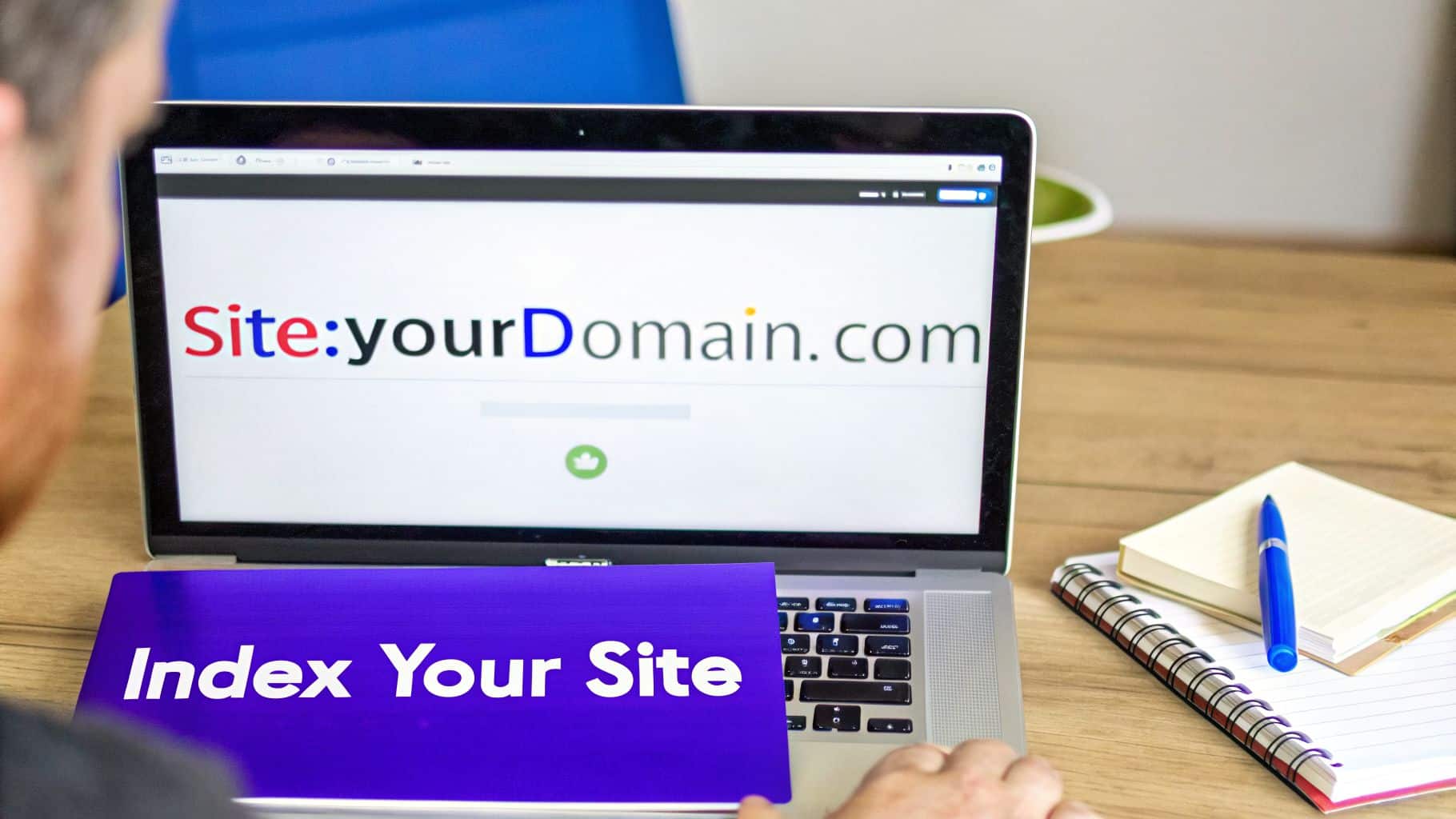
Before analyzing technical issues, conduct a simple diagnostic to see if Google has indexed your site. Go to Google and enter the following search command, replacing "yourdomain.com" with your website's address:
site:yourdomain.com
If you see a list of your website's pages, it means Google has found and indexed at least some of your site. If you see few or no results, your website is effectively invisible. This is a primary reason you are not appearing in search results. Every dollar invested in that website is currently generating zero return from organic search.
The logic is direct: if Google cannot see and read your pages, it cannot connect them to customer searches. No indexation means no visibility, no clicks, and no revenue from this critical channel.
Common Reasons Your Website Is Invisible
A website's invisibility often stems from simple, overlooked technical mistakes rather than complex coding errors. These are effectively "on/off" switches that may have been set incorrectly.
A frequent issue is a "noindex" tag. This is a line of code that gives search engines a direct command: "Do not show this page in search results." It is often left on a site by a developer after the development phase.
Another common problem is a misconfigured robots.txt file. This text file gives search engines rules about which parts of your site they are allowed to crawl. If set up incorrectly, it can block Google's crawler from accessing important pages, such as your service or contact pages.
- "Noindex" Tags: An explicit command telling search engines to exclude pages from search results.
- Misconfigured Robots.txt: A file that mistakenly blocks Google from crawling important sections of your site.
- No Sitemap Submitted: A sitemap is a roadmap of your website. Without submitting one to Google, you make it more difficult for it to discover all your pages.
These technical elements are the gatekeepers of your online visibility. Understanding what makes a website search engine friendly is a fundamental aspect of digital marketing. Fixing these indexing and crawlability issues is a critical step before any other optimization can be effective.
Problem #3: Your Digital Footprint Is Fragmented
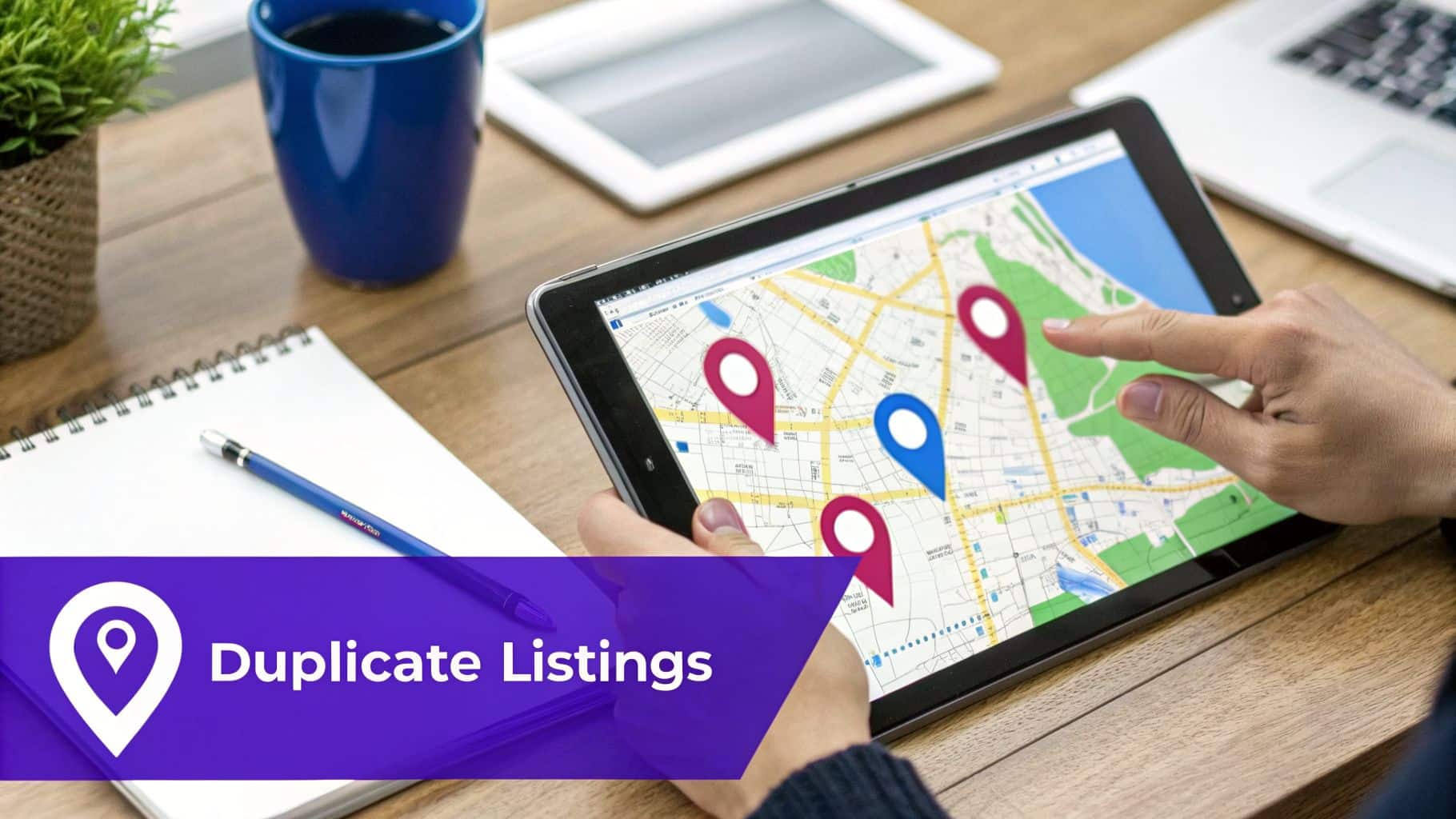
When a business is not showing up on Google, the owner often assumes the problem is a lack of presence. The reality is often the opposite. The issue is not invisibility, but a disorganized and fragmented digital footprint.
Duplicate business listings and inconsistent information scattered across the web create confusion for Google's algorithm. This confusion erodes the trust required for Google to rank your business for valuable search terms. Instead of building a single, powerful online identity, your authority is diluted across multiple weak, conflicting profiles.
This is a primary reason a business with a verified profile and a technically sound website still fails to appear in search results.
The Real-World Cost of Inconsistent Data
The core of this problem is NAP consistency. Your Name, Address, and Phone number are the bedrock of local SEO. For Google to trust your business, this data must be identical everywhere it appears online.
Consider a dental practice that moves to a new office. The owner updates their website and Google Business Profile but forgets about dozens of old listings on Yelp, Yellow Pages, and other directories. Google's crawlers find conflicting addresses for the same business, which creates a credibility problem. The algorithm cannot determine the single source of truth and splits the practice's authority between the old and new locations. The result is a drop in rankings and fewer new patient inquiries.
Your business's online authority is like a reservoir. Inconsistent information and duplicate listings are holes in that reservoir, causing your ranking potential to leak out rather than accumulate.
How to Find and Fix Duplicate Listings
Resolving this requires consolidating your digital identity into one authoritative signal. The first step is to identify and address any duplicate Google Business Profiles. These are often created accidentally by former employees, marketing agencies, or even customers.
- Manual Search: Use Google Maps to search for your business name at current and previous addresses. Search for slight variations of your name as well.
- Address Search: Enter your exact business address into the Google Maps search bar to see what profiles are associated with that location.
- Phone Number Search: Search your business phone number in Google to uncover stray listings.
Once a duplicate is found, you must gain control of it. If you have access, you can remove it. If not, claim it via the "Own this business?" link and then request to merge it with your primary profile or have it removed.
Auditing Your Citations Across the Web
Your business information also exists on hundreds of other websites and directories known as citations. Ensuring these are consistent reinforces the trustworthiness of your primary Google Business Profile.
A comprehensive audit is necessary. While you can manually check major platforms like Apple Maps, Yelp, and Facebook, using a dedicated tool is more efficient. Services like BrightLocal or Whitespark can scan the web and generate a detailed report of all your business listings and flag inconsistencies.
The goal is to methodically correct each listing so that it perfectly matches the information on your official Google Business Profile. This process builds a clean, consistent, and trustworthy digital footprint, giving Google the confidence it needs to rank your business.
Problem #4: You Are Facing a Penalty or Algorithmic Filter
If your business was once visible on Google but has suddenly disappeared, you may be dealing with something more serious than an optimization issue. A Google penalty or algorithmic filter can be the cause of a sudden drop in rankings.
This sharp decline in visibility is almost always tied to one of two events: a manual action or algorithmic suppression. Distinguishing between them is the first step toward recovery.
A manual action is a direct penalty from Google. It occurs when a human reviewer determines your site has violated Google's webmaster guidelines, such as buying spammy links or using scraped content. You will receive a notification of a manual action.
Algorithmic suppression occurs when a major Google update changes how the algorithm values certain ranking signals. Your site is not being directly penalized; rather, the tactics it was using are no longer effective. The algorithm has evolved, and your site has not.
The outcome is the same: a significant loss of visibility. However, one is a specific penalty for a violation, while the other is a failure to adapt to new standards. Recovery in either case requires a fundamental shift away from shortcuts toward building genuine, long-term authority.
Common Triggers for Penalties and Filters
Penalties are typically the result of attempting to manipulate search rankings with tactics that violate Google's guidelines. These strategies may have provided a temporary benefit in the past, but in 2026, they carry substantial risk.
The most common mistakes that cause issues for local businesses include:
- Keyword Stuffing Your Business Name: Adding terms like "Denver's Best Roofer" to your business name on your Google Business Profile is a direct policy violation and a fast track to profile suspension.
- Acquiring Fake or Low-Quality Reviews: Purchasing reviews or offering incentives in a way that violates Google's policies creates unnatural patterns that its systems can easily detect.
- Building Low-Quality Backlinks: Paying for links from irrelevant, low-quality websites or participating in link schemes is a classic black-hat tactic that can trigger a manual action.
How to Diagnose the Problem
If you suspect a penalty, your first stop is Google Search Console. This free tool provides direct insight into how Google views your website.
Within Search Console, navigate to the "Security & Manual Actions" tab. If a human reviewer has penalized your site, a notification will appear here explaining the issue. There is no guesswork involved.
If the Manual Actions report is clean, the problem is almost certainly algorithmic. The next step is to correlate the date your traffic dropped with a public list of confirmed Google algorithm updates, such as Moz's Google Algorithm Update History.
If the dates align, you have identified the cause. The algorithm changed, and your site's ranking signals were devalued. Recovery requires disavowing bad links, cleaning up stuffed keywords, and abandoning manipulative tactics. The goal is to realign your strategy with a focus on genuine quality that future algorithm updates will reward.
Building Your Path to Predictable Growth
Pinpointing why your business is invisible on Google is a critical first step. You have diagnosed the issues, from an unverified Google Business Profile to a fragmented digital footprint. However, reactive fixes do not constitute a long-term growth strategy.
The real work is to transition from fixing problems to proactively building a system for sustainable growth. True digital visibility is the result of consistent, strategic effort, not a one-time project.
This strategic shift is what separates businesses that struggle for new customers from those that achieve predictable, month-over-month growth. The objective is not just to get found, but to become the clear authority for customers in your service area.
From Fixing Problems to Building Systems
A solid foundation, such as a fully optimized Google Business Profile, is the baseline for competing in local search. Long-term success, however, depends on what you build on top of that foundation. A complete strategy requires implementing robust search engine optimization (SEO) services.
This involves creating repeatable processes for:
- Gathering Reviews: Actively encouraging customer feedback to build social proof that attracts new clients.
- Creating Content: Regularly publishing helpful content that answers customer questions and demonstrates your expertise.
- Monitoring Performance: Consistently tracking key metrics to understand what is working and where to focus your efforts.
The goal is to move beyond one-time fixes and create an intentional, repeatable system that generates a predictable flow of customers. This approach ensures your business not only shows up on Google but earns its position through genuine authority and value.
At City Web Company, we specialize in building these durable growth systems. We provide the strategic clarity and implementation needed to transform businesses from invisible to being the trusted authority in their market.
Frequently Asked Questions
Here are direct answers to common questions from business owners frustrated with their lack of visibility in search results.
How long does it take to show up on Google after I fix these issues?
The timeline depends on the issue. If you just verified your Google Business Profile, you can expect to see it in the Map Pack within two to four weeks. For technical website fixes, like removing a "noindex" tag, Google may recrawl and index your site in a few days. Recovery from a penalty is a much longer process. It requires demonstrating a sustained commitment to quality and can take several months.
My business name is not appearing even when I search for it exactly. Why?
If an exact match search for your business name yields no results, the cause is typically one of three things. First, your Google Business Profile may be unverified or suspended. Check your GBP dashboard. Second, a "noindex" tag on your website may be telling Google to ignore it. Third, if your business is brand new, Google's crawlers may not have discovered it yet.
Why does my competitor show up and I don't?
Your competitor is more visible because they have likely invested time and effort into building a digital presence that Google trusts. This is not the result of a single tactic, but the cumulative effect of a fully optimized Google Business Profile with numerous positive reviews, a technically sound website, consistent online activity, and clean business listings across the web. Their visibility is the reward for consistent, foundational work.
Turning digital invisibility into predictable growth requires a clear strategy, not just a series of fixes. City Web Company specializes in building the durable systems that move businesses from being unseen to becoming the trusted local authority.
If you are ready for strategic clarity, schedule a complimentary discovery call with our team.
These articles were popular with other readers too: